Episode 247: A Day with No Words — Nonspeaking autism in children’s books with Tiffany Hammond
-
play_circle_filled
Episode 247: A Day with No Words — Nonspeaking autism in children’s books with Tiffany Hammond
Carolyn Kiel
Tiffany Hammond is a New York Times bestselling author, speaker, and disability advocate. She is the author of A Day with No Words, a picture book about a Black mother and son who use a tablet to communicate with each other and the world around them. A Day With No Words successfully normalizes communication methods outside of verbal speech and provides representation of neurodiversity and autism in a way that affirms and celebrates.
Through Tiffany’s platform, Fidgets and Fries, she shares stories about autism, identity, and the fullness of Black and disabled family life. She is the proud mother of two autistic sons and uses her lived experiences to shift narratives around autism and communication.
Win a copy of A Day with No Words! For a limited-time, Beyond 6 Seconds is giving away a hardcover copy of “A Day with No Words” to up to 3 listeners in the United States. To enter, check out my pinned Instagram post @beyond6seconds on November 11, 2025. The giveaway ends at 11:59 PM ET on November 21, 2025. Up to 3 winners will be selected at random. This giveaway is valid for listeners at US addresses only.
During this episode, you will hear Tiffany talk about:
- How her family’s real-life experiences inspired her to write A Day with No Words
- Why she wrote her book from the perspective of a nonspeaking autistic child
- What her nonspeaking autistic son Aidan thinks of the book
- How her book is different from other children’s books about autism
- Common misconceptions that people have had about her autistic sons
Learn more about Tiffany at ADayWithNoWords.com.
Follow Tiffany on Facebook, Instagram and Substack.
Follow the Beyond 6 Seconds podcast in your favorite podcast player!
Subscribe to the FREE Beyond 6 Seconds newsletter for early access to my latest podcast episodes!
Support or sponsor this podcast at BuyMeACoffee.com/Beyond6Seconds!
*Disclaimer: The views, guidance, opinions, and thoughts expressed in Beyond 6 Seconds episodes are solely mine and/or those of my guests, and do not necessarily represent those of my employer or other organizations. These episodes are for informational purposes only and do not substitute for professional medical advice. Consult a medical professional or healthcare provider if you are seeking medical advice, diagnoses, or treatment.*

The episode transcript is below.
Carolyn Kiel: Welcome to Beyond 6 Seconds, the podcast that goes beyond the six second first impression to share the extraordinary stories of neurodivergent people. I’m your host, Carolyn Kiel.
Carolyn Kiel: On today’s episode I’m speaking with Tiffany Hammond, a New York Times bestselling author, speaker, and disability advocate. She is the author of A Day with No Words and the upcoming picture book How Do You Spell Belong (2027).
A Day with No Words was originally published in 2023 and was re-released on November 4th, 2025. This colorful and engaging picture book shows the bond between a mother and child, and follows them on a day when they use a tablet to communicate with others, instead of using speech. The tablet is a form of Augmentative and Alternative Communication, or AAC, which refers to ways that people can communicate without speaking.
A Day with No Words is based on the experiences of Tiffany, an autistic mother, and her son Aidan, a nonspeaking autistic boy. The book is illustrated by Kate Cosgrove.
For a limited time, Beyond 6 Seconds is giving away 3 copies of the book to listeners. I’ll share more details about the giveaway at the end of this episode and in the show notes.
Through Tiffany’s platform, Fidgets and Fries, she shares stories about autism, identity, and the fullness of Black and disabled family life. She is the proud mother of two autistic sons and uses her lived experiences to shift narratives around autism and communication.
Tiffany, welcome to the podcast.
Tiffany Hammond: Thank you for having me. I’m excited.
Carolyn Kiel: I’m so excited to talk with you and learn more about your upcoming book and I’d love to learn some more background about it. So how did you first get the inspiration to write A Day with No Words?
Tiffany Hammond: I wrote it as a post one day. These were days we did at home, and we called them “no talk” days. And, one day I was just like, I’ll just write it into a post. Like I didn’t have any idea of what I wanted to share, like online. I was like, oh, I’ll just share this. And so like I wrote about our no talk days, and then I put how they worked, and then I shared what we learned, like what, what I learned on these days and these outings. And then I just hit post and it kind of just like took off. I think it was like my first viral post and I wasn’t even expecting that. ’cause I felt like what that was wasn’t really like new. But a lot of the comments was like, oh no, why I didn’t think of this, or what is this? You know, and so it’s like, well I just felt like it was normal for families that had loved ones that use AAC or whatever. But I was just trying to like take it like a little bit further, you know?
I got the idea from my youngest son. He just one day was like, “Hey, we should talk like Aidan talks.” And then it just kind of like took off from there. I started like real small, like 30 minutes a day. And then I grew the time to like an hour. And then I did it outside in the neighborhood and then I did it using pictures only. So like when I first started, I was using the pictures with Aidan and then when I would go out in the community, I would like type text on the app to people, so it was quicker. Then I said no, then I’ll try and do it like how Aidan’s doing it, with only pictures. So it was like a step by step thing. And I shared about it, it took off. And then I didn’t think about it for a few weeks and stuff.
An editor from Simon & Schuster reached out to me and, and was like, “Hey, you look like you would be a good person to write a children’s book.” And I was like, you definitely don’t follow me then, ’cause like, I don’t even talk about that kind of stuff. She was saying like, you know, “Hey I love your Instagram” and your online this. And I’m like, well then you must know that I talk about like super heavy, hard, this is not kid friendly stuff!
And so like, I wasn’t seeing myself as a children’s book writer. I just saw myself as someone who had children but not someone who could write a children’s book. And I was writing novels online on Instagram, and I’m like, y’all want me to make a short book? So I was like, I can’t do this.
But she sent me a follow-up email and she was like, ” write a book about this.” And she had the link on it, it was an Instagram link. And I didn’t know what it was to yet until I clicked it. And then when I clicked it, it sent me to the post that I wrote about no talk days. And it stuck in my head after that.
So, going back and forth with her about it, I think I wrote like a sample and I don’t think she liked it, but she didn’t have the heart to tell me she didn’t like it. She just kind of ghosted me. So it was just like, okay, well maybe that was not good. But the idea was still in my head about it. And so I was like, if I ever get the opportunity to publish a book or write a book, that was gonna be my first one ’cause it was in my head and I couldn’t get it out.
So when I made the post looking for illustrators, I didn’t even have the book written. I said I need an illustrator. What are your rates? I made a post and like, that one got a lot of responses. And then I got a message from the publisher who published it the first time and they were like, you know, “Hey, let’s talk.” So we talked. I didn’t even have the book written out. I just gave the idea of the book. And so they liked it and they were like, “okay, well we wanna, we wanna publish it.” So like, then I had to write the manuscript. So I was like, that have a lot of faith in me to like not have the book even shown because most publishers want the book. If it’s a picture book, you gotta have the manscript done. It’s like no excuse to not have it done. It’s like 600 to 1200 words or something. And they wanna see the whole thing. You’re like writing a novel or something, they’ll take sample chapters, you know? But picture book, your book gotta be done! So that was rare for me. How I got into publishing it and stuff, it was not common, you know? So my, my path was different.
But I wrote the book. And I was given six months to write it. It took me four and a half months to write it. And I didn’t start writing it until like month four. So I was sitting on it for a while, like banging my head into a wall, ‘Cause I didn’t really know how to write it. The editor that I had said, “don’t think about the 600 word count limit. You can overwrite it and then we could edit it.” And once she told me that, I was like, better. Then I knocked it out. Because I was stuck on that 600 word. I was like, this is not fitting, this is not fitting, this is not fitting. So I overwrote it and they cut out pieces and that’s how I reached the word count and that’s how the book came to be in the world.
Carolyn Kiel: That’s really cool. It is so different from what you typically write because you write long form about very serious topics. And having to write something between 600 or 1200 words is, that’s difficult. People tend to think that writing longer things is hard, but I personally think writing very short things is hard, but I guess knowing that you can overwrite and then edit things down helps a lot.
Tiffany Hammond: It does. And I think the hardest thing that I’ve ever written is a children’s book. Like, that’s hard! And you don’t know, kids are tough! They’re like the roughest critics.
Carolyn Kiel: Mm-hmm.
Tiffany Hammond: And then with picture books, you have to not only make it engaging, but like entertaining. It has to have a lesson. Then it has to be, you know, within the word count. Then it has to make sense. Then it has to, like, they have to walk away from the book with something new that they didn’t have before they, before they read it. So it’s a, it’s a lot. It’s very involved. And so that’s like the hardest thing I’ve ever written was picture books, like complete, like picture books. Because you don’t know what part of the book you wanna try and leave to the illustrator to try and, and to, to tell, you know, or what you wanna have it with the words. And then you are like, is this gonna be enough? And then, It’s a lot.
It’s involved. But once I got it outta me and I’m like, Hey, I kinda like this, you know? So like, we’ll write another one! Yeah, I like it now. At first I was like, no, I don’t like, like this. Why, and now I love it.
Carolyn Kiel: That’s so awesome. Yeah. And one of many unique things about the book is that it’s told from the perspective of a non-speaking autistic boy. The main character is Aidan, which is also the name of your oldest son, who is also a non-speaking autistic boy, and his interactions mainly with his Mama for the day. How did you decide to tell the story from Aidan’s perspective?
Tiffany Hammond: That was like the hardest thing to do. Like, ’cause it was like, I don’t wanna speak for him. And then at the same time, I was looking at the relationship that I have with him and no one knows him like I know him and like his dad knows him and like brother knows him.
And I said like if I write it from this angle and not mine, if I write it from his, I wanted it to be real experiences that we’ve been through. And I want to include real reactions that he’s had, real things that he’s done and real feelings that I’ve seen him exhibit, share, you know, express and put out.
Like, so it’s not me coming in there like, I just made this up about him. You know? It’s like I want it to be real. And I’m just telling you about it, like I’m just narrating what he has done and what our experiences are together. And ’cause it’s like the biggest thing is, there’s nothing that my son has gone through in his short 18 years of living on this earth that has not impacted me in some way and that I have not experienced on some level. And I was like, I wanna tap into that. So I know how he feels, I know what it means when he looks like this, when he gives you a certain look, when he taps this button, when he holds my hand this way. When he makes a sound, I know what that sound means, and I know what he’s feeling right now. So I’m like, if I write it from this side, you’re not going to add nothing else to it. Like, don’t add nothing that you haven’t seen, felt, experienced, done, did, whatever. Don’t add nothing. ’cause then that’s when it gets, like, for me, I felt like it gets a little, a little muddy right there. So I was like, I didn’t wanna go there. So I was like, I wanna just focus on the things that we know he’s done, we know he’s experienced and stuff.
And that’s why it’s always so interesting to see how they categorize my book sometimes. And some places they’ve listed it like under Fiction and stuff. And I’m just like, y’all list all picture books under Fiction? Or like, like, this real boy. It’s real Aidan, I’m a real mom. That’s us. We went through these days, we went to the park. We had that experience at the park. It was more involved and more in-depth than what it was. But, you know, 600 words can’t put everything in there.
Carolyn Kiel: Mm-hmm.
Tiffany Hammond: But like we had those experiences. He loves his chicken nuggets, he loves his fries, he loves his orange soda. He, he pushes buttons to talk. He can occasionally inform people that he is, you know, autistic or has autism. He, you know, loves to spin in grass barefoot after rain. You know? So it was like, I need to just make sure I’m including him. What I know of him, what I see of him, what I experience of him, and then the both of our experiences together. So it’s not me coming in there like, this is a random child I don’t know. I’m just gonna write like something and, and stuff. So yeah, it was a, it’s a delicate balance. And then I had to carry that balance into the second book, of his dad and him.
Carolyn Kiel: Hmm.
Tiffany Hammond: yeah.
Carolyn Kiel: Yeah. I was wondering how much of the story is based directly on your family’s real life experiences. I assumed a lot of it, if not all of it was , considering Aidan has the same name as the main character in the book. I think it’s really powerful to be able to base it on real life lived experiences and tell it through his eyes.
Tiffany Hammond: And he knows things. That’s like the biggest thing. Like I wanted to write a book that if I read it to him, he’d be proud of that and he’d be okay with that. And be like, Mama did good. You know, like, you know, I didn’t wanna like write something about him and then, he was not gonna be okay with that.
And when I was writing it, I would switch us. Switch the mom, me, with Aidan. And I’m like saying, okay, would I be okay if that was my stuff? Like me, you know? And that’s kind of like what I do online when I share too. Like, I, I always, it always takes me like three days or four days, sometimes a week to share a post if it has to do with anybody in my family. I always switch the names ’cause I’m like, if I’m not comfortable with people knowing that about me, oh, I’m not gonna share that about my kid, you know, or my husband. I’m always switching our names and making sure it sounds good. Like I would be okay with that. And then I go to the family and read that to them and I’m like, how y’all feel about it? ‘Cause everything’s like family affair, you know? You gotta be okay ’cause the internet’s forever, even if you delete, archive or whatever. It’s there. So you wanna.
Carolyn Kiel: Mm-hmm.
Tiffany Hammond: You wanna make sure you, you do okay, the best you can with sharing not only yourself, but like your family if you go that route. So that was me trying to honor them and respect them at the same time.
Carolyn Kiel: Yeah, absolutely. Yeah. You have to be really thoughtful about sharing those stories. It can be so difficult, especially when sharing experiences with children, you know, just making sure as you said, that you’re respectful and tell it from a perspective that they’re comfortable with and sharing it with them.
What does Aidan think of the book? Has he given his review of it yet?
Tiffany Hammond: Oh yeah. Like in the beginning, he loved it. He would like tap “like” “like” and he smiled a lot. He had favorite pages. Two years later though, he’s like, I don’t care.
Carolyn Kiel: He’s over it!
Tiffany Hammond: He’s done moved on. Because it’s like, it has been two years of traveling the country, reading it over and over again. Sharing the picture, sharing the story behind it, reading over and over. And, and he came to almost all of those, you know, presentations and school visits.
And it is always cute ’cause I’ll tell the schools and stuff and the students, I’m like, yeah, Aidan’s here. He’s in the back. You know, and they’re all excited, like waving at him, and he’s just sitting there like, he’s like smiling and then, then he falls asleep. That was like two years of that. And he is a teenager, well he is 18 now, so he’s just like, I liked it for as long as I could like it, and now it’s just like, I could hear it or I could not hear it, and I’d be okay either way. Like, and so that’s kinda like where, where he’s at right now. So like every once in a while bring it up and out to him and stuff. But not as much. You know, he’s still, he’s still a teenager. He’s 18. He like Rihanna and stuff. He’s not trying to read any picture books and stuff! So like, but yeah, he, he, he did enjoy it for, you know, especially at the beginning. And his brother did do, and they’re both teenagers and now they’re like, whatever, I’ll come to your library visit. And I’ll fall asleep while you present during your library visit. Like he’s just like,
Carolyn Kiel: Spent a long time with the book and the story. That’s great that he was excited. He’s a teenager now, not as excited about picture books, but it’s still cool to be a main character in the book, so that’s really awesome.
Tiffany Hammond: Oh yeah. It’s so cool. I think he likes that part of it. It just, I think he’s also like me sometimes, he gets overwhelmed sometimes with like, like things.
And it’s always interesting because I don’t mention his name in the book. Nobody knows his name until like the, if you flipped it over, that’s when it mentioned his name. Like about “join Aidan.” And so when you go to the school visits and stuff, they weren’t connecting it yet until, you know, they would ask questions like, “hey, is Aidan real?” And this? And then I’m like, yeah, and he’s back there, you know? So they always wanna ask ’em more questions and “what’s your favorite fries?” You know, “do you like to do anything else?” “What’s your favorite music and stuff?” So I think he can do like one or two visits. Then after that he’s like overwhelmed. So yeah. So, but he likes it. They like it. They’re just tired of it.
Carolyn Kiel: Yeah. Wow, that’s really cool.
So I guess, what kind of experiences of a non-speaking autistic child do you portray in the book?
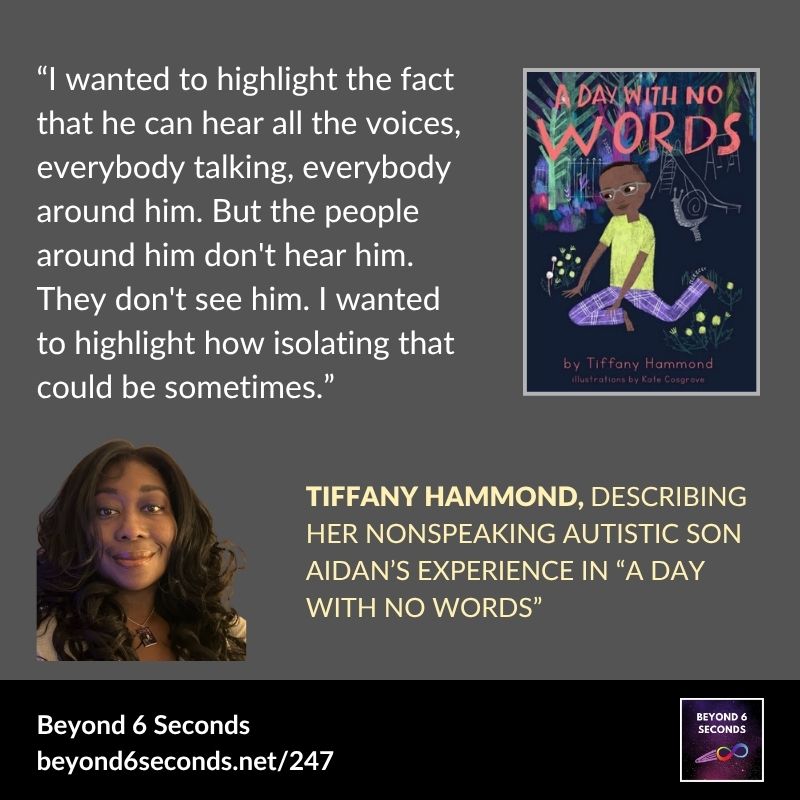
Tiffany Hammond: I wanted to highlight the fact that he can hear all the voices, everybody talking, everybody around him. But the people around him don’t hear him. They don’t, you know, see him. I wanted to highlight how isolating that could be sometimes. And I think that Kate did a super amazing job of articulating that in the art to where I didn’t have to use more words to explain that. So when she had like, the part where he’s just standing and you can only see his back and he is like holding the iPad. And you have all these tall people like legs and you see all the talk bubbles. And that’s how it could feel like to him. And he’s hearing all these different voices, loud, soft, fast, slow. I wanted to showcase that.
I wanted to show a lot of the sensory things that he has, like the spinning barefoot, the flapping. He hugs trees and he still does that to this day. I wanted to, to show the things that he loves. I love that he goes to the park. I love that he can still have fun, that he can go outside.
That was one of the biggest things that I wanted to show without actually saying it because you don’t get that many words. And I don’t know if the families that I wanted to see that picked up on it quite. But the biggest thing is, I wanted him at home as short as possible. So it’s like boom, like first page you see, he’s waking up and then boom, they’re out the door! Like there’s nothing in between there. Like he’s gone! I wanted to show that we can go outside, and we’re supposed to go outside! We are part of this world. This world belongs to us as well. We can go outside. I wanted to show us outside doing things, going to parks, going to restaurants, playing, having fun, and showing that just because he doesn’t speak, that he can still have a very meaningful life. And I wanted to show a few of the ways that, you know, he exists in this body of his that doesn’t speak. So playing, sensory things and his favorite foods. Being able to share that glimpse into our world was very amazing. And because this book did so well, I was honored with the privilege of being able to do a second book. And then expanding on that. So I got to use more words.
Carolyn Kiel: Nice.
Tiffany Hammond: Like, I get to have more of what his experiences are.
Carolyn Kiel: And since the book is told from his perspective, a lot of his sensory joy really comes through and you get, as the reader get to understand it better. Like when he’s spinning on the wet grass after the rain. Someone looking from the outside might not understand that, but since you’re hearing his perspective, you hear like how great it feels and how wonderful and how he just loves it. And it just helps really extend that type of understanding of sensory joy of autistic people, which I think is cool.
Tiffany Hammond: Yeah. You nailed it.
Carolyn Kiel: Yeah.
Tiffany Hammond: Exactly right.
Carolyn Kiel: Yeah, fabulous.
How is the story in A Day with No Words different from what’s typically included in children’s literature about autism?
Tiffany Hammond: I wanted something that didn’t make autism feel scary or different, so different. I wanted it to reflect what I do with Fidgets and Fries. Like I don’t like to teach people academically about autism. I feel like by the time you come to me, you kind of know what autism is, and I don’t wanna tell you what it is. Like, I don’t want to teach it to you. I don’t want to tell you red flags. I don’t want to tell you symptoms. I don’t wanna tell you what language you could use and what you shouldn’t use: first person, or, you know, identity first. I don’t wanna do that. There’s so many other beautiful accounts that do that, and I’m like, that’s not a lane I wanna ride in.
What I wanna do is I wanna tell stories that bring you closer to our experiences and maybe you can find a little bit of yourself in one of the stories that I shared, just a sliver. I just need a little tiny bit, then I got you. All you need is a little. You know, so I wanted to do that with this book and any other book that I write, I don’t want to teach you what autism is.
I want to show autistic people living as autistic people, like this is what we do. We just happen to be autistic, you know? You know, here we are outside doing outside things. We just happen to be autistic, I wanted to write a story that was, that was like that. I didn’t want it to be like, “oh, this is Aidan. He is autistic. He does not speak. He does these things.” You know, and I wanted it to just kind of show a little bit of like the human side of autism and Aidan. And I wanted people to see that part of him and children and the adults that read to them. Like I wanted them to see, to see that.
I wanted them to, you know, even know all the ways that they themselves communicate without speech. Like, we do it all the time. We text, we write, we wave, you know, and we smile, we frown, you know? And I wanted to, you know, remind people of that as well, and use that to extend grace to, to those like my son. I said I just wanted to do something different.
Carolyn Kiel: Yeah.
Tiffany Hammond: And, and show, you know, something different.
I wanted it to be us, for sure. Like there was a publisher in the past that I talked to, and, and they were, they, first, first one a publisher told me there wasn’t a market for my book. That was kind of like, whoa. Like it felt weird, ’cause I’m like, why wouldn’t there be a market for that book? Like disability is like the, it’s disabled people, they’re the largest marginalized group in the world. Why wouldn’t there be a market for this? And then two, another person was like, “oh, we kind of like the idea, but can we make it animals?” But I don’t wanna be animals. I don’t want my son to be a bear. You know, or like, I don’t wanna be an alligator. Like there’s nothing wrong with those. I just, I didn’t want that. Like, if I’m telling you a true story about our true life, I wanna be in the book and I want my son to be in the book and I don’t want us to be represented by an animal. So that wasn’t that, no.
So, and I wanted his tablet to look like his tablet. I didn’t want it to look like, you know, something else. So I’m sending Kate the pictures and then, Kate’s the illustrator, and I’m sending Kate the pictures of like, what our tablets look like. Mine is green. Aidan’s was red. You know, what it looked like with the straps. What did it look like, you know, and she, she, she nailed it. So she had it looking like how it looks in the cases that we had.
I just wanted it to be something that was real and authentic that people could connect with and it didn’t feel scary. And for a lot of children, that book was going to be their first introduction to not only autism, but to disability itself. And I’m like, I wanna make a great impression. You know, I want them to be able to ask like, tough questions and for teachers to, to be able to have discussions with them and parents. That was my goal.
You know, I didn’t really read too many autism books to try and compare it to. I read a couple, I didn’t wanna read too many. I didn’t wanna get stuck in like this comparison loop. You know, so I just wanted to share the way that I share something that was familiar to me. And so I just wanted to stay true to myself and write what I know and how I know and in the style that I do, and hope people could connect with it.
Carolyn Kiel: It’s such a real story and the way you’ve written it is just, you know, so, so real. Because I think a lot of media and books about autism, it’s either like, you know, “this character is autistic and it’s very sad” or it’s like ” this character is disabled but they have superpowers!” And it’s just like, we want like a real story.
I mean, this is not what this book’s about.
Tiffany Hammond: Or it was like, ” It’s okay to be different. And I love all my friends, even when they’re different.” And I’m like, I didn’t wanna write like that. I didn’t wanna write a story that made my son into another lesson. And I talk about that a lot on my page too, is like, we know every single time we leave the house that our presence itself is a message for others. So we’re always wearing that on our shoulders and our heads and stuff. Like the way we behave, the way we look, and what we do, they’re gonna take that, they’re gonna internalize that, and they might apply that to the other people who look like us, who act like us. And like, we get it.
So, but the thing is, I wanted to try to control as much of that message as possible. So in this book, I didn’t wanna make him a lesson like, “oh, he’s different. Let’s be friends with the different person!” No, I wanted to show a kid just existing and not caring what anybody else around him was doing or what was going on, and I wanted just to show that this is what we, we do on these days. We communicate in this way. We go to parks, he plays, he spins in grass barefoot. He has fun. We go eat. And then we, we assume after that we go home. But, you know, and, and, and, and then that’s it. That was it. That’s, that’s that.
Like I didn’t want him to be this lesson for others to, to be like, “oh, let’s make a friend because he’s different.” And that’s how a lot of the stories are too as well. And I’m like, nah, I just wanted to write a story about a autistic non-speaker who is Black, who is just existing and, and in all of his humanness, he’s just existing. And I want that to be enough for you. Like later on we can talk about how y’all can and, and, and, and you can do a lot of like activities and stuff that tie around, you know, understanding and engaging and, and friendship. And you tie that at the end and stuff. But this right now is just like a story of this child just existing how he is. And I’m like, let that story just be that. And then you can like, you know, add the stuff on later.
But that’s what I was doing with that. I was just showing he’s existing, that’s how he is. And I wanted to show, ’cause that’s what he does every day. He doesn’t know he’s a lesson for others. He doesn’t know, like, you know, he’s just living, existing. Not changing, not bending to anything. You know? He’s just brave and bold and bright and a ball of love! Loud, but a ball of love. A ball of loud love! You know? That’s Aidan. But I just wanted, I wanted to show that as best as I could in that book.
I get to show a lot more of him in the second book. This one is like my intro into, to the book world and is always going to be my book baby that I, I love and cherish. And I hope that with the re-release of it that it reaches not only the same people who bought it the first time around, but a newer, wider audience who can love it just as much as everyone else who bought it loves it, and just how much we love it, and yeah.
Carolyn Kiel: That’s awesome. And yeah, it’s, it’s a perfect point to the book. It’s a great introduction for children. As you said, it might be the first time that they’re learning about or reading about people who have disabilities and just, it’s just people out existing in the world. And yeah, it’s not Aidan’s job to be teaching people about disability and caring and friendship.
Like, you know, unless he decides one day he wants to take that job on and you get paid for it. But at this point he’s just out there living his life.
Tiffany Hammond: Just living his life, going outside and traveling and eating all the fries he can. And just there’s, that’s, that’s Aidan. He’s just living. And I want that to be like the message of this book. And the message of maybe most of the books I read, there might be a few where, I don’t wanna say never, you know, but of a lot of books. I just wanted to just share, you know, that we, that we’re just living.
Carolyn Kiel: Yeah.
Tiffany Hammond: We’re here and we’re just existing and it’s, it’s cool that we’re here, you know, and I just wanted to, to show that, share that.
Carolyn Kiel: Yeah, absolutely. Yeah. And again, having the story be told from his perspective, it really helps people understand more about what the internal experience of being a non-speaking autistic person really is. And I think it helps take away a lot of misconceptions that people have about non-speaking autistic kids.
So I guess from your perspective, what are some of the most common misconceptions that people have about your sons or even about Black autistic children in general?
Tiffany Hammond: I wanna say for nonspeakers in general is that they assume he doesn’t understand what’s going on around him, like he’s not aware of the surroundings. And he’s most definitely aware of what goes on around him. He’s even aware of the things that people say and the tone that they use, the words that they use. You can visibly see him and his body language change when someone is talking negatively about him.
So he’s very aware of what is going on. He just cannot tell you with speaking words how he feels. That’s the biggest thing. It’s because for some reason, people think that just because you don’t speak that that automatically means you cannot hear, and then that you cannot comprehend what is being said as well. And so we deal with a lot of, of that, a lot of assumptions on his intelligence and his comprehension. That is the biggest thing that we get from him just being a non-speaker.
Now, you combine that with him being Black, which is something that they see first. Like that’s the first thing they see. They don’t know he doesn’t speak, they don’t know any of the other things. They magnify the behaviors that he has. They always look more dangerous, more out of control, more abnormal. You know? They look more in need of control. And so his behavior and how he interacts with the world and how he moves and how his body moves has often been seen as a threat, even when it doesn’t look threatening. And so we have to deal with a lot of that.
The sounds that he makes on more than one occasion, there have been people that have actually joked that they thought the sounds that he was making was a dangerous animal, in that they were going to call the police. And this was just mouth sounds.
Carolyn Kiel: Wow.
Tiffany Hammond: And they didn’t actually like see him. And, and those occasions would happen, like at stores. And like we’re in an aisle, they’re in a different aisle and you know, they can’t see him. And then when they notice that and they come around and they see that it’s a, a, a human, it’s a person, for some reason they have to tell us. And, and they make a joke about it because apparently calling the police is funny. And so we’ve dealt with that a lot of times. We’ve dealt with a lot of law enforcement. We’ve dealt with law enforcement that has, you know, drawn their firearms. And that was because Aidan was trying to get his iPad because apparently an iPad looks like a weapon.
Carolyn Kiel: Oh jeez.
Tiffany Hammond: And, and that was back when his case was black. And now I don’t, he never has a black case anymore. They’re always big and bright and bold and stand out and do whatever I can to make it not look like whatever they thought it looked like, you know? And so you’re, you’re, you’re having to deal with that on top of the assumptions that he doesn’t understand. And so yeah, it is a lot. It’s like a, a double whammy. And, but the, the, the whammy is hard. Like you just gotta navigate doing everything you can to keep him safe.
And that’s a large part of what I do with Fidgets and Fries. And that’s a large part of why as a family we sat down and discussed the decision to have our children’s faces online. Because at first I was like, nah, I won’t, I won’t do it. If I do do it, you know, I’ll put the little emoji on their face so you can’t see them or do all this. But I’m like, that’s not protecting him when he goes outside and he’s about to be, you know, shot. Like, you know? Or, you know, police are being called. And that just brings me back to me wanting to control as much as the message that I could. So I’m like, let me tell stories about my family. Let me tell stories about my children. And let me give a face to the stories that I’m telling so that you can see that they’re human. And that they like a lot of the same things that you like, that they joke about the same things that you joke about, that they like the same types of music, that they like the same types of food. Show their humanity and remind the people of their humanity. I don’t wanna be like, oh, I’m trying to humanize my children. No, they’re already human. You should know that! Like I’m just trying to remind you that they are. And that’s what I wanted to do. And that’s what I wanted to do with the stories that I’m sharing, so like you could see.
That’s why my kids couldn’t be a bear in the book. I don’t care if they were a brown bear! Like, that they can’t be a bear. While A Day with No Words is not a quote unquote “Black book,” Black representation within the book is incredibly important. It’s incidental representation. But you know it’s there, you see it. And I wanted that. So it’s, it’s a lot!
Carolyn Kiel: Yeah. Mm-hmm. The impact of racism and ableism in society on just your, your family’s existence and just living your life is something that you write a lot about in Fidgets and Fries. And of course your book A Day with No Words that, as you said, that representation of a Black child and a Black family is really important for people to see examples of. It’s, I, I’m trying to avoid saying like, well, it’s teaching people lessons, but it is, you know, reading about people’s real-life experiences is education for a lot of people who really have never had exposure to that.
Tiffany Hammond: Yeah, they’re still gonna learn something. You’re gonna learn, so you’re gonna walk away learning something. Like, I want you to walk away learning something. I just wanted to share that we’re existing and we’re here, and it’s okay that we are the way that we are. And nothing is inherently bad about that. And I wanted to share that and show you that. And I want you to take that and, and carry that with you. So like, yeah, you’re always gonna learn something. I’m hoping you learning something. You know?
Carolyn Kiel: Yeah!
Tiffany Hammond: You know, it’s that you’re taking, you know, something from this and you’re carrying it with you, and that it helps you in your future interactions with someone or even in your life with what you have going on.
I just want to show us just being us, and existing and, and I want to attempt to control as much of the message as possible, like, that I can. And so that’s what I was doing within the story. I was trying to control that message. And that message wasn’t that he’s supposed to be this like forever lesson for, I just wanted to show that he’s, he’s just enjoying his day. And that it was okay that he was enjoying his day. And that that should be enough, is that here’s this person enjoying being outside with his mom. He hugs trees. Okay.
Carolyn Kiel: Yeah.
Tiffany Hammond: Like, you know? Okay, he’s hugging a tree. He’s spinning in the grass. I mean, okay. You know? And he has no shoes on. It’s fine! You know, like I just wanna show him like, this is, this is just Aidan.
Carolyn Kiel: Yeah.
Tiffany Hammond: That’s who he is.
Carolyn Kiel: Yeah, absolutely. Well, Tiffany, I’m really excited for the book to come out and by the time this episode comes out, the book will probably be like right about to launch or will have just launched. So where can people buy A Day with No Words and where can they help support your other writing and other work through Fidgets and Fries?
Tiffany Hammond: I’m on Facebook, Fidgets and Fries. I’m on Instagram, fidgets.and.fries. There’s a period in between: fidgets period and period fries. I am on Substack as Fidgets and Fries as well. I share more long form posts there. It’s more writer friendly. So I’m there.
I have a website TiffanyHammond.com and that can show you any of the other offerings that I have going on, like speaking engagements or consulting, things like that.
You can find the book at ADayWithNoWords.com and that can give you like a link to a bunch of different major retailers. I think there’s a link on there for a retailer in the UK, if you’re in the UK. There’s one for Canada.
There’s also gonna be an audio book this time. There’s an audio book last time, but it came out almost a year after the book, but this time it’s gonna come out the same day. So you can pre-order that. That’s also gonna be on ADayWithNoWords.com.
And you can buy it at whatever retailer you love or independent bookstore. It’s also on Bookshop and they love to give back to different bookstores to help keep their doors open. If you don’t have a local bookstore near you that’s carrying the book, you can either request they carry it, or, you know, buy through Bookshop and designate that bookseller as someone that can get some of the proceeds back to help them keep their doors open and stuff. ’cause independent bookstores are amazing! You gotta keep ’em, keep ’em around. They’re like the heart of communities and stuff. And the money stays in your local community. So if you can shop indie, go indie.
Carolyn Kiel: Fabulous. And I’m also really excited to say that as part of this episode, Beyond 6 Seconds is giving away three copies of A Day with No Words. I’m gonna share more details about that giveaway at the end of this episode and in the show notes of the episode too.
So, yeah, thank you so much, Tiffany.
Tiffany Hammond: Yes, I’m excited.
Carolyn Kiel: As we close out, is there anything else you’d like our listeners to know or anything else they can help or support you with?
Tiffany Hammond: Not really! I mean, if you already have a copy, you know, they make good gifts. The newer copy is slightly different, but the slight changes made a world of difference. It’s more glossy and it’s more shiny and it’s fingerprint resistant. The first copies, you know, fingerprints everywhere. And so every time I was seeing someone, they took the jacket off. Looked like they had fingerprints everywhere. The inside pages are, are glossy now, and they feel a little bit more durable to me. You know, and there’s been some language changes on the inside jacket and the back cover.
But they also make really good gifts, to schools and to libraries, and one thing I’m trying to push through now is getting them donated to children’s hospitals ’cause they have libraries. My son spends a lot of time in the children’s hospitals and they have libraries and they’re always looking for books so you can get a copy and donate it to the library at children’s hospitals. So, but yeah!
Carolyn Kiel: Awesome. Thanks Tiffany. It was so great to talk with you and congratulations on the re-release of the book and yeah, it’s really exciting. Thank you for all of the great work that you do.
Tiffany Hammond: Thank you so much!
Carolyn Kiel: Hey everyone, thanks so much for listening to my conversation with Tiffany today. And now, as promised, here are the details for the giveaway that I mentioned earlier, where up to 3 lucky listeners in the United States can win a hardcover copy of “A Day with No Words.” To enter, check out my Instagram post on November 11, 2025. I’m @beyond6seconds on Instagram, and I’ll put a link in the show notes so you can go right to my Instagram page. The giveaway ends at 11:59PM ET on November 21, 2025. Up to 3 winners will be selected at random. This giveaway is valid for listeners at US addresses only.
Carolyn Kiel: Thanks for listening to Beyond 6 Seconds. Please help me spread the word about this podcast. Share it with a friend, give it a shout out on your social media, or write a review on Apple Podcasts or your favorite podcast player. You can find all of my episodes and sign up for my free newsletter at Beyond6seconds.net. Until next time.