
Episode 249: The Introverted Misfit — with Caroline Smith
-
play_circle_filled
Episode 249: The Introverted Misfit — with Caroline Smith
Carolyn Kiel
Caroline Smith founded her business, The Introverted Misfit, to help shy, awkward introverts become socially confident versions of themselves so they can have healthy, manageable social lives. Because of her experience with being autistic, which was the source of many social difficulties and major social anxiety for her, she knows what it’s like to build self-acceptance, self-improvement, and a life that works for individualized needs. Now Caroline helps fellow introverts (whether they are autistic or not) learn how to connect with others, create fruitful relationships, and have a manageable social life – without acting like someone they’re not!
During this episode, you will hear Caroline talk about:
- When she realized that she was autistic
- Her experience dealing with social anxiety
- Why she decided to help people become more socially confident
- The role of self-acceptance in making new friends and connections
- Her advice for autistic people who struggle with social cues
- Why it’s important not to hyperfocus on your own social mistakes
- The importance of having coping mechanisms for overwhelming social situations
- How her “Misfit Meetups” bring people together to socialize in a low-pressure, fun environment
To learn more about Caroline, her coaching program and Misfit Meetups, visit TheIntrovertedMisfit.com and follow her on Facebook, Instagram and LinkedIn.
Download Caroline’s FREE AUDIO GUIDE: 3 Simple Ways to Start a Conversation with Anyone.
Follow the Beyond 6 Seconds podcast in your favorite podcast player!
Subscribe to the FREE Beyond 6 Seconds newsletter for early access to my latest podcast episodes!
Support or sponsor this podcast at BuyMeACoffee.com/Beyond6Seconds!
*Disclaimer: The views, guidance, opinions, and thoughts expressed in Beyond 6 Seconds episodes are solely mine and/or those of my guests, and do not necessarily represent those of my employer or other organizations. These episodes are for informational purposes only and do not substitute for professional medical advice. Consult a medical professional or healthcare provider if you are seeking medical advice, diagnoses, or treatment.*

The episode transcript is below.
Carolyn Kiel: Welcome to Beyond 6 Seconds, the podcast that goes beyond the six second first impression to share the extraordinary stories of neurodivergent people. I’m your host, Carolyn Kiel.
Carolyn Kiel: On today’s episode I’m speaking with Caroline Smith. Caroline founded her business, The Introverted Misfit, to help shy, awkward introverts become socially confident versions of themselves so they can have healthy, manageable social lives.
Because of her experience with being autistic, which was the source of many social difficulties and major social anxiety, she knows what it’s like building self-acceptance, self-improvement, and a life that works for individualized needs.
Caroline now uses her platform and her one-on-one coaching services to help fellow introverted misfits, whether they’re autistic or not, learn how to connect with others, create fruitful relationships, and have a manageable social life without acting like someone they’re not.
Caroline, welcome to the podcast.
Caroline Smith: Hello, and thank you for having me, Carolyn.
Carolyn Kiel: I’m excited to talk with you about this topic. It’s certainly something that I’ve dealt with over the years and I’m sure a lot of introverted and or autistic people have as well. So really excited to learn more about this and about your own story as well.
So first I’d love to ask you like when did you realize that you’re autistic?
Caroline Smith: That’s actually a funny question because I never even realized I was autistic. It was actually my parents, well, lemme back up a little bit.
Carolyn Kiel: Um-hmm.
Caroline Smith: So all throughout my childhood and high school years, I could always tell that I was a little different. I didn’t know what the source of the difference was, but I knew I was different.
I barely had any friends or when I was able to make friends, they didn’t really last long. I was always that kid on field trips and on band trips, ’cause I was in marching band when I was in high school and college. I was that kid that broke the rules basically, and stayed by myself. Like, you know when chaperones tell you to go places to eat with other people so you’re not alone. I was that kid that broke the rules, ’cause I didn’t have any friends and I didn’t know how to talk to them. So I always knew that I was a little different, at least socially.
And my parents noticed too. But see, I wasn’t really worried about them. It was my parents and they, they are the ones who got me psychologically evaluated at the age of 17. And that is when I got my official diagnosis with ASD level one. It was called something else before, but now it’s referred to as Autistic Spectrum Disorder level one.
Once I found out about this diagnosis, to be honest, it was not really a big deal for me because like I said, I already knew that I was really different. Now I just had a name to it. My parents were of course happy to finally know what it was so that we could learn to manage it better and they could support me better going forward.
So that was kind of a long-winded answer, but 17 is when I officially got diagnosed with ASD level one.
Carolyn Kiel: Wow. It sounds like your parents really picked up on it where you were just sort of, you know, living your life and, and managing the best way that you knew how in terms of social interactions and social situations.
You also experienced a lot of social anxiety growing up. What did that feel like for you? You did mention not really having many friends and spending a lot of time by yourself, but was that like a comfortable thing for you or did you have social anxiety around other parts of your life?
Caroline Smith: It was both, really. I’m comfortable by myself anyway ’cause I am naturally introverted. But when I still had social anxiety, which I was seeing a counselor for specifically that when I was in college, I was comfortable by myself because that meant I didn’t have to talk to anybody.
So I used to do this thing where I would do anything in my power to avoid talking to people because it made me nervous. ’cause I knew I was gonna mess something up. Like I knew they were gonna think that I was weird or they were not going to want to talk to me. I just, I knew that and so I was scared to even attempt it.
When I was in college, I would go different hallways, different stairwells that I knew people weren’t gonna be passing me. I would avoid people’s eye contact, not just ’cause I was autistic, but because I didn’t wanna talk to them. I was freaking out about it. I had all these things. I think what they’re professionally called is coping mechanism, maybe defense mechanisms or something like that. But these behaviors that you do to avoid your fears basically of talking to people.
So I would describe that time of my life as very well, anxious of course, but also kind of depressing, honestly. Because I think it’s a common misconception that all autistic people prefer to be by themselves 100% of the time. People still need connection, you know? Like it doesn’t matter what kind of disability you have, people still want to know that there are even just a few people who they can rely on and who accept them for who they are. So I think that was probably the biggest struggle with me having both social anxiety and also being on the autism spectrum.
Carolyn Kiel: Yeah, that’s true. It is a common misconception that autistic people don’t want any kind of social connections or prefer to be by themselves. Certainly there are some people who may prefer that, but I think, as you said, connection is so important. And connection may look different for each person, whether you’re introverted or extroverted, or autistic or not autistic.
Caroline Smith: I just had to insert in ’cause I forgot. Yeah, I, I am an introvert of course, so I do like to be, I like my alone time to recharge and everything, especially when I get overstimulated. But introvert does not mean, doesn’t need connection.
Carolyn Kiel: Absolutely. Yeah.
So how did you decide to help other people, or other introverts specifically I guess starting out, who struggle with social anxiety? I would assume it takes a while for you to sort of, you know, be self-reflective or understand your own social anxiety and then say, okay, now that I have an understanding of myself, I can help other people. So what was the path to helping others with that?
Caroline Smith: Yeah, I would say it was about a two year period. That’s how I remember it, because I was, I had graduated from college at this point and I was in the workplace doing adulting as they say, you know? Trying to save up some money and get my career as a web developer started.
And my social confidence journey, it kind of started in the workplace a lot. I would use really small interactions. Nothing big, nothing major. Just small conversations, little pleasantries here and there to kind of get myself used to talking to people. Instead of avoiding social interactions, I would make it a point to say, okay, you’re gonna go in here and you’re going to say “good morning” to someone, and you’re just gonna ask how their day was.
It was about, it was a while of that until I could feel myself getting better. Like I could see, I could feel myself getting less nervous around people. Even in the workplace meetings, I was starting to speak up more. I was starting to try and make jokes even though I embarrassed myself a lot. And, but I was not afraid to make mistakes anymore at a certain point. And I think that was the key.
Once I finally looked around and was like, oh my gosh, I’m not afraid of talking to people anymore, even as quirky as people know that I am, I’m not afraid of them seeing that. I just took a second to look around and be like, wow. There’s probably other people out there right now who are where I used to be, who are frustrated with how their lives and their relationships are not progressing like they wanted to and they don’t know how to get out either. And they probably think they have to be 100% perfect socially in order to do that, and they don’t. And so that is what prompted me to found my business, The Introverted Misfit and my coaching services, specifically my program, Communicate With Quiet Quirky Confidence, so that introverts who struggle with shyness or social anxiety and social difficulties, they can get over that initial fear of trying. ’cause that’s where the real change happens when you start actually talking to people and learning about yourself. And they can do it in a way that does not require them to fake being somebody that they’re not, to act like an extrovert and act like somebody that they are just not.
And yeah, that is, that’s a little bit about how I founded my business and what I aim to do with my coaching sessions and all of my other business services.
Carolyn Kiel: Yeah. A lot of times, the hardest part is knowing where to start or how to open up that conversation. And even something as simple as, you know, saying “good morning” and asking how somebody’s day was or is going. I guess we consider that small talk, but that is a lot of ways to kind of open up the conversation and, and at least get yourself some practice in getting over that initial fear of, “Oh how do I start this conversation?”
Another challenge though, and certainly one that I face, is how to keep the conversation going or how to jump into a conversation when you’re not just one-on-one. ’cause a lot of times, one-on-one is easier for a lot of introverts. You know, there’s a back and forth with the conversation. Like, you know, you talk and I listen and then I talk and you listen. But with a, a group of people, sometimes it can be a challenge to keep that conversation going. So yeah. Were you ever in situations where you were in like groups of people and had to think like, okay, how do I become part of this conversation in a natural way? Or was that something that you had techniques for?
Caroline Smith: Yeah, all the time. All the time. So especially when I was in high school and college, I’m gonna be honest with you, I just stayed away from group conversations. I tried to enter a few of them. I remember them, the moments in my head, I don’t even wanna repeat them to you ’cause they are so cringey, like. I, I was thinking about them before this meeting. I was like, I cannot believe I said that. But I, I had failed and so I just stayed away from them for a long time.
So what that looked like was, even if I was in a group discussion, I was just the one who wasn’t talking. Or if I was talking to someone else, and then another group of people came over and sat at our table, you wouldn’t hear another word from me. And yeah, there was, there was a long time where that was my coping mechanism. I just, I just, you know, sat there, smiled along, nodded, but I didn’t say anything. Especially if I could tell the other people in the group don’t struggle socially at all. They are ultra extroverted.
I actually have a funny story about that. I just now thought about it. A few months ago I was visiting Texas ’cause my sister and her family are in Texas. And my sister is the complete opposite of me. Does not, has never struggled socially. She makes friends with everybody she meets, does not struggle with group conversation. She’s like an ultra extrovert, like, I’m not exaggerating. So it’s always interesting when we hang out. But we were going to, she’s a, a praise team singer at a church. And we were in the, what’s it called, the backstage area with all of the musicians right before the service starts. And all, of course, all the musicians are equally as extroverted as she is. And so literally I was just sitting there, it was like I was watching a tennis match. It was, I, I could not figure out how to jump in ’cause you could just tell these people did not struggle socially. And if I said something, I was immediately gonna be like, people are just gonna side eye me. I could tell.
But how I’ve learned to cope with that is I get in where I can. That is, if I don’t think that I can get in while people are, you know, elevated and laughing and joking around, you know, I might laugh along and nod and all that, but I’m not gonna jump in at that moment. But if there’s a quiet moment and nobody’s said anything for a few seconds, and then I can tell that that conversation is done, so there’s gonna be another one, I’ll ask someone else something. Like, I did that a lot on a recent work trip to Vegas, ’cause I still have my nine to five in addition to my coaching business. And we were at a table, it was like 20 people and I was, it was like a group of five people and they would be laughing and we would be joking and everything. Then you, you could tell the conversation kind of dies down a little bit. And then I would insert myself or I would ask a question and then it would get a new conversation started.
You’d be surprised at how many coping techniques you can learn to, I guess, survive. I don’t wanna call it survive, but that’s how I think about it. That’s one tip that I have, I use it a lot. It works for me most of the time.
Carolyn Kiel: Yeah, it’s so familiar hearing you share those stories and your experiences. I have the same experiences even today with group conversations and knowing when to jump in. And I’m thinking, do most people like me think about like, “all right, this is this time of the conversation. Should I bring up this story?” Oh, I don’t have anything here.” “If I bring this up, will it derail everything?” Will people, like literally these are all the things running in my head while people are having conversations. And then it’s like, “I haven’t said anything in 10 minutes and this is really bad and I need to think of something to say.” So I don’t know if most people really have that running commentary in their own heads like I do, but I really relate to the experiences you share.
Caroline Smith: Yeah, I, I thought the same thing. But yeah, it’s, I don’t know if it’s just an autistic thing, maybe ADHD thing too, ’cause I’ve heard they sometimes struggle with social situations in a different way. Yeah, I have the exact same thoughts. And you know what, for a lot of people, especially when they have social anxiety, but even if they’re just introverted, I’ve noticed that group conversations are intimidating for a different reason also because it’s like the risk to reward is a lot higher in group conversations. So if you say something right and everybody thinks it’s funny or they think that was, “okay that’s a good thing to say.” You can tell. And it’s like, “okay, yeah, I nailed that, great!” You know, and the adrenaline’s going. But if you say something wrong or something that is like mismatched and you can automatically tell by the silence of the group and like, or people start like side eyeing each other and chuckling, and then they kind of go over it. That can be very scary, especially for people who struggle with shyness and social anxiety.
So there’s actually a portion of my coaching program where we go over just group interactions because I, just like you said, I recognize that the dynamic can be a little different with, with more people.
Carolyn Kiel: Yeah, for sure. And yeah, that’s an important point is that there’s that extra pressure when you’re in with a group of people to kind of, I don’t know, fit the flow of the conversation or fit the topics because there is more of that risk reward ratio, as you said. Absolutely.
A lot of people sometimes feel like they have to quote unquote “act extroverted” or act in a certain way, almost like fake their own social presence in order to be accepted or to make friends or, or whatever their social goals might be. But, I mean, ultimately you really need to have some sort of like a self-acceptance or at least an understanding of what your strengths are and what your style is in order to be able to make genuine friends in the long run. So I guess, what kind of role does acceptance play, whether it’s acceptance of yourself or of other people, in making new friends?
Caroline Smith: I think it makes a big difference. Because in my experience and just from talking to other introverted misfits if you don’t accept yourself, that means your challenges, your differences, your communication weaknesses, ’cause everybody has weaknesses of some sort. Even neurotypical people. If you can’t accept that, you go through life and you interact in these social events and these social interactions. It is almost like everything is just, it feels like rejection, because you don’t accept yourself. You think you have to act like somebody you’re not. You think you have to act extroverted, and then when that doesn’t work out for you, you get this feeling of like, oh, well I guess I’m just not enough. You know? Like they don’t like me even when I’m trying to act like them. But what happens when you can accept yourself for who you are, your relationships really change.
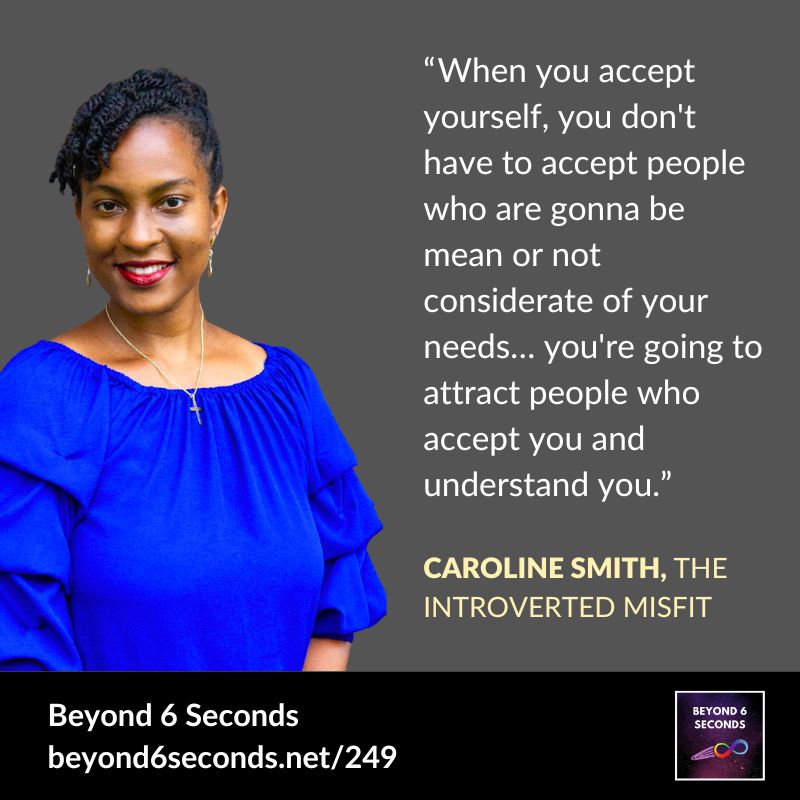
You don’t entertain people just because they’re talking to you. I used to do that a lot, even with people who I knew were not necessarily good fits for me. I would still try to keep them in my life because I just felt like, well, they’re the only ones accepting me. But when you accept yourself, you don’t have to accept people who are gonna be mean or not considerate of your needs. You know? You accept yourself, and therefore you’re going to attract people who accept you for you and understand you.
Carolyn Kiel: Yeah. There is that pressure sometime to just say, oh, this is someone who’s talking to me so this is a perfect person to be friends with because I have such a hard time making friends, and why would I turn this person down? But yeah, it is really having that kind of faith and understanding in yourself and about yourself to say that, I can choose who I wanna be friends with or who I wanna build relationships with or talk to or anything like that. So yeah, that, that totally makes sense.
This isn’t necessarily like an introversion thing, but as we know, a lot of autistic people, not all autistic people, but a lot may really struggle to pick up on social cues, especially in social situations where there are a lot of people that they may not know or may not know well. Those group conversations that are so challenging. I don’t know if that’s something that you’ve personally struggled with as an autistic person, but I guess what kind of advice would you have for autistic people who might struggle to pick up on those social cues?
Caroline Smith: Yeah, it was something that I struggled with, but just as you alluded to, not all autistic people have the exact same struggles.
So how that manifested for me was, I wouldn’t know the cues that showed you can talk to this person or you can interject yourself into this group, or they do wanna talk to you. It seemed like I was maybe overstepping boundaries, social boundaries, when I didn’t mean to, and it turned out, oh, they did not wanna talk to me. Or they you know, this was not what I thought it was.
How did I fix that? The best tip I can give you is to stop obsessing over social mistakes. Because once you stop obsessing over them, once you understand that really people are not as hyper-focused on your mistakes and your insecurities as you think they are, once you can understand that, you’re not gonna be afraid to actually make mistakes so that you can learn. And learn how to read social cues and how to stop reading more into behaviors than there needs to be.
So like, I was trying to give you a specific example. Well, like I said, I struggled a lot with knowing what are the cues that show this person would be open to having a conversation. Well, I would’ve never figured that out if I wasn’t willing to try and be a little bit embarrassed temporarily. Temporarily is the key word. Right? Because they’re not gonna think about it. As soon as the mistake is over, you’re, you’re the only one thinking about it. They’re not thinking about it. So you, you really have to get over that, that feeling of just, “oh my gosh, everybody noticed that thing that I said. You know, I can never talk to them again. I, I should just give up trying.” No, you have to stop that so that you’re not gonna be afraid to try and make mistakes and learn from them.
Carolyn Kiel: Yeah, that’s important. Not being afraid to make mistakes and also to learn from those as much as you can. ’cause yeah, I mean, I even had an interaction with some friends last night that I feel like, you know, I’m still thinking about like, oh, you know, I really should have talked more. You always have that worry about like, maybe they won’t like me if, you know, I didn’t perform well in the conversation. It’s just such strange things in my head. But logically I know, it’s like, I’ve known them for years. They’re not thinking about any of this, like I’m 100% sure of that. So it is important to just be able to kind of interrupt your own thought process after the fact, whether you made a mistake or you just didn’t do everything that you wanted to do in the conversation. Say, okay, that was one experience. What can I learn from that? And then, you know, onto the next thing, just moving forward. Yeah.
Caroline Smith: Yeah, that’s right. And if I could just add onto that quickly. If you think about yourself, this is, I’m talking to the audience now. Anybody who may be struggling with this, whether you have social anxiety or not, we can still hyperfocus on our mistakes and insecurities, right? So I just want you to think about a mistake that somebody else made. Like maybe someone else said something kind of awkward to you, or they did something a little weird and you could tell they, they were not happy with what they said or whatever. And then literally the next two minutes, you have forgotten about what they did. That’s exactly what they are thinking. They have moved on from whatever you are still thinking about. So you’re right on the money. Yeah.
Carolyn Kiel: Yeah, it’s, it’s important to keep that in mind. Definitely.
Another challenge with socializing, and this is especially for introverts and, and probably other people as well, is that it can be really exhausting sometimes. Some neurodivergent people as well get exhausted by social conversations. You know, it’s everything from having to maintain eye contact or getting sensory overload or just the mental stress of all the things we have in our head, the scripts and the running commentary to have those conversations. How do you help people socialize within their limits so they’re not completely exhausted after interactions?
Caroline Smith: Yeah, I would say probably two different ways now that I’m thinking about it. So the first way is, you actually have a little bit of choice about what kind of social situations you find yourself in, outside of the ones where like maybe at work, where you have to be there. You know, after hours when your time is yours, you can choose which social situations that you want to go to and you know which ones are gonna be less overstimulating for you.
There’s a pottery painting place right up the street from where I live, and as soon as I found it last year, I make it a point to go like at least every couple of months because it is the perfect environment for me socially and just for my artistic needs. So like, I could sit there at a table, I can paint. So the pressure is not on to talk 100% of the time ’cause we’re doing something, painting. And then it’s a quiet place. Like it’s a small place. Capacity is like 35 people. So I, even if people are gonna be there, it’s not gonna be one of those places where it’s loud and I’m gonna get sensory overload and all of that stuff.
Like, that’s just one example. But there are coffee shops that you can go to. I know there are quite a few local, like non-chain coffee shops. A lot of towns have those that are non-chain, and so that gives them the freedom to do a lot of like creative stuff. Like there’s a coffee shop up the street from me where they do like board game nights, they do trivia nights, they do wine tasting, they have book clubs. There’s all sorts of social environments that are introvert friendly or autistic friendly. Like they’re, they’re not gonna overwhelm you. So that’s one is doing some research in your local area, in your town to see what kind of places might be good for you, and then actually going to them, right? Because sometimes you might talk yourself out of going, especially if you have social anxiety of any type.
But the next way is, obviously we can’t avoid every single, you know, overwhelming social situation, even though we may want to. So part of that is learning some coping techniques that are gonna get you through that. So I mentioned earlier that in, back in February I traveled to Vegas for a work trip with 20 other of my employees and my bosses and higher ups. And we were in multiple situations where we were in group settings and we were talking a lot, and I had to rely on my coping techniques. So I would engage in the discussion. If I found a break to talk, I would talk a little bit, even if it was just to one person and then maybe another person interjects, and then I, you know, talk with them and laugh a little bit. And then I feel myself shutting down, ’cause the restaurant is loud and the lights are loud. I mean, Vegas, Vegas is one big overstimulation place. So it, it was, it was crazy there. But when I felt myself getting worked up and overstimulated, I would just take a break from the discussion. Calmly, I would just eat, keep eating, drink, look around the room a little bit and maybe do that for a couple of minutes. And then when I felt myself getting back to normal, I would interject again and talk again, engage, and then, you know, do the same thing.
It’s about knowing your limits, of course, and then also having a few coping strategies that you can rely on to get you through, right? Because I mean, like I said, you, you’re not gonna be able to avoid every single situation that you may want to. But those are the two big tips that I would have as far as finding introvert friendly, neurodivergent friendly ways of socializing.
Carolyn Kiel: Yeah, that is really important to remember is that you don’t have to engage all of the time in, in a situation like that, like you can take those breaks, whether it’s literally just, okay, now I’m going to eat for a little while because I, I feel like I need a break or I need to like, go to the restroom. Like that’s, you know, literally get up from the table and like, I’m gonna excuse myself for a while and then, you know, whether you go to the restroom or not, just take a break somewhere else that might be relatively quiet. I feel like, well, speaking for myself sometimes I used to feel like I had to force myself to stay in the moment and in the situation because, I don’t know, I just felt like if I left it, people would be like, why is she leaving? But no, no one’s really thinking that. Like they’re so focused on their own conversations. And you know, you, you just have to engage as much as you can by using your coping skills, and then trying to recognize if you are getting overstimulated or if you really need a break to just go and, and take that break.
It’s, it, it, you know, just kind of realizing that it’s okay to not have to pretend to always be engaged in every single conversation.
Caroline Smith: And that’s exactly why the key point of my program is without having to pretend to be somebody you’re not. ’cause. A lot of times they feel like they have to be on 100% of the time. And you’re gonna burn yourself out that way. I’ve been there before. Or you’re gonna work yourself up to the point of having a meltdown, which is another thing which you, you don’t want. So yes, it’s okay to temporarily take breaks. Like we just had a whole discussion about. Nobody’s gonna be, you know, sitting there thinking, you know, wow, why did she, you know, get up and leave? Or, why is she quiet right now? Just take the time you need and then get back into the conversation. And I promise you it’s not gonna, it’s not going to ruin their image of you in your head if you just take a little bit of time.
In Vegas, after those big dinner outings where we would be together for like a couple of hours, after I had had enough, I would just politely say, “you know what, I’m kind of tired now and I, I’m just gonna go back to my hotel room.” And I would get an Uber and go back. And you know, the funny thing is, there’s always usually two or three other people who were thinking the same thing. And then we all got in the Uber and went home, but it was not a big deal.
Carolyn Kiel: Yeah. Yeah. It’s interesting to realize that sometimes people are thinking and feeling the same way that you are, but kind of like you, they’re also afraid to say something, or they just wanna kind of stay with the, the activity in the group. So once one person, whether it’s you or somebody else says, ” I’m a little tired, I’m gonna go,” it may actually invite other people who are feeling uncomfortable to say something. Say like, “oh, okay, I think I’m gonna go too.” That sort of thing.
We’ve talked about this throughout the conversation is that you really emphasize people on knowing themselves and knowing their strengths and not pretending to be somebody else in social situations, or not thinking that they have to be somebody else to make friends and build relationships. What other ways do you help people build relationships in their own way, whether that’s knowing their own strengths, being comfortable with themselves, things like that?
Caroline Smith: Yeah. I don’t know if there are any other ways as far as my coaching goes, but I have started a new thing that I’m really excited about, and I call them Misfit Meetups. So for the past two months, I have been gathering shy, awkward, or low support needs autistic people, adults who are looking for a place to practice socializing with no judgment, and they maybe want to meet other like-minded people. We get together once a month and we do something fun. So for the first month of October we did painting pottery. We did an event called Paint Away the Social Spookies for a spooky season themed meetup. And it was really, it was a great kickoff. That was the first official meetup that I had.
I think doing actual community building in that way, even though we’ve only had two meetups thus far, I can already start to see just how much of a need there is for people to find each other and to be engaged in a real life community where they can be in person with people who are not gonna pressure them to talk 100% of the time to pretend to be somebody they’re not.
So yeah, that is, I would say in-person community outreach, which is what I consider that to be. That has really just been another, an extension, I would say, of my services. ’cause I actually get to see people in real life, you know, working through their struggles and talking to people. So yeah, I, I think that is probably the main other way that I help people. ’cause I mean, even with the coaching program that I have, a big part of it is action, like action based steps. ’cause we can do all of the talking that we want, you know, but if you don’t, if you are not actually doing those things in your real life, you’re probably not gonna get better anytime soon. And so those Misfit Meetups, it’s just been like an extra layer of helping people and seeing the work that needs to be done. And that, there was definitely a need for this in the community. And I’m so glad that, you know, people are interested in it. I think 20 people for my next meetup, 20 of the people who came to the last one are signed up for this one. So like they, they liked it. They liked the idea of meeting people, talking to people, and just getting over their fears of being around people. Some of them, because not all of them are shy. Some of them are just on the spectrum and they just want a place to meet people.
I mean it’s starting to be so productive that I’ve even had people internationally reach out to me who are following me or listening to me and they’re like, “Hey, can you make a virtual version of Misfit Meetups for those of us who are not in your area?” ‘Cause I’m all the way down here in Alabama, the south. Now I’m thinking like, huh, maybe I should, you know, maybe it’ll be a little different than in person talking and meeting, but I’d have to get creative with it. But maybe there’s a need for it virtually, you know? So I’m, I’m just, the wheels are already turning for a lot of different things for me.
Carolyn Kiel: That’s really cool. Yeah, those Misfit Meetups sounds like they’re really filling a need that’s really critical in the autistic community and really in the community. You know, these days I think people are feeling more and more disconnected from other people or their communities in general. So that sounds really great.
And the fact that you’re pairing it with an activity. So like the pottery painting is perfect because a lot of, I know a lot of ways that I’ve made friends is through shared common activities or interests like podcasting or music or things like that. So having that activity that gives you something to do so you don’t feel the pressure of socializing all of the time, but it’s open, like you can, and there are plenty of opportunities to do it while you’re doing the activity, is a really great structure.
How can people get in touch with you if they wanna learn more about your coaching or about the meetups?
Caroline Smith: Everything is on my website, TheIntrovertedMisfit.com. That’s where I have the signup list for the Misfit Meetup mailing list. The one that’s in the Auburn-Opelika area, that’s where I live, so you can sign up for that one. And by the time that this podcast episode airs, I’ll probably have a little link on that page where you can go sign up for the virtual meetups, if I do end up doing those, ’cause I’m, I’m just trying to see if there’s even an interest for that before I, you know, go through all this planning and stuff. So definitely go to that page. It’s linked in the navigation and I’m sure we’ll probably already link it in the description of this episode so you can find it if you’re interested in those.
As far as working with me one-on-one with my coaching services, if you go to TheIntrovertedMisfit.com/coaching that will bring you to the page for my signature coaching program, Communicate With Quiet Quirky Confidence. And you can read all about what the program entails, exactly what you’ll be getting when you are working with me, how that program can help you become a more socially confident version of yourself, without having to be loud, extroverted, or socially perfect, which was a big thing that we talked about. And then I’m also everywhere on social media. So the handle, theintrovertedmisfit that’s everywhere on Facebook, Instagram LinkedIn. And yeah, I think that is basically it.
The last thing I would say is, we kind of touched on struggling with keeping the conversation going or starting a conversation. So I have a free guide on my website, Three Simple Ways to Start a Conversation with Just About Anybody. It’s an audio guide. So it’s me talking you through three simple conversation starters that I use in my daily life to start conversations and to keep the conversation going. And I’ll include a link to that as well if you’re interested in getting a little freebie out of this conversation today. And yeah, those are the best places to get in contact with me.
Carolyn Kiel: Yeah. Fabulous. We’ll totally put those links in the show notes of the podcast so that people can get in touch with you and, and get that freebie. That’s wonderful.
Yeah, well, thanks Caroline. It’s been great talking with you. It sounds like you’re doing a lot of really great work to help autistic people, introverts, plenty of people just, you know, build their social skills and build connections, which is really important, especially these days.
As we close out, is there anything else that you’d like our listeners to know or anything they can do to help or support you?
Caroline Smith: If I could just leave you with one little tidbit of encouragement. It’s to stop obsessing over those social mistakes. ’cause again, nobody is as focused on them as you are. And that, that tip alone is gonna get you a lot of places.
Carolyn Kiel: Excellent. Yeah. Thanks so much, Caroline. It’s been great talking with you. And thanks so much for being a guest on my podcast.
Caroline Smith: Yes, thank you for having me.
Carolyn Kiel: Thanks for listening to Beyond 6 Seconds. Please help me spread the word about this podcast. Share it with a friend, give it a shout out on your social media, or write a review on Apple Podcasts or your favorite podcast player. You can find all of my episodes and sign up for my free newsletter at Beyond6seconds.net. Until next time.