
Episode 246: Advocating for dyslexic students — with Sabrina Fandell
-
play_circle_filled
Episode 246: Advocating for dyslexic students — with Sabrina Fandell
Carolyn Kiel
Sabrina Fandell is a VP at the International Dyslexia Association. Sabrina combines strategic vision with authentic advocacy to drive growth and awareness. She is passionate about fostering inclusive environments, inspired by her personal experiences as a neurodivergent leader with dyslexia and as a parent of a child with dyslexia and ADHD. She’s dedicated to empowering diverse thinkers, promoting neurodiversity awareness, and championing innovative solutions that help individuals and organizations thrive.
During this episode, Sabrina talks about:
- Her experience as a child with dyslexia, and as a parent of children who have dyslexia
- How advancements in technology and teaching methodologies can help students with dyslexia succeed in school
- Why she got involved with the International Dyslexia Association
- The complicated journey to get her son assessed for dyslexia and ADHD
- The fine line she walks as a parent when advocating for her son at IEP meetings
- Resources and advice to help parents support their children with dyslexia
Learn more about the International Dyslexia Association Dallas Branch, their hotline and their scholarship program for dyslexia testing.
Follow the International Dyslexia Association Dallas Branch on Facebook and Instagram.
Follow the Beyond 6 Seconds podcast in your favorite podcast player!
Subscribe to the FREE Beyond 6 Seconds newsletter for early access to my latest podcast episodes!
Support or sponsor this podcast at BuyMeACoffee.com/Beyond6Seconds!
*Disclaimer: The views, guidance, opinions, and thoughts expressed in Beyond 6 Seconds episodes are solely mine and/or those of my guests, and do not necessarily represent those of my employer or other organizations. These episodes are for informational purposes only and do not substitute for professional medical advice. Consult a medical professional or healthcare provider if you are seeking medical advice, diagnoses, or treatment.*

The episode transcript is below.
Carolyn Kiel: Welcome to Beyond 6 Seconds, the podcast that goes beyond the six second first impression to share the extraordinary stories of neurodivergent people. I’m your host, Carolyn Kiel.
Carolyn Kiel: On today’s episode, I’m speaking with Sabrina Fandell, a Vice President at the International Dyslexia Association. Sabrina combines strategic vision with authentic advocacy to drive growth and awareness.
She’s passionate about fostering inclusive environments, inspired by her personal experiences as a neurodivergent leader with dyslexia and as a parent of a child with dyslexia. She’s dedicated to empowering diverse thinkers, promoting neurodiversity awareness, and championing innovative solutions that help individuals and organizations thrive.
Sabrina, welcome to the podcast.
Sabrina Fandell: Hi. Thanks for having me, Carolyn.
Carolyn Kiel: I’m really excited to learn more about your story. You yourself have dyslexia and you have a child with dyslexia as well. So I’d love to hear more about your own story growing up. Like what was it like for you growing up with dyslexia that was undiagnosed at the time?
Sabrina Fandell: I think I compared myself to my son’s kind of course a couple times now. And, interestingly enough, my younger son also just recently got diagnosed with dyslexia. So we’re all a couple of, we, we always joke in our house, like left and right, it’s kind of a little bit hard for us. We’re, other left, other right.
but I always say like, you know, my son’s so lucky. He gets these like pullouts. He gets to go see a dyslexia specialist. There’s all these like accommodations and things that make his learning a little bit smoother for us. You know, as a 80s child, we got pulled out. There was three of us. We got pulled out and kind of put in the book closet.
Carolyn Kiel: Oh.
Sabrina Fandell: So it was like this closet in between two of the classrooms where all the books were stored. It was like their storage closet really. And that’s where we would do our reading. And I just remember being embarrassed, like to go. And then we were reading, you know, easier books than the other students who had to read like chapter books and like cool plots, and you know, they were very interesting. And we were like, “the dog and the cat like to play fetch.” You know like, so a little bit of a different story for us.
And you know, I remember going to the library and like picking out the biggest book I could possibly pick out just to like, be like, one day. One day I’ll read this. One day I will go through this book. And I would just kind of like flip through the pages and read, you know, the words that I could read without really understanding the whole book. But just thinking to myself like one day I’ll be able to understand the story.
And, I’ve had a couple of impactful teachers in my life. One was in sixth grade. Mr. Bone. And he kind of allowed for more of a free reading kind of system where it’s like you could get under your desk and read your book. You could, you know, because I was always like, we’re reading the same book. And you notice kids in the class, like flipping to the next page, flipping to the next page, flipping to the next page, and you’re sitting there like still trying to read, you know, the first or second page. And that’s always, you know, just a little bit of a, a heartbreak. And you’re always kind of comparing yourself as a dyslexic student to other students, unfortunately. And he just allowed for us to kind of like get where we felt most comfortable, read what we could read. He would stay behind and answer any questions about the books that I had.
And then I had a teacher in high school. He was blind and he realized, “hey, when I do the study guide questions and you guys all put your notes and stuff away, and I have my student aid, so she knows that you don’t have anything on your desk, you do very, very well. But then when I give you the test the next day, you’re like, failing the test. What’s going on?”
So it’s been like a couple teachers that really, you know, saw me for, for the student I was, and made changes to their classroom, to the way that they taught or the changes were already in place that just made, made it more inclusive and made it easier to be a part of a, that like classroom and that learning environment.
Carolyn Kiel: Yeah. Absolutely. And yeah, that experience that you had with your teacher in high school who was blind, it’s an interesting key that he was having students do parts of the tests orally, so not written so that he could judge them. And it’s interesting that that was one of the ways that he kind of helped uncover, like, wait, there’s this discrepancy between you doing really, really well when I ask you about it, and you can tell me. Like you understand the material, but there’s something about the written test that is not really showing what you know.
Sabrina Fandell: Yeah. When I think you see that too, you know, in math classes with some of the dyslexic students, including my son is like, he’s doing so well in math. So, so, so well. And then all of a sudden math goes from just numbers to word problems.
Carolyn Kiel: Right.
Sabrina Fandell: And students will drop off. They’ll have a great understanding and comprehension of math, and then all of a sudden once you add those word problems in, it just falls off a cliff.
Carolyn Kiel: Mm-hmm.
Sabrina Fandell: And so, the invention of speech to text, text to speech, has been so great. And I just, I’m envious. I wish you know that we had those options when I was a kid. And I think even now with like audio books, it’s just kind of like opening things up and being able to kind of follow along as you read the audio book or as the audio book is read to you, can really help, especially on those words where you’re like, I just give up, you know? Because when I was a kid, I would hit a couple of those in a row and I’d be like, I’m done. I’m done. I’m done trying. It was too hard.
Carolyn Kiel: Yeah. Wow. So how did you actually find out that you have dyslexia?
Sabrina Fandell: We got the diagnosis in middle school with Mr. Bone. And then I got a 504 plan, which is different than today’s, like IEPs. And there are 504 plans that still exist. But the accommodations are much broader and we’re much more aware than we were back then. I think my 504 plan included like some more time on tests.
Carolyn Kiel: Hmm.
Sabrina Fandell: And that was about it.
Carolyn Kiel: Yeah. Mm-hmm.
Sabrina Fandell: That was about it.
And my dad was very against me utilizing anything, any kind of accommodations.
Carolyn Kiel: Wow.
Sabrina Fandell: He was like, “you’re not gonna get these accommodations in the real world. You think your boss is gonna give you more time to finish your assignments?” I think having like a strong headed father, which is interesting because I married a strong headed man. And so I see him kind of having these same revelations that my dad had with my son, you know? So we’re sitting down just like this last month, and my son started a new grade. He started a new school. And they’re doing spelling quizzes, which they never did at the old school. And the teacher wrote us a nice email and was like, “Hey, you know, we have 10 spelling words. But since Nash has his accommodations, he really only has to do five. He can do as many as he is able to, but we really want him to focus on these five ’cause they’re really important.” And I’m like, this is great.
Carolyn Kiel: Yeah.
Sabrina Fandell: This is wonderful. And my husband took it another way, where he was like, “well, he’s gotta learn all those words. He can’t just learn half the words.” And so just like seeing what my parents went through with me and my brother is also dyslexic and ADHD, seeing kind of like those same triggering arguments happening between the two of us is interesting. And, you know, kind of explaining to him, it’s not less effort that he’s putting in. He’s putting in more or similar effort to the other kids to learn the 10 words. It’s just, it’s overwhelming to sit in front of a list like that and, and know that it doesn’t make sense.
And, you know, some of the things that I’ve seen is he kind of processes through the words. He’ll write it one way one day. He’ll write it right the next day. Then he’ll be like, I don’t know if that was right. And so he’ll write it a different way the next day. He’s just kind of like going through the possibilities, like this is the possible ways it could be spelled. And like every day it’s a different possibility. And with dyslexia and ADHD comes like memory cognition issues. Right? And so he doesn’t remember that he spelled it right the day before. He knows one of the versions he tried was right, but he can’t remember which one. Right? And so it really is sometimes like a guessing game and a, all the possible outcomes. Right?
Which was, is what’s really, really interesting about dyslexic people and ADHD people because I think that’s what makes us so skillful in our careers, is that we, we look at all the possible outcomes. We look at a problem and kind of decipher all the ways we could attack that problem. And it’s just a different way of thinking than a neurotypical person thinks. They’re like, “this is the right way, and this is the only way.” I’ve worked with people like that where they like cannot be budged. But I’m like, there are a couple ways to solve this problem. We don’t have to do it the same way every time.
Carolyn Kiel: Yeah, that’s a really important point is that there are multiple ways to solve problems or approach different tasks or activities. For example, sure, he probably should learn all 10 words, but he doesn’t have to learn them all like today or in this lesson, like there’s, you know, just ’cause that’s the assignment doesn’t mean that everybody has the equal ability to do that assignment with the same levels of effort.
I grew up in the eighties and nineties, that’s when I was in school, and I think that was the overwhelming attitude, at least what I hear from a lot of my guests who grew up at that time too, was that even if you get accommodations, you still need to, it’s, it’s like you still need to do the same level of work and that’s expected. And, I understand part of the drive and wanting to keep people, you know, motivated and moving forward, but at the same time, as you said, it’s not the same as someone who’s not dyslexic, learning how to spell. Like it’s a different level of effort. And yeah, it just has to be a different, sometimes different methodology and a different path to be able to do things like that.
Sabrina Fandell: Yeah. When we were going through sight words with him, his therapist had told us, a dyslexic child will have to see a word 500 times before they start to recognize it. So it’s just a, a repetition.
Carolyn Kiel: Yeah.
Sabrina Fandell: And I was, when we were doing the spelling, I had a flashback to my dad trying to go through my spelling words with me, and I would have to write those words a hundred times. And I just remember, you know, they call it educational trauma where you’re just like so affected by the way you learned. There’s a couple things, like being put in that book closet and, yeah, I think we’ve all done this as children. I, I hope, you know, it’s not just dyslexic kids, but you count the kids in your classroom so you know which paragraph you’ll be reading. You practiced that paragraph, but you counted wrong. Or someone went, went to the bathroom and now you’re on a whole new paragraph. And so even when we’re in our board meetings, you know, most of us are dyslexic or have someone in our lives who are dyslexic, but sometimes we’re supposed to read something in our board meetings. We’re like, oh God, bear with me, okay? So, you know, you’ll never find a more understanding and, and loving group than that board of directors on the International Dyslexia Association, they are truly just amazing.
Carolyn Kiel: That’s great. That’s really wonderful.
And you know, working with your son, he obviously has a lot more options for accommodations than were around when you were in school. And does he have a tutor as well?
Sabrina Fandell: Yeah.
Carolyn Kiel: Because I’m curious about his tutor’s techniques. And do you find the tutor’s techniques also helpful for you?
Sabrina Fandell: Oh my gosh. Yeah. I roped in one of the board members who’s a account therapist to tutor my boys. And so he comes by twice a week and sits with them 30, 40 minutes. That’s like all you can get out of them really, attention wise. Some days it’s less, you know, some days they can’t focus and that’s fine.
But I’ll be in the kitchen ’cause our kitchen is, you know, we have one of those open floor plans, kitchen, dining room, living room. And so they’ll be in the dining room doing their studying and I’ll be like, oh, those two letters make that sound always? You know, like just weird things that, I mean, we were told over and over again, “sound it out.” And back in the eighties and nineties we were using phonics, right? And now they have, you know, the science of reading. They have take flight. They have all these different methodologies to teach you how to read, besides sound it out, sound it out, sound it out. And when you don’t know these two letters make this sound, it’s hard to sound it out, you know?
Carolyn Kiel: Yeah.
Sabrina Fandell: The English language is complex.
Carolyn Kiel: Yes. It’s like when they always used to tell us, like, if you don’t know how to spell a word, look it up in the dictionary. It’s like, but I don’t know how to spell it. How am I gonna look it up in the dictionary?
Sabrina Fandell: I know! My dad was a, a real proponent for the encyclopedia and the dictionary, and look it up, look it up, look it up. And even to this day, I think we were playing like Cards Against Humanity and he got a word that was like a, a newer word to the English language, and he didn’t know it, so he pulled out the dictionary and starts to look it up. I just, my kids are like, “what’s Grandpa doing? What is that book?” And I’m like, you don’t even know, because you just go, okay, I’m not gonna say it because I have a Google. But it’ll be like, okay, Alexa, you know, like, whatever. And it just answers your question. My kids are always like, ” search it up, search it. Search it up, Mom. Just search it up. We don’t believe your answer. Search it up.”
Carolyn Kiel: Oh, we have like auto correct when we’re typing.
Sabrina Fandell: Mm-hmm.
Carolyn Kiel: And Grammarly and like all these, all these tools now that just weren’t around.
Sabrina Fandell: Ugh. What I wouldn’t have given for Grammarly when I was going through college!
Carolyn Kiel: Mm-hmm.
Sabrina Fandell: And high school. Oh my God. I had my parents with like a red pencil, and of course I was always like finishing homework late at night. So you’d like deliver it to their bedroom. They read it in bed and underline and cross out words with their red pencil and give it back to you, and you have to go back.
And I saw something the other day, people are like, why did people have printers back in the day? Like, do people even use printers anymore besides for like printing their packaging labels? And most of the time it’s like a QR code, they just scan. You don’t even like print it. And I was like, we printed all of our papers! We had to print them out and then edit them and then go in and fix everything and then print it out again and again. Again. And directions, right? Like even directions.
Carolyn Kiel: Oh yeah.
Sabrina Fandell: Mapquest. You know, you can just pull that up in your phone. So.
Carolyn Kiel: Yeah, I know. It’s amazing how things have changed over the past several decades. The tools are just so much more interactive and flexible.
Sabrina Fandell: I know. Well, that’s one of the interesting things, like attending these dyslexia conferences, is like the impact AI could potentially have on teaching a dyslexic student, right? Because not all dyslexic students learn the same way. Not all dyslexia is the same, right? There’s variations, there’s levels, you know, so.
Even in ADHD, I have one son who’s hyperactive and the other, the other son who’s like, kind of daydream, hard to get him to pay attention. But they both can hyperfocus, they can’t sit through a meal. Uh, no way, no how. But it’s interesting that AI could be a tool to help us teach these children and say, you know, Nash is having a problem reading these vowels or ending his sentence like this, consistently. And so If these students are reading out loud to the AI, the AI can track their eye movement, they can track where they’re having problems. It is going to change the way that we teach reading 110%.
Carolyn Kiel: Wow. That’s really fascinating to think about the possibilities and how customizable an AI solution like that would be for students. Oh, wow. Yeah.
You are also involved with the International Dyslexia Association. How did you first get involved with that group?
Sabrina Fandell: I will tell you, you know, I have women in my life that I admire and look up to. And I was reading a book, I can’t remember which one it is. I think it was like Dream Years, something, something like that where you’re trying to like have your best year.
Carolyn Kiel: Mm-hmm.
Sabrina Fandell: And it was talking about, you know, find someone you admire and, and see if you can pinpoint what you admire about them.
So one of the women that I admire, she was on boards. She was, you know, volunteering with her, her son’s older than mine, but she was volunteering and spending a lot of time doing work with her son together. And I thought, God, that’s really cool. I would love to volunteer and give my time to something that I’m passionate about that really affects me, affects my kids.
You know, when I was looking at different boards, I also looked in, my dad has Alzheimer’s and Parkinson’s. And so, um, that’s one that I was like looking at. And when I met with this board and did my interview, they were just so welcoming. And I was like, this is a home. This is a place that I could, I could stay. And I looked forward to not just giving what I could to the board, which at the time was, you know, I was a resource manager, strategic planner, and project manager. I had had experience, you know, raising money. I wouldn’t just be able to give that to the board, but the board would actually give back to me, which is learning more about dyslexia and how it affects my son, how it affects other children, and then making sure that, you know, the struggles we’ve had to face with my son aren’t being faced, uh, amongst, you know, hundreds of thousands of other students in Texas, Arkansas and Oklahoma.
You know, one thing that just recently came up, when my son was first diagnosed, his first grade teacher said, “Hey, I know you’ve mentioned this because you are dyslexic, but I think your son might be as well.” Well, we went and sat in on the ARD meeting. And they said, “Hey, you know. Thanks for calling this meeting, but your son’s testing too high and it’s first grade and we really don’t think, you know, kids don’t really learn how to read until second grade, so we can’t really diagnose it right now.”
What I’ve learned since being on the board is, you know, early diagnosis can happen as soon as kindergarten and that early intervention is massively impactful. You don’t want to be in the position where your son or daughter is struggling through middle school, and then you finally realize what you could have done to help him. Even, you know, with Nash and his ADHD, it’s like, man, the things we could have put in place to help him a little bit sooner focus and to help him, you know, set him up for the day a little bit better with less sugar in the morning, you know, healthier breakfast, things like that. Maybe taking a walk to school instead of driving to school, all set him up for success, right? And so just being aware is just part of the battle.
So, they said, “sorry, he’s testing too high. It’s too early to diagnose. We’re not gonna do it.”
Carolyn Kiel: Wow.
Sabrina Fandell: And the teacher recommended we go get an outside evaluation. And we did one of those dual evaluations that was for ADHD and dyslexia. The examination process I think took three or four hours, which was a long time for a kid.
Carolyn Kiel: Yeah.
Sabrina Fandell: Especially with ADHD.
Um, but they track, you know, they track his movement, they track his, you know, brainwaves, everything. I mean, it was really, really interesting. And they came back and said, “you know, we’re noticing he’s having this problem where he, he sees it. He can tell it to you, but when he has to write it down, he’s having issues just copying a sentence. He’ll skip letters and things will go up and off the page.” And so they recommended a vision therapist, which was really interesting. I’d never been introduced to those. I didn’t even know they existed.
Carolyn Kiel: Wow.
Sabrina Fandell: And then we were able to take that evaluation, take it back to the school, and the school was finally like, “oh, okay. Yeah, we’ll do our 45 day assessment now.” So again, it’s like the process to get the wheels in motion is so long. And recently our board just voted to start doing assessments as part of our scholarship program.
Carolyn Kiel: Wow.
Sabrina Fandell: So we’ll be partnering with Scottish Rite to be funding assessments for students. We’re really, really excited about it. Because almost half of the parents I talk to that is like the first challenge they encounter is, “I think my student’s dyslexic and I can’t seem to get the school to agree to assess them.” And you know, everyone will say by law, the school has to assess them, but the school is only given so much money for assessments and they really have to prioritize what they’re doing. And this is one of those ways that we can help those parents out.
Carolyn Kiel: Yeah.
You mentioned that one of the reasons that you wanted to be on the board of the International Dyslexia Association is because you want to learn more about dyslexia and the impacts on your son and other ways to help other children as well. Having that experience on the board, has it kind of helped you like, heal a little bit from the experiences that you had in your childhood?
Sabrina Fandell: It brings clarity, it brings like a better understanding of that’s why, that’s why I went through that, or like that’s why that happened or that’s why that was so hard to understand. And, it’s provided me the ability to grant myself some grace. And, you know, I always, unfortunately, one of my personality traits is, you know, measuring myself against a sibling or a peer or a friend. And just being like, why was it so hard for me? Why was it so easy for them? And I, I’ve been able to give myself a little more grace.
There’s a couple of speeches that I’ve listened to at you know, we have a DIG meeting that happens every month that is free, people can attend. It’s virtual online.
Carolyn Kiel: Wow.
Sabrina Fandell: And that is where I first heard about the mental health and behavior aspect for children with dyslexia. And starting to realize just even simple things like instead of doing a reading challenge where you challenge your students to read 200 pages over the summer, you’re actually challenging them to read 200 hours instead of 200 pages.
Carolyn Kiel: Okay.
Sabrina Fandell: And that’s something they can measure and, and match up with their peers on. And so it has a healthier impact on their mental health.
Looking at dyslexic students, we see higher rates of depression and anxiety. And I get that. I mean, I was there. I remember the anxiety of going to school and, you know, not having the homework assignment perfectly done or, you know, the writing assignment wasn’t where I wanted it to be. ‘Cause there’s like a little bit of perfectionism for me too. And so that was a great meeting that had a huge impact on me.
We just recently had our national conference here in Dallas, so I was able to attend that. And they had a woman who spoke on ADHD with dyslexia. And I started to understand my son a little bit better. And we also had speakers that talked about IEP meetings. And that’s when I realized, you know, I really needed to kind of bring the hammer in some of these IEP meetings. It’s so hard ’cause you’re sitting across the table from 5, 6, 7 educators. You know, in my son’s case he had a reading teacher, he had the principal, he had his counselor. He had his three other teachers and a special education staff member as well. It’s a huge board to sit across from. And I’ve always wanted to believe that educators have a heart where it’s like they want to give what’s best for the child, and I still really believe that, but I think some educators have become like disillusioned or like maybe they’re just been beaten down a little bit and are more like pessimistic, more negative, and have found it sometimes hard to see eye to eye with some of these people. Since my son has ADHD, instead of being like, okay, well what accommodations does Nash have where we could kind of assess this problem? They always like come to the parent and they want the parent to come up with a solution. Like you are the educator with 20 years under your belt. You tell me the solution. And I think being on this board has helped me understand the difference, you know, and the different types of solutions and the, you know, different offerings. You know, you can even get someone to come in and help you with those IEP meetings, so you’re not alone. You don’t have to know the laws, you know?
Carolyn Kiel: Mm-hmm. Yeah, no, that’s definitely a challenge where as a parent you feel like you have to, you really have to come in super prepared and, and educated. Otherwise, it’s, yeah, it’s really, really challenging.
Sabrina Fandell: Well if you do come in educated and prepared and with a, you know, advocate like I’ve done in the past, then sometimes the, you know, the principal’s there. The principal was very defensive and very much like, I think our advocate had said, you know, by law he should be taught by the highest educated in reading and dyslexia.
So they wanted to move him just to a special ed class instead of reading therapy. And he is like, that that doesn’t track, you know?
Carolyn Kiel: Yeah.
Sabrina Fandell: And the reading therapist had said, “Hey, we did our program with him. He’s done, he’s graduated, move him on.”
Carolyn Kiel: Wow.
Sabrina Fandell: And we had to bring up the bylaw part and she got very, very defensive and upset. And I think, gosh, it’s like a fine line. You don’t wanna like encroach too much on their territory where they’re defensive now and now all of a sudden they’re bringing, you know, the district lawyer to your IEP meetings. But sometimes that’s what happens.
Carolyn Kiel: Wow. You’re right, that is a really fine line to, to walk to advocate, but at the same time, you know, work with the dynamic of the, the people that you’re with. Yes, exactly.
So, the organization that you work with, the International Dyslexia Association. I know you mentioned that you’re based in Texas, but I’m guessing by the name that it’s international. Is this a resource that parents can use for situations like that? Just to either get information or support if they need to work with schools?
Sabrina Fandell: So, we have a hotline. You can call into the hotline anytime and people, you know, get you the answer you need. You can email us, you can Facebook, you can DM us on Instagram. We can help you. We just recently renovated our website, and we’re adding what we’re calling currently a parent pathway, where if you’re a visual person, assume that it’s like Candy Land and different people are on different parts of the map, right? Maybe your son or daughter is in middle school and they wanna know if there’s a community of students that they can talk to online about what’s going on in their classrooms and issues they’re facing. Right? These are all monitored by parents and things like that, these chats.
Carolyn Kiel: Yeah.
Sabrina Fandell: but you know, it’ll give you a resource for them.
If you’re going in your first IEPR 504 meeting, we have checklists for that, where it’s like, here are all the accommodations you can ask for. We have videos, old DIG meetings, video speakers short clips, long videos, anything like, we’ll meet you where you’re at in your dyslexia journey with yourself or your student, and really try to help you. But we want it to be like something very easy to navigate for parents where it’s like, Hey, I’m going to an IEP meeting. I would like an advocate. I need to find one in my area. Here’s a directory. Here’s a directory of therapists in your area. You need a therapist that travels to you. You probably have to come to our hotline, but if you want a therapist that travels to you or if you wanna go to them, we can find a solution for you.
We are north Texas. So there’s also an Austin and a Houston branch of the International Dyslexia Association. And we have moved into Oklahoma and Arkansas. So we also support those regions. We hold annual conferences that are for parents and teachers. Like I said, we have an online DIG meeting which happens every month.
And then we just have a ton of resources and so we want to, you know, put the resources at your fingertips and make things easily accessible. Really, we’re always around. Like I said, find us on Facebook, find us on Instagram. Send us a message, and we will, we will get you an answer. Might not be right away, but we’ll get you an answer. We’ll find someone.
Carolyn Kiel: Very cool. And did you mention earlier that you also have scholarships for testing?
Sabrina Fandell: So we have scholarships. This just opened up, where we, we voted on it last month. So we’re, we’re broadening our scholarships in the past. Our scholarships have just been for therapy and remediation with tutoring. And now we’re, we’re broadening that because we’ve seen the need, right? We have parents coming to us all the time: “I can’t get my kid assessed.”
Carolyn Kiel: Mm-hmm.
Sabrina Fandell: And so that’s where this partnership will come into effect where we’ll be helping out with assessments as well.
Carolyn Kiel: Very cool.
Sabrina Fandell: And we’ve been raising more money than we ever have in the past, so we have more scholarship funding than we ever have in the past. Our branch we just found out is like number one among all the International Dyslexia Association branches. We’ve been raising the most, doing the most, holding the most conferences. And so we’re really, really proud of where we’re at and where we’re going.
Carolyn Kiel: Wow, that’s excellent. Do you have a website that people should go to if they wanna learn more?
Sabrina Fandell: Yes, it’s DallasIDA.com. And October is Dyslexia Awareness Month. So you’ll be seeing a lot of stuff on dyslexia this month from us, and we are doing our annual fundraiser to try to raise money and fund those scholarships and assessments. We also run our conferences for teachers. Those are for teachers, for parents. We’re not really bringing in any, any income from that for our branch. We’ve just decided to just operate them at cost and, it’s been really, really great. We kind of made them a little bit smaller so people can mix and mingle and, you know, meet each other, and that’s what our teachers are telling us they really love.
Carolyn Kiel: That’s really awesome. And you mentioned that there was a hotline phone number. Is that on the website as well? If people wanna call in?
Sabrina Fandell: The hotline phone number is on the website. Yeah.
Carolyn Kiel: Okay. Cool.
Sabrina Fandell: Like I said, instagram, Facebook. Message us.
Carolyn Kiel: Mm-hmm.
Sabrina Fandell: Any, any form that you’d like.
Carolyn Kiel: Perfect. And again, you’re in the Dallas area, but the International Dyslexia Association is really everywhere, multiple chapters. So if you’re somewhere else in the country or maybe even in another country, you can find your local chapter. That’s really cool. Awesome.
What general advice do you have for parents who may see their children struggling with reading or learning?
Sabrina Fandell: I would practice patience and grace. My dad used to do hooked on phonics with me. He used to be so frustrated. He’d be so frustrated that I, like, we’ve gone over this six times. How do you not get it yet? Every kid learns at their own pace. A dyslexic child or non dyslexic child.
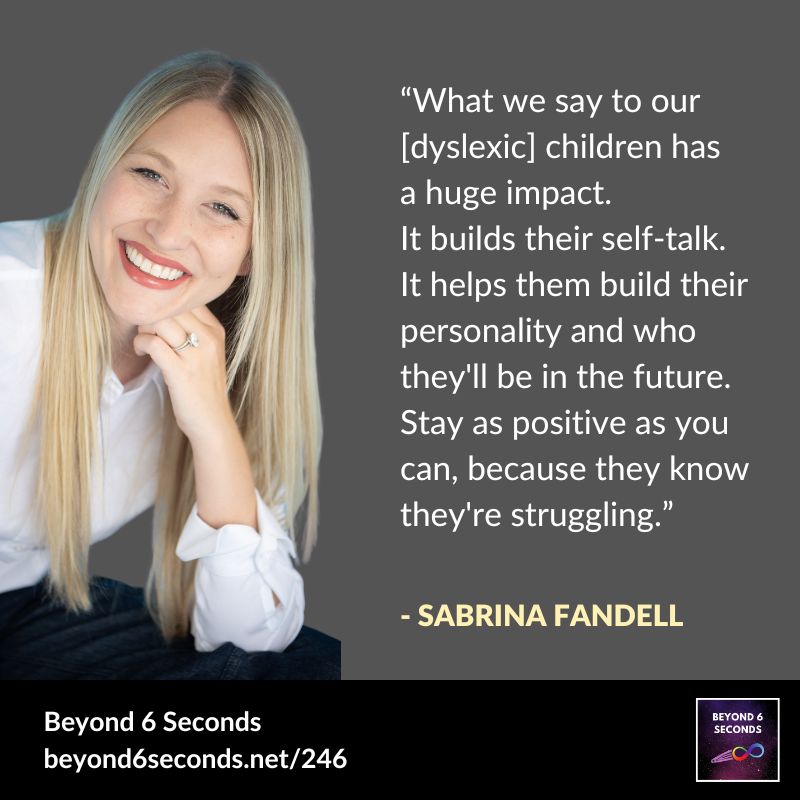
But I think our words and what we say to our children have a huge impact. It builds their self-talk. It helps them build their personality and who they’ll be in the future. Stay as positive as you can, because they know they’re struggling. They do. They know it.
And, you know, seek help. If you don’t know, find someone who does. And that’s, that’s something I would take into business, I would take anywhere, is if you don’t know, find someone else who does. That’s why I work with mentors on my business side as well. It’s because I’m not an expert at all things, you know? And we just have to realize that about ourselves. Because we know how to read doesn’t mean that we know how to teach a dyslexic child how to read.
Carolyn Kiel: Mm-hmm.
Sabrina Fandell: And so go seek help. Find a tutor, find a therapist, find those resources. They’re out there.
Carolyn Kiel: Well, thank you so much. Yeah. Thank you Sabrina, for the work that you’re doing to support the dyslexic community. And thank you for being a guest on my podcast.
Sabrina Fandell: All right. Thanks, have a great one.
Carolyn Kiel: Thanks for listening to Beyond 6 Seconds. Please help me spread the word about this podcast. Share it with a friend, give it a shout out on your social media, or write a review on Apple Podcasts or your favorite podcast player. You can find all of my episodes and sign up for my free newsletter at Beyond6seconds.net. Until next time.