Episode 242: Identity, horror and artistic expression – with Tas The Artist
-
play_circle_filled
Episode 242: Identity, horror and artistic expression – with Tas The Artist
Carolyn Kiel
Content note: This episode discusses abuse in a religious cult, gender dysphoria, body dysmorphia, and the negative impact of U.S. current events on marginalized people.
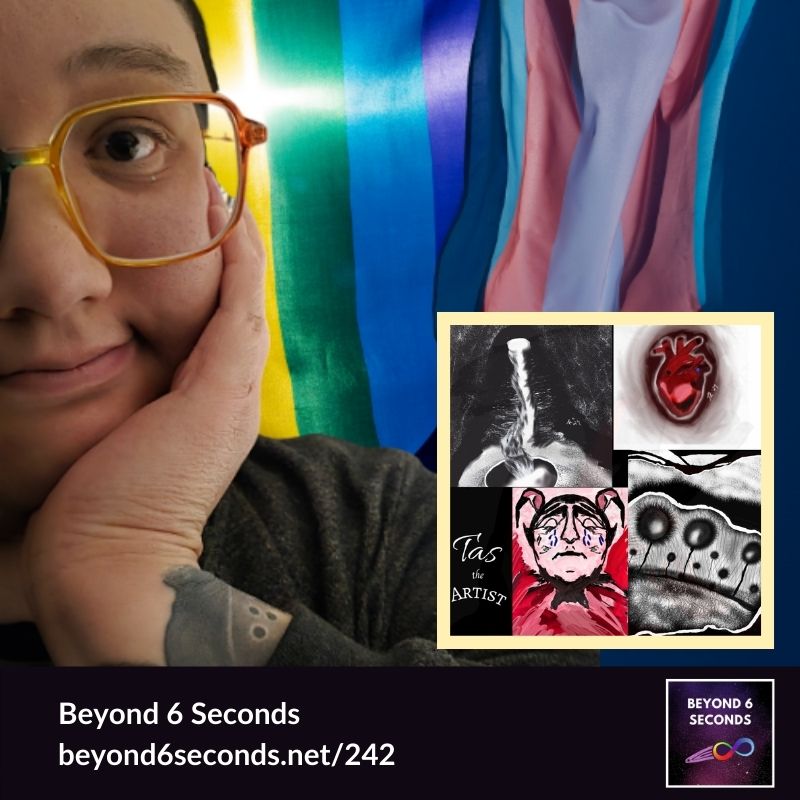
Tas The Artist is an autistic, queer, disabled and deaf graphic artist, illustrator, and advocate who blends storytelling with a passion for accessible design. Tas supports fellow members of their community through vocational coaching, developing adaptive curriculum materials and advocating for workplace accessibility. Whether they are creating a surrealist horror piece or working in advocacy, Tas brings a thoughtful, inclusive, and innovative approach to every aspect of their professional life.
During this episode, you will hear Tas talk about:
- The unique circumstances of how they discovered that they are autistic
- What their childhood was like growing up as an undiagnosed autistic child in a religious cult
- How were they able to leave the cult and “deprogram” themselves
- How they discovered their passion for art, and how art helps them process their trauma
- What drew them specifically into the horror genre for their art
- Their experience with progressively losing their hearing in adulthood, and processing their hearing loss through their art
- Their work in digital accessibility and design, and how to make art more accessible
- The impact of current events on their life
Learn more about Tas and their work at TasTheArtist.com or on LinkedIn.
Follow the Beyond 6 Seconds podcast in your favorite podcast player!
Subscribe to the FREE Beyond 6 Seconds newsletter for early access to my latest podcast episodes!
Support or sponsor this podcast at BuyMeACoffee.com/Beyond6Seconds!
*Disclaimer: The views, guidance, opinions, and thoughts expressed in Beyond 6 Seconds episodes are solely mine and/or those of my guests, and do not necessarily represent those of my employer or other organizations. These episodes are for informational purposes only and do not substitute for professional medical advice. Consult a medical professional or healthcare provider if you are seeking medical advice, diagnoses, or treatment.*

The episode transcript is below.
Carolyn Kiel: Welcome to Beyond 6 Seconds, the podcast that goes beyond the six second first impression to share the extraordinary stories of neurodivergent people. I’m your host, Carolyn Kiel.
Carolyn Kiel: Before we get started, I wanted to give you a quick heads-up about some of the topics of today’s episode. My guest talks about some of the abuse they experienced growing up in a religious cult, gender dysphoria, body dysmorphia, and the negative impact of current events in the United States on themselves and marginalized people in general. If these are difficult topics for you, please use your discretion when listening to this episode.
Today I’m speaking with Tas The Artist, an autistic, queer, disabled, and deaf graphic artist, illustrator, and advocate who blends storytelling with a passion for accessible design. Tas supports fellow members of their community through vocational coaching, developing adaptive curriculum materials and advocating for workplace accessibility. Whether they are creating a surrealist horror piece or working in advocacy, Tas brings a thoughtful, inclusive, and innovative approach to every aspect of their professional life. Tas, welcome to the podcast.
Tas: Hi, thanks so much for having me.
Carolyn Kiel: I’m really looking forward to talking with you. You have so many interesting things that you’re working on and a very interesting story. So I guess starting from the beginning: how did you discover that you’re autistic?
Tas: So that is a question that I actually love answering. I think for the generation I grew up in, I think this happened to a lot of us in the autistic community where you’re like labeled as that weird kid that like does strange things, that doesn’t listen, doesn’t follow any of the rules, how it’s supposed to be like, sit still, stop doing that. Why are you doing that? And, and so that was really a lot of what my childhood encompassed as far as like autistic traits presenting themselves and being squashed down.
I had had the fortunate yet unfortunate discovery of finding my childhood medical records, and I went through them. And turns out my mother was doctor hopping as a way to avoid an official autism diagnosis when I was a kid. Which I was not aware of that until I found just like the stacks of all of these old paper records. And at any time a doctor would bring up, oh, we should do this assessment, or there might, your kid might be autistic, instantly, boom, another doctor. And so I knew that the, the label of autism was something that my mother didn’t want me to have, ’cause later on she talked about that with me, but I didn’t realize how extreme that avoidance was of that happening.
So, it was always really hard to interact with people. I still struggle a lot with social interactions, but it was really bad as a kid just because of that pressure to do it. One of the things I always remember growing up in the whole: make eye contact, you’re not listening, look in my eyes, if you’re not looking in my eyes, you’re not listening, which is just very painful and difficult to do.
And I think that a lot of those just autistic traits, later on in life, when I was 24, I pursued like a formal diagnosis because I was like, I’m just gonna see, because I see I was interacting with some people that I knew that were autistic and they were like, you should just get an assessment. If you can get one, go get one.
Thankfully I was able to get one with a neurologist. And I remember during the assessment, normally it was gonna be about like four to six hours is what they had told me. And two hours in the neurologist just looked at me and is like, okay, yeah, you’re like so autistic. We don’t even need to do the rest of this. And I was like, oh, okay, cool. Because I, I always, I’ve never been high masking, but I never realized how much I don’t mask until that happened. And then I learned later on of course how masking is and that expectation. But when I got the formal diagnosis when I was 24, it kind of just like put everything in perspective of like, oh, I wasn’t that weird kid. I was that autistic kid.
Carolyn Kiel: Mm-hmm. Oh, wow. So yeah, that’s really interesting that you were able to get that diagnosis in your mid twenties and, and it must be interesting to kind of look back and, and say like, oh, you know, now I kind of have a different framing on you know, the things that I experienced in my childhood and in my life and, and how people reacted to me.
That’s, that’s very interesting.
Tas: Yeah, absolutely. It’s been like a really long self-acceptance journey, but also just self-awareness and kind of undoing that tangled mess of ableism that has been so hardly like ground into my head. So like, taking apart the internalized ableism and realizing like, oh, it’s actually okay that I did this as a kid, or I was like this as a kid, in trying to help myself not be critical of the things that are just who I am.
And I’d say now it’s been over, almost, it’s been like 11, oh, over 11 years, actually. Gosh, sometimes I’m like, wait, how old am I? It’s, it’s been about 12 years since I got my diagnosis and since that point, it’s just been a lot of dismantling of all of the, the stereotypes and the bias and the internalized ableism that was impacting how I felt about myself.
Carolyn Kiel: Yeah, it can take a very long time because that ableism is so ingrained growing up just by, you know, family, society. It’s everywhere. Once you see it, you realize that it really is everywhere. Yeah.
Tas: Oh exactly.
Carolyn Kiel: Yeah. So what was your childhood like for you growing up as an autistic child, even though you didn’t know yet that you were autistic?
Tas: Well so I was raised in a Christian fundamentalist cult, so I would say I didn’t have the best childhood, for that particular reason. I never understood until I understood about being autistic, why I was always kind of the prey for a lot of the predators that were around me. I had a lot of abuses that happened from my childhood of every kind. And I think that being autistic and having that not be okay, it gives a level of vulnerability, especially if you have a family that isn’t actually supportive and is also part of what’s like the problem. And I think that growing up in a religion like that is a whole nother ballpark comparatively to a religion that isn’t a cult. So the expectations are heavier in general, no matter like neurotypical or otherwise. The expectations in a Christian fundamentalist cult environment is extreme. Everything in it is extreme. And so everything from how you act, how you interact with other people, you’re always taught what things are. Oh, you have that whole thing. The thing that was ground into my head all the time as a child: “you can’t have friends unless they’re part of this organization because that’s spiritually dangerous for you.” So isolation was a big part of it.
And I think that when you’re autistic, there’s like two sides to it. On one end, I am good at following rules, which I do attribute to me being autistic because I’ve, I’ve always been that like, “well, that’s not what it says,” or like, “that’s not what you’re supposed to do.” So in that way, when you’re willing to follow the rules, it creates an extra layer of expectant subservient behavior in that environment. Then on the flip side, I was also very analytical and I liked to know the why. I always wanted to know the why. It’s like, oh, you’re telling me this is wrong, but why? And you show me, oh, here’s the scripture you’re using to justify this, but then this scripture says this, that contradicts that. So which one am I supposed to listen to?
So it it, I became very much a, what difficult?
Carolyn Kiel: Mm-hmm.
Tas: I became ever so difficult, and it became more and more restrictive. The more I pushed forward with trying to understand things, the more restrictions I had placed on me in every facet.
I remember an experience I had where I still, to this day, I do not shake hands with people. I, I don’t like to do that. I don’t like to be touched by strangers. And when I was younger, I would refuse to shake people’s hands. Like someone would come up and I’d be like, no. Or they’d wanna hug me, and I’d be like, no. And I actually, I got in trouble for that. That was literally a taken in front of a disciplinary like committee of, you cannot treat people this way. You have to shake hands. You have to hug people if they want to.
They take away your autonomy. And it becomes a, I mean, they brainwash you. That’s like what cults do, right? It’s what it’s about. And so for me, I think the reason I continued questioning, no matter how restrictive it got. The more restrictive things got, the more I questioned what they were telling me and the more I had an issue believing what they were telling me. So I think my head strongness definitely helped. And I attribute my desire and like thirst for the why to being autistic. That’s like one of my personal autistic traits. I always need to know that.
And I think in a way that definitely helped me once I left as an adult to deprogram myself over time. You know, when you grow up in that environment, when you’re taught, like I was taught at the age of four, how to withstand torture because they teach you that religious persecution is gonna happen and they’re gonna torture you. And they teach you how to recite your social security number. They teach you what to say, how to say it. And my mother was like a whole nother level. My mother was extreme, even within the cult. It was another level there. And I mean, she would say, “okay, you’re gonna go in the back room. I’m gonna be out here and I’ll be screaming for help and it’s gonna sound like I’m dying, but you can’t come out.”
Carolyn Kiel: Whoa.
Tas: And so she would for like an hour, just be screaming, banging things around while I have to sit in a closet and I’m not supposed to come out because of just like, it’s all just complete and utter, it’s just terrible. And so I think that being autistic made me more vulnerable, but also made me more defiant.
Carolyn Kiel: Mm-hmm.
Tas: I, now, I, it’s, I left when I was 23, so it’s been a bit, I’m 36 now. And I was just telling my, my spouse this week, even though I have worked through and deprogrammed a lot of aspects of it, when something stressful happens, the first thought that pops into my head is, oh, there’s probably a demon that has possessed something. Oh, I need to pray. And then I’m like, wait a minute. No, I don’t. What am I doing? Like, and even now at 36, after being out for over a decade, I still have that initial thought. But the difference is, I’m aware I’m doing that. And I’m like, no.
Carolyn Kiel: Mm-hmm. Mm-hmm. Wow. So you have that conscious override that of the sort of initial feelings that you have. Wow.
Tas: Absolutely, well, I know that it, it is a conscious override. And in Christian fundamentalist cults, when you get out, it’s very common when you’re raised in it to go on a fully destructive path. There have been people that I grew up with and 90% are dead already, whether it’s drugs, whether it’s unaliving, like whatever that looks like.
And so I think that when you have a different neurotype in a way I like, I really do think that being autistic is why I was able to not be one of them, and I was actually able to be able to get out and actually be alive still.
Carolyn Kiel: Wow. And if you don’t mind me asking, how did you get out?
Tas: So I left home at 17. I just picked up and left. I left everything. And after that I didn’t ever go back home. And I think that started the transition out.
When I was 23, I literally had, I had a circumstance happen where I was just like, oh no, I am not going through this again. That’s been like my whole childhood. I’m like, I’m not doing this again. And I think a lot of that comes with like realizing my queerness and realizing like, “you’re trying to teach me this is wrong. It is not. This is who I am.” And I’ve always been very headstrong and defiant. I respect authority. But if you can’t give me the why and you’re just trying to push something on me that isn’t, it’s not right, it’s not fair, there’s no equity in it, then I will instantly, I’m not doing it. So a lot of that pushed me out, and then I never went back.
Carolyn Kiel: Wow. Yeah. That’s gotta be so difficult to leave, really leave everything you’ve ever known and, and deprogram yourself. So yeah, that’s, that’s really incredible.
Wow. Wow. And also part, something that’s been part of you for your whole life has been your passion for art, and that’s something that you are continuing to use now as, as a big part of your career and, and a big part of your passions. So how did you first discover your passion for art?
Tas: So I have always been one of those kids that love to create things. I loved the sensory aspect of, I really love watercolor paints, and like the feeling of like acrylic paints, and like finger painting and creating things. I’ve always had like a deep passion to any kind of creative outlook and I, creative outlet because of, I think it’s that escape from the situation I was in.
The, the problem was with my art is that my mother was an artist and therefore every single thing I ever made got picked apart about how, how this was wrong, this was bad, this isn’t how you do it. And so I focused a lot on writing ’cause that didn’t get picked apart. But I’d say I always did it for myself, and then over the last year I was like, what am I doing? I love to create, I love art. I love to do these things. Why am I not just doing it and putting it out there? Because not everyone’s gonna pick it apart. Like some people, people like it, people will not. And so that has really made me, over the last year, really focused on my art, and that’s where I’ve been finding the most joy is creating.
Carolyn Kiel: Yeah, and you create in a lot of different themes, but I know one of the big ones that you are a fan of is the horror genre or surrealist horror. So yeah, I guess I’m just curious, how does your art, whether it’s the horror part or the other themes that you create art in, how does that reflect your life experiences?
Tas: You know, I think when you live something that is horrific, whatever that falls into, when you’re in those extreme circumstances, art mirrors that. And horror as a genre, sometimes people are very much like shying away from it and it makes them uncomfortable. And I think for me, when I see that, I’m like, that’s ’cause you know how real this is. Like horror is an exaggeration of trauma. It’s an exaggeration of like societal commentary on queerness and how there’s no inclusion and acceptance and equality. Art has always been that voice that makes sometimes a bigger impact on people when they see it.
And so I think with horror, there’s nothing that I can create that would be worse than what I experienced, but what I experience is always in my art. Even if it seems like, oh, that looks like it’s not as creepy as something you’ve done before, but it’s like, no, if you look close, you can still see it. It’s there. It’s there. And I think that exploring recently, one of the things it that I have been struggling with is my body dysmorphia and then my gender dysphoria, and I realized something. I was drawing a new piece. I was looking at the page and I was like, why am I drawing this femme person skinny? And then I was like, this is, and it just, I don’t know, it just clicked. And then I went through some of my older stuff and I’m like, oh my God. I always draw this like stereotypically thin femme built person. And I was like, why? I’m fat. Why am I drawing self portraits like a twig? I realized that a lot of this like internalized piece with being trans and not accepting of my own body was bleeding into my art. So there are even things that I make that I didn’t even realize had a horrific thing in it. And, but it’s always there. It’s always there.
Carolyn Kiel: Wow. Yeah. That’s so interesting that you can now look at the art that you’re creating and have those realizations like, oh, why am I drawing this? What does this mean? And then it gives you insight into the things that you’re going through and, and kind of helps you, you know, kind of understand, or at least be conscious of, of what you’re feeling.
Does creating art help you kind of process some of your past traumas in any way?
Tas: Absolutely. I think that with creating the pieces, there will always be some, there’s always a reason. Like I sometimes don’t go into creating something with an intention. I just let it go where it goes. And then I see as it, as it gets formed, I’m like, oh, I know where this is coming from.
Being raised, my dad is Black and my mom was white, but my dad wasn’t in the picture, so I was primarily raised by my mother and she whitewashed everything. So I missed out on a really important part of my culture. And exploring that through art helps me connect with it more. I’ve done a lot of genealogy research coupled with art, and I had found that my great, great grandmother had been enslaved. And I found out where they’re from in Arkansas, and originally my ancestors were from Ghana. And so exploring that through my art and that kind of disconnect that I feel between what should be my culture, but I didn’t have the opportunity to learn it when I was growing up. So learning that now definitely really goes into my art a lot.
Carolyn Kiel: Wow. Yeah, I could see how it helps you explore different themes that really you couldn’t verbalize or, or necessarily talk about with your family or other people, but it does kind of help make that connection more tangible by creating something and making those ties.
Tas: Oh absolutely.
Carolyn Kiel: Yeah.
And you’re also a deaf person. Does that part of your identity also come out through your art?
Tas: Yeah, so that’s been a journey in itself. I found out in 2023 that I had Meniere’s disease, and so I lost my hearing on this side. So I can’t hear on this side at all, and it’s been progressively getting worse through the years. I so far still have this side, so far. That could change.
Carolyn Kiel: So you still have your left side hearing, at this point.
Tas: Yeah, yeah.
And I think the way that it comes out in my art is more learning what it’s like to traverse this new disability plane. I have disabilities and I have various types, but not this one, and I haven’t dealt with that myself. So realizing how navigating life has now become even harder than it already was, because access to communication has then gone down for me. Hearing aids aren’t covered with insurance. And so I did try to get some over the counter hearing aids, but then I got tons of ear infections, so navigating that. So I just let it happen. I’m like, Nope, no hearing aid. So I know I don’t wear them. I have them, I don’t wear them.
And realizing just how people view deafness. I’ve always been around the Deaf community ’cause I was around a lot of people. I’ve known ASL since I was 15. So like I was, I’ve been around the Deaf community a lot, but I’ve never been a part of the Deaf community. And one of the things that I learned really quickly is even within the Deaf community, I won’t find any type of connection because I am older deaf. I’m like, because you know you have cultural deaf, so like Big D Deaf, little d deaf. So like there’s Deaf and then there’s deaf, and so I’m on this end of it. So it’s very hard, especially being autistic, to try to navigate a brand new social framework that is complicated and it just adds a layer of barrier. Well, it adds a barrier, significant barrier for me when it comes to having community, and I think that if I didn’t have my art, it would be harder to deal with this transition.
I mean, I was slowly losing my hearing over the last, they said it’s been slowly deteriorating as of 2023, it’d been about eight, eight years. So I, I know it was a gradual transition into it. But now that it’s kind of at its peak, it’s very difficult to always express in words what it’s like to deal with it.
So the art, definitely, I’ve been doing a lot of art with my head, like heads. It’s like lots of heads, lots of surrealist melting. Ears and things like that. And I really love anatomy. So I’ve, I’ve been studying Grey’s Anatomy. I’ve been studying it so I can learn how to draw different aspects and different things in, in the body. And so it’s definitely caused some really creative pieces that I find meaningful to happen.
Carolyn Kiel: Are there any specific messages or perspectives that you actively try to convey through your art? Like, I know we talked about some in terms of processing trauma and ways that you’re feeling. But in terms of sharing with other people, are there certain messages you try to sort of reinforce or convey?
Tas: Absolutely. I think that when you’re not part of any type of marginalized community and you don’t make a point of educating yourself to be an actual ally, you avoid it. You avoid it. I had a conversation with someone a few weeks back and they’re like, “oh, I just, I don’t watch the news. I don’t follow anything ’cause it’s just too depressing.” And I’m like, okay, you don’t know what allyship is. Like, I don’t have a choice. All of it impacts me. And with my art, I always challenge people because I do horror. I say, how long can you look at it before you’re uncomfortable?
Carolyn Kiel: Oh!
Tas: And when someone struggles, I’m like, and that is what you’re doing to marginalized communities. It’s hard for you to look, so you don’t.
Carolyn Kiel: Yeah. And you have the privilege of not having to look. Like you can turn the news off and you’ll probably be fine.
Tas: Exactly. It’s like you can ignore it. And people have a hard time realizing the privilege they have. Because it requires people to admit they have this ignorance that they shouldn’t have. Because information is accessible. In like the disability community, we’re very vocal about it. But people, if you have the privilege to look away, then look. And if you can’t look, then fix yourself, because there’s a problem.
Carolyn Kiel: Yeah, I saw a quote recently and I, I don’t remember who said it. If I can find it, I’ll add it in later, but it was something like, “Art should comfort the disturbed and disturb the comfortable.” I’m like, yeah, and it really should challenge your viewpoint. If you’re looking at art that’s on a topic or an experience that you are not familiar with yourself, it can be a great way of kind of educating yourself and working on your allyship and confronting your biases and feelings about things.
Tas: Oh, absolutely. Couldn’t agree more. When someone looks at something I’ve created and they say like, “oh, I get it.” I’m like, okay, that’s my community. And then when someone looks at it and is like, “Ugh, like, ooh, why did you make that?” I’m like, and you’re not part of my community.
Carolyn Kiel: Mm. Yeah, because I think there might be some stereotypes about people who write horror. They might think of like, people creating horror for shock value. And that’s the end point, is like, you just wanna make people upset and you wanna make people scared, and that’s really all it’s about.
But really it can go so much deeper than that and really have people, in a sense, confronting and connecting with their own fears. And maybe for some people it’s, it’s freeing in a way of processing it. And for others it maybe expands your perspective.
Tas: Exactly. The best word makes you think
Carolyn Kiel: Yeah.
Tas: a hundred percent.
Carolyn Kiel: Yeah.
So most of your art now, I know you really specialize in horror. When you’re working with clients, do you mainly focus on clients who are interested in sort of surrealist or horror related art, or do you explore other topics with that?
Tas: So I wish I could just do horror! I wish I could, but I can’t. It’s like, darn. But no, I would, I do a lot of different things. The way that I look at it when I’m creating for someone else is if you tell me what you need and I instantly can picture it in my head, I can do it for you. So I do have to connect somewhat to the concept in order to create it, but as long as I connect, I can, I can do it all.
I recently finished a project for a client that needed a new logo done. And completely just like not my style of art that they wanted, none of it. But I got the concept, I could see the concept, so then I was able to do it. So as long as I can see it, I can do it. But if I don’t connect with something I tell people, I refer elsewhere. ‘Cause I want people to get what they’re looking for. And if I can’t deliver that, I feel like I can send them to someone who can do much better than me.
Carolyn Kiel: Hmm. Oh, that’s really cool. And I know you’ve sent along some examples of your artwork, so if people are following my account on social media, you’ll be able to see some examples of Tas’s artwork and and what they put together so you can kind of see their style.
In addition to being an artist, you’re also an advocate for inclusion and accessibility. So yeah, tell me about what kind of advocacy you do.
Tas: So I am very much involved in the accessibility spaces. Specifically right now I’m doing a lot of digital accessibility. And being an artist, I focus a lot around making art accessible. I think that a lot of times it’s a piece that people miss because they either don’t think about it or they think it’s too hard. Like just something as simple as putting alt text or making sure that the color contrast is correct. And there’s, there’s a lot of things that you can do that take two seconds. And so I focus a lot around educating people on that, as well as the cognitive accessibility. So being autistic, I have a delay with my cognitive processing, and so I like to help people design like their documents, like have a simplified version, have various formats that you can offer someone if they need information. Because cognitive accessibility sometimes gets forgotten a lot, and I really work hard to show what people can do to make things neurodivergent friendly.
Carolyn Kiel: Mm-hmm. Accessibility is something that I think sometimes gets simplified as, you know, physical accessibility, like for buildings, like wheelchair ramps and elevators.
But it’s really interesting to think about it in terms of art. Alt text and image descriptions are, are incredibly helpful. But yeah, just trying to make art accessible for people with disabilities and, and just people who bring different experiences and perceptions to it. It’s important.
Tas: Very much so. And like for me personally, I do more digital work than traditional art. But one of the things that I love to see people that do traditional art is making tactile pieces.
Carolyn Kiel: Oh, nice.
Tas: It’s so amazing and, and it’s a sensory piece. It’s a accessibility piece for low vision and if you’re blind, but it’s also part of that like being accessible to the neurodivergent population because some of the sensory processing disorders make visuals hard to understand what you’re looking at. So if you can feel it, you sometimes are able to understand it more. So making art accessible is not as difficult as people think it is, and you don’t have to sacrifice the art to be accessible. You just have to format it in a way that everyone can enjoy it. But look at it from that perspective, is I want everyone. It’s that equality and inclusion. I want everyone. I don’t wanna exclude anyone from this experience. And I think that’s the mindset that people have to have going into it.
Carolyn Kiel: Oh yeah, that’s really interesting to think about the tactile experience and just how to engage all different senses when you’re putting together art.
And yeah, I guess it’s easier in the physical world than the digital world, but there’s, you know, there’s ways to do it digitally to, even if you’re thinking about your color contrast or descriptions and, and things like that.
That’s really cool.
Tas: Learning as an artist to describe your own work to still convey what it is, it’s a challenge. It can be really hard to do, but it’s worth doing. Because that for digital pieces is going to be the most inclusive way. Like describe your own piece, like how do you look at it? What do you feel when you see your own piece and what does the flow of the lines, what does the color, what message does the color give? Is it warm? Is it friendly? Is it, there’s ways to describe your own work to help someone understand it better.
Carolyn Kiel: And I guess from an artist’s perspective, when you’re describing your own work, are you describing it physically, like this is what it looks like, and then based on the description, the person consuming the art kind of has their own reaction? Or are you as the artist saying basically, ” this is what I meant when I created this piece. This is what your reaction should be.” For lack of a better word.
Tas: So I think it depends. For me personally, I like to give a plain description of like, here’s the format, the style, the vibe of it. But I do like to include more specifics. I like to use words like, one of my favorite words, I don’t know why is wispy. I love describing lines as like wispy lines against like this turquoise like ocean view of et cetera, et cetera. I don’t do landscape, but if I did, I would do it like that.
And, and I think that it’s not so much about conveying what you want people to feel, it’s more about giving people enough information to determine it for themselves. So even if you as the artist are giving like a backstory that’s very different from like describing the technical applications of what you made and then relating it to real world things so people can get a connection there.
Some of the art, I love abstract art, but when it’s just like a white canvas with like a dot in the middle, nothing else. What do you want me to know? Like what do you want me to feel? What is the point? And so having the description though, and making it convey intention can then help me understand how I’m viewing it.
Carolyn Kiel: And I think that’s helpful even for people who don’t have disabilities, to make art more accessible in that way. Not just accessible to people with disabilities, but more accessible to the masses who haven’t spent like years studying art history. In school, when I used to take like music appreciation classes, I always loved, you know, you hear the piece, but you may not really understand what the composer was getting at. And then you kind of get the breakdown of like, oh no, this is why this crescendo happens here. This is why these harmonies are constructed In that way, I’m like, “oh, I appreciate it and I understand so much more now that it’s been explained to me.” So I imagine it’s similar for, for visual art too.
Tas: Exactly.
Carolyn Kiel: You explore a lot of issues in your art. A lot of your identity is expressed through your art. And we’re, we’re recording this in mid 2025 in the United States. And the current political and social climate is incredibly challenging for many, many people, including people of identities that are traditionally marginalized in the society of, of which you hold many of those identities. And I’m just, I would, I would love to just hear about what, how you’ve been experiencing things lately as, as someone who’s autistic, queer, disabled, and deaf and a person of color as well.
Tas: It’s hard. It has been, it’s only May and I just, the, the world, the, ugh, there’s so much attached to it. I think for me, the biggest piece, so I have always struggled with agoraphobia and I have had that get a lot worse now. Like as of January it’s increased. And I was already struggling with it, but then it amplified it a lot for me. And as of the recording of this podcast, I have not left my house for nine months.
Carolyn Kiel: Wow.
Tas: Which got, as of January made it extend longer ’cause I was working really hard trying to work with some therapy and to be able to. And then that, everything that started happening, it didn’t happen, so I haven’t left my house. It’s, it’s a achievement if I’m able to like, go on my front porch. Then I, that’s like a, a big deal for me.
I think that the fear level from a leaving the house standpoint, so I’ve always experienced a lot of negative things interacting in the community that I’m in. When I was a teenager, I was threatened with a knife by a neo-Nazi. I’ve had people call me slurs when I’m walking down the street. Like I’ve had a lot of really bad interactions with people in the community I’m in specifically. And I think that now it’s amplified. I know my neighbors enough. I know. I’m like, yeah, you don’t like me. They’ve never spoken to me. I’ve never actually had a conversation with any of my neighbors, and we’ve lived in the same place for three years as right now. And a lot of it is because I’m very clearly not a heterosexual straight woman identified person. Like it’s very obvious. Like, and I love pride stuff, so I wear pride stuff, but I know that it isn’t necessarily safe to just like walk the block. I couldn’t do that. Even if I wasn’t struggling with the agoraphobia, especially now, I wouldn’t be able to do that.
I follow the news ’cause I have to for safety reasons, but a lot of the policy changes have impacted me in terms of I won’t be able to get top surgery now.
Carolyn Kiel: Oh.
Tas: On the disability side, there’s a lot of things that have impacted my ability to just have everyday necessities, and I’m still in the midst of that situation now, trying to get things sorted out.
And I think that one of the things I’m working really hard not to do, despite everything going on, is to become so full of negativity that it paralyzes me because the having hope is hard for me on a good day. And now I’m like, okay, having hope is difficult as is, but now I just, and I don’t have much of it. I don’t at all. I think that in my lifetime, all of the things that have been going on, some of the things that have just happened in like a slow progression leading up to here, it’s not just 2025, it’s just been slowly coming to this point for a while now, and I think I will not see the resolution in my lifetime. I already know. The resolution of having the inclusion and the equality and having autistic people be okay. And not have the, let’s get rid of autistic people. That whole situation will not ever resolve in my lifetime. And I, and I, I know that, and I’m, I’m okay with that.
Because someone had asked me and someone had asked, this like sums up my experience. Someone had asked me about like, “so what are you going to think when you’re 80? Like, what, what are you gonna look back on?” And I’m like, I kind of hope I, I’m not here to see what that looks like. Because right now, I mean thinking of from the time I was born, all of the world events that have been there, but just the events in the US, like two wars, COVID, 9-11, like so much has happened in a really short amount of time. And I think that I’m tired. I’m very tired.
And in the advocacy spaces, it’s hard to keep that up because how exhausting it is on an impactful, like on a personal level. But I think one of the things that people are not looking at per se, because there’s a lot of, even in the advocacy world, there’s a lot of judgment there. It’s like, oh, you’re queer. Why aren’t you posting about that? Oh, you’re trans. Why aren’t you posting about that? Why didn’t you comment on this article about autism? And it’s like, because not everyone can, and not everyone has the safety to do so. And I must, I was terrified just to do this interview. Like it was hard. I know that it’s, and I, I decided to do it because… oh, here we go, I have tissues in my pocket, ’cause I knew when we got to this point, something was gonna happen. I know that life is too short to not do the things that are important. Speaking up on things that need to change and showing that, there ev everyone in my community is in a similar circumstance right now, no matter which intersection it is, whether you’re disabled, whether you’re trans, it, it, it’s all happening to marginalized populations. And I think that it is important if you can speak up, speak up. But if you can’t, that’s okay. Because there should, you have to be safe. You have to keep your mental health and your own wellness first.
Because the reality is, these aren’t things that are gonna be solved in a year or 10 years. These things have perpetually been going on for hundreds of years. So if you can’t do it, it’s okay. You can’t. Let yourself have what you need and don’t worry about everything else, ’cause you have to advocate for yourself first.
And I think that, I hope the next generations, I hope Gen Alpha, maybe. I don’t know about Gen Z. No, I’m joking. I’m joking. Like I think that those are the two generations that are going as it is how it works in history. You have to deal with the mistakes that everyone else has made in a society that is built around a need for conformity in pushing away difference. So those are the generations that are gonna have to change that. And all you can do, and all I can do is what you can in the moment. Because the present’s all we have. That is all we have. There’s a lot of uncertainty in general, but living in the future doesn’t get you anywhere. Living in the past doesn’t get you anywhere. So in the every day, what do you need first, before you’re putting yourself out there for your community? Because if you don’t take care of yourself, you can’t help anybody.
Carolyn Kiel: Mm-hmm. Yeah, that’s, that’s an important point and, and so many really important points you brought up just now. One is, it’s a really difficult time. As you said, it’s not gonna be fixed like anytime in the near future. You know, I, I’d love to be optimistic, but as you’ve said, this has been happening slowly for a very, very long time, and I think depending on who you are and what your experiences are in society, you may just be realizing it in the past year or a couple years. But really it’s, as you said, it’s been going on for decades, even hundreds of years. It’s all built on previous generations and previous structures in society, and that’s how we got to where we are now.
Especially as you know, if you are someone who’s in a community that is marginalized or blatantly under attack right now by our current administration, it is important to just prioritize your own safety, your own wellness. Even find, I guess, find your own joy where you can. Like, it’s so hard to say that. Or at a very minimum, just try, try not to give up. It is so hard to keep pushing through and not just say like, oh, it’s never gonna get better.
And you’re right about the online spaces. There is so much of that pressure to be like, you know, I need to be posting about this. If someone doesn’t post or comment on that, then they’re not paying attention. People get into squabbles about kind of silly things when really we should just be like focused on challenging what’s going on now. But yeah.
And Tas, I’m really grateful that you decided to do this interview because I, I really enjoy talking with you and your experiences are just so incredibly important and and, and I’m really just amazed at your story and like all the things that you’ve gone through through your childhood and building and discovering your own talents and careers and and, and all of these things. I, I feel like your messages are just so important for people to hear.
I know you don’t, you know, you don’t spend a lot of time online, which these days I think is a good idea. I, I know I have more and more friends who are not online as much, and it seems to help them in a lot of ways. I really appreciate you spending time with me and sharing your story with my listeners ’cause it’s just so important and and I always really love talking with you.
Tas: Thank you for having me. I’m glad to be here. And I’m, and thank you for doing these interviews and highlighting voices of so many communities that need to speak, and that’s huge that you use your platform for them. So thank you for, for doing this.
Carolyn Kiel: Thank you. I appreciate that.
Yeah. So, yeah, Tas, what is the best way for people to get in touch with you about your artwork? If they wanna see it, if they want to work with you, how can they get in touch with you?
Tas: So you can go to my website TasTheArtist.com, and you can also find me on LinkedIn. That’s the only, I, I have a website and I have LinkedIn. I don’t really have any other social media. If you’re a horror fan, you can find me on Slasher. But those are the two places if you want to check out my work or message me for collaborations, and I’m always looking to work with other autistic and disabled and queer professionals and kind of do what we can to support each other, so yep. TasTheArtist.com or TAS The Artist on LinkedIn.
Carolyn Kiel: Okay. Very cool. And you know, as we close out, is there anything else that you’d like our listeners to know or anything that they can help or support you with?
Tas: You know, I, I think I would just… oh, here I go… end on one thing, if I can do it. I just want people to know, like I see you and I know it’s hard and horrible right now, but you’re not alone. So just remember, people do see you. People do have empathy. People understand, and you’re not alone. That would probably be what I’d wanna say.
Carolyn Kiel: Thank you, thank you for reminding people of that, because I think a lot of people really do feel alone, especially right now. And yeah, it’s really important to be reminded that you’re, you’re not alone. You, you do have a whole community of people who care and are going through, you know, similar or related struggles. So yeah, I guess we all just have to find our communities and our connections wherever we can. And it’s important.
So thank you. Yeah, thank you again, Tas. I, I really appreciate you being on my show. So thank you so much for being here today.
Carolyn Kiel: Thanks for listening to Beyond 6 Seconds. Please help me spread the word about this podcast. Share it with a friend, give it a shout out on your social media, or write a review on Apple Podcasts or your favorite podcast player. You can find all of my episodes and sign up for my free newsletter at Beyond6seconds.net. Until next time.