
Episode 273: Overcoming limiting beliefs – with Lawrence C. Harris, Autistic Youth Speaker
-
play_circle_filled
Episode 273: Overcoming limiting beliefs – with Lawrence C. Harris, Autistic Youth Speaker
Carolyn Kiel
Lawrence C. Harris is a Youth Empowerment speaker who helps teens and young adults believe in themselves, think differently about their future, and make better choices. Growing up as a young autistic boy, Lawrence faced serious challenges. Those experiences led him to start speaking so other young people would know they are not alone and that their past does not have to decide where their life goes.
During this episode, you will hear Lawrence talk about:
- What life was like growing up before he got diagnosed with autism
- The limiting beliefs that made him hesitate to share his experiences with others, and how he overcame those limiting beliefs
- How he got started as a public speaker
- How he helps young people overcome their own limiting beliefs
Learn more about Lawrence and his work at LawrenceCHarris.com and follow him on YouTube @lawrencecempowers, on TikTok @lawrencec.empowers and on Instagram @lawrencec.empowers. You can also get his free journaling e-book by sharing your feedback about his interview on this podcast.
Contribute to Carolyn’s tip jar to support this podcast at BuyMeACoffee.com/Beyond6Seconds!
Follow the Beyond 6 Seconds podcast in your favorite podcast player!
Subscribe to the FREE Beyond 6 Seconds newsletter for early access to my latest podcast episodes!
*Disclaimer: The views, guidance, opinions, and thoughts expressed in Beyond 6 Seconds episodes are solely mine and/or those of my guests, and do not necessarily represent those of my employer or other organizations. These episodes are for informational purposes only and do not substitute for professional medical advice. Consult a medical professional or healthcare provider if you are seeking medical advice, diagnoses, or treatment.*

The episode transcript is below.
Carolyn Kiel: Welcome to Beyond 6 Seconds, the podcast that goes beyond the six second first impression to share the extraordinary stories of neurodivergent people. I’m your host, Carolyn Kiel.
On today’s episode, I’m speaking with Lawrence C. Harris. Lawrence is a youth empowerment speaker who helps teens and young adults believe in themselves, think differently about their future, and make better choices.
Growing up, Lawrence faced serious challenges. Those experiences led him to start speaking so other young people would know they are not alone and that their past does not have to decide where their life goes. Lawrence, welcome to the podcast.
Lawrence C. Harris: Thank you. It’s great to be here.
Carolyn Kiel: Yeah, I’m really excited to talk with you and learn more about your story and the public speaking that you do and learn more about who you are as a person.
What was life like for you growing up as a young autistic boy?
Lawrence C. Harris: It was very complicated because up until around the age of between 11 and 15, I didn’t actually get diagnosed because I’m very high on the “ability to function on your own” spectrum. So as a child, people just thought that, oh, he, he’s a bit different.
And I had this extreme positivity and this extreme love for everyone, where I just wanted to be friends with everybody. But unfortunately, growing up, my interests were so different than the people around me that I would often get bullied a lot and shamed, and I couldn’t figure out why doesn’t anybody want to be my friend, because in my mind I’m being nice to them, but they weren’t really a fan of it. So I had to spend a lot of my life feeling isolated, different, and alone.
Carolyn Kiel: Wow. So yeah, those are some really big challenges, and especially those sort of those early preteen years seems to be when a lot of those social challenges really start coming out for a lot of people, and especially for autistic people. And you said you really weren’t diagnosed or identified as autistic until around that time. Like, how did that come to be? Was it something that came through the school or how did that work?
Lawrence C. Harris: Well, it came through my summer camp counselor. Because we were doing a project where we were taking plastic straws and we had to build a bridge to hold up a weight. Now, at the end of the activity, everyone else, they just, as kids do, knocked theirs down, threw straws across the room, just being kids. I started taking mine apart piece by piece in a way where I could reassemble it when I got back home, ’cause I really liked my bridge. But this other kid, I guess he didn’t like how long I was taking, so he came over and just knocked over my straws, and I got really upset about it.
My counselor later told my mom, “You should probably get him checked for autism,” because that behavior of taking things apart like that is super common among autistic people, and that counselor was trained in how to recognize the signs because she worked in special education.
Carolyn Kiel: Wow, that’s really interesting that it was that one incident and yeah, that counselor who had the training and was educated enough to identify that, hey, this might be something to look into. Wow.
Lawrence C. Harris: Yeah, because it was that and other things that started to make more sense as we looked into it, such as how I pretty much almost always walk on the fronts of my toes. So I would walk certain ways. And even my vocal inflections, the way where I talk and then I stop mid-sentence and then I start talking again, that too, once we looked into it, was like, “Oh, now it makes sense why I’ve always done that.”
Carolyn Kiel: So then after you got diagnosed as autistic, did life change significantly after that? Or did it help your understanding of yourself a little bit? What was that like?
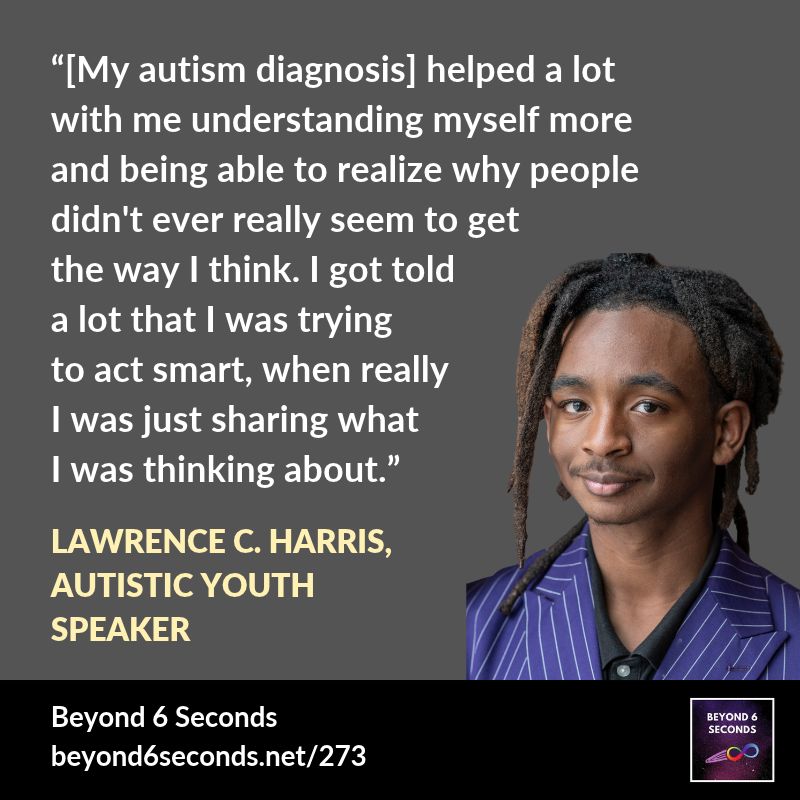
Lawrence C. Harris: Well, it helped a lot with me understanding myself more and being able to realize why people didn’t ever really seem to get the way I think. I would, growing up, always… I got told a lot that I was trying to act smart when really I was just sharing what I was thinking about. Because, again, in my logic, if I told a 25-year-old the most intelligent thing I knew because I loved watching National Geographic, then logically that 25-year-old, it should be basic information to them. So I would get frustrated when I’d tell my family what I learned and they had no clue what I was talking about. So they interpreted it as I was trying to belittle their intelligence, but it was actually, we think in completely different ways, and because of that, I had to learn how to understand the way people who aren’t autistic think and translate my thoughts into words that they, that makes sense to them.
Carolyn Kiel: Yeah, exactly. Like how do I share information with people who think differently from me so that it doesn’t come across as, yeah, as you said, people taking it the wrong way or not understanding what you’re trying to, to do.
You talked about some of the challenges that you faced growing up, and you also talk a lot in your public speaking about limiting beliefs that you had about yourself. What kind of limiting beliefs about yourself did you have that you had to eventually overcome?
Lawrence C. Harris: One of the biggest ones was that nobody cared what I had to say. Because not only growing up facing bullying with other students, but then home issues with getting abused by my dad, getting kicked out the house when I was 13, and that whole process led me to believing that nobody really cared what I have to say.
And obviously, if you believe that, you won’t share what you’re going through, you won’t talk about your feelings, and you won’t be able to get the help you need because you won’t open your mouth to ask for it. And I had to get rid of that so that not only I could eventually become a public speaker, obviously, but also so that I could simply get better.
Carolyn Kiel: That’s a big limiting belief to, to get past, especially once you’ve had so many experiences that have seemed to reinforce it, but it’s just something to absolutely overcome. So yeah, I really admire you for finding the pathway to say “No, all of these experiences don’t mean that people don’t care what I have to say, and what I have to say is really important for people to hear.”
Like how, how did you do that? Like, how did you counteract all of the negative environmental and negative feedback that you’d been getting early in life to realize that “No, what I have to say is really important for people to hear”?
Lawrence C. Harris: Well, the way I did it was, and this is actually how belief systems form. Everything we believe is because we have evidence to believe that. So I went out and I would find evidence that said people do care what you have to say. So I started making TikToks and Instagram videos, and whenever somebody would enjoy that, it would be this piece of evidence that says, okay, there have been people in my life who didn’t care what I have to say, but this person cares, and then another person cares. And eventually you start to build up this list of proof that people do care. But it’s more important that you remind yourself that you care what you have to say, because then you stop chasing outside validation and you start to get it within yourself.
Another huge thing I did is journaling. I talk about this all the time. When you sit down for 15 minutes a day and you just write out your thoughts, you write out, “Why do I feel this? Why do I think this? Why do I believe this?” You start to find the answers. And now that you know why, you then ask yourself, “Well, what can I do to solve this?” And then you get the answer. And then you eventually realize that the way to break those limiting beliefs is by getting the evidence.
Carolyn Kiel: That’s really powerful to be looking to, to get evidence, and like you said, it’s sort of whatever you look for, you’ll find, chances are. Like, if you’re really focused on negative things that have happened, like there’s, there’s always plenty of negative things in the world, but there’s plenty of positive things, too. So it’s finding that balance and finding things that motivate you.
But as you said, even more than that, not constantly chasing validation from other people and other things, really having that understanding of the importance of who you are as a person, because that, that can’t be taken away from you. That doesn’t depend on who’s in your social circle or who’s responding to your social media posts. That’s something really critical.
Lawrence C. Harris: I actually created a free journaling e-book. I can send you the link so you can put it in the show notes if anybody wants it.
Because of all things that I’ve personally found, if somebody does not have the money for professional therapy services, and most people don’t have close family or friends who understand how belief systems actually work, journaling is the solution to that because only you know yourself as much as you know yourself. Nobody else is inside of your head, and journaling helps you to get all the stuff in your head out onto paper, and then you look at the paper and you’re like, “Oh, now I see what to do.”
Carolyn Kiel: Yeah. And it, it encourages you to be introspective sometimes and think about what happened. Even if you’re just writing down literally the facts of what happened during a certain day, something about putting it in a journal, whether it’s on paper or on a private journal online and seeing it is oh, now I can get a little bit of a distance from it and try to understand more about what happened and why I’m feeling the way I’m feeling.
Lawrence C. Harris: Yeah. What you said earlier about how we’ll find what we look for, it, it made me think of, it’s called confirmation bias. So whatever you believe is true, you’ll find proof that that thing is true, and you start to ignore the proof that it’s not true.
A great example that I often use when I’m giving speeches is if you’ve ever met somebody who genuinely believes that there’s no good men or good women in the world, they’ll find every single example of celebrity drama where people cheat on each other. They’ll find gossip. They’ll find YouTube loyalty test videos. They’ll find all of that, and they will ignore the 50-year-long marriage between their neighbors. If you ask them, “How long have your neighbors been married?” They don’t know. I- it’s not because they didn’t ask. The reason they didn’t find that out is because they’re looking for what they already believe.
So when we change what we believe, we change what we look for, and what we look for changes.
Carolyn Kiel: Yeah. That’s powerful. Yeah, because that, that confirmation bias is common across all humans, so we’re all susceptible to that in some way or another. So it is this constant sort of rethinking and, as you said, going back to thinking about what you want your belief systems to be and always just trying to expand your circle and, and question the way that you think about things. So that’s really powerful.
What inspired you to become a public speaker who shares these thoughts and encouragements with, It, it seems like you talk with a lot of younger people as well, but what got you started with public speaking?
Lawrence C. Harris: Well, the thing that first got me started was, I honestly just thought it would be to help me feel better about myself by, it’s gonna sound silly, but making these motivational videos, put them on the internet so I could re-watch them and encourage myself through myself. That was what it started out as.
Carolyn Kiel: Yeah!
Lawrence C. Harris: It turned into some people saying “Hey, I mean, I relate to the stuff you’re talking about.” So I started doing it more and more, and eventually I realized that everything I went through and how I got better, that, that might be able to help somebody.
When I first started this, I was 16. The average 16-year-old has no idea that your brain can physically be changed. So they don’t understand what neuroplasticity is. They don’t understand that stuff, but I was able to explain to them, how do we actually start to believe in ourselves? How do we actually feel better instead of just trying to be more motivated?
So over time, what started as me just trying to cheer myself up turned into helping other people, and then I stumbled across people like Tony Robbins and the Les Browns and Alan Watts and all those people. And it struck me that, huh, I- I’m pretty good at this. I don’t have it all figured out. I might not be where they are, but I could get there eventually. So I started looking at, well, what would that actually take? And over the course of four years, I was able to start speaking on actual stages, speak at schools, and do, do, this!
Carolyn Kiel: That’s really awesome. Wow. And it relates a little bit back to the journaling, is that you were making videos so you could re-watch them later, but it’s like journaling, like writing stuff down so you can revisit it later. It helps you process information, and it sounds like you were making the content that you needed.
Lawrence C. Harris: Yeah, I did.
Carolyn Kiel: And you realized other people needed it, too.
Lawrence C. Harris: It’s funny because recently I re-watched one of my old videos where I was talking about my goals and aspirations, and almost all of them came true within about… I made that video in September of 2024. Within about seven months of making that video, almost all the things I said in there became true. The only thing that didn’t was getting my own apartment. That one didn’t come But I said I was going to be traveling the country, speaking on stages. That one came true. I was going to have my own office building. That one happened. I was going to become an author. That happened. What was the other one? That I was going to create a big impact on humanity. That one, very vague, but I would say I, I did a pretty darn good job there. So yeah, getting your thoughts out and just having the audacity to start. You don’t know how far it’ll take you.
Carolyn Kiel: That’s really cool. Wow, and that’s amazing. It’s almost like a, … I know some people do vision boards, but it’s sort of like that too, is just something about envisioning and putting your dreams and your goals, whether it’s on paper or on virtual paper or somewhere online,
It starts your brain thinking in that direction, and sometimes it’s like a good first step to get people motivated and going in the right direction. And obviously you have to do the work behind it, but it, it sounds like that was something that you were able to do in a relatively short amount of time. That’s awesome.
Who are your favorite audiences to speak to?
Lawrence C. Harris: My favorite audiences to speak to is a combination of high school students and mental health organizations. That’s where I thrive.
Carolyn Kiel: Do you usually go to schools or conferences or like what kind of venues?
Lawrence C. Harris: It’s a mix of everything. It’s a mix of schools, conferences. I’ve done parks. I did a church. Pretty much anywhere where they’ll have me. Because I’ve done my material so many times that I can do it with or without a projector, without slides. I could do it with 10 minutes notice if I needed to. I don’t have my speeches written down or memorized or any of that. I know what I’m going to talk about, and then I make it on the spot. So it allows me to be very, be very fluid and give my real authentic passion to every place I go to.
Carolyn Kiel: That’s really cool. As part of your speeches, are there specific ways that you like to inspire young people to overcome challenges and live their dreams? Do you share a lot of stories about yourself from your childhood or, or your beliefs, things like that?
Lawrence C. Harris: I share a lot of stories about my own childhood and what I went through because naturally it’s really easy for people to assume that, they see who you are right now. They see “I could never get like that because that guy seems so much farther ahead of me.” I tell people about the worst parts of my life so that they know, “Oh, he came from that and he was able to get better.” So maybe they didn’t go through the same exact experience as me, but they can see similarities like, ” I had a hard upbringing and childhood and bullying. So did I, and I can relate to that. This guy gets me. And if he went through similar things as me, then his stuff must work.” ‘Cause it- they can see the proof.
Then I help them remember what to do, and it’s simply: think, feel, live different. That’s the whole framework I use. I help them to first figure out why they think the way they do, why they feel how they do, and what’s the life that they want. And as we work through that, I have them create like their own superhero version of themself. It sounds silly, but it, it really works. You create like a version of who do I want to become in my head? What did that person believe? How do they feel? How do they act? How do they live? And you start to become them until one day you wake up and you’re just like, “Wait, everything I wrote down on that vision board, it came true.” Not because I just said “I want it so bad. I want it so bad.” No. You became the person who could, and by becoming the person who could have that, you, you do the natural byproducts that lead to the result.
It’s kinda like how if somebody wanted to become a millionaire, they shouldn’t focus on making a million dollars. They should focus on becoming the kind of person capable of becoming a millionaire. So like financial literacy, business skills, taxes. It sounds like boring, but if the thing you want is so far outside of your norm, you need to become a different person to get it.
Carolyn Kiel: It again goes back to what you did a, a couple years ago in terms of envisioning like what you wanted. And then at least it gets your brain thinking in that direction, and it gets you thinking of what the steps are to get there, and that’s powerful. Because yeah, I think one of the first steps is sort of, it’s not even just believing in yourself, but it’s really trying to get specific about what you want and then getting comfortable with those thoughts and then building your life around it and saying “Well, what do I need to do? What actions do I need to take in order to get where I need to be?”
Lawrence C. Harris: Yeah. I can’t remember where exactly I heard this, but it’s a quote about how pretty much all religions disagree about a lot of things, but the one single thing that they all agree on is we become what we think about.
Carolyn Kiel: Yeah You’ve shared a lot of the belief systems that you were able to build and the way you were able to change your thinking about people wanting to hear your story and realizing the importance of sharing your experience. Along those times, were there people who helped and supported you along the way? ‘Cause it’s hard when you’re all by yourself to of keep up, keep up the positivity when you’re alone. Were there people who encouraged you or supported you through your early parts of your journey?
Lawrence C. Harris: Yeah, there were plenty of people. A big one was my mom, even though she didn’t exactly… Like, when I got on the internet and I started making these TikToks and I’m outside screaming in the park and it’s raining and I’m stuttering the whole time, she didn’t exactly understand what I was doing. But she said, “I mean, he’s, he’s doing something. It, it looks productive. ‘ He looks like he’s having a good time doing it. So at least he’s not out committing crime. Like, yes, he might be making a bit of a fool of himself on the internet right now, but he’s not committing crime. He’s, he’s doing what he likes.” And one thing she did that I really still remember to this day was she bought me a little microphone to plug into my iPhone so I could actually make the videos not sound so windy.
Another person who helped me a lot was, his name is Mike. I was at this conference, and he was one of the speakers there. So afterwards, because I was still very early into my career and trying to figure out, like, how do I actually make this thing work? I went up and I asked him a bunch of questions. “Okay, so how do I get in contact with the schools, and how do I get them to take me serious?” Because at that time, I didn’t have the testimonials and the reviews and, like, all the stuff that make people take you serious. I was just a guy trying my best. He gave me exactly what to do, when to do it, how to do it, and I followed that advice. And for the last two years, me and him have been super close. Whenever I have a problem or a question, I call him and I ask, “Hey, what am I supposed to do at this spot?” And he helps me with that.
Then there have come other people such as his name’s Ron. He runs a company called Speaker Hub. And when I was 18 years old, I found myself in one of their Zoom meetings taking notes and trying to learn from them all. And since I was new, he asked me like, “Well who are you? What do you do? What, what brought you here?” Told him a little about me, about my life, to which he was shocked because he was like, “You’re 18? What, what made you get into this?” And I told him, and he gave me a lifetime free account to their service. Normally, that thing is $8,000. And that has been super helpful. They give me tons of advice, daily coaching calls. It’s wonderful.
And I also wanna mention my therapists, like both of them when I was younger. When I was at my lowest, they were two people who helped me to just get back to baseline, to get to a point where I believed I, I could do something, that I could turn lemons into lemonade, to put it cliche.
So I’ve had a lot of people who helped me, and to this day I still do. And even though I put in the work, they were the ones who gave me a lot of the framework and direction on what to do.
Carolyn Kiel: That’s awesome. Yeah, it, it’s so important to have a support system and people who are there to help in, in a whole variety of ways. That’s really awesome. Wow.
Lawrence C. Harris: It’s interesting too how these people show up in… If you look at the lives of any successful person, those support system people, they usually show up after you’ve already taken a few steps. Once they see you’re moving, people love to come and help you. I’ve had people who have tried to get one over on me and trick me and stuff, but the people who are, like, winning, when they see you starting out and they see you taking steps and you’re, like, trying to figure it out, they love to help you, because they remember when they were you and how much they wish they had them when they were in your position. They might just give you a little bit of advice or… I’ve even had a guy who was, like, we were doing a podcast recording in Michigan, and I flew there, and he let me stay in his house so I didn’t have to pay for a Airbnb.
Carolyn Kiel: That’s a really interesting observation is that a lot of the help comes when you start to move towards your goal. Yeah. No, that’s something really interesting to think about. Wow. Yeah.
Lawrence C. Harris: They see you doing stuff.
Carolyn Kiel: Yeah.
Lawrence C. Harris: And they respect someone for trying
Carolyn Kiel: Absolutely. Wow. So you’ve spoken at all different kinds of places and events. Are there any specific events or venues that you would still like to speak at someday that you haven’t gotten to just yet?
Lawrence C. Harris: TEDx, that’s definitely one.
Carolyn Kiel: Yeah. That’s cool.
Lawrence C. Harris: In my city, they’re actually having one in December, I believe, and I reached out to the organization’s host ’cause… I reached out to organization’s host after, I think four days of them having posted that they were planning it. Because coincidentally enough, the school that they’re hosting the event at, it’s one of the schools that I used to record my YouTube videos outside of. So it’s a full circle event.
I also wanna s- for some reason, I just have this urge to go speak in California. I don’t know why California specifically, just I feel like I should go speak at a organization or school there.
Carolyn Kiel: Yeah, that’s fabulous. Yeah, to really get all around the country. And California’s a great place. I’m sure there’s lots of opportunities to speak, so I definitely see you speaking that into existence.
Wow. Well, Lawrence, how can people get in touch with you if they wanna learn more about your public speaking and the other type of work that you’ve been doing?
Lawrence C. Harris: I’m incredibly easy for people to find. My website is LawrenceCHarris.com. That’s where people can get things like books, products, journals, one-on-one coaching calls. All of my products and stuff are there.
For school principals or organizations that are looking to potentially have me come speak, there is a button that says Book Me. You click it, you schedule a time to hop on a Zoom meeting with me. No commitments, just so that we can actually learn am I a good fit for your organization, and I can learn a bit about you guys.
Now, social media, all of them are lawrencecempowers on YouTube, TikTok, and Instagram.
Carolyn Kiel: Very cool. And I can put links to your website and socials and things in the show notes so people can find you easily from this episode.
Well, Lawrence, is there anything else that you’d like our listeners to know or anything else that they can help or support you with right now?
Lawrence C. Harris: I would say one thing that I would want the listeners to know is that every time when you feel the urge to say, “I can’t. That won’t work for me. That person got lucky.” Whenever you say those sorts of things, ask yourself, “How can I, despite my circumstances?” I’m in the process of writing another book, and one of the biggest belief that I hear students and adults and people of all demographics say is, “I can’t because of XYZ reason.” And I found some of the most extreme examples of people who were able to succeed, such as Henry Salas. He is a artist who is paralyzed from the neck down. He draws using pens in his mouth. So he holds a pen in his mouth, bobs his head up and down, and makes photorealistic drawings like that. So I wanna be an artist, but I can’t because I’m paralyzed from the neck down. Henry Salas proves that even if you’re paralyzed from the neck down, you can still draw. It isn’t easy, obviously, but it’s possible.
Oprah Winfrey grew up in severe poverty wearing potato sacks as clothing. She ran away from home at the age of 13, had a miscarriage at 15, became the first Black female billionaire in American history at 32.
Another one was, I can’t remember how his name pronounced, but he’s a Paralympic swimmer. He doesn’t have arms nor does he have legs, but somehow he’s a gold medalist swimmer. So when you say, “I can’t because,” ask yourself, “how can I?” If you just sit with that question, it might not be easy to find a solution, but the solution will show itself.
Carolyn Kiel: Thank you. That’s really powerful to remember that there’s almost always different alternatives and different ways that we can consider in order to achieve our goals or to move towards our goals even though there are real obstacles in the world. But having that thinking of, “Well, how can I?” Is, is really powerful, so thank you for, for that.
Well, Lawrence, it was great talking with you today, and thanks so much for sharing parts of your own story, and I’m wishing you all great continued success in your public speaking and all of the work you do. So thanks for being on the show today.
Lawrence C. Harris: Thank you. I appreciated it too.
Carolyn Kiel: If you enjoyed listening to this episode, let me know! Send me a message at beyond6seconds.net/contact. I’d love to hear from you!
Thanks for listening to Beyond 6 Seconds. Please help me spread the word about this podcast. Share it with a friend, give it a shout out on your social media, or write a review on Apple Podcasts or your favorite podcast player. You can find all of my episodes and sign up for my free newsletter at Beyond6seconds.net. Until next time.