Episode 271: Autistic representation in film – with Lillian Carrier from Horsegirls
-
play_circle_filled
Episode 271: Autistic representation in film – with Lillian Carrier from Horsegirls
Carolyn Kiel
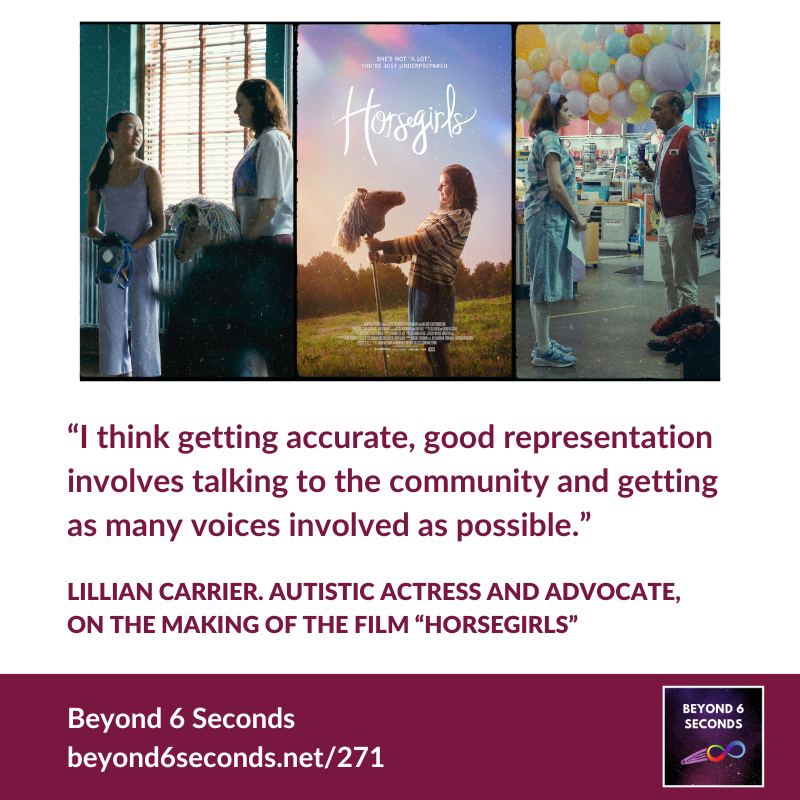
Lillian Carrier is an autistic actress and advocate from Los Angeles, best known for her breakout role as Drea in the television series “Everything’s Gonna Be Okay.” In 2025, Lillian starred in her first leading film role in Horsegirls, an acclaimed independent dramedy that premiered at the Tribeca Festival. Lillian plays Margarita, a 22-year-old autistic woman who discovers confidence, community, and a path toward self-determination through the unexpected world of competitive hobby horsing. Lillian’s performances are grounded in truth, humor, and emotional depth, driven by a mission to reshape how autistic stories are told.
During this episode, you will hear Lillian talk about:
- What her life was like growing up autistic
- How she became interested in acting
- What drew her to the role in Horsegirls
- Disability accommodations she had during filming
- The difference between authentic and accurate representation in film
- Why it’s important to get multiple perspectives when creating media
- The projects she’s working on next
Watch Horsegirls on your favorite streaming platform.
Learn more about Horsegirls on Instagram, Facebook and TikTok.
Follow Lillian Carrier on Instagram and learn about her latest project, Caverns & Chimeras.
Find out more about Alex Plank, autistic producer on Horsegirls, and Chloe Estelle, the autism sensitivity coordinator on Horsegirls.
Contribute to Carolyn’s tip jar to support this podcast at BuyMeACoffee.com/Beyond6Seconds!
Follow the Beyond 6 Seconds podcast in your favorite podcast player!
Subscribe to the FREE Beyond 6 Seconds newsletter for early access to my latest podcast episodes!
*Disclaimer: The views, guidance, opinions, and thoughts expressed in Beyond 6 Seconds episodes are solely mine and/or those of my guests, and do not necessarily represent those of my employer or other organizations. These episodes are for informational purposes only and do not substitute for professional medical advice. Consult a medical professional or healthcare provider if you are seeking medical advice, diagnoses, or treatment.*

The episode transcript is below.
Carolyn Kiel: Welcome to Beyond 6 Seconds, the podcast that goes beyond the six second first impression to share the extraordinary stories of neurodivergent people. I’m your host, Carolyn Kiel.
Carolyn Kiel: On today’s episode, I’m speaking with Lillian Carrier. Lillian is an autistic actress and advocate from Los Angeles, best known for her breakout role as Drea in the television series Everything’s Gonna Be Okay.
In 2025, Lillian starred in her first leading film role in Horsegirls, an acclaimed independent dramedy that premiered at the 2025 Tribeca Film Festival. Lillian plays Margarita, a 22-year-old autistic woman navigating the transition to adulthood while confronting questions of independence, family, employment, and belonging. Through the unexpected world of competitive hobby horsing, Margarita discovers confidence, community, and a path towards self-determination.
Lillian’s performances are grounded in truth, humor, and emotional depth, driven by a mission to reshape how autistic stories are told. Lillian, welcome to the podcast.
Lillian Carrier: Thank you so much for having me, Carolyn.
Carolyn Kiel: Yeah, I’m really excited to learn more about your career as an actress and about Horsegirls, which premiered last year, and it’s so exciting to, to see it come out into the world.
I’d love to start off by learning more about you and what it was like for you growing up. So what was your life like for you growing up autistic?
Lillian Carrier: So I didn’t know I was autistic. I got diagnosed at 16. But I did know there was a difference there. I knew there was a social disconnect, and I struggled with understanding that stuff. But also that made me fearless and do a lot of fun things as a kid ’cause I didn’t understand stuff. To the point I remember being in class, and I didn’t understand the concept of having to be in class, and when I got bored, I’d walk out of class and try to find another classroom that was more interesting. And they kept sending me to the principal’s office, and they were like, “Why are you here?” I said, “I don’t know. I was bored, and I looked for something more interesting.” And they’re like, “I… Well, you can’t do that.” And I was always like, “Why? I don’t understand.”
And that was like, like how I lived my life until finally in high school, I was, like, reading a book in the special education classroom ’cause I had accommodations for other things, and there was a book that was, at the time, Asperger’s. All Cats Have Asperger’s.
And it was just flipping through that and going, “Me. Me. That’s a trait I do. That’s a thing I do.” And yeah, I took me into a deep dive into learning about autism. And yeah, went… Eventually, I went to my sister and my mom, and I was like “I think I have this.” And my mom was like, “Oh, I’m actually so relieved because actually multiple people have come to me about this, and I was looking into getting you diagnosed.” I’m like, “Great! Let’s do that!”
Carolyn Kiel: Oh, wow.
Lillian Carrier: And yeah, we went on that journey.
Carolyn Kiel: Wow. Yeah, that’s interesting that it was really a combination of you discovering or learning about it yourself and coming to that realization, and then also getting the other people coming to that same conclusion or same idea as well. Wow.
So how did you get interested in acting? Was that something that you did in school or when you graduated?
Lillian Carrier: Okay, so that ties into the autism thing of again, not knowing I’m autistic, but knowing that I struggled socially. I would be in social situations where I would make someone angry or upset in some way, and then I’d be like, “Why are you making that face?” Or, “Why are you upset? What happened?” And doing that in that moment usually just makes someone more upset at you. They don’t really have the capacity to explain the social nuance or why their face moves the way it does. And most of the time, that just ended up people really not liking me.
And I found, I did a, a summer camp which had a theater involved in the rotation of activities, and I was able to ask all those questions, and I was able to learn how to move my face in a way that people understand it and learn body language and dissect scenes and characters in a way that was useful in tools in my real life, and that really was the reason that I got into it. I also just enjoyed it and loved it. So I did youth theater as a way to be able to have social skills.
And then because I’m using those tools daily that I don’t have facial expressions that naturally match the way people understand stuff, I’m constantly going, “What am I feeling? How do I express that in my body and face?” Which became, when acting became an option as a career, it was like, oh, that’s actually so much easier ’cause I don’t even have to know what I’m feeling. Someone tells me what I’m feeling and what I… There’s a script there, and I follow it, and I’m doing this every day, and it feels yeah, it’s, it was just a natural transition to do that.
Carolyn Kiel: Oh, well that’s really– Yeah, that’s interesting. I can totally see the relationship and how acting can help really work with that and relating to social skills. And also, yeah I’m thinking about facial expressions, and I, don’t think most people even think about what their face is doing, so it’s interesting to study that and be like, “Okay, how do I move it to express this emotion that I’m supposed to do in the script?”
Lillian Carrier: Yeah, and we lie to children. The thing of a smile means happy that you’re told at four years old or younger, and when I was like, “Oh, pe-!” No, there’s an angry smile, there’s a sad smile, there’s a frus- you have to know the nuances of smiles. But when I was told that, people were smiling at me, and I was like, “you’re so happy right now!” So having that acting class where I’m like, “Oh, smiles does not mean happy. We just have a smiley face as the representation of happiness, but a smile can mean every other emotion, too.” The small nuances when that’s not just naturally in your brain how to tell that, it’s so subtle and sometimes so hard to tell.
Carolyn Kiel: Yeah. No, that’s definitely true. Yeah, and there really are different types of smiles, and then sometimes people smile just to cover up what they’re feeling, so it’s not even related to what they’re feeling. So yeah, it’s something to study, for sure. Wow!
You did a lot of acting, and then you had your TV breakout, and now you’re starring in your first feature film. So I’m interested in how you pick the type of acting work that you wanna do. And for Horsegirls, what kind of drew you towards that script and made you want to audition for Horsegirls?
Lillian Carrier: So I appreciate that you think I’m big enough to pick. It’s really, it is, they pick me. I audition for everything that comes my way and hope I get a project.
I have been so lucky to be gifted these incredible groundbreaking projects with autism representation, and to do just the coolest things. But I think that just happens to be the projects that think I’m perfect for it and love me, and I’m so grateful because I love the, the stories I’ve been able to tell. But yeah, it is, I’m auditioning for everything out there, and whatever they’ll let me right now, so.
But yes, seeing the script of Horsegirls for sure was one that wasn’t just a job. I desperately… This was a really cool script. The representation of autism was so good, and the layers of Margarita and all the things she got to do. I mean, I didn’t think they would pick me ’cause I didn’t think I was capable of doing all the, the stunts and the dancing and the karaoke and the, all the… it was an insane… I was like, “They’re gonna get a superstar who’s done a million movies before.” And then they picked me. I was like, “Oh. Oh, that’s incredible.”
And I’m glad they had faith in me ’cause I didn’t have full faith in me to do this project. But it turned out really good, and I’m really glad they gave me a chance. And now I’m like, “Oh, I’m better at things than I thought. I can do some other things.” And it was fun. Yeah.
Carolyn Kiel: Wow. No, that’s awesome.
One of the focuses of Horsegirls is that the main character is written as an autistic young woman. There’s so much different types of representation of autism in the media, and some of it is more authentic than others. Some of it involves more autistic people in the creation and production of the media than others. So for Horsegirls, how did the people involved with making the movie kind of help ensure that autism was being portrayed in an authentic way throughout the movie?
Lillian Carrier: So starting off, Lauren and Mackenzie were the one who came up with the concept, and Lauren wrote it. Mackenzie’s sister is autistic herself, Marguerite, and that’s who the character was based on, and she contributed to the character and the script as they were developing. And yeah, Mackenzie brought the family dynamic into it, so Lauren had them as that resource. And then Sandy is also a real person. That’s Marguerite’s mom. They just removed her siblings from the story. Hobby horsing is not her choice of interest, but like they thought that was like a dynamic, interesting thing, and Marguerite is very into Disney, Once Upon a Time, and like we didn’t have the rights to Disney. So hobby horsing is her thing.
It was really cool ’cause I don’t think there are any stories really about hobby horsing, so to have such a niche topic, too. And it was fun to learn about, ’cause I didn’t know anything about hobby horsing before doing that.
Yeah, and then once I was involved, I was told that they were going authentic casting. If they didn’t find an autistic person, the movie wasn’t going to be made. So grateful for that. And I was attached. And I asked, I’m like, “Are there other autistic people involved?” And they told me no, but they were interested in doing that because they were starting to hire people. And we had the wonderful Alex Plank brought on as an autistic producer who looked over all of the autism stuff. I was able to bring on Chloe Estelle as the autism sensitivity coordinator to make sure the set was autism-friendly for me, and they got all my needs met, so I didn’t have to advocate for myself. I could just do my job. And then because she was there, she was also to, able to catch a few things and point out, ” here’s better representation. Let’s change this.”
Carolyn Kiel: Yeah.
Lillian Carrier: Yeah, so it was pretty cool to be on a project like that was so open to all that stuff.
And then yeah, working with Lauren was a dream in that sense of representation, that she was… Between me, Marguerite, and her, like we worked on developing this character to like really portray her in the best way that we believe we could.
And to me, this story, autism is weaved deeply into it. It’s a story that could be told without the autism. It just creates a unique part of the character. And it’s a beautiful story that it has autism, and like it’s… We did a, we worked really hard on it. But I think that in itself is wonderful because the story doesn’t have to be about autism. So many stories are like, “Oh, they have this struggle, and they overcome it!” And “Disability’s so hard!” And this one is just, while disability and autism is in there, it is just a finding your place in the world type of story that anyone can go through these sorts of things. And I think more stories like that where like an autistic character can just be slotted into any sort of story, that is true. We live lives just like anyone else!
Carolyn Kiel: Yeah, I think it, it sounds like a very relatable experience to anyone that’s finding yourself and growing up and finding your independence and doing something that you love is relatable to almost anyone.
Lillian Carrier: And the label autism isn’t spoken out loud in the film. While it’s not coded in any way, she is autistic. All the advertisements, the way we’re saying she’s an autistic character, that was a choice that it was talked about multiple times, and we talked about even discussing should we have the option in case we wanna put it in? But we decided on, there are just so many of us that go through life, and we don’t tell everyone we meet that we’re autistic. And there just didn’t seem a moment where she’s like, “I’m gonna reveal. I’m gonna say it.” We were just like, there’s, there was no reason for that. I think autism should be said aloud in a lot of projects, and I’ve done projects, all my other project, I was like, “I’m autistic!” And but this, I feel like we’ve reached a point that it is important to say you don’t know when you come across someone, and they’re not always going to disclose. And having a story where the people around her who don’t know her that she’s meeting in this story, it’s not said out loud to them, and some of them guess and figure it out, and other ones are more clueless.
And I think that was really interesting to me of that choice, and that we settled on that. And the way all the actors that we discussed portrayed the way they perceived her. ‘Cause that is how most of us go through life, is we’re not just walking around saying our labels, that you just walk in a room and go, “I’m autistic! I’m gay! I’m like, what-” You just, you live your life, and sometimes it comes up. But oftentimes it doesn’t. And I, that was, yeah, that was a core part of it, like a big discussion that we had a lot and what we settled on.
Carolyn Kiel: Yeah.
Lillian Carrier: I don’t know in the end if it’s the right decision, but I feel strongly that we made a good choice in that the product shows that.
Carolyn Kiel: Yeah. Yeah, I mean, yeah, that’s true. As you said, a lot of times the people that we interact with don’t know and, i- in some cases the person themselves doesn’t know. ‘Cause, that’s an interesting choice, and it sounds like it works really well with how the movie is put together.
You mentioned having an autism sensitivity coordinator on set to kinda make sure that the filmings and the sets were running and supporting the needs of all the actors who are autistic or had other disabilities. What kind of accommodations were made on set to help support you as an autistic actor?
Lillian Carrier: So she definitely helped me with making sure communication was happening efficiently. She’s much better at communication than me. She was on the email threads and the text threads, and yeah, when things went down, she would step in, “Okay, let’s figure out where the communication stuff happened.”
And then yeah, sensory needs. Costuming is the biggest one for me, that if I’m not comfortable in the costume, I really struggle to be able to perform. And this was one where she had very different sensory needs from me, and it was written in the script. And so I had undergarments and things to make me comfortable in the outfits, and she was there to make sure all those things happened.
I have dietary restrictions that she checked on. And yeah, things that would come up in a scene. We had a scene where I had to use a sponge, and we were working with a lot of water, and it came, and it was like, “This is actually getting overwhelming ’cause we’ve now been filming for an hour, and my hands are very wet.” We were like, “Can we come…” things like that, that she was just often able to catch before I even walked on set. She would see those things and get them sorted out, so I came to set and was like, “Oh, it’s… I don’t even have to think about that.” There was a lot of that stuff.
Carolyn Kiel: Wow, that’s really great. Yes, I’ve heard a lot of times on movies, like the filming days can be very long, or you, as you said, you wind up doing the same scene for an hour or two. So I was interested how that interplays with autistic and the other actors with disabilities.
Was that something that was trying to keep the amount of time filming to shorter than say 12 or 15 hours, or was that part of it?
Lillian Carrier: I mean, I would definitely prefer shorter hour days whenever possible, but I think everyone in acting or on crew would love that.
Carolyn Kiel: Yeah.
Lillian Carrier: Yeah, so definitely weather creates a big difference. There were days that it was over 90 degrees and I had to wear a sweater. It just depends on what we’re doing in the event. And then there was the opposite, like we were filming at midnight in the wind, and it was freezing cold, and I was just in a T-shirt and shorts, and we’re like, freezing cold and trying to get through it. It just… There’s a lot of with what we’re filming is not what the weather is.
We filmed in a storm. It was like raining, pouring, and like every time there was a break in the weather, we hopped into the scene and did it. So I mean, what’s going on with weather and the day is unpredictable, and long days are just part of this career.
And I definitely feel like, it’s so social as well, that my social battery gets drained so fast with this that I really don’t have a social life when I’m working on set, that I go home on the weekends and I just crash and stay isolated so I can recoup that enough to come back to set on Monday and be able to be a warm, wonderful person to be around and not cranky and miserable and going, “I don’t wanna talk. I can’t stand this.”
Yeah, so I do feel like that does have an effect, especially if you’re someone who needs more rest than other people, that it, this is a tough industry to be in. There is not a lot when you’re working the lead of a project or you’re on crew that you have to be there every day. But there are choices in this industry. You don’t have to be the lead. You can be a day player that comes on, works for one or two days. That is a choice, and I feel like that might be more accessible to some people. And I think, again, some of the day players on this project were the most talented people I’ve ever worked with. They’re not lesser actors for doing that, so.
Carolyn Kiel: How many weeks were you filming Horsegirls for?
Lillian Carrier: So I wanna say it was about two months of filming. We were gifted a nice amount of time for how small of a budget independent we were. It was filming in Portland, so I was in a hotel and not in my hometown. That was a whole experience to be somewhere for three months away from home and having to adjust to that, definitely especially as a disabled person where I had to bring a support worker with me too, because I’m incapable of doing that on my own.
Which again, I think this also, this is what this story is about, that you are a full adult even with support like that. And I was grateful to have a story and them allowing me to have that sort of stuff, and I didn’t have to pay out of pocket to bring my support worker with me, that they were willing to do that for me, which I don’t know if every project will be willing to do that. But this was, I’m grateful.
Carolyn Kiel: You mentioned that during the film that you had a lot of sort of physical things, whether it was stunts or choreography and stuff. How did you learn that?
Lillian Carrier: I flew out and I had two and a half weeks that I was there before we filmed, and I think we had two four-hour sessions to learn the dance during that time, which was then filmed. And I kept rehearsing that until that was, like, one of the last scenes we filmed. So I had the time to learn, although not much, because I was working every single day on other stuff.
I’m not a dancer. I’m never gonna claim to be a dancer. It was not easy, so those girls, some of them are professional dancers, they’re on dance teams and do all that stuff. So they were incredible and relied heavily on them to make me look pretty while I just did the wheeee! And in the background they’re doing the leg over their head, flip, whatever, and made me look like I knew more than I, I did. Although I think for someone who doesn’t dance and was only given two four-hour sessions, I did a really good job, if you watched, like that was … Watching it back, I’m like, “Oh!”
Also it was a project where they are a beginner class. It wasn’t like Karate Kid where we became the best in the world in a couple weeks. So I feel realistically, like they gave me enough time to be a beginner at it. ’cause I, yeah, if I had to be, like, the best dancer, I don’t know if I could’ve pulled it off like I did.
Carolyn Kiel: Yeah.
Lillian Carrier: But yeah, the stunts, I mean, the big ones, we did have a stunt person for the big falls and stuff, but I did the, the wire work. And like that for me was really fun.
Yeah, so we did a couple safety stuff and learning about harnesses and whatnot, but for the most part they just, they strapped me in, they did all the work, and I just had to float in the air and do my thing.
Carolyn Kiel: Oh, wow. Well, that’s really cool. Wow. Yeah, ’cause through the movie you get to see the dancers and the hobby horse club preparing for their competition, so you get to see the progression.
Lillian Carrier: Yeah.
Carolyn Kiel: Very cool. This is a very general broad question, but going back to the theme of authentic autistic representation, like, in media, what do you feel like that looks like? We have so many different experiences as autistic people, but how do you know if you’re looking or watching or reading about something and it’s like, “Oh, okay, this feels like an authentic experience and not one that somebody just made up who doesn’t know much about it”?
Lillian Carrier: So first off, in the film disability world, the word authentic means something different than the dictionary definition. So authentic just means that someone with the personal identity was involved. Authentic casting is they cast someone autistic. Authentic writing was it was written by someone autistic, like et cetera, et cetera. Like an authentic movie just has someone involved that’s has the identity. Where like then there would be like accurate, good rep- like we would go into.
And then accurate representation doesn’t always mean it’s good representation. It can still be harmful when accurate if you’re relying on stereotypes, and then you have people involved that do harmful things and show the world “this is how you treat us” when that’s not how we should be treated. But the autism is accurate, right?
Carolyn Kiel: Mm-hmm.
Lillian Carrier: Like that’s where the nuance of language comes in. But in the film world, when we say authentic, that just means someone involved is autistic or has the identity of whatever identity they’re talking about. And again, authentic can still be inaccurate, right? So, I think you’re more likely to be accurate when you have someone with that identity involved, and I think it’s way more, really important to have authenticity involved.
I think getting accurate, good representation involves talking to the community and getting as many voices involved as possible. ‘Cause as much as like hiring me, I love it, thank you so much! But it it shouldn’t be the Lillian show because then we’ll have a new Rain Man. Well, I feel like Rain Man initially was such good representation because it was the only representation. It turned into a stereotype, and we all dislike being compared to him because that was all there was at the time.
Carolyn Kiel: Mm-hmm.
Lillian Carrier: Now I just, I don’t wanna be the next Rain Man, that you keep hiring Lillian and all of this stuff.
Carolyn Kiel: Yeah
Lillian Carrier: As an actor is that this one, I played closer to Marguerite’s experience of autism, and I can do that. But if they relied solely on me to bring the autism, it would be another version of Drea that I’ve already done.
Carolyn Kiel: Mm-hmm. Yeah. Oh yeah, that’s really interesting. To understand sort of the difference between authentic and accurate and what those words really mean in, in the film industry. And yeah, and as you said, we all have different experiences. And I think even having not just one autistic actor in your story about autism, but having a producer and writers and other people on set. The more people are involved, talking with the community, like you said, is I think that helps make something that’s a more robust movie like that.
Lillian Carrier: Yeah. I think the more voices you have involved, the better it’ll be, and you can get all those different perspectives. ‘Cause my lived experience is only one lived experience. I don’t have the same understanding as other people who might have faced more discrimination or different sort of discrimination than me who are like, “Oh, I was in that situation and it wasn’t so good for me.” Right? It- or they were like, “Oh, no, I do that and it’s fine.” I’m like, “Oh, okay.” So some people are capable of that, and I’m not. It’s … I don’t know everything. I know my experience, and I think it’s important to know. Again, what we say, one person, you meet one person with autism, you’ve met one person with autism. Is the same thing from our perspective, that like I experience my autism very specifically one way.
‘Cause while we all have the same diagnosis and it’s the same traits, they manifest so differently because it is the brain.
Carolyn Kiel: Yeah.
Lillian Carrier: The way our brain processes things, and brains are so confusing!
Carolyn Kiel: Yeah, they are very complicated.
Lillian Carrier: It’s so complex! We don’t understand anything about the brain.
Carolyn Kiel: There’s so much that we have to learn about how our brains work.
And, yeah, like you said, so we all have our own experiences because of our different brains. But also there are other things like discrimination and having other types of disabilities in addition to being autistic that can totally influence your relationship with society and how you interact with the world. So it’s important to know.
What projects are you working on next, whether it’s film or not film projects? What’s next for you?
Lillian Carrier: Yeah, so I mean, I’m doing a lot of promotions for Horsegirls right now, so please watch that. I don’t have a specific project in the works. I am attached to a project called Caverns & Chimeras that is being produced by the company Spectrum Laboratory, where it is a bunch of us autistic people. It was written by autistic people. It’s a musical, so songs were created by autistic people. The entire cast right now is cast autistic, and we are hoping to get as many people when it goes into production. It’s, right now we’re in fundraising, so this could be years in the making. But the hope is that we have as many autistic people involved in this project, and it’s a proof of concept that once it’s created, it shows something, that this is something autistic people did and created, and it’s a full movie and it’s good hopefully.
And then as a proof of concept to be like, “Hire us. We are capable. We can do all the jobs in this industry or any, any other industry,” to a point to “We made a movie. Hire me at Walmart,” or whatever job exists that people should be doing, ’cause our unemployment rate being 80 to 90%, depending on the study, is so bad. And we are capable of working, a lot of us, and the underemployed, the people with huge degrees that can’t get a job in those fields, and it’s insane.
So yeah, we’re hoping that a project like this can make a difference, at least in this industry, but hopefully in other industries so that… so if anyone has any connections or money or something and wants to get involved in helping support that, please reach out. But that is something that is currently I’m putting a lot of energy behind to try and make happen.
Hopefully the Horsegirls coming out makes my name a little bit more powerful having involved in it, but we’ll see.
Carolyn Kiel: For sure. Oh, very cool. Could you say again what the name is and what the main, like…
Lillian Carrier: It’s called Caverns and Chimeras, which is based off of D&D, Dungeons & Dragons.
Carolyn Kiel: Oh!
Lillian Carrier: It’s a fantasy world thing where they’re like playing the game and then they end up in the world, like Jumanji-type story where we like… it’s not an autism story, it’s fantasy and we just go on a fun adventure and stuff. Yeah.
Carolyn Kiel: Oh, that’s cool. That sounds great. If you have a link or a website for it, I can put that in the show notes along with the link to Horsegirls where people will be able to see it when this episode comes out, so people can check it out and learn more.
Lillian Carrier: Absolutely. Please do!
Carolyn Kiel: As we close out, is there anything else that you’d like our listeners to know or anything else that they can help or support you with?
Lillian Carrier: Follow me on social media. I don’t know if I’m interesting, but I’m always posting what I’m up to, and I made a movie! That’s pretty cool!
Carolyn Kiel: Yeah.
Lillian Carrier: Chloe Estelle and Alex Plank, I think you should absolutely support them. They’re always doing something to change the world, and I’m in awe of all of their work, and I’m so glad I get to work with them on this project and hopefully get to keep working with them.
And please hire them if you’re doing an autism project, or not doing an autism project but you just like the skills that they have, ’cause they’re really good at film!
Carolyn Kiel: I can put, yeah, links to your socials and links to maybe some of their socials as well so people can find them. That’s so cool. Yeah. Well, yeah, Lillian, it’s been really great talking with you. Again, congratulations on Horsegirls coming out in theaters. It was great to talk with you, and yeah, thanks so much for being on my show.
Lillian Carrier: Wonderful.
Carolyn Kiel: Has this podcast had an impact on your life, your heart, or your perspective in some way? If so, I’d love to hear about it. Send me a message on social media or through my website at beyond6seconds.net/contact. Your feedback means a lot to me, and it helps keep me going with this show. Thank you.
Thanks for listening to Beyond 6 Seconds. Please help me spread the word about this podcast. Share it with a friend, give it a shout out on your social media, or write a review on Apple Podcasts or your favorite podcast player. You can find all of my episodes and sign up for my free newsletter at Beyond6seconds.net. Until next time.