Episode 270: Dyspraxia representation in film – with Owen Williamson
-
play_circle_filled
Episode 270: Dyspraxia representation in film – with Owen Williamson
Carolyn Kiel
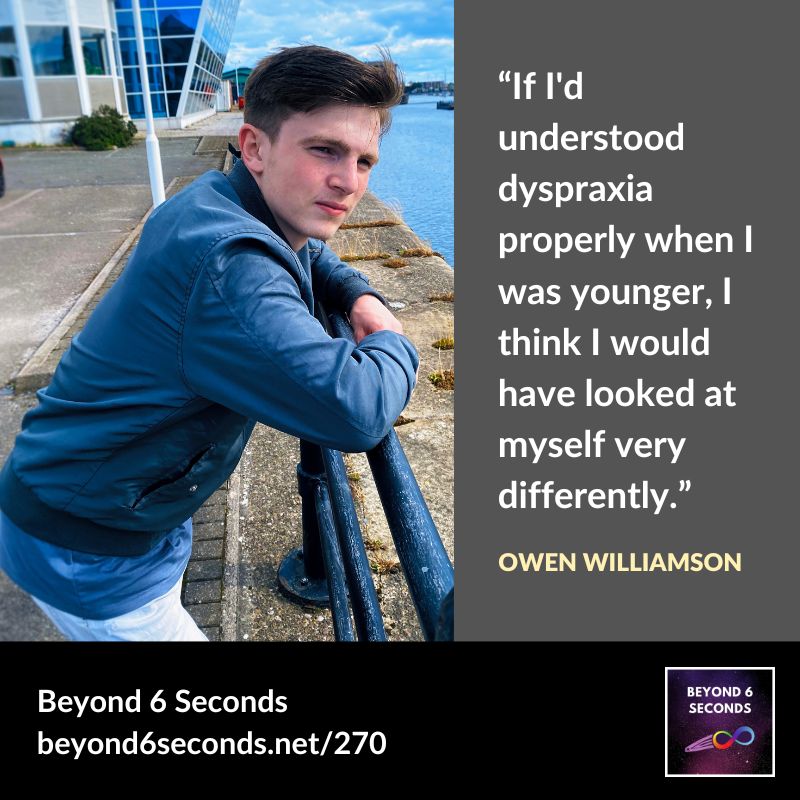
Owen Williamson is an emerging filmmaker from England and an advocate for dyspraxia awareness. He is developing a new short film called DYSPRAXIA, which is inspired by his own lived experience. Through his filmmaking and advocacy, Owen aims to challenge misconceptions about dyspraxia and help bring greater understanding and representation to dyspraxic people.
During this episode, you will hear Owen talk about:
- The challenges he faced growing up with dyspraxia
- How his short-lived career as a boxer gave him a reality check about his limitations
- What inspired him to make a film about dyspraxia
- His goals for this film
Learn more about Owen’s short film DYSPRAXIA on Instagram @dyspraxiamovie and support the film on his Crowdfunder page.
Listen to other Beyond 6 Seconds episodes about dyspraxia.
Contribute to Carolyn’s tip jar to support this podcast at BuyMeACoffee.com/Beyond6Seconds!
Follow the Beyond 6 Seconds podcast in your favorite podcast player!
Subscribe to the FREE Beyond 6 Seconds newsletter for early access to my latest podcast episodes!
*Disclaimer: The views, guidance, opinions, and thoughts expressed in Beyond 6 Seconds episodes are solely mine and/or those of my guests, and do not necessarily represent those of my employer or other organizations. These episodes are for informational purposes only and do not substitute for professional medical advice. Consult a medical professional or healthcare provider if you are seeking medical advice, diagnoses, or treatment.*

The episode transcript is below.
Carolyn Kiel: Welcome to Beyond 6 Seconds, the podcast that goes beyond the six second first impression to share the extraordinary stories of neurodivergent people. I’m your host, Carolyn Kiel.
Today I’m speaking with Owen Williamson, an emerging filmmaker from England and an advocate for dyspraxia awareness. He has written and directed two short films, and he’s now developing a new short film focused on dyspraxia, which is inspired by his own lived experience.
Through his filmmaking and advocacy, Owen aims to challenge misconceptions around the condition and help bring greater understanding and representation to dyspraxic people. Owen, welcome to the podcast.
Owen Williamson: Hello. Thank you for having me.
Carolyn Kiel: I’m looking forward to learning more about your own experiences and the filmmaking that you do.
What was life like for you growing up with dyspraxia?
Owen Williamson: My dad told me I had dyspraxia when I was around 13 or 14, so I didn’t know I had it before then and I didn’t really know it even existed.
Carolyn Kiel: Wow.
Owen Williamson: I remember being quite bright when I was younger and fairly natural at things. I did have some special education for certain subjects, but it never really crossed my mind why I needed it.
I guess the clumsy part was probably the main problem when I was younger. When I was first learning to walk, I was always falling over, so my aunt actually told my mom that I could trip over my own shadow. But for some reason, as I gradually got older, it felt like I was getting worse at things, and the stuff that I was naturally good at when I was younger just didn’t come naturally anymore, and I’d be terrible at it to the point where it was almost laughable.
But high school was the worst because even though I knew I had dyspraxia at that point, I didn’t really understand it and I didn’t know much about it. A lot of the things I thought it might have been, other people would tell me it wasn’t, because they just thought dyspraxia meant you were clumsy or you lacked coordination.
And this was also the point where I was getting bullied horrendously at school. It basically became a trend for the whole school year. Even students you’d expect to know better were joining in. So it could be because of the tone of my voice or because I couldn’t answer a question as quickly as everyone else. And it went from being mocked and being called names to being threatened and having stones thrown at me.
Carolyn Kiel: Wow.
Owen Williamson: And once I was punched in the chest so hard that I fell forward and my friend had to catch me.
And looking back now, a lot of the things I was being bullied for were things I know now are symptoms of my dyspraxia. But at the time I didn’t understand that, so I just thought there was something wrong with me, and that really took a toll on my confidence and my mental health.
Carolyn Kiel: Oh, wow. In case people aren’t as familiar with dyspraxia, could you talk more about how dyspraxia impacted you growing up? Like I know you mentioned it’s known as being clumsy, but it sounds like it was much more than that in terms of how it impacted you. Could you tell me more about that?
Owen Williamson: Yeah. So dyspraxia is a neurological condition that mainly affects things like coordination, movement, motor planning. But for a lot of people it can affect much more than just being clumsy.
It can be processing. Sometimes somebody can ask me a question and I know what I want to say, but I just need that extra few seconds to actually process it and get the answer out. And it can affect things like organization, remembering things, following instructions, and doing certain everyday tasks that other people might not even have to think about.
Carolyn Kiel: Okay.
Yeah. So it really impacts a wide variety of conditions and, wow, especially it sounds like in high school it really impacted you quite a lot in that people were not, either not understanding or not accepting or not treating you well at all.
Owen Williamson: Yeah. Exactly.
Carolyn Kiel: You had mentioned to me before, I don’t know if it was before you got into filmmaking or at some point when you were younger, that you spent some time learning boxing, which is interesting looking back as someone with dyspraxia to be involved in a sport that requires physical coordination.
But I’m interested to learn, like, what was your experience with learning and participating in boxing?
Owen Williamson: Yeah. So I did boxing for three years, and I actually really enjoyed the time I had there. I liked the idea of training and preparing for a couple of months, then entering a ring in front of hundreds of people and executing what I trained for, which honestly never really ended well.
I met the coach through a friend who set me up with him, and from there we just got training. The fitness side of things I was actually great at. I could run circles around everyone if it was just fitness related. But with boxing, there are so many different things you need to be able to do, and with dyspraxia there are certain things that just don’t come naturally. And at the time I didn’t know that.
I had my first fight at this charity event raising money for cancer research, and I believed I trained a lot earlier than everyone else for it. And I went in the ring and essentially I got battered. I was basically a punching bag.
Carolyn Kiel: Wow.
Owen Williamson: And nothing was working for me. My reaction time was terrible. I telegraphed my punches, so I knew they were always coming, and my coordination was sloppy. And that right there should have been a reality check for me. But did it? Nah. All it did was make me believe I needed to train harder, so I did.
And at this point I was working full-time as well, so I was constantly tired, never getting enough sleep. I had my own gym in the garden, and I just kept losing back to back. So was that my reality check? No, not really. Hmm.
I believed it was the coach at this point, so I changed coaches and actually found some success there because in my next fight we drew, which ultimately I believe I should have won, but got dropped in the first round supposedly, and apparently that was enough to make it a draw. So that was enough for me to keep going.
We had a rematch, which I lost badly. I tried to play smarter than I did in the first fight, but that was never really going to work for someone with dyspraxia because I was trying to dodge and block and react to things when realistically I should have been the aggressor and putting the pressure on.
Carolyn Kiel: Uh-huh.
Owen Williamson: So eventually I ended my boxing career last year after having eight fights. I won two, lost five, and drew one. But the whole experience did eventually become a reality check for me. It made me realize that because of my condition, there are certain things I just can’t do in the same way other people can: boxing, sports in general, things that rely heavily on reaction time and coordination. And for a long time I really didn’t want to believe that. I kept thinking if I just train harder, I’ll eventually get it.
But eventually I’d accept that sometimes training harder isn’t necessarily going to change the way your brain is wired. You can train boxing, you can enjoy boxing, you can get fit through boxing, but going out there and getting into actual fights probably isn’t the best idea for someone like me, ’cause otherwise you’re just going to get hurt.
Carolyn Kiel: Yeah. I guess it’s a long way to learn what your limits and capabilities are. It sounds like you also learned that maybe other fitness activities were things that you could excel at that maybe didn’t rely as much on reaction time and that sort of like physical choreography or coordination. Do you do other fitness activities that you enjoy that aren’t boxing these days?
Owen Williamson: I enjoy running.
Carolyn Kiel: Mm-hmm.
Owen Williamson: Running I’m pretty good at. And running I picked up during my boxing ’cause that’s a very important part of the training you needed to do and that it was probably one of my most enjoyable parts as well, could just listen to me, my music and get going.
Carolyn Kiel: That’s great. I guess sometimes we don’t, we can only learn about ourselves by going through the experience and then go from there.
Owen Williamson: And a shame it took me three whole years to get through.
Carolyn Kiel: Yeah, it sounds painful to be in fights and lose like that. Is there, like, I’ve never done any kind of boxing. Does it take a lot of time to physically recover from that?
Owen Williamson: There were short fights. It wasn’t like anything professional or anything like that.
Mm-hmm. Just, I don’t know, I didn’t really have much time to recover ’cause they were always short fights and we wasn’t wearing the same cuts or gloves the professional use. So-
Carolyn Kiel: Oh …
Owen Williamson: I’d just have a week off and then I’ll be all right.
Carolyn Kiel: Okay. Wow.
The other thing that you spend a lot of time you doing now is making films. How and when did you become interested in filmmaking?
Owen Williamson: I was still boxing at the time I got into filmmaking. I just made a joke with my f- my friend about, imagine if I like wrote a film about a killer seal or whatever. Because I was always just so random with things and I just decided in this ridiculous idea about writing a film about a killer seal.
And for a couple of days I just left it at that. But then on a weekend it just came straight back to me and I decided to take it seriously and I actually wrote a draft for the killer seal movie. And, uh, but I did in the end scrap it ’cause I eventually come to my senses and thought the idea of a killer seal is a bit ridiculous.
I kept going at it though. I kept going at the screenwriting and eventually I met a friend online who convinced me to get into filmmaking as a whole, like the whole directing side of things and that. And I thought, okay, I’ll give that a go. And then I started writing my first short film, The Errand, which is about Danny and his two friends who get in trouble with his boss. They have to run an errand for their boss to catch this lad who’s been scamming people and things, and it just spirals out of control.
And that was my first film I recorded on just my iPhone, what I hired professional actors for, and that’s basically where it all started.
Carolyn Kiel: And you’ve done two short films at this point, right? So the first one it sounds like was called Errand.
Owen Williamson: The Errand.
Carolyn Kiel: And then what was the second one about?
Owen Williamson: The second one is called Pen Pusher, where I pushed the production a little higher and actually hired my own camera crew for this time, good cameras and things.
And this one was about two eccentric gangsters. They burst into this man’s office and basically forced to sign away his company, but the gangsters are essentially idiots who can’t decide how to do the job properly, and they have this argument, and it’s a crime comedy.
Carolyn Kiel: Oh, wow.
And then your current film that you’re working on or preparing to work on is actually about dyspraxia. So what inspired you to decide, I want to make a film about dyspraxia right now?
Owen Williamson: I believe that if I’ve been through the things I’ve dealt with at school and at work, then there’s probably someone else with dyspraxia whose been through the same things as well. Dyspraxia has been around for decades, long before even I was born, yet the knowledge and understanding of it is still so very little.
And since I’m a filmmaker, it just makes a lot of sense to me to make this film and base it off of my own experience growing up with the condition. I want to use filmmaking as a way of actually showing people what it’s like rather than just explaining what dyspraxia is. Hopefully, it can raise awareness for parents, teachers, and even young people with the condition themselves so they can understand it a bit better, because if I’d understood dyspraxia properly when I was younger, I think I would’ve looked at myself very differently.
Carolyn Kiel: Yeah. And what’s the plot of your film? And the film is called DYSPRAXIA. Is that right?
Owen Williamson: Yeah. Very on the nose, I know. Yeah. That was done on purpose because way too many people don’t even know the name, let alone the condition. And in America, it’s more commonly known as developmental coordination disorder.
Carolyn Kiel: Right.
Owen Williamson: Anyway, the film follows Elliot, a 14-year-old boy struggling through an ordinary school day while dealing with the hidden challenges of dyspraxia. With Elliot, I’ve basically taken different moments from my own school life and home life growing up and fitted them into this one particular day. Things like sitting in a classroom, the teacher asks a question, everybody’s hands shoot up, and they choose the one kid who doesn’t have their hand up. That’s a very humiliating moment that I have unfortunately lived through.
And that’s what I wanted to do with the film, take these little moments that might seem insignificant to someone else, but actually mean a lot to someone with dyspraxia, and put them together.
While the film is mostly set in school, it mainly focuses on the relationship between Elliot and his mum, Sandra, because I believe the first place understanding should come from is in the household. If a young person is struggling with something like dyspraxia, they need to feel like they can come home and be understood there. So while the school is where we see a lot of Elliot’s struggles, the relationship with his mum is really the emotional heart of the film.
Carolyn Kiel: It’s definitely based on your own experiences that you’ve had in school and probably at home too, it sounds like.
Owen Williamson: Yeah, 100%. Not like the bad stuff that I’ve told you about.
It’s more about the making fun of part.
Carolyn Kiel: And then as you’re casting and getting together the production crew for this, are you working with other cast and crew who are dyspraxic or neurodivergent themselves? Is that something that you’re considering along as you cast and crew with this?
Owen Williamson: I’ve been speaking to a cinematographer who is on the autism spectrum. He’s very g- I’ve seen him do stuff before. He’s worked for big companies and that, and he’s very, he’s very into the work he does, and he’s very professional and he cares about the projects he works on. And I thought it’d be a good idea to have a neurodivergent cinematographer as well.
Carolyn Kiel: Have you written the film already?
Owen Williamson: Yeah, I’ve written the film already. Took a few rewrites. I actually started writing the film before I even directed my last one, and during production and post-production I was just rewriting this one ’cause I feel like my last two films have basically just been leading up to this, even though it’s very different to what I have made. But my last two films were crime films. Now I’m working on this drama, raising awareness film.
Carolyn Kiel: Yeah.
Owen Williamson: So it’s a big jump, but it is what it is.
Carolyn Kiel: What’s the timeline that you have for making this film?
Owen Williamson: I started in June. And we’re shooting on October 9th and 10th. So it’ll be a two-day shoot. On Friday it’ll be a shoot in the school, and then on Saturday it’ll be a shoot in the home. We’ll work on the parent and son dynamic, and then we’ll work through post-production. Post-production usually takes around two months.
Carolyn Kiel: Mm-hmm.
Owen Williamson: So we’re looking probably around the end of the year where the film will actually get finished.
Carolyn Kiel: Oh, that’s really great. And then when you finish this film, and I guess for your other films too, do you submit it to film festivals? Like, how do you get the word out for people to see it?
Owen Williamson: I haven’t done for my last two films ’cause those were more experimental. Because of the importance and the careful planning I have made for the current film about dyspraxia, I do intend to submit to a whole wide variety of film festivals across next year. Push it to as many eyes as it can possibly see.
Carolyn Kiel: That’s really great. It’ll be great to get more and more people seeing this because it really is meant to raise awareness about dyspraxia. And as you said, a lot of people still aren’t familiar with the term or what it means and what the experience is like. So that’ll be great.
Owen Williamson: Yeah, 100%. Like, in film festivals, people go in there and they’re basically just forced to watch it, I think, so-
Carolyn Kiel: Mm-hmm …
Owen Williamson: it’s a win.
Carolyn Kiel: Yeah. And do you have specific goals for the film? So obviously awareness, more awareness about dyspraxia, but do you want to, like, start conversations about it, or is general awareness the biggest thing for you?
Owen Williamson: Yeah, definitely raising awareness is 100% the most important part. I would like it to change more about how schools are running things. Because in school I, I was put onto this thing called functional skills for my last exams, and it was basically where they took me away from the GCSEs, which all the everyone else was doing, and they put a test in front of me, which was something year threes could do, like infants.
Carolyn Kiel: Oh.
Owen Williamson: And that was basically what my final test was. And I’m not learning anything doing that. It’s like these are things that I don’t even have to think about doing. And it’s basically like two plus two is four, and how many apples are in this picture.
Carolyn Kiel: Wow.
Owen Williamson: It’s quite a humiliating experience, but… And another thing is I can’t show this to anyone. No one’s gonna be impressed at looking at this piece of paper, ’cause it just shows that I needed special education. What I really needed was to be pushed and motivated more, and be shown, like, certain specific different ways of learning than everyone else, rather than just give me easier questions. And that’s what I want to show as well for my film, and show that dyspraxia does not affect intelligence. We just need that extra push.
Carolyn Kiel: Yeah, it sounds like you needed different types of learning supports in the regular classroom or with a lot of the regular material that your peers were learning, maybe a, a different way to learn it or to have people teach it to you instead of, like, easier material that was years below your capabilities.
Owen Williamson: Yeah, of course. It was quite a humiliating experience.
Carolyn Kiel: Wow. I don’t know a whole lot about the education in the UK. I know the GCSEs is, like, the high school graduation, I don’t know, certification. I’m not sure. But is that something that you were able to earn, or did they even offer you a path to getting that?
Owen Williamson: Not really. They sort of just pushed me into doing this one particular way. So they basically said, “If you wanna pass this subject, then you should come this way and do like this.” They basically told me I have no chance.
Carolyn Kiel: Yeah, that’s frustrating, and I’m sure so many people with learning disabilities, whe- or dyspraxia, which isn’t even always a learning disability, wind up not having those opportunities because they’re not getting the right support.
It sounds like your film will help raise awareness of that as an issue.
Owen Williamson: Yeah, of course. That is the goal.
Carolyn Kiel: I’m wishing you all the best of luck with the film, getting it together and filmed, and I hope you find a lot of success with it. Like, where can people go to learn more about your film, DYSPRAXIA?
Owen Williamson: They can go onto the DYSPRAXIA Movie’s official Instagram, which is just dyspraxiamovie. I post updates of the film and I also post many videos explaining more of my experience, even telling embarrassing stories, deep personal stories, and advice to fellow dyspraxics or advice to parents of dyspraxics.
We’ve also got a Crowdfunder up for the film as well, if anybody wants to donate and pledge to the film. Donating to the film will help cover equipment such as camera and lighting, the cast and the crew, and food and travel for the cast and crew as well, if anybody wants to support.
Carolyn Kiel: Awesome. How long is the Crowdfunder running for?
Owen Williamson: I think it’s September 27th.
Carolyn Kiel: Okay. I can put links to the Instagram account and the Crowdfunder in the show notes of this podcast so people can find it that way, too.
Owen Williamson: Thank you.
Carolyn Kiel: Owen, thank you so much for sharing about your film. I think it’s really exciting. It’s something that is important for people to understand more about dyspraxia and raise awareness and grow understanding, and I’m wishing you all the best of success with your film when it comes out.
Owen Williamson: I appreciate it. Thank you for having me on the podcast. It was great talking to you and sharing my experiences and about the film.
Carolyn Kiel: Yeah, it was great talking with you, too. Thank you for being a guest on the show.
Has this podcast had an impact on your life, your heart, or your perspective in some way? If so, I’d love to hear about it. Send me a message on social media or through my website at beyond6seconds.net/contact. Your feedback means a lot to me, and it helps keep me going with this show. Thank you.
Thanks for listening to Beyond 6 Seconds. Please help me spread the word about this podcast. Share it with a friend, give it a shout out on your social media, or write a review on Apple Podcasts or your favorite podcast player. You can find all of my episodes and sign up for my free newsletter at Beyond6seconds.net. Until next time.