Episode 275: Embracing the intersections of AuDHD, Queer, Disabled, and Asian American Identity – with Dennis Tran
-
play_circle_filled
Episode 275: Embracing the intersections of AuDHD, Queer, Disabled, and Asian American Identity – with Dennis Tran
Carolyn Kiel
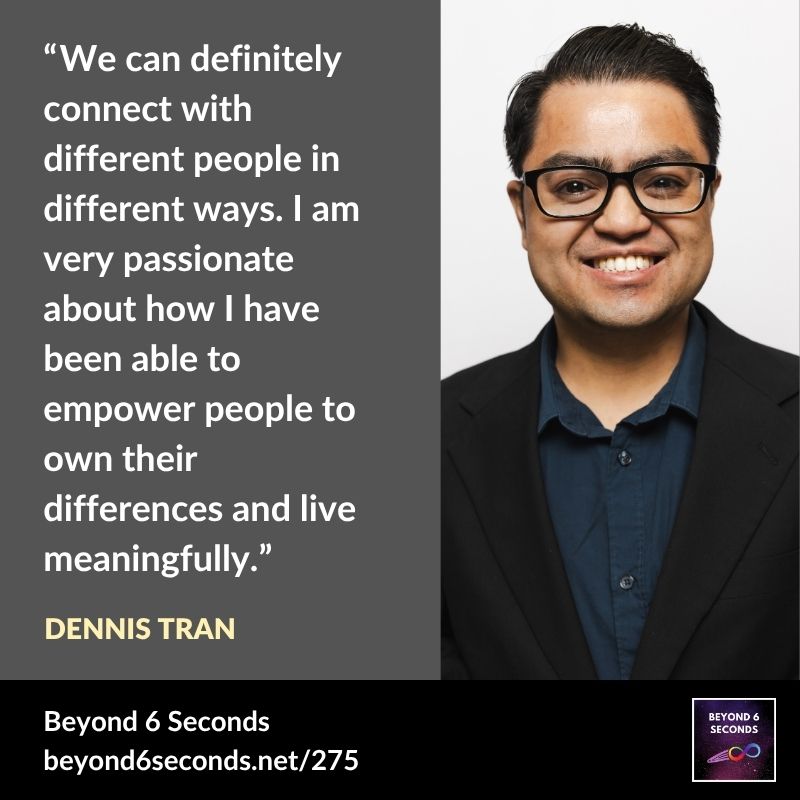
Dennis Tran is an award-winning queer, disabled, late-identified autistic-ADHD, and partially blind Vietnamese American storyteller and inclusion strategist based in Los Angeles.
With a background in public health, media, digital health, and nonprofit leadership, Dennis bridges lived experience with systems change to advance neurodiversity, disability justice, and mental health advocacy, especially within Asian American, Native Hawaiian and Pacific Islander (AANHPI) communities.
He’s a global speaker and advocate whose work has been featured in several major publications. Most recently, he wrote and starred in his short film Crosswalk and consulted on Lavender, the first autistic character on Blue’s Clues & You.
During this episode, Dennis talks about:
- How discovering that he is neurodivergent changed his life
- The intersections of neurodivergence with the rest of his identity
- How he discovered that storytelling could help build connection, community, and inclusion
- How his family reacted to him being open about his life story
- His favorite ways to use storytelling for healing and advocacy
Learn more about Dennis at www.DennisVTran.com.
Follow Dennis on Instagram at @denvtran and @crosswalk.film and on LinkedIn.
Support Dennis’ film Crosswalk on Buy Me a Coffee: BuyMeACoffee.com/crosswalkfilm
Contribute to Carolyn’s tip jar to support this podcast at BuyMeACoffee.com/Beyond6Seconds!
Follow the Beyond 6 Seconds podcast in your favorite podcast player!
Subscribe to the FREE Beyond 6 Seconds newsletter for early access to my latest podcast episodes!
*Disclaimer: The views, guidance, opinions, and thoughts expressed in Beyond 6 Seconds episodes are solely mine and/or those of my guests, and do not necessarily represent those of my employer or other organizations. These episodes are for informational purposes only and do not substitute for professional medical advice. Consult a medical professional or healthcare provider if you are seeking medical advice, diagnoses, or treatment.*

The episode transcript is below.
Carolyn Kiel: Welcome to Beyond 6 Seconds, the podcast that goes beyond the six second first impression to share the extraordinary stories of neurodivergent people. I’m your host, Carolyn Kiel.
On today’s episode, I’m speaking with Dennis Tran. Dennis is an award-winning queer, disabled, late identified autistic ADHD, and partially blind multi-hyphenate Vietnamese American storyteller, artist, speaker, and inclusion strategist based in Los Angeles.
With a background in public health, media, digital health, and nonprofit leadership, Dennis bridges lived experience with systems change to advance neurodiversity, disability justice, and mental health advocacy, especially within Asian American, Native Hawaiian, and Pacific Islander communities. He’s a notable global speaker and advocate whose work has been featured on several major publications.
Most recently, he wrote and starred in his short film Crosswalk and consulted on Lavender, the first autistic character on Blue’s Clues & You. Dennis, welcome to the podcast.
Dennis Tran: Yeah, thank you for having me.
Carolyn Kiel: Yeah, I’m so excited to learn more about you. I know we’ve been following each other on social media for quite a while, so I’m glad we were able to connect and have a chat about your really great story.
I’d love to start from the beginning. Like, how did you first realize that you are neurodivergent?
Dennis Tran: So my neurodivergent journey started off like, I would say in 2020 when a family member friend at the time told my sibling that I may be on the spectrum. And of course, like, how did I find out about that was that they had a friend who was cis white who has kids with autism, and that’s how they kinda saw as they were hanging out with me, they actually saw traits of autism in me, and that’s how they made the connection, then told my family member about it.
And for me culturally growing up and being traditionally Vietnamese American, Southeast Asian American, we didn’t have language for any of this stuff, so we didn’t have understanding of what it means to be neurodivergent, what it means to be autistic even. And there was, like, a lot of cultural silence around this type of topic.
So of course I did not know, and I think that’s the first time I heard about it and through that process of learning about it and just doing my own research at the time, and then being connected to a psychiatrist who first diagnosed me with autism.
And I was like if I had to live with autism, then so be it. I was like, I didn’t really see a problem with autism. I kept thinking back to myself that if I live autism my entire life so far, then then let’s just find a way to make the most of it.
The neurodivergent journey was a long journey, I would say. It was just like having that diagnosis was not the end of the world, but more like the beginning of a long journey over the last five years of rebuilding myself, re-understanding myself and understanding who I am now today.
Carolyn Kiel: Yeah, and then you also have ADHD. So was that part of the discovery, learning that you had ADHD?
Dennis Tran: Yeah, I would say when I first diagnosed with 2020, the nurse psychiatrist was only like say, “Oh, autism.” And then all she did was like, “Hey, you want pills to get relaxed?” And I think that’s that was my own understanding of hey, I was like, I don’t really know much about autism right now. I don’t really know where to go, and I think that’s like the big challenge of the health system and the medical system is that the diagnosis is also like what I learned from other in the community as well, is like sometimes you get diagnosis and then you’re left figuring things out on your own.
And that was my case for me was like I told the nurse I, didn’t want to take medication because I was like I don’t need medication. Because I got through college, I got through life, like I had some jobs here and there and then navigate life pretty fine for the most part and despite there’s like some struggle with system barriers and stuff like that.
But ultimately it was like, yeah, I was left to figure things out on my own because I didn’t took medication. So of course I leaned into a lot of social media, content creator, learning from other people sharing their story. That’s when I realized huh, like I realized that I don’t really connect with just the autism community because I realized that like my brain works very fast.
There’s certain aspect of me like, oh I have lots of interests. I don’t have a specific interest or towards one specific thing. I have lots of interests. I do things a lot fast, and. But also like I realized the push and pull that I’ve been feeling between like navigating from the autism community of having one specific interest, one special interest here, to having like multiple interests, multiple passion, and I realized like being a part of like navigating both communities like the autism community separately and the ADHD community separately, I realized I get along with ADHD pretty well, but at the same times like I sometimes I get very overwhelmed or very like very just, like a lot going on that but sometimes like I, I am like kind of balancing between the fast-paced world, but also needing my time to slow down, decompress too, and process information and realize that how these confliction really tend to my autism and ADHD identities.
And just like resonating mostly with autism ADHD, or AuDHD community, like who, who share their story and that’s when I realized yeah, I resonate with this a lot. Sometimes I resonate in parts with all these different creators I saw. And it wasn’t until like 2013 or 2014 when you could actually be diagnosed with both autism and ADHD together. I feel a lot of doctor may or healthcare professional may not know that, or may not know the overlap, and I think that’s when I realized that yeah, it was, like, a lot of learning curve I had to do since my diagnosis in 2020 of like figuring out myself and just learning from people. And so oh, like, where do I fit in or how do I connect with all this stuff?
And so it really took having seen a therapist with lived experiences in 2024 who share my own identities, like, who actually went through the same process I went through, who was like late diagnosed autism, ADHD, was also queer, neurodivergent, and Southeast Asian like myself, what really was, like, the real true turning point for me to actually really fully own who I am and embrace who I am and my complexity. And she was the one that confirmed that I had au- autism ADHD right away. And I think that’s what very helpful. It was like I finally have a clear understanding of who I am at that point, as opposed to, there was a lot of missing puzzle piece along the way.
Carolyn Kiel: Yeah, that’s really interesting that you, it sounds like you really got the diagnosis at least of autism at first, a little bit before you had a sense of what that really meant. There was an example of oh, someone we know their child’s autistic, so you have those traits.
But then you had to go figure out like, all right, what does that mean for my life? How does that impact how I go going forward? And then it took a while to find the right support. ‘Cause you’re right, a lot of times we’re left to figure out like, all right, what does that mean for us?
And that’s why so many, like at least later diagnosed autistic people, a lot of times we go to social media to connect and just see what the internal experience can look like for autistic people, and people with ADHD too.
How did the other parts of your identity, I mean, you alluded to it in the beginning of your story about the Southeast Asian culture that you grew up in, that it wasn’t really something that was talked about very much. So the other parts of your identity, like how does that impact the way that you experience the world as a neurodivergent person?
Dennis Tran: Yeah, so I used to feel like all my identities separately. I just, siloed like how the healthcare system has occurred to me. I always understood my identity in parts. I grew up low income, Vietnamese, Southeast Asian American, where my own culture try shape my perception of how disability is taught and even talked about, or even mental health, because there’s such a cultural stigma where we don’t talk about these type of thing, or just keep it in the family, or you’re so lazy. And these conversation are just never talked about. There’s a lot of shame around that in our community.
And of course, there’s also the model minority myth, which is like, Asians are hardworking, we keep pushing through. It’s a harmful narrative that left a lot of conversation that all Asians are successful. But Asian are not monolith. And same thing with disability community and neurodivergent community, we’re not monolith. And of course it’s just putting ourself into a box and just and just putting our race superior to the other and just approximate to whiteness and stuff like that, was really just very harmful negative stereotype.
A lot of like people who are neurodivergent tend to be very successful, hardworking and the one that do well in school, or like they mask their way through school and somehow got straight As or like sometimes do very well or oftentimes don’t do very well in school. But it’s also not often talked about enough that they’re the one that become later diagnosed in life because of the masking behind that and not knowing it and just surviving through, pushing through, keep pushing through and not talk about anything.
And I was that person for 20 plus years until my late 20s that was like, I was like, “Oh, my life fell apart. I can’t take doing this anymore.” And that diagnosis was like kind of the, the entry point to me really opening up and just putting myself out there. And I think that was the entry point to all that stuff.
But I would say that how my other identity came to be is like that’s just like the Asian upbringing, and then the whole like being late diagnosed with glaucoma as well in a severe state that caused me to go blind and become partially blind in my right eye, but also completely blind in my left eye and become I guess low vision or partially blind. It’s like I, grew up without any representation. I grew up like without any example of that. I grew up with my dad who had disability and he had glaucoma, and he probably does have neurodivergent traits like autism too, but it’s often not talked about because there’s a lot of stigma, shame, and like I saw his relative and family members distance themselves away from them. There’s like avoidance in the community.
And once I became blind with glaucoma, I would say that I faced the same barrier. It’s like rooted in the medical model where it’s like, “It’s your fault. Why couldn’t you catch this earlier?” Or like people didn’t know how to respond to disability. I just saw my peer avoided me, or they saw how I put on eyedrop they got very overwhelmed and they didn’t know how to react to it. And I felt very lonely because I was like, it hurt because these are people that are my friends or family that’s supposed to care about me, but they’re treating me with distance, avoidance, and I didn’t feel supported.
And that’s the reason why I kept things to myself because oftentimes I’m going through a lot, but oftentimes like I know that I’m not getting the responses, the support or the allyship that I needed to actually navigate my life. So I was like if I’m gonna open up to people and they’re gonna treat me this way or respond this way, it doesn’t make me feel good. So I just kept to myself because it’s better than hearing these responses or getting no responses at all. So that’s how I deal with life being blind, low vision.
And then of course, how that ties to my perspective with autism after my diagnosis was the increase of representation I would say was helpful. Like I would say in 2014 when I met MasterChef Christine Ha, who is also blind and low vision, who won MasterChef and actually is living thriving life. And that’s was something, the first time I actually saw a young representation of someone with disability who share my identity as well, like Southeast Asian, Vietnamese American, who is sharing openly about their disability, but also is doing successful thing and thriving in life. And that’s what really shaped my perception of hey, I could, be disabled or be neurodivergent or just autistic and live like this, and live like that. Versus like what I’m so used to seeing growing up was just survival and just going through. And of course, like, because I had a similar disability as my dad, like all I knew was survival. And of course, because I realized that I accomplished so much already in life just, at the age of, by 27, I realized hey, I got through college, I got jobs, and I got some work jobs and I’ve done two. And I was like, I need to be able to learn how to thrive, learn to actually live my best life with this, right? And so that’s when I kinda thought about oh, like how to kinda shift that perspective and really want to live that way. And so that’s how it kinda come to be.
And of course the queer identity is this, it’s also its own thing because I didn’t really know I was queer until in my discovery journey, after my diagnosis actually, like in, in the last five years when I started seeing a statistic, right? Of like autistic, ADHD, neurodivergent folks are more likely to identify LGBTQIA+. There’s like up to 8% are trans or queer. And that really made me realize that hey, yeah, like- I may not be straight at all. Hearing other stories from other people who are late diagnosis also made question things about that too. A lot of autistic ADHD people are, like, pansexual, demisexual. And I kept thinking to myself, even if I had romantic attraction for these people, I’ll be like, hey, if I happen to hypothetically like another autistic ADHD person, and they identify as queer, then does that make me straight? I don’t think so. And that, that’s how it really forced me to kinda ask more question about hey maybe I am queer, and come to terms to that end.
And of course I always felt like growing up, I was always too much and not enough. And even as a man, I, as a queer man, I was like I just didn’t really have language for it. I didn’t really feel like I connect fully with all the guys at my school, and I always kinda felt like I was too much and not enough to kinda fit into traditional norms. So I always kinda felt more, like, comfortable being in co-ed spaces or comfortable around other women too, girls too, I guess because I was raised by a strong matriarch, so I guess that influenced me.
But I didn’t really associate my queer identity until more over the last few years, and that’s when I realized hey, all these aspects shaped me. And it really took talking to my therapist who share my lived experience, who actually got through the exact same process I have, that realization, really helped me truly understand myself and understand the intersectionality aspect of who I am. Like, how these, all these identities, all these disabilities, co-occurrences really shape who I am as a person. And rather than identify them as separate identities, I really just totally need to understand holistically to shape me as a person. And that’s when I realized that we all have our own experiences, but ultimately it’s like these intersectionality identities are what shape us who we are, and that’s why we’re not a monolith, and we are our unique self, right?
Carolyn Kiel: Yeah. And it takes a long time to go through that and figure that out. And the issues you were talking about, the importance of representation, I think a lot of times that’s where it starts, because often we only know what we grow up around, whether that’s our circumstances, the media we consume, the belief systems that we’re raised in or where we live, our other identities. That’s our main role models. So sometimes you have to learn more you break out of that sometimes, and something like a diagnosis like this and trying to learn about yourself is like, oh, there’s actually other perspectives and other language for things. Yeah, as you said, a lot of times we just don’t have language for the way that we feel or identify, and then it’s a little bit mind-blowing sometimes to learn about how other people live, like in other parts of the world or the country.
And yeah, it takes a long time to really start questioning and being introspective about yourself, about well who am I really? And how do I relate to the rest of the world and relate to other people?
So yeah that’s a really powerful journey, and I think that representation, just having other examples of people who have lived differently from you or in some ways have a lot of things in common with you, that’s really powerful.
Wow. So I can totally see how your experience kind of dovetails into storytelling because so much of this is learning about other experiences and sharing that in a way that really resonates with other people. So how did you discover that storytelling is a really powerful tool for building connection or community and inclusion?
Dennis Tran: I think just growing up story was how it was already embedded in me. Like growing up, I guess, through consuming media. I grew up playing video games and food, culture. These are language I grew up with understanding how story shaped me.
I didn’t really see a lot of representation growing up in media about myself, or even just being disabled or even things about Asian American at least. Most of the time it’s mostly stereotypes, stigma or rooted in the model minority myth. So of course, like it’s always put you into a box. So I didn’t really see anything truly reflect who I am growing up. I remember back in high school, Asian YouTuber was like kind of the, the big thing at the time, Wong Fu Production or Ryan Higa and other early creators on YouTube really were the pioneer kind of sharing their story, creating content, just about being Asian American, just being out there.
And for the first time, I definitely saw people like myself out there doing all these other things, and that’s when I realized that hey, like I resonate with these experiences, and I felt very seen. And of course, for me, as someone who really struggled with being vulnerable, because oftentimes, like in my own family and culture upbringing it’s always been like, “Keep your head down. Don’t share your story. Don’t share problems outside or keep it in within the family.” And all of it is survival immigrant mindset. So of course, like for me, I didn’t really know how to be vulnerable. I didn’t really know how to connect with people. That aspect of not knowing how to connect with people is oftentimes to survival from immigrant side of family, but also the, the barriers that I face as well of seeing how other people respond to disability, seeing how people respond to being different, it made me not wanna share either.
And so for me, that was the push and pull of like culturally and systemically, I just really didn’t know, but I was like, I really want support. And so that’s when I realized like through community, I definitely from Asian YouTuber to like listening to other Asian creator on podcasts too. That’s how I discovered my own life coach who was one of the Asian creator. So after my diagnosis I definitely listened to my then life coach at the time who was a podcaster who was from the early Asian creator phase, and she shared her story about living as an Asian American, living with mental health challenge and navigating family, life, relationship.
And that’s when I first started to resonate with all these stories and connection. I was like “Hey I, could use this advice. I could use these like tools and things to navigate my own cultural identity.” And I think that was the start of it, and that’s when I realized “hey, this is very helpful. I very connect with this.” And none of my peers at the time or people my age were actually talking about the things I’ve been going through openly. And of course, we didn’t really have language for any of this stuff growing up, like especially as millennials. Every time you go to college, always been like, “Hi, how are you?” “Good.” And we just move on, and there’s like nothing to have conversation around. So of course like that was never really the talking point. So to hear people share their story openly podcasting or YouTube really just the early stage of content creation really just helped me resonate and just connect with people who share challenges or identities conflict that I have too. And that was a starting point.
And I think for me it’s when I heard Christine Ha share her story and won MasterChef and her journey, it really made me question a lot of things. It was like, “Hey, these are Asian people and they’re sharing their story openly and they’re being vulnerable.” Have my culture taught me wrong, or what my parent taught me wasn’t right? I have this confliction of do I share my story or don’t share a story? After my diagnosis, I started reaching out to a life coach that I was like, “Hey, I want to be able to share my story, but also I want to be able to live a meaningful life with my autism.”
And from that life coaching moment was the moment where I realized the power of my story and being able to get to share my story through podcasting. And I think my podcast was first medium into storytelling.
When I share my story, it was always to help people feel seen and feel less alone and feel connected. Because I felt so alone, I just wanted to find community. And since sharing my story, it’s just allowed me to connect with a lot of different people, but also became an advocate. Because I never anticipated becoming an advocate. It led me to be an advocate as I share my story. And that doors open to speaking engagement, consulting on media, and so much more opportunity to different fellowship opportunity and research opportunity, film opportunities and so forth. And it led me to who I am today.
Carolyn Kiel: Wow. So yeah, just sharing your story, as you said, really opened up a lot of doors, gave you opportunities to do things that you may not have had otherwise, as well as making those connections with people. And yeah, it’s really interesting to hear about the specific content creators in the early days of YouTube and elsewhere on TV who shared a lot of your background and were sharing their story as those early examples of “Oh, I can talk about my story, and the world won’t end. And if I’m connecting with the story, that means that other people maybe can connect with my story.” So yeah, that’s really powerful.
You, mentioned earlier that in your culture and your family, it was discouraged to talk about problems, and you really were meant to just focus on achievement. Now that you’re out sharing your story much more generally, how has your family reacted or responded to you sharing openly?
Dennis Tran: I mean, I guess they don’t really care. I think it’s, I think that it’s like there’s not, a lot of resistance actually. It’s just I guess there’s like always that perception of like the, the fear base of “Oh, something will happen to you,” or there’s like the imposed fear.
I guess it is because of I understand like how my own family upbringing is like rooted in war, displacement, and immigrating here to a new country, and they have that like fear base. They have distrust in the system or new country. They just don’t really know what’s going on.
So of course there’s like a lot of resistance and the fear, but ultimately behind the fear it’s like, “Oh,” like it’s like whatever, it’s like they, they’re like “Okay, whatever,” as long as like you’re, okay with whatever, then it’s okay.
But of course like, of course it’s like, sharing your story is not all great and stuff. There’s also risks. It’s, there’s some truth to vulnerability, like people… There’s times when people take advantage of you or use your story against you as well. But ultimately I realize that yeah, in relationship you share your story, you open up to people, then they take advantage of that. There’s, some like hurtful aspect to that as well, but ultimately the benefit outweigh the risk, right?
And so I often experience a lot more benefits from being open about my experiences, sharing my story out to people, and it been very receptive by the community and by everyone around me.
For me it was also healing in the process, like I’m also breaking generational trauma in my own family. And so it’s like doing this work actually healed my relationship with my own family in the ways that it didn’t have before. It was really hard because like in the early stages, you don’t have the backing of your own family. So, in my cases, for me I had to do the opposite of what they told me to do, and I think that’s the hardest part was to break from it and do, do it.
And then I definitely see the benefit in the long term as opposed to instant result.
Carolyn Kiel: Yeah. Wow, that’s really powerful that over the years of sharing the story, like of course there was a lot of fear in the beginning, but that it really can evolve over time in terms of how people feel about it and the impact that it has on yourself and your family and other people as well.
Wow. So what are some of your favorite ways that you’ve used storytelling for healing and for advocacy?
Dennis Tran: Yeah, like I, I feel like for me it’s like the reason for my storytelling and me continue doing it is now, it’s just kinda be the representation and change I wanna see in the world, but also to be able to be what my younger self needed, and provide resources, be a connect with other, but also to help shape representation in media to help people feel seen and feel less alone.
Especially in the world where like today’s there’s like loneliness is kinda like the most prominent issue right there in the world right now. And of course people, despite how rising technology, media, people feel less connected. I think that’s why storytelling is the way to connect people and help people feel seen, less alone.
And I think for me it started off sharing my story through podcasting and that transformed into more of me doing more speaking engagement through university conferences, through ERG workplaces. It’s all… in college and university, like it’s all to be the representation I needed and help others feel seen through the process.
Even my recent keynote graduation speaking engagement, I kept thinking like, hey, my younger self would probably need to hear that, right? I kept thinking to that young Asian kid or young BIPOC kid who is disabled, neurodivergent or navigating through their autism ADHD as hey, they could use this advice too. They could use this other advice or what my younger self needed. So I always share my story to help those.
And I provide resources for the community because there isn’t any resources or hardly any resources because we didn’t have language for any of this stuff growing up. So it led me to do that whole stuff.
Other ways I learned to do things was through media and film. Like I recently created Crosswalk. And I think for me it’s it’s also like representation has been very important because I didn’t grew up with any media representation or hardly anything. So of course for me it’s to shape a character like Lavender On Blue’s Clues & You, we’re impacting millions. We’re very meaningful because of thinking about kids growing up to feel seen because media is the first thing people see. And through my own lived experience and stories, media was a thing that helped transform me a lot over the last five years, I would say.
And, so I would say that it’s the reason why I’m passionate about helping change that perception in media for kids and those people with disability and neurodivergent. And so for me, it’s like from consulting on Blue’s Clues & You to now writing and starring in my own short film, Crosswalk, was in that journey of hey, I don’t see representation that reflect my complexity, my disability, neurodivergence, so I want to create that for people to feel seen and heard and understood. And, that’s the reason for this type of work I do.
Other than that, I also share my story through writing. But ultimately, storytelling can take various form, and for me, I think that’s what the beauty of storytelling is through various form and connection, we can definitely connect with different people in different ways. And I definitely am, like, very passionate about the different outlet I have been able to do to empower people to own their differences and to live meaningfully.
Carolyn Kiel: Yeah, those are a lot of very different ways to help share that storytelling and also to increase that representation. And especially the work that you do in media with the recent example of the character of Lavender on Blue’s Clues & You, I think having more examples of autistic characters in children’s shows and children’s media, and characters with other disabilities as well, helps kids get it, disability just becomes a, a part of life. So that hopefully in a couple years, they won’t be treating their disabled peers as being afraid of them or making judgments about them, preventing some of the pain and grief that you went through as a teenager. So that’s really powerful to be able to get in early with kids and share those experiences and say “This is authentically what it’s like,” and “This is how we all get together,” and it becomes like, okay, this is what we do.
And of course making your own film, Crosswalk, that has more disability representation, but from lived experience of disability is so important because for most of media’s existence, it’s always been stories told by others about disabled people as opposed to people with disabilities having that opportunity to create their own stories and share authentic lived experiences. So that’s really important and yeah, totally powerful and life-changing for so many people.
You’ve done so much amazing work as a storyteller and a writer and an advocate. How can people get in touch with you if they wanna learn more about the type of work that you do?
Dennis Tran: Yeah, they can follow me on Instagram at denvtran, or they can connect with me on LinkedIn on Dennis V. Tran there as well. That’s how they could keep up with my work and an upcoming project I do there.
Carolyn Kiel: Okay, great. I can put links to your social media in the show notes so people can just click on it from there and find your work there.
Dennis thank you so much for being on the show. I really enjoyed getting a chance to talk with you voice to voice after following each other for a while.
Is there anything else that you’d like our listeners to know or anything specific that they can help or support you with right now?
Dennis Tran: Yeah. Well, thank you for having me. It was a great having conversation. I would say to those listeners, being different doesn’t make you any less. It’s just you’re unique yourself. And to truly build a more inclusive society, you need to be co-creating with each other and learn to listen and understand each other differences and respect their differences and identities, and treat each person as a whole and not separate from other identities only as well.
If people wanna support my film, I do have a Give Coffee where I’m like raising funds to go to film festival and also to hope to make more film project as well in that end. But also just stay in touch with my work and just my advocacy work as I continue to grow into other artists and other avenues as well. Yeah.
Carolyn Kiel: That’s very cool. Okay. Well, yeah, thanks again for being on the show and you’re doing really great work. I look forward to seeing the new projects that you get involved with in the future as well. So thank you for being here.
Dennis Tran: Yeah, thank you as well.
Carolyn Kiel: Has this podcast had an impact on your life, your heart, or your perspective in some way? If so, I’d love to hear about it. Send me a message on social media or through my website at beyond6seconds.net/contact. Your feedback means a lot to me, and it helps keep me going with this show. Thank you.
Thanks for listening to Beyond 6 Seconds. Please help me spread the word about this podcast. Share it with a friend, give it a shout out on your social media, or write a review on Apple Podcasts or your favorite podcast player. You can find all of my episodes and sign up for my free newsletter at Beyond6seconds.net. Until next time.