Episode 254: Living with Dyscalculia – with Ivy Rizzo
-
play_circle_filled
Episode 254: Living with Dyscalculia – with Ivy Rizzo
Carolyn Kiel
Psychotherapist Ivy Rizzo has a master’s degree, speaks multiple languages, and owns her own business… but she struggles with doing basic math, remembering important dates, and recalling events in chronological order. Dyscalculia is often dismissed as just being “bad at math,” but for Ivy, it has a wide-ranging effect on her life.
In this episode, Ivy talks about:
- How the severity of her dyscalculia impacts her math, memory and sequencing skills
- What it was like for her growing up with dyscalculia in the 1980s-1990s
- How dyscalculia impacts her adult life, including work, parenting and friendships
- Her viral post about how she visualizes the months of the year
- The shame of being misunderstood by educators and supervisors, who misinterpreted her dyscalculia in traumatic ways
- How her neurodivergence helps her support and strengthen her client relationships
- Using her strengths and tech tools to help accommodate her dyscalculia
To find out more about Ivy and her work, visit her website and follow her on Threads.
If you enjoyed this episode about dyscalculia, you may also enjoy my episode about dyscalculia education and advocacy with Elena Chambers (episode 190).
Do the things we mention in this episode match your experience as a neurodivergent person? Do you have other experiences? Let me know what you think!
Contribute to Carolyn’s tip jar to support this podcast’s disability advocacy at BuyMeACoffee.com/Beyond6Seconds!
Follow the Beyond 6 Seconds podcast in your favorite podcast player!
Subscribe to the FREE Beyond 6 Seconds newsletter for early access to my latest podcast episodes!
*Disclaimer: The views, guidance, opinions, and thoughts expressed in Beyond 6 Seconds episodes are solely mine and/or those of my guests, and do not necessarily represent those of my employer or other organizations. These episodes are for informational purposes only and do not substitute for professional medical advice. Consult a medical professional or healthcare provider if you are seeking medical advice, diagnoses, or treatment.*

The episode transcript is below.
Carolyn Kiel: Welcome to Beyond 6 Seconds, the podcast that goes beyond the six second first impression to share the extraordinary stories of neurodivergent people. I’m your host, Carolyn Kiel.
Carolyn Kiel: On today’s episode, I’m speaking with Ivy Anna Rizzo, a neurodivergent advocate in New Mexico where she has been practicing psychotherapy for 18 years. Ivy provides training, coaching, consulting, and counseling to groups, couples and individuals. Ivy loves animals and advocacy and is an ecotherapist at heart. Ivy, welcome to the podcast.
Ivy Rizzo: Thank you. I’m so happy to be here.
Carolyn Kiel: I’m really excited to talk with you today. You responded to a post that I put out on Threads where I was looking for new guests to talk about different types of neuro types that I haven’t covered on the show that often. And you kindly volunteered to share your experience with having dyscalculia. So I’m really, really interested to hear about what that’s been like for you, how that impacts your everyday life and work and, and all of, all of that wonderful stuff.
So, I guess just to start out, just, you know, in case people aren’t familiar with the term: what is dyscalculia?
Ivy Rizzo: Yeah. So, you know, I came into this, like the understanding of what dyscalculia is as a child, and so maybe have a different perspective on it than if I was looking at it clinically, ’cause I’m a therapist right? So like as a therapist I might say, well, you know, it’s a learning disability. It impacts, you know, functioning with numbers. People will compare it to things like dyslexia or dysgraphia or dyspraxia even, where there’s just something going on in the brain that for some reason these skills are not happening.
But like when I explain to people what dyscalculia is, a lot of times I just say it means that numbers won’t stick
Carolyn Kiel: Oh.
Ivy Rizzo: for me.
And like that’s the easiest way that I’ve come to really understand it. And we could talk more about what it impacts, but it also impacts things like units or sequencing, which I think people don’t understand as much. Yeah.
Carolyn Kiel: Yeah. Yeah, that’s interesting. I think sometimes people try to simplify dyscalculia as like dyslexia with numbers, but that from, from the small conversations I’ve had with people about it so far, it’s so much more impactful than that. Like it really, as you said, impacts other types of parts of your experience.
Ivy Rizzo: Well people don’t understand dyslexia either.
Carolyn Kiel: That’s true.
Ivy Rizzo: It’s like, if you say, I think, you know, sometimes I will bring up dyslexia, just because people seem to understand it a little bit more. But, you know, dyslexia, I think people think of it as just reversing letters and it impacts so much more than than that.
So Yeah. If you figure out a good way, maybe today we’ll figure out a good way to explain dyscalculia to people.
Carolyn Kiel: It is hard to encapsulate the experience into a, a, a short description, but yeah, it’s important to help expand people’s understanding of, of, of what it’s like.
Ivy Rizzo: I was really excited when you asked about just, you know, in your list you had things and you said dyscalculia, because people always wanna know what I think about autism. People always wanna know what I think about ADHD. And yet I feel like dyscalculia for people who have it, it’s like this thing we have to live with without being like cared for, you know? “Oh yeah. You’re bad at math. That’s right. I forgot.”
Carolyn Kiel: Right. It’s like, “oh, I’m bad at math too. Math is hard.” It’s like, well, no, it’s not. It’s not just being bad at math. And, and that’s the whole point of the conversation to share more about it.
Ivy Rizzo: Totally. I have really profound dyscalculia, so you know, and probably that’s part of the diagnosis is that it’s, you know, more, more on the extreme end when it comes to capacity. But like I have a master’s degree, I own my own business. But like kind of what we talk about with autism, where people have that spiky profile of like really, really wonderful strengths often that are specific and then these really low dips and foundational basic things. I have that with dyscalculia as well. Where it’s like, I speak a few different languages. I, you know, I have a lot of things that people might go like, “that’s a really capable person.” But I can’t, I can’t add, I can’t subtract, can’t multiply, divide, nothing above basic, like basically counting on my hands. I can sometimes use like other parts of my intelligence to figure out math stuff.
So I don’t know if you saw like I had posted a question of like, ” How do you see the months of the year?”
Carolyn Kiel: Oh no, I didn’t see your post on that.
Ivy Rizzo: Uh, yeah, it was like, it was wild. I mean, it was like totally viral, big time. But, yeah, I can send it to you, but a lot of people responded. But you know, I’m also a synesthete, so I have synesthesia, so I’ll use my synesthesia to understand concepts that are sometimes mathematical or sequential. So like when I was a kid, I never learned the months of the year. Like I just couldn’t make them stick in any type of order. And they would really insist that you memorize them in order obviously for, it’s important to know what comes after December, right?
Carolyn Kiel: Mm-hmm.
Ivy Rizzo: And I would just pretend that I knew it for years and I couldn’t get it until like middle school. But what really helped me was seeing it visually. So I see the months of the year, and I’ve since learned that most people see them clockwise, but I see them counterclockwise with kind of like a tip at the top, so it looks like a drop, like a raindrop or something.
Carolyn Kiel: wow. That is really interesting , how we understand and, and store and process that type of information in our brains. And it probably is a little bit different for everyone, but that’s, that’s really interesting how you can use your other senses to learn information in a different way than maybe it’s taught in school.
So, yeah.
Ivy Rizzo: I was really touched by that conversation. You know, like thousands of people responded with either “what? I, I’ve never thought about what the months of year looked like visually. I’ve never visualized the months of the year.” But then there were also, you know, thousands of people who responded with actual drawings of how they see it, 3D models. And you know, there were psychologists who came in and were like, ” we don’t talk about how many people with synesthesia exist.”
Carolyn Kiel: Yeah, that’s really interesting. Yeah, definitely send me that, that post. I can probably link it in the show notes here so people can take a look and see everything.
Yeah, that’s really cool. So what was your experience in school like as a student with dyscalculia?
Ivy Rizzo: So I’m multiply neurodivergent so I had a bunch of different things going on. I was socialized as a girl, and so I think that impacted how like, kind of my capacities were seen. And this was the seventies, so I, I was born in the late seventies. So we’re talking about very different ways of conceptualizing these needs.
I was in special ed. People did use the r word to describe me. I was “sweet” and “out of it” most of the time. You know, people called me a daydreamer. And I got every single report card, and teacher interaction was like, “well, they’re really, you know, sweet and, and smart, but they like, don’t apply themselves.” Or like, oh, there’s like, what are they missing?
And daydreaming was a big one. And for me, you know, the daydreaming was probably more about, I had to check out ’cause everything was so hard. So it was probably a dissociation, like from a very early age. I remember doing a lot of “what can I pretend I understand,” because I just couldn’t get it.
Carolyn Kiel: Mm-hmm.
Ivy Rizzo: So just a lot of like really what we think of dissociation. Like I’m the kindergartner sitting on the rug in the classroom, and all of a sudden I realize like I’m in the classroom, right, versus in my daydream world.
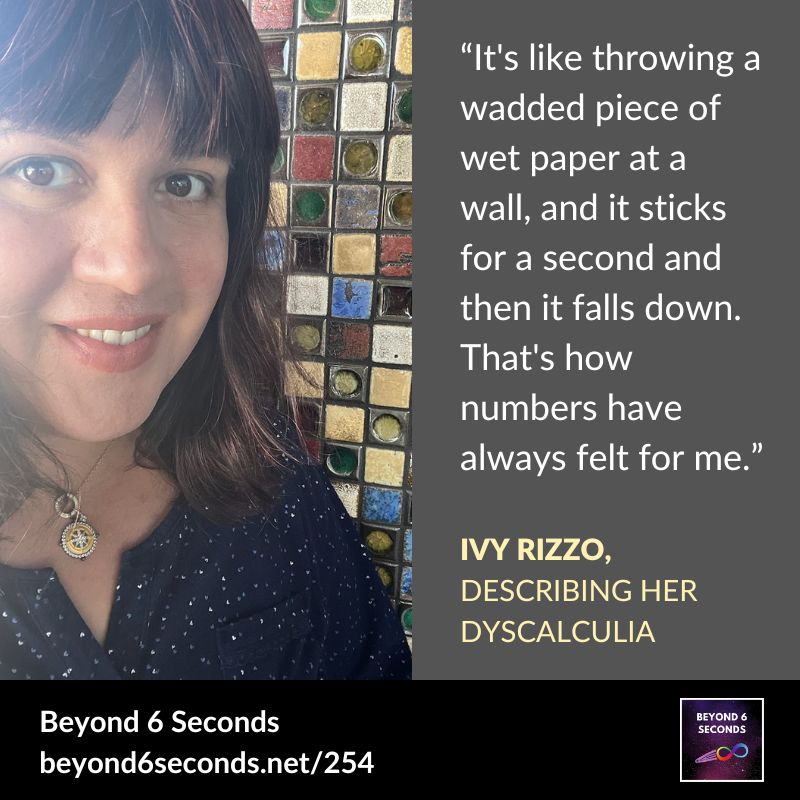
Yeah, just watching other students go through each stages of math and me realizing that I wasn’t getting it. I do think that at one point I was able to memorize some of the multiplication tables and do some division at some point. But, you know, I think his name’s Richard Branson. He’s a famous person who has, I think, dyslexia and dyscalculia. But he described it as “numbers don’t stick.” And, and I love that. Because for me it’s like, it’s like throwing, you know, a wadded piece of wet paper at a wall, right? And it sticks for a second and then it falls down. And that’s how numbers have always felt for me. So I think in the past, there were times when I was little where there was some things that I got, but what I hear from neurotypical people is that they get those concepts and they kind of stay with them for life. And I’ve never had that experience with math.
And with sequencing too, like the months of the year, like I, I don’t think I would remember them if I hadn’t used my other strengths, like lexical strengths or synesthesia to know the months of the year.
Carolyn Kiel: Mm-hmm. Yeah.
So you mentioned you were born in the late seventies, so kind of going through the schooling in the eighties and nineties. Did you, like, did you get a diagnosis of dyscalculia, like while you were in school or did that come later in life?
Ivy Rizzo: Yeah, I was just, I was diagnosed as having dyscalculia as a child. I can’t absolutely remember at what point I learned that word.
Carolyn Kiel: Mm-hmm.
Ivy Rizzo: It was early. You know, I, I don’t remember. But I was lucky I received, you know, I was identified as having all of these learning differences, I believe in first grade. And there was some pushback. It’s funny ’cause my, my dad, both my parents are also multiply neurodivergent. And my dad did the, the typical thing of being like, well, you know, they’re just like me. Ivy’s just like me. There’s nothing, you know. And he was a, professor of creative writing. And so sometimes I wonder if my parents had had more knowledge of what it meant or maybe taken it more seriously if I could have gotten more help. But I just was in the public school system, so I just got that help.
I know I had a math tutor at one point and it was excruciating. Because it was like they were giving me all the tools that you would give a kid who’s struggling with math, but you know, not understanding how dyscalculia works. So I would just sit there for an hour. And you know, they would be like, “they’re not paying attention. She’s not paying attention.” And I was trying, you know, and I remember pretending like that, which has, its the shame. Like I definitely wanna talk about shame today. The shame of kind of pretending you understand. Because at some point it’s like you feel the other person’s frustration so much. And I think this is true with other forms of neurodivergence, you feel the other person’s frustration so much that finally you just are like, well, it’s gonna be easier on both of us if I pretend to get it.
Carolyn Kiel: Yeah.
Ivy Rizzo: Almost like masking.
Carolyn Kiel: It is, yeah, it is definitely a form of masking, I would think is, you know, especially growing up in the school system, you know, the, the focus on like, okay, everyone’s learning this and you should learn it too, and you, you don’t wanna like, disappoint your teacher or whoever. So there is that pressure to be like, well, I’m just not getting this with the tools that they’re giving me, so let me just, you know, let me just pretend that I know it.
School can definitely be a challenge when when there are learning differences. And, and especially back then when I feel like there weren’t as many distinct tools to help kids who were in special education. It was just sort of like in some school districts it was like resource room and other special classes, and that was kind of what they had at that time.
Ivy Rizzo: Oh yeah. I remember being pulled out, and I really liked the lady who pulled me out. I remember my mom told me that when I was little, I said, oh, I really like her, but that I didn’t like being considered a stupid kid, you know?
Carolyn Kiel: Yeah.
Ivy Rizzo: So.
Carolyn Kiel: Yeah. And that stigma, and that goes back to the shame that you were talking about, is just being sort of othered in that way. Even being physically put into a different room for training and getting other supports and yeah, I think that’s, that is difficult.
Ivy Rizzo: We talk a lot in the neurodivergent community about kind of all of the like hacks and extras that we have to do to do things that neurotypical people just do. You know, it’s like, it’s almost like we have to like visualize our, I visualize ’cause I’m a visualizer, but you know, a chess board of like, if I do this, then what happens if I do that? What happens?
And, you know, going through being in undergrad and being like, okay, what major can I do that doesn’t require math? And not having any support in that from advisors or anything.
Carolyn Kiel: Yeah.
Ivy Rizzo: But I remember I, I wanted to do study linguistics. And after the first semester I was like, oh, there’s just too much math in linguistics. Yeah. Well, ’cause you do, you know, there’s like, like I can’t do graphs and equations and numbers and percentages, like, you know? Cause linguistics is really like, also it’s language, but it’s also the science, right? Studying the science of, and science requires numbers, you know?
Carolyn Kiel: Oh, like the science of language?
Ivy Rizzo: Mm-hmm. Yeah. I mean like even in exams for linguistics, there would be like, what percentage of this? Or if this is true in a language, then what can we extrapolate? And it would be in a numerical way.
Carolyn Kiel: Oh, got it.
Ivy Rizzo: Like and so realizing after the first semester, like, I’m not gonna be able to do this because I’m gonna do well in my classes, but fail at the exams, because the questions will be proposed in this kind of scientific way. And I switched over to creative writing.
But I think now, like when I have clients with neurodivergence, I’m always thinking of ways that they can ask for accommodation or accommodate themselves. And so like if I had been able to talk to myself as a younger person, I would’ve said like, you absolutely deserve to be able to have a test that takes into consideration that you’re not gonna be able to answer these questions mathematically.
Carolyn Kiel: Yeah. Yeah. And especially if the math really came in during the exam time, so it wasn’t necessarily critical to understanding the information itself. It was more a way to assess your understanding.
Ivy Rizzo: Yeah! Ironically with all the other neurodivergences I have, I was actually really skilled at in class learning and interaction. I have been somebody who was able to learn how to mask socially in middle school, so I wasn’t able to do it until middle school. But after that I really learned by memorizing how humans interact socially and making it kind of a special interest, which I’m a therapist, so it’s still a special interest today.
Carolyn Kiel: Mm-hmm.
Ivy Rizzo: And so I could do classroom discussion really well, right? Like that intelligence. But yeah, like what if I had had the accommodation?
And you know, there were times where people, really traumatically for me, people would assume that I was cheating or that I was lying about my abilities because of this huge contrast in ability, you know? That’s been true with other parts of my neurodivergent identity. But but with this, like I worked as a, waiting tables when I was young. And I remember every restaurant I worked at, people would be like, ” wow, this person’s really good at interacting with the customers. They’re good at this, they’re good at that. Real strengths at like always coming to work.” You know? But, the people who were in charge of the money, I can still see the looks of like kind of frustration and disgust on their faces of like, you know, this was before people walked around with tablets doing, you know, so the wait staff had to figure everything out with money. And there was a specifically a woman who was just, I could tell this, like this person liked me as a person, but was just so like, didn’t wanna see me walking up at the end of the day.
Carolyn Kiel: Wow.
Ivy Rizzo: Or I remember I worked at a cafe and would close down the cafe at night, which meant tallying the numbers of the money that came in. And I remember getting a phone call the next morning from the staff that opened where they were just furious with me about the numbers.
And then the number one most shameful experience I had was actually after graduate school. I had a supervisor who was really burned out. And I don’t, are you a therapist?
Carolyn Kiel: I’m not, no. But I, I do have psychology degrees. I have in organizational psychology, so I’m therapist-adjacent I guess.
Ivy Rizzo: Yeah totally, totally. Okay. So, you know, in our field, because it’s a helping field, there’s a decent number of people who are pretty burned out. And this supervisor was very burned out. And I was a new therapist. And part of like, when you become a therapist, you have to accrue a lot of hours, you know, of work before you can get like, full licensure. And what that means is just keeping a tally, the number of hours that you work, number of clients that you see. And she was really burned out. I think she probably didn’t get other parts of my neurodivergence either. I remember walking into her office in the mornings and she would just say “what” to me. And I was like, why is this person being so mean? And then it came out that she felt I was lying about my numbers for licensure because I had messed up or transposed so many of them over the time that I was doing it, to such a degree that she actually called the ethics board on me. And I, I mean, I mean, that’s so scary as somebody who’s gone through all this work to become, and I was just a young therapist. I didn’t have people to consult about it. And she called them and was like, you know, I think this person’s being unethical.
Carolyn Kiel: Wow.
Ivy Rizzo: I am concerned about this, whatever. And luckily one of the people on the board knew me and was able to say like, no, that I’m sure that they’re not. And like, there’s gotta be an explanation for this.
But that I think was so traumatic to me that there are times where I see myself avoiding things that have to do with big numbers, like figuring out my taxes or figuring out major moves in life where I’m like, what if I mess this up numerically? Even things like, you know, I have young children and they were both diagnosed with anaphylactic food allergies at a young age, and that requires a lot of awareness, like reading labels and carrying an Epipen.
Carolyn Kiel: Mm-hmm.
Ivy Rizzo: And, so there, there’s definitely been trauma for me around this neurodivergence.
Carolyn Kiel: Yeah. Yeah. That is really scary. When it, it, you know, it, people don’t understand and it can have an impact like that on your whole career. Like that’s, that’s huge. Wow.
It goes back to again, that spiky profile that we call it, that people really don’t understand. If you seem like you’re really strong in certain areas, a lot of times people have a hard time believing that you might have big challenges in in other areas that seem to come easily to so many other people.
Ivy Rizzo: Totally.
Carolyn Kiel: Or people just take it for granted.
Ivy Rizzo: Yes. Yes. And it’s like, it can be confusing because it’s like, well, like, for example, with this podcast, I’ve actually been invited to be on like, a lot of podcasts and I almost, I think I’ve always said no. This is the first one. ’cause I was, this year, I was like, I need to start saying yes to more things.
Carolyn Kiel: Oh my gosh.
Ivy Rizzo: But I think that when, when we’re neurodivergent and our brains process things differently, there are all these buildup of traumas that make us go, I’m gonna say no. I’m gonna say no. I’m gonna say no to all the things that feel scary, right?
Carolyn Kiel: Mm-hmm.
Ivy Rizzo: Because we’ve had such experiences of rejection and shame.
Carolyn Kiel: Yeah.
Ivy Rizzo: But it’s like it does over time, you know, it kind of aligns with the monotropism and, and hyperfocus.
Carolyn Kiel: Mm-hmm.
Ivy Rizzo: It’s like we become really narrow sometimes in what we say yes to.
Carolyn Kiel: Yeah.
Ivy Rizzo: Because there’s like, I don’t wanna experience those painful things again.
Carolyn Kiel: Yeah. Well, yeah, I’m, I’m very flattered and, and honored that you, that this podcast is the first one that you’ve said yes to, and I’m, I’m, I’m really happy about that, so thank you. I’m really, I’m so glad that you’re here!
I’m not usually on as the guest, but occasionally I will go on other shows as a guest and yeah, it is always a consideration is like, is the host going to really understand what I’m talking about, like how much am I gonna have to educate them, you know, what kind of conversations are we gonna have? Like it’s, it is an unknown. So I could totally see how that’s, if you’ve been misunderstood so many times in your life, how you would have the inclination to say no before you say yes.
Ivy Rizzo: Yeah, and that can look like, you know, we talk about Pathological Demand Avoidance,
Carolyn Kiel: Mm-hmm.
Ivy Rizzo: PDA in neurodivergent communities, and it’s kinda like, why do we do that? You know? And for the people who might be listening who don’t know what it is, it’s adjacent to, to other, to neurodivergence. Like it comes along with neurodivergence, but it’s like tendency to to avoid demands, right? And it can demands from other people or demands internally. And like I, I feel like we talk about that as if it’s so confusing as to why we have PDA, but it makes sense when you think of at a very early age, everything you do, you try your very hardest to do well with all the capacity that you do have, and you still fail. So then it’s like, well, I’m not gonna try. Or I’m not gonna do what you tell me because I’m just gonna not do well at it. Right?
Carolyn Kiel: Yeah.
Ivy Rizzo: I’ll do it my own way.
Carolyn Kiel: Yeah. And I think, you know, it’s not just the person saying like, “well, I don’t feel like doing that because it’s hard, or I just don’t want to.” The idea is that your nervous system interprets it as a threat. So it is a serious, you know, physical and emotional and mental reaction to a demand that some people have and I think it’s something that we, I, I feel like psychology has been trying to understand it. ’cause I’m like, well that sounds a little bit like oppositional defiant disorder. It’s a little bit like I’ve heard, I’ve seen like pieces of it coming up through the literature. And yeah, it’s interesting. The concept is still there and I think we’re still really trying to understand like what that really means.
Ivy Rizzo: Yes, yes. Yeah. And so, you know, I do think it impacted me, my decision to come on and do this with you knowing that you were neurodivergent. It’s like, I know how we’re seen. You know? And so like with you, I know I can monologue. Which people don’t know, with neurodivergence it’s common, especially with autism, for people to talk longer than what is seen as a normal amount of talking in conversation, you know?
So,
Carolyn Kiel: yeah.
Ivy Rizzo: that made me feel comfortable to know I can just kind of expound.
Carolyn Kiel: No, that’s great. I think, you know, especially with topics like this, that we don’t get to hear a lot from people’s lived experiences of what it’s like to have dyscalculia or other types of learning disabilities. So I’m more than happy with people who wanna come on and share very, you know, openly about what it’s like for them.
It’s I think it’s important. So, yeah. Thank you for, thank you for doing that today.
Ivy Rizzo: Yeah, of course.
Carolyn Kiel: You did talk a little bit already about how dyscalculia impacts your daily life now as an adult. You are a therapist, you have your own practice. I’m sure there’s some level of numbers and calculations that come into running a business or a practice like that. So like how, like how does that impact the way that you either run your business or do your therapy with clients?
Ivy Rizzo: It’s been hugely impactful. You know, I, I’ll even sometimes joke that people think, oh, being autistic or ADHD or, you know, even hyperlexic, et cetera, is the most impactful thing. And I actually think my dyscalculia in many ways is the one that’s the hardest because other people don’t get it.
Carolyn Kiel: Yeah.
Ivy Rizzo: Like very, very few people really understand the breadth of how it impacts me.
So for one thing, I worked in community mental health probably way longer than I needed to. People maybe don’t know, but as baby therapists, many of us who don’t have the finance, the financial background to start out in private practice, will start out in community mental health. And there’s lots of great organizations, but many, many kind of take advantage of young therapists by overworking them, underpaying them. And so, you know, you can do it for so long. I remember having a supervisor who was like, this work is work you do when you’re young and then you’ve gotta move on.
Carolyn Kiel: Mm-hmm.
Ivy Rizzo: And so many people will work in community mental health for five years, 10 years maybe at the most. And I think I got closer to like 15, you know, because I knew if I went out on my own, I’d have to do all of these systems that required numbers. Luckily things have become more automated, more digitalized. And so that’s one thing, right? The difference between making $40,000 a year and a hundred thousand dollars a year, right? Is working in community mental health.
Carolyn Kiel: Yeah.
Ivy Rizzo: Then when I finally did go into private practice, I had to be so, you know, monotropic in my choices of how I practiced because of the numbers too. So I feel like I had to be super skilled in order to be successful because I, I don’t feel that I can take insurance. Because insurance requires, like all of this auditing, right? They do all this auditing of your numbers and your codes and everything that when you’re in private practice, like I don’t, I’m not even required to give people a diagnosis unless they want one, right? But, but messing up on a simple code, right? A number for how you code things or the time or the date. If you’re working with insurance, they can do something called a clawback where they go back in and take the money back from you. And you know, my fellow therapists a lot of times don’t get that. They’re like, why don’t you take insurance? And luckily I have a full caseload of private pay clients. You know, I mean, I, I’ve been really lucky, but I, again, it’s like, I feel like I have to over excel and be like extremely good at what I do in order for me to be able to do my practice the way that I want.
But kind of embedded in your question that what I love is like, how do you explain this to clients, and do you have to? Because I work with many, many of my clients are neurodivergent, I do really model talking about my neurodivergence in real time. I try to only do it when it feels clinically relevant to them, which includes the relationship. So like clinically relevant might be like, I’m not gonna just share about my relationship, but maybe, right, with a lot of thinking I might share about, oh, I’ve learned that I need to communicate about my trauma in my relationship or something because like I, you know, that’s not a great example, but we as therapists, always should be thinking about whether what we share about ourself is clinically relevant.
So I always start out, when I very first see clients, I will work it into like how I talk to them about what we’re gonna do by saying something like, “just so you know, these are the forms of neurodivergence that I, I bring on board with me and this is how they might show up.” And I will say, if I’m talking about dates that we’re meeting up, or I’m talking about maybe you said an age you were when something happened. Or you know, there’s money, right? We’re talking about money, and I make any mistake, I really invite you to let me know because of this learning disability I have. And I will sprinkle it in. Like if I make a mistake with a number or a year or whatever, I will say, oh, that’s my dyscalculia I told you about.
Carolyn Kiel: Oh.
Ivy Rizzo: So I’m not talking about me, but I’m setting them up. And I like to think that it’s modeling for people how to really be preventative and proactive around neurodivergence. And then I think it also helps the general population that I work with, even if they’re not neurodivergent, to start thinking in terms of brain processing differences, right? “Oh, my therapist, who like I admire and I think is smart can’t do basic math!” Right? And so I think that invitation, that communication is important.
Carolyn Kiel: Yeah, no, that’s really powerful because there’s a difference between, you know, disclosing your neurodivergence. Like for me, if I would say, I’m autistic, then certain people have different ideas in their head about what that means and what behavior or how they expect I’ll react to things.
So going that extra step if something comes up in a conversation saying, oh, this is related to my autism, because that’s maybe why I, you know, didn’t pick up that you were trying to tell me something through a social cue. I don’t know, something like that.
But I think that helps bring it home like, oh, okay, now I understand. And the other person doesn’t have to guess or sometimes totally misunderstand and misinterpret. And especially with things like money, which socially people are, there’s a lot of anxiety around talking about money for a lot of people. So it’s important for you to say like, oh, you know, I, I made this mistake, or I reverse these numbers and that’s my dyscalculia. So people don’t think like, oh, there’s some weird, like, I can’t bring this up. Or there’s something like, you know, bad going on. So that’s, I think that’s really important for education.
And if a lot of the people that you work with are neurodivergent themselves, I imagine that that is also an important connection to have, at least that sort of baseline understanding of, of common experiences too.
Ivy Rizzo: Because the relationship piece, I think with all forms of neurodivergence is so important, how it impacts our relationships. And if we can’t kind of get ahead of it and have that transparency, you know, which is hard ’cause we all have different levels of communication skills, right? And that’s a really sad piece is that there are a lot of people who have lower capacity when it comes to communicating, right?
And so, like for me, I can use my hyperlexic ability to explain myself in relationship. But then what happens with people who can’t explain themselves in relationship?
And when I was younger, there was real fallout in relationship from dyscalculia. Like I would miss important things because I didn’t have the iPhone that we have now with dates. I couldn’t hold the dates in my, I’d be convinced I had an interview on the 14th and it was the 16th, you know, or I was convinced my friend’s birthday was the 18th. And, you know, I’ve had many times where it’s like I show up to something and they’re like, well, it started two hours ago. And I’m like, oh, it’s because I will transpose, you know, I will hear a number and then think another number.
And this is a, you know, a piece I wanted to bring up too and how it impacts me. I can’t hold the, I, like I said, I can’t hold numbers in my head. So like, you know, when they do those, those things where you have to have a code and they like show you the code and then you have to switch to another screen and enter the code.
Carolyn Kiel: Or it comes on your phone, you have to type it in.
Ivy Rizzo: I often will have to go back to the initial screen one or two times just because I can’t, if I can’t write it down, I can’t hold numbers from one second. It’s like a number of like three seconds, four seconds. I can’t hold them in my head.
Also this is another one that impacts relationally because it seems so strange, but I can’t remember like basic things I’ve known or heard hundreds of times. So for example, like let’s say I have a code for my debit card. Most neurotypical people, right, they know their code for their debit card and they just use it. And I’ve had the same one, you know, for years! And yet I still have to go through a thing in my head many times when I’m at the cash register, which might be a trauma response, but where I go, you know, I have like kind of, there’s a thing that I know the number relates to and I have to go back to that thing and be like, okay, there’s this, is this number right? And I still get it wrong sometimes and the panic comes up.
Or, my kids’ birthdays. That’s, I mean, that’s a wild thing, right? Like people don’t understand, like, how could you? One of my children I got their age wrong this year and I could just tell they were like, you know, how could you not care enough to?
Carolyn Kiel: Mm-hmm.
Ivy Rizzo: But like, it’s not about caring. But if you, you know, with people’s birthdays and things like that. You know, luckily both of my kids’ birthdays are on dates that are really famous dates, and so I lucked out in that way, you know?
But like, yeah, there’s, yeah, the, the remembering things like even my social security number or things that feel to other people like, oh, you, how could you possibly forget that?
Oh, this is an important one too! And I don’t know that this is true for all people with dyscalculia, but I can’t remember events chronologically very often. I can remember them visually or through a story. But I, like, I’ll hear neurotypical people be like this happened in second grade, or this happened in 1984. Or my partner’s the type of autistic person who can remember like, this movie was made in this year. This actor was this age. You know?
Carolyn Kiel: Mm-hmm. Yep.
Ivy Rizzo: And there’s no way! There’s no way.
Carolyn Kiel: Mm-hmm.
Ivy Rizzo: So, you know, sometimes that feels like a loss. Like I wish that I could remember my life in more of a chronological way.
Carolyn Kiel: Yeah, yeah. And that’s, thank you for going into more detail about that, because I don’t think people really think about how, you know, having, you know, having the numbers not stick in your head how that impacts real world relationships beyond, you know, doing a math test or like, you know, actually doing math itself. But it is, it’s so much broader than that. So, yeah, thank you for highlighting that because there really are so many different ways that dyscalculia can impact so many different parts of your life. Yeah.
Ivy Rizzo: I think I would, if I was thinking about children with dyscalculia and parents, you know, I think that really trying to help your child to understand how neurodivergence works more broadly, I would offer that so that they can advocate for themselves. Rather than like, I think a lot of parents do a lot of work to like get the kids a math tutor or maybe even advocate for an IEP, you know, these kind of things which are important, but really helping their child to understand, oh, like these are the ways in which your brain, you have strengths, these are the places where you might have differences. Do you think visually? And then, you know, if you have the resources, finding resources that are specific to kids with dyscalculia.
Carolyn Kiel: Mm-hmm.
Ivy Rizzo: But like what I wish my parents had been able to do, which they just didn’t know, would be to really validate my experience, right? To really say like, yeah, this is real. It’s not just you not trying hard enough.
Carolyn Kiel: Mm-hmm.
Ivy Rizzo: You know, these are the places that you could ask for accommodation. This is how you talk about this thing.
Carolyn Kiel: Mm-hmm.
Ivy Rizzo: I don’t know if that helps
Carolyn Kiel: Yeah.
Ivy Rizzo: but.
Carolyn Kiel: Yeah, for sure. Because you had mentioned earlier in our conversation that because you have synesthesia, you’re able to connect other, whether, you know, it seems like a lot of visual images to the math to help you remember and understand and process math things. And I think that that, I don’t know how often that happens in accommodations. I would imagine that you would have to learn that about yourself first, how you learn best, and then try to get those accommodations to help you.
Are there resources for that? I don’t even know.
Ivy Rizzo: I think that now there are a little bit more. There’re obviously neurodivergent coaches that do, you know, I do coaching work, I don’t work with kids. But finding coaches, first and foremost always, if you can find somebody who actually is neurodivergent themselves to work with your kids is like such a, such a big deal, you know?
Carolyn Kiel: Yeah. It’s really great that there are more options for accommodations these days than there were when we were growing up.
Ivy Rizzo: And I think there are math like, in the way that we have curriculums for dyslexia, I think that there are ones for math. And I just don’t, you know, I’ve never, at this point, I’ve never gone back and learned about them, but they do it.
Carolyn Kiel: Yeah, good. Yeah, definitely something for people to consider, or parents who have children with dyscalculia. Different curriculums and different ways to learn.
Wow. And you know, you mentioned a couple times you know, now we have a more digital world. Most of us have like smartphones in our pockets all the time.
Does that help you now, like basically like having a calculator on your phone, does that help as an accommodation or is that still a challenge because it’s still numbers?
Ivy Rizzo: I mean, it helps so much. For sure. Yeah, definitely it helps. I mean, I do have some workarounds.
Like, this is how I do tipping in my head. So I use my hands. I go, okay, for every $10 there’s $2 to make 20%, you know?
Carolyn Kiel: Yep, mm-hmm.
Ivy Rizzo: And so then I’ll go, okay, how many tens is this?
Okay, the bill’s $50, so then I’ll go 1, 2, 3, 4, 5, 6, 7, 8, 9, 10, right? To figure out how much I should tip. You know, like I, yeah. And so that was before, and now I can just type it. You know, rather than having to do all that work, you know.
And I do that visually, like when I’m doing that, I’m seeing two numbers. Two numbers, two numbers, two numbers, two numbers, but then I also have to say it out loud in order to hold it. Right. Using my hand, I’m using visualizing and I’m saying that out loud.
But, but yes, having the phone has been incredible. Like I said, you know, feeling like I’ve let people down because I’ve missed appointments. You know, even today, like I couldn’t hold what date or time we were meeting,
Carolyn Kiel: Mm-hmm.
Ivy Rizzo: but because it was in my phone, you know, I could go back and look. So yeah.
Carolyn Kiel: Yeah, and like, you know, calendar reminders and notifications, I’m sure for things like that can be helpful. Well helpful for everyone, but especially if, you know, important dates are, are a challenge. If you now can have your calendar or your phone pop up and remind you like, Hey, in a week it’s this important date, or today is somebody’s birthday, like that’s, you know, that I imagine that’s probably helpful too.
Ivy Rizzo: Yeah. Yeah. And there’s I, I still make mistakes though. I still will have times where I, I think, oh, I can hold this in my head. I, I’ve remembered this, and then it comes to it, and it’s wrong.
It’s funny ’cause, you know, we grew, I grew up at least with teachers saying, well, you won’t be able to carry a calculator around with you.
Carolyn Kiel: I did too. And I, I thought of that phrase a couple times while we were talking. Now it’s like I have to bring that up at the end that like teachers always told us we wouldn’t be able to walk around with calculation in our pockets, and now that’s what most of us do all day long.
Ivy Rizzo: Yes. Yes, totally.
Carolyn Kiel: Well, yeah, Ivy, it’s been really great talking with you. How can people get in touch with you if they wanna learn more about the type of work that you do?
Ivy Rizzo: Yeah, I mean, they can just Google search Ivy Anna Rizzo New Mexico, will come up. I used to do a lot through something, my name or whatever was @mightbeautistic. And then I took a couple years off of doing social media stuff. And now I’m using @ivymooninstitute. So not doing a ton.
I just got on Threads not too long ago and started doing some advocacy stuff on there, and that’s been fun. Yeah, they can reach out to me through my website. Just Google me.
Carolyn Kiel: Okay, great. Yeah, I think I have your website somewhere in my notes, so I can put that in the show notes so people can just click the link and go right there if they want.
Ivy Rizzo: Yeah.
Carolyn Kiel: Ivy, as we close out, is there anything else that you’d like our listeners to know or anything they can help or support you with?
Ivy Rizzo: I think just bringing the kindness and grace to yourself, if you’re neurodivergent, and then to the neurodivergent people in your life and just, you know giving accommodation and assuming good intent I think is, we need more of that in our world today.
Carolyn Kiel: Thank you. That’s very important. Thank you again for sharing your story. It’s been really enlightening, I know for me, and I’m sure my listeners will agree as well. Just really important for people to understand more about dyscalculia and how it impacts people’s lives. So yeah, thank you for talking more about that today.
Ivy Rizzo: Thank you!
Carolyn Kiel: I hope you enjoyed my conversation with Ivy about dyscalculia today! If you’re interested in learning more about people’s experiences with having dyscalculia, check out my episode with Elena Chambers. It’s episode 190, so you can find it at beyond6seconds.net/190.
And if any of my podcast episodes have had an impact on your life, your heart, or your perspective in some way, I’d love to hear from you. Send me a message on social media or through my website at beyond6seconds.net/contact. Your feedback means a lot to me, and it helps me keep going with this show. Thank you.
Thanks for listening to Beyond 6 Seconds. Please help me spread the word about this podcast. Share it with a friend, give it a shout out on your social media, or write a review on Apple Podcasts or your favorite podcast player. You can find all of my episodes and sign up for my free newsletter at Beyond6seconds.net. Until next time.