Episode 262: Learning to read at age 32 – with Oliver James
-
play_circle_filled
Episode 262: Learning to read at age 32 – with Oliver James
Carolyn Kiel
Oliver James is a California-based personal trainer, motivational speaker, literacy activist, and influencer. He has been featured by Today, NPR, the Jennifer Hudson Show, the Los Angeles Times, Newsweek, Rachael Ray, and ABC News, among many others. Additionally, he received the Barbara Bush National Literacy Award in 2023.
Oliver is the author of “Unread: A Memoir of Learning (and Loving) to Read on TikTok.” His book is about teaching himself to read starting at the age of 32, and his experience with childhood learning disabilities and educational neglect. In just 365 days, he went from barely being able to read a restaurant menu, to closing in on his goal of finishing 100 books in a year.
Oliver has become a TikTok/BookTok sensation for the way he’s documented his decision to learn to read as an adult, and his struggles and triumphs along the way.
During this episode, you will hear Oliver talk about:
- Why he describes himself as being “functionally illiterate” and how his experience with literacy “started wrong”
- What inspired him to share his journey to learn how to read on social media, at the age of 32
- How reading has profoundly changed his perspective on life
- What it was like writing a book about his experience
Buy Oliver’s book “Unread” on Amazon, Barnes & Noble and Bookshop.org.
Follow Oliver on Instagram, TikTok, Threads and YouTube.
Email Oliver at OliverSpeaks1 [at] gmail.com.
Learn more about the Nardagani app that has helped Oliver learn how to read.
Contribute to Carolyn’s tip jar to support this podcast at BuyMeACoffee.com/Beyond6Seconds!
Follow the Beyond 6 Seconds podcast in your favorite podcast player!
Subscribe to the FREE Beyond 6 Seconds newsletter for early access to my latest podcast episodes!
*Disclaimer: The views, guidance, opinions, and thoughts expressed in Beyond 6 Seconds episodes are solely mine and/or those of my guests, and do not necessarily represent those of my employer or other organizations. These episodes are for informational purposes only and do not substitute for professional medical advice. Consult a medical professional or healthcare provider if you are seeking medical advice, diagnoses, or treatment.*

The episode transcript is below.
Carolyn Kiel: Welcome to Beyond 6 Seconds, the podcast that goes beyond the six second first impression to share the extraordinary stories of neurodivergent people. I’m your host, Carolyn Kiel.
Carolyn Kiel: On today’s episode, I’m speaking with Oliver James, a California based personal trainer, motivational speaker, literacy activist, and influencer. He’s been featured by Today, NPR, the Jennifer Hudson Show, the Los Angeles Times, Newsweek, Rachel Ray, and ABC News, among many others. Additionally, he received the Barbara Bush National Literacy Award in 2023.
Oliver is the author of Unread, his new book about teaching himself to read starting at the age of 32, and his experience with childhood learning disabilities and educational neglect. In just 365 days, he went from barely being able to read a restaurant menu to closing in on his goal of finishing a hundred books in a year.
Oliver has become a TikTok and BookTok sensation for the way he’s documented his decision to learn to read as an adult and his struggles and triumphs along the way. Oliver, welcome to the podcast.
Oliver James: Hey! Thank you for having me.
Carolyn Kiel: Yeah, I’m so excited to talk to you about your new book. By the time this episode comes out, it will be out and available for people to read and purchase.
I got a chance to read an advanced copy and I absolutely loved it. Your story is so compelling, your insights about things are just really amazing and I really believe this book is going to help and change the minds and lives of so many people.
In your book, which is called Unread, you describe yourself as being “functionally illiterate.” Could you tell me more about what that means?
Oliver James: One of the problems about being functionally illiterate is that you don’t know much about being functionally illiterate. So like I am the functional, illiterate person. So the fact that I don’t have the understanding to know things that I have issues with, like reading, it makes me functioning illiterate.
Like, I don’t know I have issues a lot of times. Like I’m just, I’m realizing now as I start to learn that I’m like, oh, crap. Like I do things a little harder when it’s comes times to fill out applications. I do things harder when it comes time to read things. Like, it becomes an awareness of you realizing that you exist as someone who does things a harder way. Like everything is harder. Like you, you get your driver’s lessons, 10 times harder. Everything. You go out to eat, 10 times harder. Anything you wanna do that involves reading, it’s 10 times harder.
So that’s what I could like, base being functionally illiterate off of, like, from my understanding. Because I am functionally illiterate and I could give you an answer, but I can only give you the real answer like I just gave you now. Like, I don’t know. I just know I’m all, I, I’m not good at doing a lot of things with reading. That’s it.
Carolyn Kiel: Oh. So is it being able to read some words or just guess in context? Or I guess some level of reading but it takes longer? What’s your experience with that?
Oliver James: Well, I think like, because yes, all those things are yes, but I think the, the part that makes it functionally illiterate like is functioning in society.
Carolyn Kiel: Oh!
Oliver James: So you’re illiterate at functioning in the way society has educated itself up to be. You’re illiterate to it. There are so many things from your daily life, things that you do to just getting out the bed and knowing how to do the steps of a daily process is totally different to a person who doesn’t read compared to a person who can read. They have a totally different world, like it’s not the same world.
And I think that’s what I’m trying to touch base on with a lot of it is to let people know, like what I mean by functional literate, I could tell you like, yeah, I struggle at reading. But there’s many people who struggle at these things. Functionally illiterate like would be a person who is, he is having a hard time functioning in society. Like he is illiterate to it. It’s not, it’s not the same between you and I.
Carolyn Kiel: Yeah. Yeah. Reading your book really shows that point is how hard it is if you are functionally illiterate or can’t read, how many things in society really hinge on being able to read at, at a certain level or a certain expectation. It really does impact not just reading things, but almost every aspect of your life.
Yeah, absolutely. And I guess this, a lot of this really started in, in school for you where you experienced a lot of educational neglect and you also have learning disabilities that contributed to that and, and a whole host of other factors. So what was school like for you as you struggled to read or really just didn’t learn the basic concepts as you were going through school?
Oliver James: One of the most amazing things about this journey, right, is that I’m not giving you like a finished product of me. I’m giving you a product of me in development. So stuff that I’ve like went through, I processed, like when I was writing the book, I’ve changed to a whole different place with it now.
And it’s gotten to a space where, you know, this may be the answer or not, ’cause sometimes I go off on my own little tangent. But I can see now that like not having a, a relationship built from the beginning with, with literacy is where everything has started. That’s where everything started. That foundation has to be built and imprinted into you as if like speaking is. Like, before you even know you’re conscious of even knowing it. You gotta have a relationship with it.
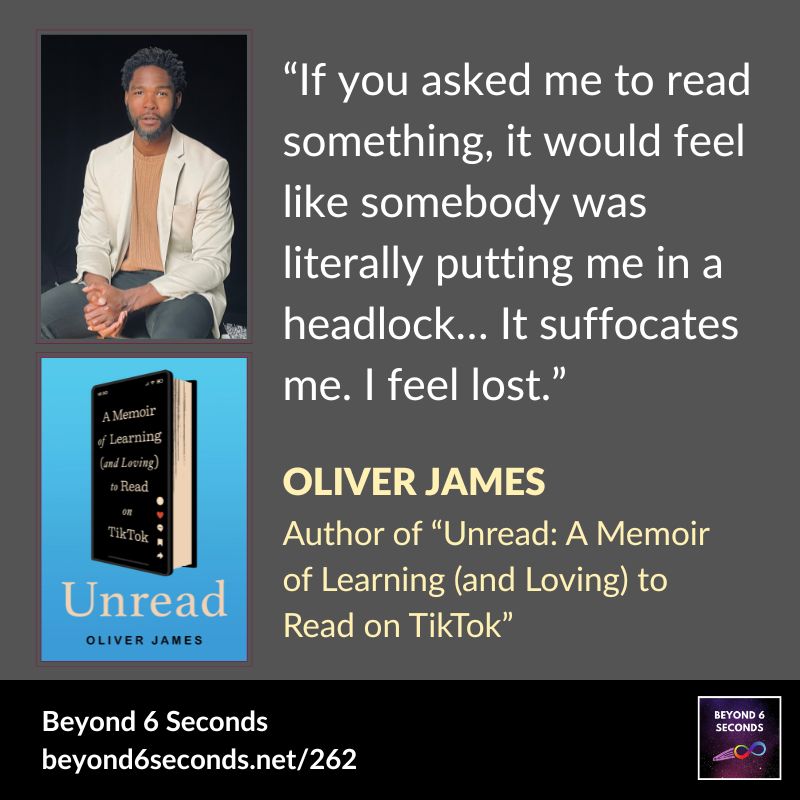
Like when I talk to you, I have no bad relationship with my communication speaking with you. I just speak to you and it, it feels normal. But if you asked me to read something, it would feel like somebody was literally putting me in a headlock. I’m like, it would, it, would it. That’s what it feels like. It suffocates me. I feel, I feel lost. And I realize, I’m like, it’s not just the reading part. I’m like, you don’t even have a relationship with it. To feel comfortable to even exist in the place of a, as like, as a reader, you don’t even, you don’t even, I don’t feel, there’s, there’s no connection. And I realize, I’m like, because nothing was built, there was no foundation built in my household or before, wherever it was. Like that, that had to be the first part of where my, my literacy journey, I guess you would say like, started wrong. Like, it needs to start there. Yeah.
Carolyn Kiel: Yeah, absolutely. As you said, it needs to start early or as, as early as possible. Or it’s hard to catch up when you don’t have the early foundations for, for a variety of reasons. Wow.
And you also, you have ADHD, you have OCD, PTSD that you got later on in your adult life. So that was compounded against the education and the environment around you, not really supporting literacy or encouraging that when you were younger.
Oliver James: Yes.
Carolyn Kiel: In your book you also talk about the impact of shame, which is something that happens a lot if, if you’re someone who can’t read or, or can’t read well. Part of that is also trying to keep that information from people, because unfortunately, as you talk about in your book, people will either judge you or they might take advantage of you, or it’s a very difficult situation to be in. So you do talk about shame quite a bit in your book. But I guess, how does that, that feeling of shame like make it hard to ask for help when you’re struggling with something like reading?
Oliver James: It feels the same as if any shame you’ve, like you’ve ever experienced, that’s not even related to reading, but just in general. So it, they don’t separate shame and shame.
But I, I will say, like to revert back to what I was saying before, the relationship, that’s how shame starts to creep in. I still struggle as I’m speaking with you and telling you the struggles and I still have shame, like, but I have a relationship now with reading. So I don’t, I don’t, it, it just seems silly to like, to feel bad about it or something. Like, I’m like, that’s silly. I’m like, I’m, I have a great relationship with literacy now. So it’s, there’s joy in it. And I’m like, whatever. Like, I, I’m gonna get better. I don’t. So I see that, I’m like, wow! I’m like, the shame is there. But I’ve, I’ve built a good relationship with, with reading now, and it’s a part of me now. It’s not like a separate piece. So.
Carolyn Kiel: That’s really important and it takes so much self-reflection. And as you said, probably the process of writing the book helped you continue to process and change as a person. ’cause you’re, you’re constantly changing, constantly learning and, and growing as a person, as we all are or as we all should be. So yeah, that’s, that’s really powerful.
Just to go back to an earlier point you were talking about, or we were talking about how not being able to read really impacts every aspect of your life. And who you trust, the type of environment you’re in, different decisions that you make in your life. And there was at one point you talk about in the book how your struggles with reading wound up getting you in trouble with the law and and spending time in prison.
And I, I want people to read that section of the book because it really outlines so well, like how, how that all happened. Can you tell me more about how not being able to read got you into that situation where you did wind up getting in trouble with the law?
Oliver James: Like I said, I, I’ve grown so much to, so like even from then ’til now, no, nothing changes too much, but it changes enough to see it as like, I guess I can shorten my answers down to things like, not knowing how to read left me with not many options. Being able to read gives you options. If there’s no options inside of your brain, like you, you, you go with the best option that you think is suitable for you. And I think a lot of people need to understand that. Like you don’t push it on him. It’s like, oh, if he could read, he’s gonna make better choices. I’m like, no. If he could read, he has more choices. So maybe he doesn’t make the wrong one. I’m like, so I’m like, that’s the only difference. I’m like, but when you can’t read, y you just, you’re working with just a couple, two or three. And you can read, you are working with endless choices. So you can like, oh, what? Well, it’s two different types of versions of you. And now, like I said, as a reader, as a person who enjoys reading, even having this conversation with you, you’re able to understand. I’m like, wow. He gets it. He gets that reading gives you an ability to, I’m like, yeah, but that, that’s something I couldn’t give you before. ’cause I didn’t have no choices. I didn’t know how to, to read.
Carolyn Kiel: Yeah, no, and that, that makes a lot of sense. And related to not having as many choices, you probably have to trust a lot more people that they’re, that they’re being honest with you or that they’re saying things the way that they should be, because you can’t double check them and, and read or get different opinions from people who aren’t
Oliver James: Yeah.
Carolyn Kiel: in your immediate environment.
So that’s part of it too. Yeah. Wow.
Oliver James: Yeah, it gives you much more options. All that you just mentioned. If you could read, you just did it yourself. You could have just, you could just did all that yourself. And
Carolyn Kiel: Yeah.
Oliver James: How many, how many decisions you just avoided. How many situations and interactions you would’ve avoided now just because you can read it yourself.
Carolyn Kiel: Yeah, yeah, for sure.
When you were 32 years old, you were already a content creator on social media in, in the fitness world. But you decided at one point to basically come out and share with your followers that you can’t read and that you were going on this journey to teach yourself how to read. So what kind of made you decide to finally do that at age 32?
Oliver James: Well, there were many things. But I think from where I’m at now, and even where I was at then, I just didn’t realize it, is I wanted, I wanted like freedom. I wanted freedom from the things that were holding me back. Like there were so many things that, like, now I, like I said, I live on my own. I I try to pay my own bills. I try to read my own emails. I try to set up my own Zoom links. This is all new for me. Even like right now. I’ve always had help with everything. And even right now as I did this, I’m like, like something, like something’s not right. Like how am I doing this all alone? You know what I mean?
And I, this is, this is, this is why I started reading. So the joy that you’re getting to experience is actually happening in the moment right now. Me setting up my little fan light and trying to figure out the email while I’m living in my camper van with solar so I can get battery. And I’m just thinking, I’m like, you’re doing all of this dude! And like, now you’re in the email and you’re searching, you’re looking for you. And I’m like, okay, I found you! I clicked. I’m like, those things weren’t things I did. Like, I didn’t think like that was my space and now I do it.
I don’t know. Again, I go off on these tangents, but you’re catching me at a really enlightened time, I would say. Like I’m really changing my, my, my world. So my world is, back to where we were at, it’s becoming more free, but very, very uncomfortable. Because again, like I said, living on my own. Doing all this stuff on my own. Trying to, like I said, trying to pay my bills. I’m messing that up completely. But I’m like, oh, you know what, at least I’m messing it up. I’m like, I’m like, I’m, I’m, but it’s making sense that I’m doing it. And I would never do those things before. People paid this for me. I send them Zoom, Venmos or cash apps, and then they pay it. Like I just, I never did this stuff ’cause it was too hard.
Carolyn Kiel: Wow.
Oliver James: So, now I do!
Carolyn Kiel: Reading really changed your life and also a lot of your perspectives on life because you spend a lot of time in the book going into a lot of detail about how reading really, really opened your mind. And in some ways was, as you said, like really freeing but also like an information overload and, and scary at certain time. It’s like the whole world opens up to you and all this knowledge and perspectives and experiences that you had no idea exist, you now have access to all of this. It’s like, it’s like plugging into the whole internet, like all at once one day when you’ve never been on the internet before. And it’s like, whoa! It’s just too much! So yeah, really, that’s really powerful.
And it changed your, your perspectives on yourself as well. So, I guess what was the biggest way that reading really changed your perspective on, on life, whether it’s your life or just like life in general?
Oliver James: I would say my emotional intelligence. My, the empathy. The thought now to actually like, take a second and think about some things. I, I think that comes with age in general, but yeah, I, I’m gonna be honest with you, even though I was getting older, I wasn’t getting older mentally. So I wasn’t, I wasn’t really, I wasn’t really aging enough where I can say like now I can sit back and feel someone else’s situation and feel encouraged to help, encouraged to like wanna see them do better, wanna see them do better than me. And I’m like, I don’t even know you. I just want you to do better than me. I’m like, because just feels good to see people do good. And I’m like, and I like it. It’s not just about me. It makes me happy to see people happy.
I think reading gave me a, a friendship, like a, a friendship I needed so I could, I can observe. Instead of like having to go out and make so many friends to, to, to maneuver around the world. And when you’re a person who can’t read, connections and friendships are great for you when you can’t read because ’cause these people, everybody has a, a something that you can, you can benefit from. Every single person. So when you start reading, you stop seeking for those benefits. You look at it as like, I just wanna see you, like, I wanna see the person you are. Like, I don’t, I don’t want nothing from you. Like, I just wanna, I just want to, and then that reading gave me that ability now to start to see like, man, I feel happy just to be able to take a breather and look at other people’s worlds.
Carolyn Kiel: Yeah.
Oliver James: Enjoy their world.
Carolyn Kiel: Yeah. Because reading really gives you access into other people’s worlds and perspectives and their thoughts in, in ways that other, other types of media or even in-person interactions don’t always. And it’s literally, you can learn more about that.
And you talk about in your book, each of your chapters has a book or two that you’ve read and your thoughts on some of the characters and how they impacted you. And I know a lot of times you’ve said like, oh, I really relate to this main character because they’re going through X, Y, Z experience and I went through something similar, or Hey, somebody else feels like I did in this certain point in my life. And I, I imagine that’s gotta be really powerful to hear.
Sharing this experience with your followers and going on lives on TikTok to read books with them. Like how have people responded to you sharing your reading journey with them?
Oliver James: Very positive. I think a lot of people see like, the real. I, I try my best to, like anybody else, I’m, I’m normal. So like I, I could get lost in trying to fake things or hype something up. And a lot of times I catch myself and I’m like, I’m, I’m still human. I’m like, I, I don’t wanna look, I don’t wanna look like I’m just a, a mess up to the world, like all the times. Sometimes I wanna look good. So I, you try to fake things. But I think even my followers understand just like, “yeah, like you do a lot more showing the real side of you, than you do the fake side of you. And we appreciate that.” And I think they, they feed that back to me and let me know, like, “Hey man, like, we get it. You’re trying. Like, like do your best you can. Like, we get it. Like we believe you. Like we know you got a little struggle, but we don’t think that it’s over for you. Just keep going, keep keep working.”
Carolyn Kiel: Yeah, and I’d imagine it probably gives other people who struggle to read just an inspiration to be like, oh, there’s somebody else talking about it. Maybe I don’t have to hide the fact that I struggle with reading or struggle with something else that other people seem be able to do.
Oliver James: That’s the goal!
Carolyn Kiel: Yeah. That’s awesome.
As someone who’s still learning to read as an adult, like what’s it like writing a book? What’s the process for that?
Oliver James: I’m still processing it. I, I still haven’t really processed it. I haven’t talked, like, every time I get to talking about it, I just avoid it. Because I’m like, I feel like a fraud! Like, like, because I’m, I don’t know what it’s like.
This might sound silly, but you know what? I think I, I think y’all need this. Like, you need this silly, I think this is the stuff that people need. Because to me it’s not silly, but to you, this may sound silly. All right, ’cause I could see now. Like, to me, because I never had no, I never had no like, like understanding of how a book is made. I never could, my brain couldn’t go that place. I’m thinking like a person sits there like with a pen and ink, like the cartoons show you and like, and they just write. Like, you know what I’m talking about? Like, I’m not, I can’t think of like anything like, like professional. I’m like, oh, somebody’s gonna be sitting there in a chair with me. And I’m like, all right, I’m gonna talk to you. And they’re just gonna write page by page and, we’re gonna, and this, so I’m like, I’m like, but I’m thinking that’s what I’m supposed to be doing. Like a, like a, like a mad person, like in their room writing on a paper and like, okay, this is now my book’s together. Like movies show you! I didn’t know how books are created. So that’s what I mean by like, when I feel like a fraud, I’m like, to myself, I didn’t do it like the movie showed me! Like I should have been like in a room by myself for seven months trying put the, like, that’s what I’m thinking, because that’s what the movies showed me. And I never really understood this.
But to understand now like, okay, you wrote a book and this is how simple it is. It’s simple now. Because I wrote a book and I put myself in these uncomfortable spaces to tell people I can’t read and stuff. But that’s how the book got written. It got written because I started to talk about it so people could come in, the right people, and say, Hey, would you like to write one? And I’m like, well, how? I’m like, well, of course you’re gonna need a team ’cause you can’t write. So we’ll find people who can write. Do you not talk? And I’m like, yeah, I can, of course I can talk! I talk. They’ll be like, we know you can talk. How about you talk and we write? And I’m like, okay, we can do that. Like that works. And I’m like, and that’s what it ended up being.
But it allowed me to see that, I’m like, it was this simple all this time. Like, it was this simple, I’m like, I’m thinking in my mind, like the movie showed me, I’m like, no, man. Like you could just be sitting at a cafe or meet up somewhere or Zoom call or something. It was months and months of just audio and video and talking and they’re recording you. And I’m like, dang, that is so fascinating! So I’m still processing that. Because I’m trying to change my brain from the, the ignorant way of thinking how a book should be written to like, this is how easy things are in the world when you start to learn that putting yourself out there and keep learning these steps are not hard. But before, think of how hard those steps were in my brain. Those were real imprinted like thoughts that I’m thinking, you have to write a book like that. And I’m like, dang. I’m like, just think of how I’m like, i’m like, of course I would never write a book. I’m like, but now I’m thinking. I’m like, I could have wrote a book my whole life! This was easy, like because it gave me the ability to put myself in those positions. So yeah, I’m yeah.
Carolyn Kiel: Well, thank you for sharing that because I, I actually don’t think it’s silly ’cause I, I’m not sure that most people really know exactly how a book is written. I think a lot of us probably have that image in our mind about whether we were watching in the movies or on cartoons we were kids about, yeah, someone writing with a fountain pen or on a typewriter or a keyboard, staring at a blank page, staring at a blank page. Like, okay, what do I write? But, yeah. But, but now with, yeah, now with technology, you can can use audio notes and transcribe them later. You can have teams of people who
Oliver James: Yep, yep!
Carolyn Kiel: Write for a living, like this is what they, the one thing that they do, and they can edit
Oliver James: yep. Yeah.
Carolyn Kiel: your story into a, a really compelling and great book.
Oliver James: Yep.
Carolyn Kiel: I, I think that’s awesome. Very cool.
Oliver James: You start to understand the power of people’s abilities, you know? The way that they captured, like I, I’ve, I haven’t read the entire book because I can’t read it, but I’m telling you already, like, I’ve had, like, people try to read me like three chapters, I think I’ve got to so far. And I’m already like, cringing! Like, I’m like, I wanna stop. And I’m like that’s a good thing. But I’m like, man, I’m like, they really captured this book, like, like just me talking. And I’m like, wow. I’m like, I could hear myself talking and I’m like, this is weird. Like, I think that’s cool. Like, I’m like that they captured you from an outside perspective, and now you’re reading their, their writing and they just just put you on paper. Like they put you in a book. You’re like, holy crap, this is me! I’m like, how did I get here? Like, I’m like that, that’s dope. That’s super dope. The book. Yeah. That’s super dope.
So yeah, it’s from me, from the, like, from the beginning to the end. I can already tell it’s, it’s gonna be hard for me to read that book.
Carolyn Kiel: Yeah, it definitely seems like it captures your voice. It’s very, there’s a lot of honesty and vulnerability, and I think it’s what makes it so compelling and relatable for people, is that the the way it’s written and the way that your story and your voice comes through, it really shows like, oh, I, I understand your thought process. I understand the journey and why you made the decisions you made and the change that you’re going through. And I think a lot of people are gonna relate to a, a lot of the, the growth and the struggles that you talk about in there. So it’s, it’s really cool.
Oliver James: Yeah. cool.
Carolyn Kiel: Yeah. Well Oliver, what’s the best way for people to get in touch with you if they wanna either follow you on social media or learn more about your book?
Oliver James: Well social media, I’m always on. So Oliverspeaks with the number 1. That’s usually my accounts for like any social media platforms. I have Instagram, TikTok. I have YouTube. I have Threads. I have pretty much like all the main platforms. So you can easily, easily follow me there or send me messages there. Or my email and that’s OliverSpeaks with the same thing, number 1 at gmail.com too. And yeah, that’s the best way.
Carolyn Kiel: Very cool. And then again, when this episode comes out, the book will be out. So I’ll also add a link to purchase your book. And I’ll put links to your socials as well.
Oliver James: Thank you.
Carolyn Kiel: Cool. Yeah. Oliver, is there, as we close out, is there anything else you’d like our listeners to know or, or any other ways they can support you besides, of course, following you and buying your book?
Oliver James: Yeah. I work with a person, her name is Nardagani. She’s a really good friend of mine and I’m gonna be trying to help her raise some money for her app. And I think trying to give people resources like things that I didn’t have, like this is such a good idea that she’s putting an app out there for people so they can just just doodle around with learning to read. And i, I, I wanted to make sure that I, like in times I’m gonna try to mention her as much as I can because I really, truly believe in her. Like I reached out to her, she’s a, she had a TED Talk, I reached out to her years ago and just to talk to her about communication and talking, and how I could learn how to be a communicator and do speeches. And she became a really good friend of mine who really just been supporting me even financially, like, like living, paying me to be able to get food and gas and things. And didn’t have to, didn’t have to do these things. And she just was doing these things, was like, Hey, listen, like, just wanna help you out ’cause you’re, you’re not doing too well. And it’s true. And I told her the least I could do is just talk about her thing on any platforms that I, I go on to.
Carolyn Kiel: Yeah. No, that’s great. And what’s the name of her app again?
Oliver James: Nardagani. So it’s N-A-R-D-A and Gani, G-A-N-I. And it’s a reading app. It helps people learn how to read and I’ve been messing around it with it myself. It’s pretty dope.
Carolyn Kiel: Very cool.
Oliver James: Pretty dope.
Carolyn Kiel: Awesome. No, that sounds like a great tool. Absolutely. Great.
Yeah, well, Oliver, thanks again for sharing your story on my podcast. Yeah, really excited for your book. I think people are gonna love it. And yeah, thank you for sharing more about your story and your journey on this show. I appreciate it.
Oliver James: Yeah, thank you.
Carolyn Kiel: Has this podcast had an impact on your life, your heart, or your perspective in some way? If so, I’d love to hear about it. Send me a message on social media or through my website at beyond6seconds.net/contact. Your feedback means a lot to me, and it helps keep me going with this show. Thank you.
Thanks for listening to Beyond 6 Seconds. Please help me spread the word about this podcast. Share it with a friend, give it a shout out on your social media, or write a review on Apple Podcasts or your favorite podcast player. You can find all of my episodes and sign up for my free newsletter at Beyond6seconds.net. Until next time.