
Episode 264: Job searching for Black, Disabled, LGBTQ+ folks – with Jasmine Williams-Jacobs, Black Remote She
-
play_circle_filled
Episode 264: Job searching for Black, Disabled, LGBTQ+ folks – with Jasmine Williams-Jacobs, Black Remote She
Carolyn Kiel
Jasmine Williams-Jacobs is the founder and director of Black Remote She, a community-driven platform for Black queer, trans, non-binary, disabled people and allies interested in working and connecting remotely. Black Remote She connects community members to remote-flexible job postings at equitable work cultures, as well as to liberatory networks, mutual aid support and gender-affirming resources as tools for economic empowerment.
Black Remote She has been recognized in numerous publications, including Essence, Stonewall, Community Centric Fundraising, INTO More, and Inclusion Hub. Jasmine is also a 2025 Disability Rising Fellow with Disability Culture Lab, where they are helping to build narrative power for disability justice.
During this episode, Jasmine talks about:
- The layoff that inspired them to start Black Remote She
- The specific job searching challenges that Black, LGBTQ+ and disabled people face
- How Black Remote She connects people to jobs and support resources
- How employers are vetted before they can post job listings on Black Remote She
Visit BlackRemoteShe.com for more information about job postings and resources.
Connect with Jasmine at info [at] blackremoteshe.com.
Contribute to Carolyn’s tip jar to support this podcast at BuyMeACoffee.com/Beyond6Seconds!
Follow the Beyond 6 Seconds podcast in your favorite podcast player!
Subscribe to the FREE Beyond 6 Seconds newsletter for early access to my latest podcast episodes!
*Disclaimer: The views, guidance, opinions, and thoughts expressed in Beyond 6 Seconds episodes are solely mine and/or those of my guests, and do not necessarily represent those of my employer or other organizations. These episodes are for informational purposes only and do not substitute for professional medical advice. Consult a medical professional or healthcare provider if you are seeking medical advice, diagnoses, or treatment.*

The episode transcript is below.
Carolyn Kiel: Welcome to Beyond 6 Seconds, the podcast that goes beyond the six second first impression to share the extraordinary stories of neurodivergent people. I’m your host, Carolyn Kiel.
Carolyn Kiel: On today’s episode, I’m speaking with Jasmine Williams-Jacobs, a cultural worker, radical communicator, and network weaver whose work centers on building community power.
Jasmine is the founder and director of Black Remote She, a community-driven platform for Black queer, trans, non-binary people and allies interested in working and connecting remotely. Through the platform, community members are connected to equitable work cultures, liberatory networks, mutual aid support, and gender affirming resources as tools for economic empowerment.
Black Remote She has been recognized in numerous publications including Essence, Stonewall, Community Centric Fundraising, INTO More, and Inclusion Hub. Jasmine is also a 2025 Disability Rising Fellow with Disability Culture Lab, where they are helping to build narrative power for disability justice.
Jasmine, welcome to the podcast.
Jasmine Williams-Jacobs: Awesome. Thank you for having me.
Carolyn Kiel: Yeah, I’m really interested in the work that you’re doing with Black Remote She and would absolutely love to learn more about it. So what inspired you to start Black Remote She?
Jasmine Williams-Jacobs: Yes, Black Remote She is really a space that kind of started as me sharing my own experiences in the workplace. So before it was a website, I started a YouTube channel to talk about my experiences with harassment and discrimination in the workplace and more traditional work environments, and really specifically talking about the experience that kind of led me to remote work, which was being laid off from a job that was connected to my housing that kind of uprooted my life from a corporation that did not care about the employees that were connected to their work.
And I wanted to speak out. I wanted to talk about my experiences and kind of look for a support system and was struggling to find that space. I was struggling to find support. And eventually in the process of looking for jobs after being unemployed for months and being in that situation, found a remote job and then an in-person job. And ultimately chose the remote job because my wife had been in a car accident that totaled her car at the time, and so I needed that flexibility. We have one car. She was able to get a job in person. This remote job paid less, but it offered the flexibility that I needed at that point in my life.
And so I took that opportunity and it, it was life changing for me at that time. It really gave me the flexibility that I needed navigating that work trauma. I really needed that space and time in my new place to kind of rebuild my life. And I wanted to talk about that experience because I knew it was not something, unfortunately, that was only something I experienced. This is a common situation that happens to Black queer, trans people in the workplace, disabled people in the workplace, where we’re disregarded, we’re isolated and excluded from spaces without consideration on how that impacts our livelihood and wellbeing.
And so I really wanted to talk about what remote work offered for me and be able to share that with other people kind of as an educational tool at first, because I was often in conversations with friends and family that were like, “how are you working from home? Is that a real job?” At this time it was something that wasn’t super familiar. This was prior to the COVID-19 pandemic starting. And I really had that educational piece to talk about this option for my community, and it grew into me wanting to create an actual platform to directly connect people to remote jobs that I started to see, working remotely myself.
And that that really is how Black Remote She started. I made the website and it happened to be a month before the national emergency for the COVID-19 pandemic. So the timing was just very much in alignment.
Carolyn Kiel: Wow. And where did the name Black Remote She come from?
Jasmine Williams-Jacobs: That’s such a good question. There’s a beautiful story I feel like, of me being up with my wife in the middle of the night of wanting to create a name that kind of stood out as something that represented me at that time in my life of being someone who’s Black, having this experience of remote work, this word that started to mean something in my life because I had made that transition to remote work and wanting to specifically honor Black women. And at the time that was an identity that I held, but also wanted to honor because Black women are specifically treated as disposable in the workplace. The experiences are disproportionately difficult for Black women, Black disabled women especially, and I really wanted to center Black feminism at the center of the name. So when people associate this work, they’re making that connection. And so it was very much centered around Black feminism and wanting to put that in the name.
Carolyn Kiel: That makes a whole lot of sense. Yeah, there are so many challenges, especially lately with employment crises, especially for Black women. They’ve, we’ve had so many exit the workforce even within the last year, but persistently, even with Black people, members of the LGBTQ+ community, disabled people with challenges and remote work options becoming more common around the 2020 time. But largely starting to disappear more and more as time goes on. So you’re really addressing a lot of major challenges that are going on right now. Definitely.
So yeah, I would love to learn, could you talk a little bit more about some of the, maybe the job searching challenges that are currently faced by members of the Black community, queer, trans community, disabled people, things like that?
Jasmine Williams-Jacobs: Yes, absolutely. We are actively facing DEI being removed from the workplace. And in so many ways, DEI was being embedded into the workplace prior to this time of the current administration trying to remove it because of the structural inequities that are existing in the workplace right now. They are not, they have not traditionally been created to hold space for our communities. They were not centered. Policies were not made, practices were not implemented with us in mind, and we have bared the impact of that in ways that have directly impacted us in very negative ways. It’s, it’s completely derailed our ability to have spaces that feel safe. And safe is relative, right? That looks different for people.
And with that said, we’re all different types of individuals as well. And so we’re not saying that the DEI practices were not performative in some cases because, especially in 2020, at the timing of launching the platform, there were a lot of spaces that were very performative in their DEI work, but they were responding to the media. And I think now we’re actually seeing what are the spaces that really did care about centering DEI in the first place. The actual practices that diversity, equity, inclusion, accessibility, and belonging were supposed to be putting in the workplace. The folks who were not truly holding those practices with real intentions have removed them without a second thought, and people have lost their jobs because of this.
I recently spoke with Essence about the state of Black unemployment right now, and Black unemployment is still nearly twice the national average for other racial groups. The reality is we are still disproportionately unemployed in Black communities, and we know that those numbers are even more exasperated for Black disabled people and Black trans people, especially as this idea of radical gender ideology trying to be targeted as a thing that needs to be completely dismantled, that other genders don’t exist. This, this narrative that’s being put out there is very harmful to our communities because it’s trying to erase our right to publicly exist. It’s trying to erase us from history. It’s trying to keep us from being able to actually show up and feel safe in spaces. We are actively being targeted and that impacts us within the workplace and outside of it. And this is how we live. We’re, we’re in this position where we’re having to question, where do we go from here? How do we navigate the world when we are actively under attack, when we feel unsafe to be ourselves?
And so this, this reality of how we’re being excluded, how we’re being isolated and shut out, but also exploited in the workplace from spaces that are really upholding these same structural inequities and systemic oppression within our communities, they’re inflicting this harm on us without regard for our humanity at all.
Carolyn Kiel: Yeah, absolutely. It’s been such a, a, so many changes, especially with the, the new current administration that we’re seeing. And the challenges existed long before that as you yourself experienced in your own job search, so, yeah.
So this podcast we tend to talk a lot about people with disabilities. There’s, you know, so many intersections with other identities, so I’m curious about how Black Remote She helps workers with disabilities navigate a job search that’s already really difficult?
Jasmine Williams-Jacobs: The vetting process that’s embedded into Black Remote She. So Black Remote She is community driven. And that essentially means that everything that’s being curated in the platform comes from the needs of the community. And so that experience that I had before that led me to creating Black Remote She of being disregarded for the needs that I had, of having spaces say “unfortunately we have nothing for you,” the platform is consistently fighting that. It’s fighting against the people who say, “unfortunately we have nothing for you.”
Actually, there is so much, especially in movement building spaces and spaces that are doing direct work, grassroots organizing or rapid response funding to make sure that our communities are taken care of, because they’re centering racial, social, gender, disability, healing justice, restorative justice. They’re doing the work to make sure that we have what we need. They’re raising the funds, they’re centering community centric fundraising. They’re doing what’s necessary to take care of us.
Because we understand as a community, historically in Black communities, we’ve always had to take care of us. And so with the job process, we talk to our community. We actually look at what have community members said about specific workplaces, what have their experiences been? And that’s through a lot of different sources. We have direct community reports that folks can submit as folks who are looking for jobs, or even if they’re at a job, but they had a neg negative experience at a previous job, they can share exactly what they experienced in that workplace, to be able to keep those workplaces transparent, hold them accountable so that we don’t continue to recycle the same jobs at workplaces that are refusing to make changes.
So we look at employee review platforms. We have a specific partnership with an organization called Inside Voices, where they actually take in anonymous reviews from BIPOC folks specifically that have shared their experiences with DEI and former and current workplaces. We also look at worker interviews. So looking through Prism and some of these local media and smaller media publications in the sense that oftentimes there are progressive social justice kind of focused publications, but where they’re actually uplifting the stories of workers.
It’s not about shaming spaces either. With Black Remote She specifically, we go through this vetting process of doing this vetting on the backend ourselves for places that are currently hiring, but also folks who are actively looking for jobs can kind of report their experiences, or if they have an experience in a workplace that’s not positive, they can share that with us. And we kind of have this collaborative vetting process where we’re empowering job seekers to anonymously share their experiences in the workplace so we can hold workplaces accountable, and also to support workplaces in making these changes.
Because the reality is we are all facing harm in so many different ways. And we know this is structural. We know that it’s built into the system. It’s working exactly as it was meant to. It was designed this way to be exclusionary to Black folks, to disabled folks. We know this. And so. A part of the focus is also making sure that it’s harm reductive. So we support organizations who are not in a place where they are making those changes for whatever reason, but they’re saying that they’re wanting to, they’re saying that they’re willing to. We support them in being connected to anti-oppressive tools, to being connected to the DEI firms to get the racial equity audits done, and then to implement the changes and recommendations that are coming from these firms or consultants that are supporting people in changing their workplaces. However, in those vetting processes where we’re doing that, those organizations are not able to post until those changes are made. So if there’s leadership changes that need to be made because the person who’s causing the harm or the group of people who’s causing the harm refuse to change, and you’re not willing to have those folks be removed, you’re not in a place that’s truly going to be safe for our community. And so we’ll connect you to the resources to help you work through leadership change management, to really have those tools to do what you need to do to make that space actually safe for us.
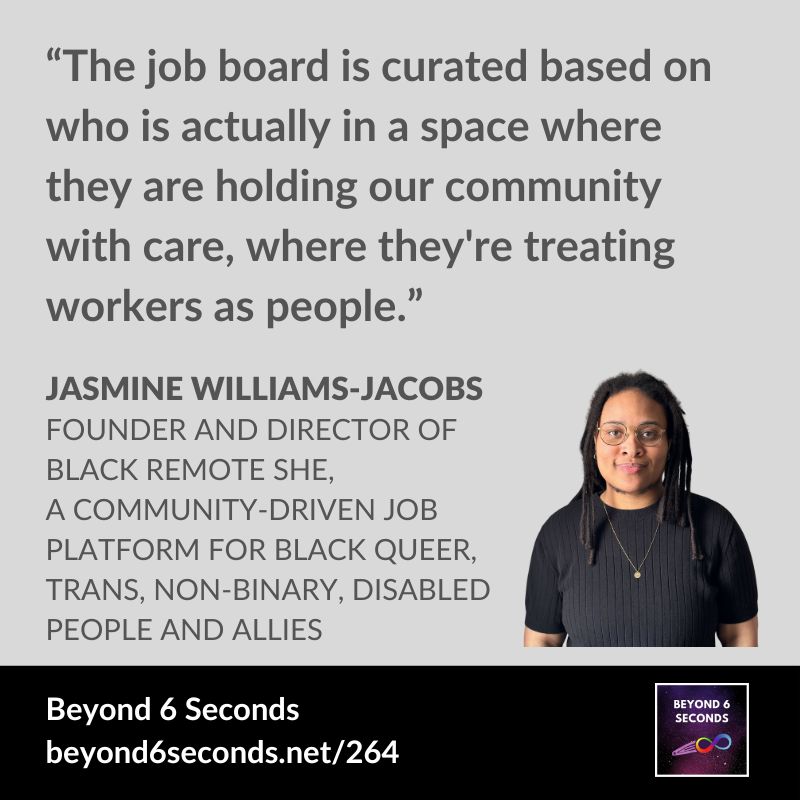
And so the, the job board is curated based on who is actually in a space where they are holding our community with care, where they’re treating workers as people. Because yes, we are being invited into the workplace to apply. The, the term of “diversifying the pipeline,” I think was super common about 10 years ago. And that was very harmful. It was very harmful. It was this checking a box, wanting to say, “oh we have X amount of disabled people in our workplace, we have X amount of Black people in our workplace.” And who is that serving, when the practices and policies are not serving us? They’re not supporting us at all, and we come into the workplace and experience harm with no accountability. And so we’re changing that through our vetting process at Black Remote She.
Carolyn Kiel: That’s great. Yeah. Especially having that sort of view and understanding of employers and a little bit more about what it’s really like to work there. Because I’m, I’m sure everyone’s had the experience of something looks great on paper and everyone says the right thing in the interview and then you get there and it’s like, this is not at all what people said, what, how it was presented to me!
So that’s really, it sounds like you have a really robust process for working with employers and companies to, you know, just especially vet them and, and help them kind of get to a certain point if they’re not there yet. And that’s, that’s just so, that’s, that’s really powerful. Yeah, it’s important. You can’t just bring people in and then not support them or actively harm them with the structures and the systems you have in place. Yeah, absolutely.
The types of job postings that are featured in Black Remote She, are they all remote or is it kind of a blend?
Jasmine Williams-Jacobs: It’s all remote flexible. And so typically that means they at least need to have at least one day of remote work per week available to folks. So we have hybrid positions, fully remote positions, remote with some travel required or remote with some in-person requirements, maybe meetings. Or some roles just have more of a grassroots organizing kind of community, in the community type of positions. But we have those different filters for folks to choose what works for them. Because there are folks in our community too, who appreciate having the flexibility of, I want to work from home sometimes, but sometimes I want direct people to people stimulation. I want to be out in the field talking to folks. So we have a mixture of things for folks, but there’s always some type of remote flexibility, even for consultancies, contracts, full-time, part-time positions, whatever folks are looking for.
Carolyn Kiel: Yeah, that, that’s great. The focus on remote positions is important ’cause those are very hard to find. But yeah, at the same time, there absolutely may be people who want sort of more flexibility to be in office or in the field or just really depending on the role. So that’s great.
What kind of feedback have you received so far on Black Remote She, whether it’s from the, the employers you work with or the, the people who are on the platform searching for jobs?
Jasmine Williams-Jacobs: Yeah, I, I love that question because it gives me a fuzzy feeling inside. I think really just having folks within our community, I’m thinking specifically job seekers, but also the entrepreneurs. Black Remote She started as remote work focus and jobs, but it has expanded since that time to include a resource hub that shares fellowships, grants, emergency funds, gender affirming care resource guides to help people create community care models and to learn how to locate low or free healthcare in their areas. How to create narratives that center our communities’ voices and uplift our, like, so many different types of things. And so with this expansion, it’s, it’s been people being able to feel supported in all aspects of their lives. There’s also peer support groups, and so people have found community in Black Remote She. Especially with our events, we host these quarterly mixers where they’re really more like community listening sessions. We’re giving people space to share what they need and we’re providing resources.
It goes back to that experience that I had of, “we have nothing for you. Unfortunately, that rental assistance program doesn’t exist in the state anymore. That emergency fund that you saw on that website unfortunately no longer exists.” That that reality is just depleted in this space. And so folks have been able to say, “Hey, I need food.” And we can share an emergency fund regardless of where they’re based. Because with this focus on remote, it’s not just the remote jobs, but also the experience of having accessibility online to be able to be connected to what you need in your local area, through a conversation that we had in a meeting in our, in our mixers.
And so being able to have people share there, even after those mixers, specifically folks saying:
“You know, this was not only the best part of my day, but I’ve been struggling to get resources to be able to meet my basic needs, to be able to have food to pay my rent.”
“And I was able to get a fellowship on Black Remote She. Like, I went there looking for a job because I learned about it looking for a job, but I got a fellowship that supported me furthermore, for what I needed right now.”
“I was able to get an emergency fund that you sent out that was open to folks nationally that I would’ve never known about had it not been for being connected to this space. I saw it in the newsletter and just applied because I didn’t know it existed and I got it.”
“I submitted my work and it was selected and I’m getting paid a stipend for it.”
“I got a job from Black Remote She and I wanted to come back just to say thank you for the work that you do.”
“I heard from my former colleague that the employer that tried to post was told they weren’t able to because they didn’t meet the vetting process. And I just wanted to say thank you for being true to your commitment to protecting us from work trauma.”
Those testimonials have truly been the roots of keeping this work going because it hasn’t been an easy journey choosing to create something like this and, and making it full-time work. I was working three jobs when I started Black Remote She. And so really just being able to see that it’s making an impact in people’s lives, and me being able to kind of transmute that energy of that experience to try to make sure that like we as a community can take care of each other. Because it’s not only me putting these resources on the website, but also our community advisory committee getting the resources out to other people. We strategize together like, Hey, you know, let’s get this out. We’re all in different parts of the country.
And also community members being able to share out the resources. ’cause I always say like, Hey, this resource list from our mixer, share it with people that you know are looking for support. There’s enough for all of us. There’s so much scarcity mindset that’s been built into this time from the fear mongering. But no, we’ve shared solidarity grocery networks when SNAP was being cut, and that was like specifically from SONG, Southerners on New Ground. They were doing a grocery solidarity network. And so we shared that out through the platform and that connected to people throughout the south where they were all working together to support each other in getting food. And so just understanding that we as a community, we can do so much together to take care of each other during this time where the folks who have the positions of power currently are choosing not to, we as a community can still do it together. And this work always reminds me of that.
Carolyn Kiel: Yeah, and the community support is so critical, especially in times like these where the systemic and structural supports, the ones that were in place are, are being shrunk or removed entirely. It really, as you said, comes down to community and how can people help each other, whether it’s through mutual aid or money or grocery networks or just sharing any kind of resources. That’s really what it comes down to in terms of you know, supporting each other and making sure that we all, you know, we all find the opportunities and resources that we need. Because, again, there is such a scarcity mindset that really gets people scared. And and there really is, you know, it, it doesn’t have to be that way. There’s, there’s more for, there’s things for everyone. So it, that’s great that you really emphasize that on Black Remote She.
Jasmine Williams-Jacobs: Yeah.
Carolyn Kiel: Yeah. And how do people join the network? Like if you’re a job seeker for example, is there an application process or how does that, how does that work?
Jasmine Williams-Jacobs: Everything’s open. So there’s no account required. If you go to BlackRemoteShe.com you can click the job board button. It’ll take you to the job board with all of the filters. There’s also the Get Involved section. That’s where you can find the Resource Hub. There’s also a free seven day email course for job seekers. So folks who are looking to kind of structure the job search, looking for affirmations in the process, it can be very frustrating navigating that process. We have free templates in there for cover letters and resumes. There’s a breathing exercise in there to, yeah, just there’s, there’s all of that is on the website, but there’s no account required to do any of this.
If folks want to stay updated with Black Remote She, that would primarily be through the newsletter. And there’s an option to sign up for the newsletter as well on the homepage, and there’s like a popup that comes up. And that’s sent biweekly every other Saturday. So it’s not super frequent, but it’s frequent enough that we normally share reminders of upcoming deadlines for some of those resources I was talking about. Whether it’s emergency funding, mutual aid funds or rapid response funds. We also share resources for organizations, business owners. And then for job seekers, there’s always the find out who’s hiring within the newsletter as well, so you can find out exactly what open positions are currently available in our network.
Carolyn Kiel: That’s awesome. And then for applying to those open positions, is it through the regular, I guess whatever the company’s regular job process is, whether
Jasmine Williams-Jacobs: Yes.
Carolyn Kiel: applying through their website? Yeah.
Jasmine Williams-Jacobs: Yes, so we have on the job board, it’s basically you get the organization name, the position, title, and qualifications. We try not to make it super overwhelming. And then there’s a Learn More and Apply button, and that’ll take you to whatever preferred way the employer takes applications. And if it’s like via email, that information would be in the qualification section as well. And there’s always salary transparency. So there’s never a question of how much do I get paid for this? It’s required on the platform.
Carolyn Kiel: That’s awesome. Yeah. Well that sounds like such an amazing resource. Like how can people get in touch with you if they wanna learn more about Black Remote She, whether they’re a company who wants to partner or list their jobs or you know, someone who is looking for work themselves?
Jasmine Williams-Jacobs: Absolutely! The newsletter primarily, but if you want to reach out directly, info@blackremoteshe.com, I can be reached there most times. I’m not super active on social media. But there’s also an option on the website as well for employers. There’s a section where you can learn more about our vetting process to find out if you qualify to post a job. And then if you review the vetting process and you’re very clearly able to tell, no, we’re not quite there. Or we have it. ’cause there’s very much specific language. If you have any discriminatory complaints that you know are not public for whatever reason, but you know internally that it’s happening, we really rely on transparency from employers.
Because the reality is as much as we do what we can to find out what job seekers have experienced in the workplace, we know with most harm, many things go unreported. And so we truly rely on employers. And we have really tough conversations with employers as well, to really let us know if you’ve had a complaint, we can talk through it. Folks will not be turned away just because you’ve had a complaint. It just won’t mean that you can post to the website, but we’ll be able to connect you to resources to help you repair and rectify any harm that’s happening in your workplace if you’re ready to make those changes.
Carolyn Kiel: Okay. Very cool. That’s great. Okay. I’ll put a link to the website in the show notes so that people can go there directly and sign up for the newsletter and, and potentially get involved. That’s really awesome.
Jasmine, it’s been really great talking with you about Black Remote She. As we close out, is there anything else you’d like our listeners to know or any other ways they can help or support Black Remote She?
Jasmine Williams-Jacobs: Yes. Thank you for having me again. It, it’s honestly been great.
I’ll just say to folks who are listening, I hope that you feel empowered to share when you have not been treated in the way that you should be treated, which is with care, and there are, there are spaces where you can do that anonymously, but know that there are other resources to help you repair the harm.
Being able to have, be connected to restorative justice resources, healing justice resources. I know we all believe in different things, but there are so many different types of resources that are available. Peer support. We as a community can truly, truly, truly support each other together. And really at Black Remote She, that’s all this space is. It’s a space to support you fully with your livelihood and wellbeing in all ways. So if you’re looking for resources, don’t hesitate to look through the website, and again, please share resources with other folks. That’s truly how we make sure that we are all collectively fully resourced as a community.
Carolyn Kiel: That’s awesome. Yeah. ’cause those resources are out there. Sometimes they’re, they’re scattered and they’re hard to find and decentralized, but it sounds like Black Remote She, you really, one of the big goals is to bring that together and help people find what they need and, and connect with each other and just making it easier for people to help each other, and support each other. And that’s, that’s really great.
Yeah. Well, thank you so much Jasmine. Thank you for sharing your own story and the story of Black Remote She. And wishing you, yes, so much success with the platform.
Jasmine Williams-Jacobs: Thank you.
Carolyn Kiel: Has this podcast had an impact on your life, your heart, or your perspective in some way? If so, I’d love to hear about it. Send me a message on social media or through my website at beyond6seconds.net/contact. Your feedback means a lot to me, and it helps keep me going with this show. Thank you.
Thanks for listening to Beyond 6 Seconds. Please help me spread the word about this podcast. Share it with a friend, give it a shout out on your social media, or write a review on Apple Podcasts or your favorite podcast player. You can find all of my episodes and sign up for my free newsletter at Beyond6seconds.net. Until next time.