Episode 267: Neurodivergent creativity – with Luke from the Howdy Beans Podcast
-
play_circle_filled
Episode 267: Neurodivergent creativity – with Luke from the Howdy Beans Podcast
Carolyn Kiel
Luke hosts the Howdy Beans Podcast, where he reviews movies, TV shows, video games, books, and all things pop culture. He is dyslexic with an overlap of dyspraxia and dyscalculia, and he’s currently on the waiting list for an autism assessment. Luke is an avid reader who writes short stories and poems, and he’s currently writing a dark fantasy novel.
During this episode, you will hear Luke talk about:
- How he discovered that he was neurodivergent at a young age
- Why he doesn’t take reading and writing for granted
- His passion for writing stories
- What led him to start the Howdy Beans Podcast and how he’s kept it going for five years
Listen to the Howdy Beans Podcast on Spotify.
Follow the Howdy Beans Podcast on Instagram and YouTube @thehowdybeanspodcast and on TikTok @the_howdybeans_podcast.
Contribute to Carolyn’s tip jar to support this podcast at BuyMeACoffee.com/Beyond6Seconds!
Follow the Beyond 6 Seconds podcast in your favorite podcast player!
Subscribe to the FREE Beyond 6 Seconds newsletter for early access to my latest podcast episodes!
*Disclaimer: The views, guidance, opinions, and thoughts expressed in Beyond 6 Seconds episodes are solely mine and/or those of my guests, and do not necessarily represent those of my employer or other organizations. These episodes are for informational purposes only and do not substitute for professional medical advice. Consult a medical professional or healthcare provider if you are seeking medical advice, diagnoses, or treatment.*

The episode transcript is below.
Carolyn: Welcome to Beyond 6 Seconds, the podcast that goes beyond the six second first impression to share the extraordinary stories of neurodivergent people. I’m your host, Carolyn Kiel.
Carolyn: On today’s episode, I’m speaking with Luke. He’s dyslexic with an overlap of dyspraxia and dyscalculia, and he’s currently on the waiting list for an autism assessment.
Luke is an avid reader who writes short stories and poems from time to time, and he’s currently writing a dark fantasy novel. He’s also been a podcaster for five years, which is actually how we met. So Luke, welcome to the podcast.
Luke: Oh, thank you. It’s absolutely wonderful. It’s a pleasure to be here.
Carolyn: Yeah. I’m really happy to have you here. I know we’ve been connected in kind of a mutual podcast group on social media for probably a while, so it’s really nice to be able to connect away from social media and get to learn more about your own story as someone who’s neurodivergent. So yeah, I’m happy to have you here.
Luke: As I said to you before we started recording, I am a fan of your show. So I was just like after, sort of heard some of your episodes and one of the episodes was somebody I knew personally it was one of those moments of I’ve gotta be on this show.”
It is brilliant what you do. It’s brilliant, the stories that you hear of the people. And obviously being somebody who’s neurodivergent, you do feel quite lonely. So to hear other people, not just in your local area but around the world, who have the same struggles but are somewhat different, but you share overlap, it’s wonderful to kind of feel less lonely and more welcomed in a very sort of chaotic world that we live in.
So it was, it’s lovely. So I wanna thank you for what you do, so really it’s an honor to be here on the show for me.
Carolyn: Oh, thank you so much. Yeah, I really appreciate that. Thank you.
So yeah, I would love to learn more about your own personal story. So I guess I could start out by asking, like, when did you realize that you’re neurodivergent? Were you kind of identified early in life, or did you find out later in life?
Luke: Oh that’s a wonderful question. I wanna say early in life, but it, I didn’t really get my diagnosis till I was 18, when I was in college. All through my life when I was in school I was always told that I had dyslexia, that I was… I don’t think the word neurodivergent was around, but somebody who had learning disabilities and things like that.
And obviously being a young kid, you never questioned it. It was like, “Oh, that’s what the adults always thought.” So, ’cause the adults always told me, that’s what always assumed. I remember being taken out of lesson, being put one to one with a learning, a teaching assistant, I think that’s the name.
Carolyn: Mm-hmm
Luke: Having teaching assistants, not really realizing, kind of questioning why I was being taken out of class, why couldn’t I study with the other kids. And as I got older, I s- I, I slowly started to realize.
And I remember going with my mom to meetings, having one to one. I w- I would sit there and watch educational sort of like videos while my mom would have talks with people. I never really understood any of it. But I was always told that there was something about me that was different. And as I got older, I realized it was dyslexia. It was, like, some sort of learning disability.
‘Cause I didn’t really properly learn how to read until I was in my final year of primary school, and that was mainly because the teacher had to put me one to one with a teacher, and we had to read books over and over again. I couldn’t spell my last name, so my teacher wrote down my last name. I’d have to copy it, then she would fold the paper, do it again, and we’d just keep going, and we’d just cover this whole paper, folding it, changing it. And luckily, by the time I got into senior school, I was a lot more confident, a lot more adept with my writing.
But it wasn’t till I was in college when I was doing my exams, ’cause I had to do my English, that they said to me, goes, “Oh, no, you have dyslexia, but have you got any proof so we can give you tools? We can give you a laptop. We can give you help with tests.” I said, “No, I’ve just always been told that I am. I’ve got no real proof.” And luckily, the college that I went to was really really lovely and really supportive. They put me in, and I ended up having a test with an examiner for a good two, three months. It was a long time, just sitting down, having chats. She did puzzle tests. There was dif- other sort of examinations that she did. And by the end of it I, wish I remembered her name, but by the end of it, she gave me this huge, thick document that went through everything that we spoke about, everything that we understood. And she said to me, she went, “My overall sort of thought for you is that you are dyslexic, but you have an overlap of dyslexia and dyscalculia.”
And that was really interesting to me because I just thought I was dyslexic. I didn’t realize there were other forms of dyslexia really. So to find out that there were other thing, there were overlaps as well, and actually thought that I was potentially on the spectrum. But sadly, by the time that we had finished the actual examination, I was close to turning sort of 18, so by that stage in the college I was an adult, so they couldn’t do much for me. I would’ve had to pay for it. So they were like, “Look, we’ll do the dyslexia. That’s free. But if you want to do extra, you’d have to pay for it.” But I was going off to university then, so it was like they, they kind of was like, “We can’t really do much for you,” sadly. But I am on the waiting list for that.
But I’ve always known that I was different. I always like to explain how I was like y- have you seen Madagascar, the DreamWorks movie?
Carolyn: I have not, no!
Luke: In, Madagascar, Marty thinks he’s very unique. He always thought he was black with white stripes, and he thought who he is, he’s a very unique person. ‘Cause I always known I was weird, I was different, I was sort of the oddball sort of person. But I loved it, I embellished it, ’cause it made me feel a bit unique. And not to sound sort of egotistical at all, but it wasn’t till I found out that I was dyslexic and there was something wrong with me, I felt… and again, I don’t wanna sound egotistical, I felt less spe- less special in myself. I felt less sort of unique. I felt less when I found out there was other people like me, I was like, “Oh, okay, so I’m not just me.” So it took me a while to kind of learn who, me, who I am.
And at, as I am now at 27 years old, I love it, because I’ve got to rediscover who Luke is. I got to rediscover who am I now that I know that I’ve got dyslexia, now that I know I’ve got these other learning disabilities, now that I know I’m potentially on the spectrum. And then looking back at my past life and my things that I’ve done, my successes, my failures, and having answers, be like, “Oh, that’s why this, why. That’s why I struggled with this. That’s why I struggled with that.” It was really lovely. And to, to, now to somebody who does a podcast, who went to university, who was always told that he can never go to university, never get into college, never be able to get a good job. Somebody who was told who can’t, would never be able to properly write or read, and I read every single day. I’ve read so far about seven or eight books this year. I read 65 last year. And then being a writer, loving to write. It’s quite wonderful.
I think for me mostly it’s the fact of… ‘Cause when I tell people that I read a lot and I write a lot, they go, “Well, you’re dyslexic. That makes no sense.” And it’s one of these things where I’m like, I understand that, but at the same stage, it’s the fact of … I love reading. I love reading. I love the idea of stories and… But I always wanted to do what the other kids could do, and it always annoyed me and really upset me that I couldn’t. Because I always wanted to read, I had the passion for it, but because I couldn’t do it, I just it, just really got to me. So as I got older and I could read, it was one of those where I wanted to keep reading, because I had that fear that if I stopped reading I’d lose this ability. I know it might sound a little silly, but it was that thing of like I didn’t wanna lose it, so I just kept reading and reading.
And it’s become a, next to podcasting, my biggest hobby. It’s like I’d never go anywhere without a book in my hand or a book in my bag. So I always carry one with me. I love reading. So I feel like- Yeah, I’ve n- really, my overall sort of thought is, even though I am dyslexic and I’ve got my other sort of learning disabilities, I’ve never let them get me down. I’ve always been very much the fact of, I’ll prove everybody wrong. I’ll prove myself wrong. I’m going to learn to read. I’m going to read loads of books. I want … I’m currently writing a book to prove that somebody who has learning disabilities can write a book and get it published.
So yeah I, just, I’ve never let it get to me. I’ve always lived a life of positivity and just being like, “Look, I’m going to go to college. I’m gonna go to university,” which I did. I got a bachelor’s degree. I’d like to go back and do my master’s in creative writing one day. So yeah, even though I am neu- neurodivergent, and I have got my struggles as we all do, and life can be a bit difficult at times, I’m still very happy, still very positive and loving life. So I’ve always been weird, but I love it. A weird life for me, as they say. I enjoy it.
Carolyn: Yeah, that’s awesome. That’s really interesting, ’cause yeah, I think people do tend to assume when they hear someone is dyslexic, that they can’t read at all, and that’s a really simplistic way of saying it and not necessarily true probably for most people with dyslexia.
And I think you mentioned that you really didn’t learn how to read consistently until your, was it your last year in, I guess, college? Which I think, for in the United States, I think that’s our equivalent of high school or secondary school?
Luke: Yeah, so th- so, so primary school is like just before you go to high school would be in America. So it’s like your last year. So I think I would’ve been I think about 10 or 11 going into sort of high school.
So it, it’s a bit embarrassing to admit, but at the same stage it’s the fact of … I wanted to read, I just … It took me a while to get there. And by the time I got there, it was the fact of, I didn’t wanna lose it. I think so many people who can read normally take reading so much for granted that y- people that can’t read or struggle to read, we don’t. We’re so fact of, “Oh I can do it now. I’ve unlocked this new world, this new avenue of life, and it’s wonderful.” So yeah, I, I don’t take it for granted at all. I think that’s why I read so much is the fact of, I’m just terrified of losing it one day, so I wanna make sure that I read as much as I can just in case one day I wake up and I can’t do it anymore.
I know it sounds strange to say, but it’s just … Yeah, it’s a weird worry. But.
Carolyn: It kind of makes sense. I feel that way a little bit with writing, like especially in the age of AI. It’s well, now I can have the computer write me things. It’s but wait, then I’m gonna lose my ability to write. And I enjoy writing, so, but I can totally see if I just start leaning on those tools a little too much, I will just start to… I do worry I’ll forget, like, how to write something that’s halfway decent, so.
Luke: To be honest, I’m exactly the same. When I’m at work and my colleagues say they’ll use ChatGPT to help them write an email, and I’ve said, “Why don’t you just write the email normally?” And a- again, these are people … A- again, I love my colleagues I work with, but obviously they don’t have the same sort of struggles that I had.
So to me, it’s a fact of I’d rather do it myself. I’d rather not give it to a computer. Whereas other people, like I said, who take it for granted: “I can do it anyway, but why should I? A computer will do it in a couple seconds.” So there are times when I sit down, I do question the whole AI sort of thing, and I’m like, “No, you’re taking away the humanness of what we are, who we are. Don’t take reading and writing for granted because if you do lose it one day, the computer might not always be there to help you. So being able to do it yourself is a wonderful skill.
Carolyn: Yeah. Yeah, I mean AI is helpful in some ways, but at the same time, as you said it really doesn’t fully, it doesn’t replace humans and the ability to have talents, especially with something that we, love, like reading and writing and whatever we enjoy doing. So yeah, totally agree with that.
And you’re a writer as well, so I know you’ve written short stories and poems, and you’re working on a novel. So how does that, I guess reading and writing are obviously related, but how did you sort of discover your passion for writing?
Luke: Well, it w- actually started when I was in primary school. Again, because I struggled with the reading and writing. I couldn’t do the creative writing with the other children, so I’d always been taken out. And whenever I’d be taken out of class and I’d sit with the teaching assistant, she’d have the pen and paper, and she’d be like, “All right, Luke, we’re gonna tell a story. Whatever you want, just you, you tell me,” and she’ll write it down. And I’ve always been a very imaginative sort of person, so not having to have to worry about the spelling or punctuation and just be able just to speak it was a wonderful thing. So I, remember having loads of stories and adventures, creative writing of just talking to the teacher and she’d write it all down, and just going on adventures.
And obviously being the younger child as well, my sister being older than me, she was too old by the time I was born, so she wanted to do her own thing. So y- you would sit and you’d play on your own. You’d play with toys and stuff like that. So the imagination was always there.
And then as I got older and I started getting into reading a lot more I found myself wanting to write more. I was a big fan of science fiction, big fans, fan of fantasy. And these worlds that I would go into with books like Harry Potter and stuff like that. And I was just like, “Oh my God,” there’s a whole world out, out there that I really want to explore.” And that’s where it started really with the stories. It’d be little stories, little bits of fan fiction from either short stories about me being, like, a spaceman or me being, like, a super spy, and then it would, it went on to characters like Ben 10 when I was older. And I w- I was always Ben 10. The stories were always me. You’d always have the character, but it’d always be me with the the h- the hero.
And then as I got older, I just started dabbling in more with poetry. ’cause the teachers when I was in high school, they got me into doing poetry ’cause it would really help with learning the grammar and how best way to structure and stuff like that. So I got into doing poetry. But I always found I could only do poetry when I was sad. I could never do it when I was happy. So a lot of my poetry was always not depressive, but always very low. So I struggle to do it now because I’m a very happy sort of… Things are going well, shall we say. So I always struggle to write now. But that helped as well with the spelling and getting into it.
And then the stories, they just took sort of their own sort of shall we say, experience, like writing fan fiction for Doctor Who and stuff like that. And then I was like, “You know what? One day I’m gonna write a story.” And I just ke- I had my phone and I would write down notes. I’d be on the train or bus to college. I’d be like, “Oh, that’s interesting. That’s interesting.” And it’s the same with the story that I’m writing now. I was on the bus on the way home from college, and it was absolutely chucking it down with rain. And the bus stopped ’cause we was in traffic, and right out the window was this old lady next to a bus shelter, absolutely drenched, poor woman. But then there was a woman and child that were under the cover And they were dry. And I kept again, this may be my imaginative sort of mind. As I was watching them, I just thought in my head, ’cause the old lady kept looking at the mother and child, but had a really scornful sort of mean look. And I thought to myself, “Well, if you’d only just move a few inches away, get under, you’d be dry.” But for some reason she’s got, she’s standing there wet, but she’s looking at these two that are dry very scornfully. And I thought to myself, and this sounds mean to old people, I don’t mean to be mean. But I thought to myself, “Well, she looks very witchy as she is now. Like, why do witches hate children? Why do witches want children? Why do wi- witches hate sort of people?” And that sort of thing. And that’s where that story came from.
And I, other ideas from, I like to people watch, which I know we all do. You can’t help but when you’re sitting there, you can’t help but just watch people when they’re in their element. And you kind of get a lot of sort of inspiration when you just see people just living life not realizing that anybody’s watching them. So that’s a lot where the ideas come from.
But yeah the book I’m writing at the moment is coming from that one scenario, and it’s, kind of … I’ve been writing it for five years now. So I started during lockdown, planning stages, going through it. And it’s slowly but surely, ’cause the podcast has taken up all my time. Before I started the podcast, I had loads of time to write, but now that I do the podcast and I’m working and I’ve got other hobbies and I’ve got books to read, I’ve got movies to watch and review, and games and all that kind of stuff, it’s finding the time. Like I’m at the end of the story now. I know how it’s gonna end. It’s just finding the time of actually going, “Okay, I know it’s gonna end. Right, I’m gonna put my bum in my seat and I’m gonna sit and write.”
After that, I know when it’s done, I’ve got other ideas for stories, of involving superheroes, a story involving two wizards on, on rival towers that they hate each other, and stuff like that. Like small little silly little sort of stories like that. I don’t know if they’ll ever be published, but I’ve got the ideas, they’re there.
So yeah, the idea of writing has always been there. The idea of wanting to be creative and tell stories has always been there. It’s just that it took me a while to get to that point because I had to learn how to do it. It took me a while to really hone my craft, is probably the best way to say it. Not take it for granted, learn how to read, learn how to write and get comfortable with my world and my creative side.
Carolyn: Yeah, and the only real way to hone that is to practice writing, just do more and more of it.
Luke: Yeah. it’s a muscle. If y- the more you work it the stronger it is. I always say that to people ’cause I had a lot of people in, when I went to school who was neurodivergent, and they struggled themselves. And I’d always see them going, “Oh, I can’t do it. Oh Miss, I can’t do it,” and they would always misbehave. And it’s not their fault. It’s just the fact that they were struggling and they were frustrated. And I felt the same things. And I’d always try to say to them, “You’re giving up. Is … It’s a muscle. You’ve gotta keep at it. If you don’t keep working at it, you’ll lose it, and that’s why you’ll struggle.”
But it … ‘Cause obviously for a lot of people, they felt dumb, they felt silly, they felt stupid because that’s what they were told by a lot of people, by the system. And I was like, “No, it’s not. It’s just the fact of it just takes you a bit longer to get there, but work that muscle. The more you work it, the better it’ll be.”
And that’s why I say now I’m always reading because I’m working the imagination and working that reading muscle out of fear of maybe one day I could lose it, and I don’t want to. So it’s that fact of keep reading, enjoying what I’m doing, enjoying the written craft and just immerse myself in it.
Like I said, I’m always reading a book. I’ve always got an audiobook on the go. So no matter where I go, I’ve always got stories going on in my head, and I love it. I absolutely do. But yeah, it’s definitely, it’s a muscle that you have to keep working, ’cause if you don’t, you will lose it.
Carolyn: Yeah. Yeah, definitely practice and working that muscle. And also for a lot of people, sometimes we have to remember there’s more than one way to be able to accomplish things. So you mentioned earlier in your life kind of telling your teacher the story and they would write it down. That’s sort of like an early version of speech-to-text, which I know is something that other people, dyslexic people and not dyslexic people, we we use it all the time now as technology.
So that sometimes is one way to at least get started if you really are struggling. I know other people who will storyboard if they’re, like, writing things that are audiovisual, and that’s another way. So there are if, one, the one sort of official way of doing something isn’t working for you, there are other ways to explore and get your goals accomplished.
Luke: Yeah, definitely. Absolutely. You’ve just got to put the work in. I think that’s what it is. I think a lot of people who are neurodivergent tend to give up quite easily. And it’s not, again, it’s not their fault. It’s just the fact of the rest of the world’s going so quickly, and because they’re going so slow, they want to keep up. And it, it was the same for me, my experience. I wanted to catch up so quickly, but I had to realize in myself I can’t catch up too quickly because I’m going to miss something, so I’ve got to take my own path in life.
I think that’s all it is, really. It’s yes, we’re all going to get frustrated, and it’s not fair sometimes that somebody can do something you can’t do. But that doesn’t mean you never can do it. Some of the smartest people I’ve met in my life have been neurodivergent, whether autistic, whether dyslexic. When I was in college, I happened to know a guy that was in his 50s, he took himself back to school to, to relearn, to re-educate himself. And he was one of the smartest men I ever met, and he was autistic. And the conversations that you’d have with him, if you didn’t know that he was neurodivergent, you wouldn’t know. You’d just thought he was a genius. And I, sadly, I’ve lost contact with him, but yeah it’s a fact of this whole, the whole stigma of society that, “Oh, because you’re a bit slow, because you learn things a bit less, you’re less.” But it’s not. It’s like, I said, some of the smartest people I’ve ever met in my life have been neurodivergent, and they’re absolutely wonderful people. Because I feel again, they don’t take anything for granted. They take everything as a pleasure of “Oh my God I can do this. Wow, I finally managed to crack the code. This is incredible. I can finally speak to my fellow man. I can finally communicate in, in different ways other than speech.” And yeah it’s a wonderful gift. I see it as a gift. I know it can be a struggle, but I definitely see it as a gift. It’s, it allows me to see the world differently, but in a way that’s still unique and still wonderful. And it helps with the podcast, it helps with writing stories because my perspective is different from the average man, and it’s, it’s lovely. It really is. It, I definitely see it as a gift. I really do. It c- it can be a struggle, but it’s a wonderful thing to have, and I wouldn’t have it any other way.
Carolyn: Yeah. That’s awesome. Yeah, I think our approach to life, which probably is also impacted by our families and the kinds of supports that you might be getting or not getting from them and the people around you. And also who you are as a person. Are you someone who really decides like “I’m gonna, I’m gonna show them! I’m gonna achieve this even if people say that I can’t,” or are you someone who gets easily discouraged by that? And there’s no like judgment either way. Everyone’s different.
Luke: No.
Carolyn: It’s an interesting mix of things that go into what makes us who we are.
So you’re also podcasting and that’s actually how we met. I’d love to learn more about that. Like when did you get started with that and what’s your show about?
Luke: Oh, well, this is another interesting thing to talk about really. I started during lockdown, during COVID, I think like a lot of people, to be honest. So my lockdown, when I went in, I was in my last year of university, so the majority of my time was taken up sort of doing my last sort of dissertation, doing all my studies and, getting that all ready.
But when that was done, I kind of was like, “Okay, so what have I got left to do?” So I, I had loads of books to read, so I read all them. I was like, okay, read all them. I’ve got some audiobooks to listen to. Done that. Played all the games, watched all the films that I wanted to watch, and I quickly was starting to run out of things to do. I was just like, “I’m gonna go stir-crazy if I’m stuck inside with nothing to do.” So I thought to myself, well, I went to … It’s gonna sound funny. On YouTube, there’s a sort of homepage. I never knew there was a homepage on YouTube. I never used to watch on the people that I subscribe to. And I was flicking through the sort of s- it’s a suggestion. It’s just “You’ve watched this, you’ll like this” sort of thing. And I was flicking through and I found Joe Rogan and he was talking to Bob Lazar about UFOs and aliens. And I’m, I love that kind of stuff and I was a big fan of Bob Lazar ’cause again, the whole conspiracy theories and that sort of stuff. I was like, “Oh, that should be interesting.” Had no idea who Joe Rogan was to be honest. I had no interest. I was just like, “Look, he’s talking to somebody that I know. He’s talking about a topic I’m interested in. It’s two hours long.” I thought, “Listen to it.” I listened to it. I just was like, my mind just exploded. I was like, “This is incredible.” And I went down a rabbit hole of listening to other interviews that he’d done with other people or who talked about aliens and Bigfoot and other sort of things like that and I was like, “Well, there’s got to be more to this.”
So I started listening to other podcasts. I found one called The Friendship Onion which is not around anymore but it was done by Billy Boyd and Dominic Monaghan who played Merry and Pippin from Lord of the Rings and it was a very positive sort of podcast that they did once a week where they talked to other celebrities. They talked about Lord of the Rings. They did a thing called BIlly and Dom Eat The World where they get food from around the world. It was a very wholesome lovely thing to listen to during lockdown to be honest. It was like a very positive ray of sunshine for me.
I listened to loads of different podcasts and as I was listening I thought, always thought to myself, “I can do this.” Like I, I can waffle. I’m a waffler. If you get me on a topic, as you can see now, I can talk for England.
Carolyn: Mm-hmm
Luke: So I was like, “I can do this.” And a lot of friends when I was in school always told me like, “Luke, you should get onto YouTube. You’ve got the personality. You’ve got the charisma to do it.” And I always wanted to but I never n- I always tried but I never knew what to do. So when it came to realizing about podcasting, I had a really good close friend of mine, she got me into it. She was like, “Well,” she gave me a list of structure. She was like, “First of all what do you want to do?” And then it’s “Okay, once you figured out what you want to do, what’s the platform that you’re gonna talk on? Then what’s the name? Are you gonna have guests?”
We went through it with my best friend and we chucked through everything and once, we wouldn’t move on till we got the first idea. So I was like, “Okay, I want a podcast that talks about sort of- movies and books and things that I’m passionate about, video games. But I also wanna talk about things like hidden gems, movies that not a lot of people talk about.
For example, everybody talks about Jurassic Park because it’s a big popular movie. Everybody loves it, but everybody’s done it to death. I wanna talk about films that I love but nobody talks about, like the movie Rat Race, for example from like the early 2000s or defending the movie Cat in the Hat. I know people don’t like the Cat in the Hat. I personally really love the Cat in the Hat movie with Mike Myers. It is a personal favorite of mine, and I will defend it till I die. But that’s what I mean. People don’t talk about these movies, but they only wanna talk about Godzilla, Goonies, Jurassic Park, those ones, because they’re big and popular, and they get the views. They get the downloads. So that was my aim, was like I wanna talk about my passions, but I want it to be specifically about underrated, underappreciated things.
So when I figured that, I was like, “Okay, so I’ve got the topic. I’ve got what I wanna do. Now for the name.” The name took a while. I’ve actually changed my name a few times. It started off as the Nerdstalgic Podcast, which I ended up having to change because I… Unbeknownst to me, I thought it was a original idea, but apparently there was a guy on YouTube who had millions and millions of followers and views, with the same name, and people were getting confused. I had people messaging me going, “Oh, God, I really loved the episode you did on that.” And I was like, “I haven’t done an episode on that.” And they were, “Oh, I listened to it.” and I didn’t want sort of confusion. I was still very small, but I didn’t want the confusion, so I ended up changing it to the Howdy Beans Podcast because my best friend who helped me used to call me Bean. She said to me, she goes, “You’re an old bean” or “a young bean.” and I loved that. It was really cheesy and lovely, and I thought, “Oh, I like that.” So I thought, “You know what? Howdy Beans. I say that at the beginning of the episodes anyway. That’s how people know me.” So I changed it to the Howdy Beans Podcast. It doesn’t mean anything, but it’s a catchy, sort of silly, sort of Howdy Beans! It’s a nice little catchphrase.
So once I’d figured everything out, I found the platform, and I didn’t know what I was doing when I first started. I was recording off my phone. I didn’t have a mic. I didn’t have a computer at the time. My computer was old. I had to upgrade it. And I remember I just pressed record on my phone, and I walked around my room back and forth just talking in it. I wrote a whole list, a whole sort of bullet points of what I wanna talk about, points I wanna hit, my name, all that. And I walked back and forth for an hour nonstop. I didn’t take a drink. I didn’t stop because I didn’t know how to edit. And I did that for a good, oh, two months until I realized, “Oh, hold on a second. This is getting tiresome. I need to edit. Again, having to talk for an hour, by the end of it, my, my voice would go. So I’d have to leave a week to sort of get better.
But over time, as the years gone on, I’ve found new ways of doing things. So as you mentioned with earlier about having ChatGPT write things for you, stuff like that. With me, I wanted to be very structured. I have a lot of friends who do podcasting who have scripts. I tried scripts. I couldn’t do it because with dyslexia, even though it’s my words, when I used to read, I used to read as if I’m reading a book and be like, “Oh, I- today I’m gonna talk about this. I want to…” And it, for me, it didn’t flow.
Carolyn: Yeah.
Luke: And the best way I work is if I could just have bullet points. So I’ve always done bullet points.
So I’ll be like “Do the introduction. Okay, next bit, what are your memories of this movie? Who was the cast? What’s the production?” And the way that helps me is the fact of I can waffle as much as I want, and then when I realize, okay, I’ve got nothing else to say about this topic, go on to the next thing.
And that’s how I do a lot of my reviews. So, like, when I do the rev- a review for a movie, it’s okay, first impressions, give my first impressions. Then I’ll talk about the story, then talk about certain cast members. I’ll be writing notes, and that way it can flow better instead of going, “Oh, I really like this movie. This movie was really good.”
And I know a lot of podcasters that do scripts. They’ve never really worked for me.
Carolyn: Mm-hmm.
Luke: But I find the way that I do it and again, I’ve been told this by friends, family other people that listen to the podcast, I’d never planned it for it, but my voice is very monotone, or so I’ve been told, so that I’ve had a lot of people who are neurodivergent, who are autistic, who are on the spectrum, have come back to me and said, “Your voice is really relaxing to me.” And when it gets really, ‘Cause again, I never planned it. I just very sort of just speak the way I’m speaking now. But I found it to be very sort of popular with a lot of people for that, who’ve like… I’ve had friends tell me, “Oh, I listen to your podcast while I’m in the bath ’cause it really chills me out,” or “When I’m on the, the school run or whatever, I’m listening to you on the radio in the car,” which does really surprise me ’cause I never thought anybody would ever listen. So to know that I’m in somebody’s car while they’re driving, I’m on the radio is really still very strange to me.
But it’s been a wonderful experience. Like this year’s my fifth year doing it. And I, again, most people don’t get this far in podcasting. I’m sure you’ve had a lot of experience with people that have probably only ever done a year. Most podcasts only last a year.
Carolyn: Yeah.
Luke: So to be doing it for five years, and I’m at 214 episodes. I release an episode today as we record for the movie Dinosaur. Brilliant movie, underrated. A masterpiece if you ask me. It’s just incredible. So I’ve still got ideas. I’ve got a notepad here that I wanted to show. I don’t know if you can see it. I’m still on page one. I did this first page back when I first started and I’m still on page one, five years in, and this book is just deep with other i- You probably can’t see it.
Carolyn: I can’t see it, but yeah I see your…
I can see a lot of writing there, so wow!
Luke: There’s a lot of writing, a lot of ideas and topics that I wanna do, but I still, I’m on page one, and I’ve been doing this for fi- for f- five years now. So yeah, the podcast is going to go on forever, or as long I can do it. And I’m just like, even now, like I’ve got ideas okay, I need to do page one, but, oh, I really like this movie or this book or whatever, so I’ve gotta go do this.
And now I’m on TikTok and other things and it does get overwhelming. It does get very overstimulating at times. But I think what keeps me going and why I haven’t really burnt out and gone, “Ah, that’s it. Okay, I can’t do it no more,” is because I s- I love it. I’ve got … This allows me to be so creative, as it does with the writing. Even though my writing has kind of slowed down a lot since doing the podcast, ’cause it takes a lot of time, having new creative avenues to talk about things that I love, to have … to be passionate with other people, to meet other like-minded people who like what I’m doing, what I’m talking about, is wonderful. To be able to reach people, like I said, in their homes.
Like Christmas Day, I did a … Last year, I did a review for It’s a Wonderful Life, and I had people message me Christmas Day saying, “I made you part of my Christmas Day. I listened to your episode on Christmas Day.” I was like, “Oh my God, you didn’t have to.” “Family first, but thank you.” I was really appreciative that they would bring me into some- something that’s very personal, like family to family. Christmas is very … especially Christmas Day, is a very personal thing. So to hear that off people to, know things, keeps me going. I’m like, yes, it does get overstimulating, a bit stressful at times, having to juggle everything. But you know what? As long as people are listening and as long as people enjoy it and people … I still have the love for it and I still have the passion for it, I’m gonna keep going. I’m n- I’m not gonna stop.
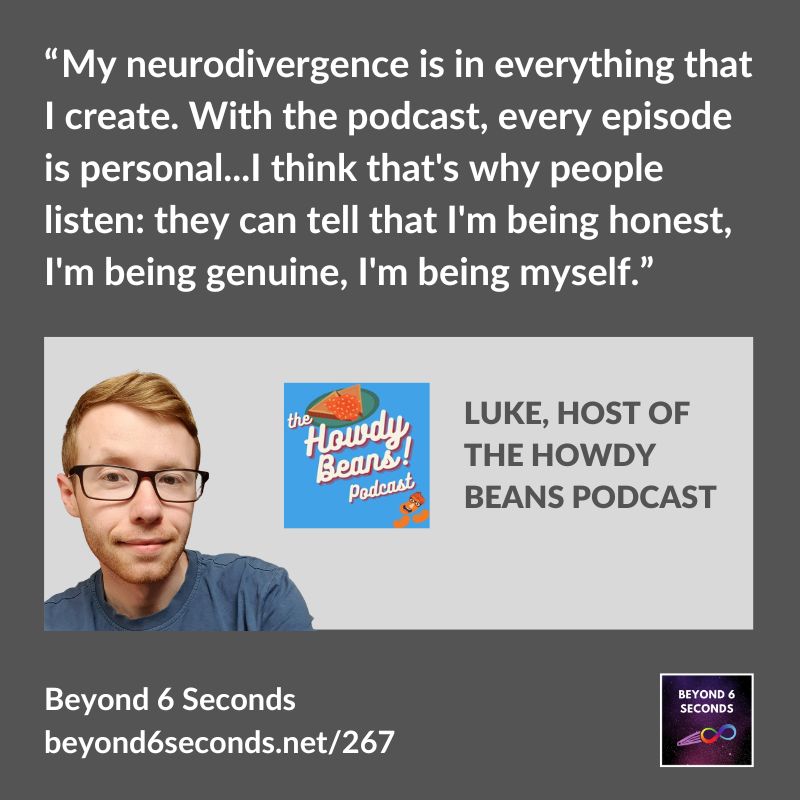
So and to … And the creativeness of doing thumbnails, like I’m … Like, you don’t understand how fun it is to create a thumbnail, just to kind of get the background and get the fonts right. I know it sounds silly. You could spend ages doing it. But it’s being able to be like, “I made that,” I … No o- d- didn’t use AI. That was me. I created that thumbnail. I created the episode. I used bullet points. I didn’t use ChatGPT to write quotes for what things I should say, blah, blah, blah. I was like, “No it’s all organic. It’s all me.” Like it is with everything else in my life, I wouldn’t want it any way different. Part of my soul, part of me, part of who I am, my neurodivergence, is in what I create, in everything that I create, as well with the podcast. So every episode is personal. Every episode I spend a lot of time on. And I feel like that resonates with a lot of people. I think that’s why people listen, is the fact that they can tell that I’m, I’m being honest, I’m being genuine, I’m being myself. And if I like something, I like it, and if I don’t, I’m gonna give you my honest opinion of it. I’m not gonna hate it ’cause … I’m not gonna be negative about something that I love just because it gives you loads of views, like most people do. I’m just like, “No, if I like something, I’m going to defend it. If I don’t like it, I’m going to tell you why I don’t like it.” I’m not just gonna say, “I don’t like it. It’s terrible.” I’ll be like … I’m very much the fact of “I liked it, but it needed to do this, or these things got let it down.” So I like to give everything a chance.
So yeah, so the podcast, yeah I, even I just can’t believe I- I’m doing this for five years. But I absolutely love it. And it’s allowed me to meet wonderful people like you. I’ve managed to collab with so many different people from around the world. I’ve met wonderful people from doing it. And yeah I just don’t see myself stopping anytime soon. I have so much love for what I do that I just, yeah. It’s just a new avenue to be creative. And I think we just need that in times like this. We need new avenues to be creative, and this is that new avenue. And I so appreciate it.
Carolyn: Absolutely. Yeah, one of the reasons I started podcasting is because I needed a new creative outlet at the time. And yeah, I can totally relate to, at least for my podcast, feeling like really excited about it and passionate about it, and also overwhelmed by it at the same time because we put a lot of work into it. I don’t know if people realize, a lot of us are just sort of either doing it as one person or one person with some additional help. And just the amount of caring and creativity that goes into it is, it’s really a labor of love for a lot of us.
So
Luke: Oh, absolutely. If you’re a one-man project like, like us, like I- I’m on my own. I don’t have a co-host. I don’t have somebody who helps me. It’s like I’m the recorder, I’m the editor, I’m the creative person, I’m the marketing person. So I don’t… I think a lot of people just think we press record and then it, we, it goes out.
No, Yeah, we press record, but then we have to edit it. We have to… Some people do scripts, some people do bullet points. You’ve got to do your research, you’ve got to watch the movie, read the book, blah, blah, blah, blah and a lot goes into it. So I, again, I love meeting other fellow podcasters who are in the same boat, who’s understand how much struggle it can be.
So, and it’s lovely meeting fellow podcasters ’cause if you’re got an issue, you can go to a lot of people. As the group that we’re involved, you can to other people, “Oh God, I’ve got a problem with this. Can somebody help me?” And there’s always somebody out there who’ll go, “Oh, well, I’ve run into that issue. Have you tried this?”
The podcasting community has been absolutely wonderful. And I recommend it. It’s easier now than it ever was when I started five years ago to start a podcast. And I think there’s a lot of people out there who have a voice and should do a podcast to let it out, because it’s been so rewarding for me to have my voice, to push it into the world and to find people who resonate. It’s been so eye-opening and wonderful. And again, as I mentioned, it’s the reason why I keep going, is because just meeting fellow people who do podcasts, who understand, who are very lovely and heartwarming, and the community’s been fantastic. And yeah, it’s just been a very positive experience for me. And it’s really, rewarding for, personally, for me, for anyway.
Carolyn: Yeah, for sure. Same here. Yeah, I’ve met a lot of really wonderful indie podcasters through that community over the years, and yeah, it, it’s just really great to be able to meet people who, you know, maybe are passionate about different topics than you are, but you’re kinda got that common bond of being podcasters and as you said, like kind of having those same struggles, whether it’s with technology or marketing or other things, creating episodes, stuff like that. It’s a lot of work, but it’s really rewarding, and it’s just, it’s fun. It’s really a lot of fun.
Luke: That’s the main thing. As, as, long as you keep that fun, as long as you keep that passion and that drive, keep going.
Carolyn: Yeah.
Luke: Only you know when it’s time to stop, but if you still feel like you’ve got fuel in the tank and you wanna keep going. There was a time for a while where I struggled a lot with knowing if I should carry on because the views weren’t there, the engagement wasn’t there. I was like, “No, I still got things I wanna talk about. I’m still loving what I do,” so I kept pushing forwards, and eventually I found my audience. It took me a while. And like I say, yeah they keep me going. So as long as you keep that, as long as you have that passion, it’s not just a podcast, anything you do in life, as long as you have that passion, keep going. As long as it makes you happy and it doesn’t hurt anybody, keep doing what you love.
Carolyn: Yeah, that’s so important. And people really do need to hear your voice. Sometimes people wonder if podcasting is oversaturated or there’s too many podcasts, but really there aren’t, because as you said, most podcasts really don’t get past a year. Maybe most don’t even get past seven or 10 episodes. So in terms of active podcasts, there’s still a lot of opportunity to get out there and find a topic that you’re really passionate about and connect with people that way. So yeah, it’s something I encourage.
Luke: No, definitely. I completely agree with you there.
Carolyn: Yeah. Luke, it’s really been great talking with you. So how can people get in touch with you, whether they wanna find somewhere to listen to the podcast or learn more about your writing?
Like, how could they find you?
Luke: So you can find me on all podcasting platforms. Just search The Howdy Beans Podcast, and you can find me on Apple, you can find me on Spotify, YouTube, TikTok. I’m on Amazon as well. If you have an Alexa device, I found this out recently, if you go to your Alexa and say “Alexa, play The Howdy Beans Podcast,” it’ll play my podcast, which again blows my mind that’s a thing, but apparently. So yeah, if you’ve got one of those smart speakers, you can do it on there.
I’m on TikTok as well, like I mentioned. Just type in Howdy Beans Podcast. I’ve recently did a Instagram. Just type in Howdy Beans Podcast and you find me there. I’m on Twitter as well, or X it is now known. Just type in howdy_beans I think. Yeah. Yeah, that’s right. I think so. It’s been a while since I’ve been on there. I don’t, I’m not on Twitter a lot nowadays, to tell you the truth. I still call it Twitter.
Carolyn: Yeah, me too.
Luke: No, we will never call it X. But yeah, I think, yeah, howdybeans_pod I think it is for Twitter. But yeah, those are the socials.
As for the books and writing, none of that’s out yet. That’s all still very sort of on my computer, not anywhere, but I will eventually start putting it out. So as of now, it’s not out there, but when it is, I will make the announcements and I’ll tell people where to go to listen to it all.
Carolyn: Yeah. Sounds great. So yeah, and I can put links to like some of your socials and your podcast so people can find it from the show notes. So I’ll drop those in there as well. Very cool.
Yeah, well Luke, it was great talking with you. I’m so glad we got to connect directly for after being sort of on social media together for a few years.
And yeah, congratulations on podcasting now in year five. That really is a big accomplishment, especially for an indie podcast, and looking forward to hearing more episodes and eventually seeing your writing go out into the world. So you’re doing a lot of really cool things, so thanks for sharing them with us.
Luke: Well, h- honestly, thanks to you. As I said, big fan of your show. And I love what you’re doing. Just as what I’m doing is important, I think what you’re doing is more important because you’re put- giving people voices who never thought they ever could have a voice into this world, and it’s a very beautiful thing.
And for as long as you’ve been doing it and all the stuff that you’ve done and the people that you’ve spoke to, for me personally, I can’t speak for anybody else, but it’s been really inspiring. So again I’m gonna have a bit of a gush moment, but thank you to you for what you do because it’s absolutely wonderful, and we need more people like you in the world.
So it’s an honor for me to be on the show. It… and it’s an absolute… It’s been a pleasure, and it’s absolutely a pleasure to meet you. And I hope, fingers crossed, this is not the first and last time that we speak. Hopefully, we get to do this again in the future. And hopefully, your audience, if they listen, that they really, enjoy it.
Hope you all do. Fingers crossed. By all means, please keep listening to this podcast because it’s wonderful. Support it, rate, all the things you’ve gotta do because Carolyn, really, she deserves it because she’s wonderful. So again, thank you very much to you. That’s what I wanted to say, my final words, just thank you to you.
Carolyn: Oh, thank you so much. Yeah, that direct feedback is so important for indie podcasters like ourselves.
Luke: We don’t get it enough
Carolyn: Yeah. There’s never enough.
Luke: Just something.
Carolyn: Exactly. Yeah. Any comments, any DMs, comments, we absolutely… It helps keeps us going, so whether that’s for me, for Luke’s podcast, for any other indie podcasters, we do take that to heart.
So yeah, please, if you love a podcast, let your host know. That’s wonderful.
Luke: Definitely.
Carolyn: Have a great day, Luke. It was really great talking with you today.
Luke: And yourself. Thank you very much for having me.
Carolyn: Has this podcast had an impact on your life, your heart, or your perspective in some way? If so, I’d love to hear about it. Send me a message on social media or through my website at beyond6seconds.net/contact. Your feedback means a lot to me, and it helps keep me going with this show. Thank you.
Thanks for listening to Beyond 6 Seconds. Please help me spread the word about this podcast. Share it with a friend, give it a shout out on your social media, or write a review on Apple Podcasts or your favorite podcast player. You can find all of my episodes and sign up for my free newsletter at Beyond6seconds.net. Until next time.