Episode 266: How ADHD Shaped a Career in Cancer Research and Health Equity – with Eugene Manley
-
play_circle_filled
Episode 266: How ADHD Shaped a Career in Cancer Research and Health Equity – with Eugene Manley
Carolyn Kiel
Dr. Eugene Manley Jr. is a cancer scientist, health equity leader, and longtime patient advocate working at the intersection of biomedical sciences, cancer care, AI ethics, and leadership. As a Black healthcare advocate and founder of SCHEQ (STEMM* & Cancer Health Equity), a nonprofit focused on cancer health equity, Eugene runs an annual lung cancer summit that brings together patients, clinicians, researchers, and industry to co-create solutions to disparities in screening, diagnosis, and treatment. Eugene has ADHD, which didn’t get diagnosed until he was in graduate school.
*STEMM stands for Science, Technology, Engineering, Mathematics, and Medicine.
Content note: This episode discusses medical/healthcare trauma and high-level descriptions of physical injuries.
During this episode, you will hear Eugene talk about:
- Discovering his ADHD later in life, and how ADHD shaped him as a person
- How his academic interests, education and career experiences led him to start his nonprofit
- The impact of a recent traumatic experience he had as a patient in the healthcare system
- How SCHEQ helps people understand their rights and options in healthcare settings
Learn more about Eugene’s work at SCHEQ.org.
Contribute to Carolyn’s tip jar to support this podcast at BuyMeACoffee.com/Beyond6Seconds!
Follow the Beyond 6 Seconds podcast in your favorite podcast player!
Subscribe to the FREE Beyond 6 Seconds newsletter for early access to my latest podcast episodes!
*Disclaimer: The views, guidance, opinions, and thoughts expressed in Beyond 6 Seconds episodes are solely mine and/or those of my guests, and do not necessarily represent those of my employer or other organizations. These episodes are for informational purposes only and do not substitute for professional medical advice. Consult a medical professional or healthcare provider if you are seeking medical advice, diagnoses, or treatment.*

The episode transcript is below.
Carolyn Kiel: Welcome to Beyond 6 Seconds, the podcast that goes beyond the six second first impression to share the extraordinary stories of neurodivergent people. I’m your host, Carolyn Kiel.
Carolyn Kiel: Before we start today’s episode, I just wanted to give you a quick heads-up about some of the content. In this conversation, my guest describes a traumatic experience he had due to how he was treated by the medical and healthcare system after having surgery on his foot. Part of that discussion also includes mentioning foot-related injuries. If this is a difficult topic for you, please use your discretion when listening to this episode.
On today’s episode, I’m speaking with Eugene Manley. He’s a cancer scientist, health equity leader and longtime patient advocate, working at the intersection of biomedical sciences, cancer care, AI ethics, and leadership. As a Black healthcare advocate and founder of SCHEQ, which stands for STEMM and Cancer Health Equity, a nonprofit focused on cancer health equity, Eugene runs an annual lung cancer summit that brings together patients, clinicians, researchers, and industry to co-create solutions to disparities in screening, diagnosis and treatment. Eugene has ADHD, which didn’t get diagnosed until he was in graduate school.
Eugene, welcome to the podcast.
Eugene Manley: Hello. It’s a pleasure to be here. I can’t wait to have this conversation.
Carolyn Kiel: I’m really looking forward to learning more about all of the really great work that you’re doing and also about your own ADHD journey. You got diagnosed later on in life when you were in grad school, but how exactly did you realize that you had ADHD?
Eugene Manley: Well, you know, I didn’t realize I had ADHD. I just always knew that my brain was wired differently. You know, people would respond all the same way to something and my brain would be like, well, I’m not gonna do it just because everyone else is doing it. And I didn’t think that was me being a rebel, but it was just how I functioned.
My mother said I was very shy until I was about four or five. And then my mother said when I went to Head Start and found out I was smart, then they could never shut me up. So, I would, would be the type that would be in class yapping my mouth at everybody, but my work would get done still, and no one else’s. And, and I didn’t really think anything of it. Then I went through high school, but always just knew I did the road less traveled. I just never, I still never really fit in groups. I never wanted to be in groups, but I was always the one to talk to people that tended to be isolated from a group, if that makes any sense.
Carolyn Kiel: Yeah.
Eugene Manley: And then, and I only maybe thought something in undergrad because I was used to study so hard for exams and super stress out, and then still not get high grades. And I was almost at the point of burnout. And I still didn’t know I had ADHD. I said, okay, something’s going on. And it didn’t get diagnosed until I was in my master’s, I believe. No, yeah. Early part of my PhD.
Carolyn Kiel: Wow. So what was school like for you? Was it kind of boring? Was it hard to focus? Were you kind of just interested in other things? What was that like?
Eugene Manley: It, it’s weird. It was easy to focus on the things I liked, but if I had no interest in it at all, that was just like the inertia was not going anywhere and, and that’s what made it hard. That’s eventually what got me out of all the engineering that I was doing. Like I, I could do the math and the computations. And then finally I hit a wall at some point after my master’s and said, I just don’t wanna do this. And then my brain was just, Nope. And I still understand it, but I was like, I’m not, I’m not. So that’s sort of how that, that shook out.
Carolyn Kiel: Yeah. And so you’ve done a lot of different things in your career and it, it sounds like a lot of those were driven by your various interests. When you were doing your masters, did you say you started out studying engineering at first?
Eugene Manley: Well, my undergrad was in mechanical engineering.
Carolyn Kiel: Okay.
Eugene Manley: Then I went and did my master’s in biomedical engineering, and I had originally started my PhD in bio med. And then they were making us do an applied math course that I knew I would never use. And I said, I, I’m just not gonna sit through this. And so I ended up transferring to a more molecular program and then got back into wet biology and did a lot of molecular biology, combination drug therapy. So that was interesting and fascinating.
But at the same token, even though I had, was diagnosed early in the PhD, I didn’t start the meds until late because it was getting really hard for me to sit in the chair for four to five to six hours to do experiments. And that was always a challenge, always.
Carolyn Kiel: Okay. So yeah, that is an interesting turning point about what changed that kind of prompted to say like, oh, maybe there’s something going on here regarding ADHD or, or something. So it was the fact that you were in like, I guess essentially labs where you were in the same place and had to focus for very, very long periods of time.
Eugene Manley: Yes. And couldn’t leave because, you know, your stuff is time sensitive and, and my brain just, I can do it, but I don’t, I’m not good at sitting still.
Carolyn Kiel: So did you get diagnosed through the school that you were at, or did you pursue something separately?
Eugene Manley: I was diagnosed at the first school in Jersey, but I didn’t get rediagnosed until, it was more so I got rediagnosed so I can get on treatment late in the PhD. But the problem was we still didn’t have a great insurance plan, so it was basically medications were unaffordable.
Carolyn Kiel: Oh. Yeah, that makes it tough. There’s a lot of challenges with people being able to get medication, especially for ADHD, for a whole variety of reasons. Wow.
I’d love to learn more about how your career shaped. So you went through a couple of different areas of study starting with mechanical engineering, then biomedical engineering.
Yeah. And then what was your PhD on?
Eugene Manley: Molecular and cell biology and biochemistry. Now on its root level, it looks like that so unfocused. But for me, it made sense because when I, I grew up, I had a chronic asthma and allergies, and I was in the hospital a lot. I also really liked transformers. So I had this thread of engineering and biology in my head. So me jumping back and forth between them made sense to me.
I always was a person that learned and wanted to do different things, so that’s sort of where we got to doing a PhD in molecular biology. Now, I didn’t know I was gonna end up in a cancer lab. It just so happened after I did my rotations that lab had a pretty good track record of getting publications and people left to go on to do great stuff.
Carolyn Kiel: What kinds of jobs and career did you have before you started your nonprofit, like after school or during school?
Eugene Manley: Well, even when I was an undergrad, I sent my summers doing biomedical research. And that was mainly because my science department head in high school saw my aptitude and she helped me get my first job in a lab in high school at the Michigan Cancer Foundation. And then when I went to do my master’s at Wisconsin, I did biomedical engineering and did knee ligament biomechanics, and then the combination drug therapies and tumor microenvironment and lung cancer for my PhD.
And then when I started my postdocs, I originally wanted to study cancers that metastasized to bone, ’cause that would sort of be a good way to bridge both of those areas. So I did some work in bone biology, again, in bone biomechanics. And then I went to look at arsenic induced carcinogenesis and lung epithelial cells. And then I went to a breast cancer lab to work on invasive proteins, and then eventually looking at using histological staining to change different markers in the cells with antibodies that then you could digitally change the color to something different, and then you could look at how everything happens on a single cell level to see how things change as a function of tumor growth or resistance.
And then I finally said, I’m off this postdoc train because I still wasn’t really getting help getting grants and they weren’t getting funded. And I said, I’m getting too old to still, you know, be struggling and, and, and trying to make a path that clearly is not going to happen.
So then I ended up getting a job in a nonprofit sector. That was not my original choice, it’s just I applied for so many rounds of jobs near the end of that postdoc, and it was just, it was just impossible to, to get called back so you get the first interview. And, and so I ended up at the AACR, which is American Association for Cancer Research, and their foundation. And I did fundraising and development and that made sense ’cause I had this bio background, so I knew how to talk to the different pharma companies. And then I went to Lung Cancer Research Foundation and Longevity, which are two lung orgs, and I oversaw grant systems, developed mentorship programs and did outreach for underserved communities.
And then they started reaching out to me to ask me to develop content and programming that helped them understand lung cancer better, because they typically were not seeing any materials on many organizations’ websites. So that sort of led me to then create the nonprofit. And as part of the combination of me growing up as a first gen scholar and seeing what I did and didn’t have, looking at how healthcare was and wasn’t delivered to my family and how they would never understand the stuff and try to read MyChart, and it was just virtually impossible. And then trying to make sure we get those diverse scholars to go into these fields and help them get into spaces where they can hopefully work on behalf of underserved communities so they can get equitable care.
Carolyn Kiel: Wow. Yeah. It sounds like you had just so many interests and passion that you wound up getting a whole lot of experience, not just on the STEM side of things, but also around how to communicate that information. And especially sharing it and communicating in ways that, you know, people who aren’t studying this at a graduate level can really understand. ’cause that’s a huge challenge for people to understand, like their own medical diagnoses and their options. That’s such a critical thing for people to really see.
Eugene Manley: Yes. We don’t do a great job with health literacy in the US but also worldwide. Patients don’t understand information. They don’t know how to ask questions. They sometimes are dismissed or ignored. And so it’s really incumbent upon us to try to teach people how to better conceptualize this terminology.
And so part of the work we do is creating infographics that break down medical information and cancer information.
Carolyn Kiel: Are there specific populations of people that you work with or especially, you know, focus on when you’re working on your communications?
Eugene Manley: We like to try to make it so it’s accessible for Black and Hispanic, but we still think the goal is to educate all.
So now an instance, we may have an infographic on a disparity and one of the infographics is ovarian cancer in Black women. And that is, of course you want to have representation because often underserved communities never see themselves in materials. So by putting a face or image in there from that community, they’re more likely to feel seen and more likely to engage the materials.
So we try to target this stuff that way when we can. But when it’s general medical information, it’s harder to target, but you still can make it at a fifth to eighth grade level. So that’s what we try to do, and make it digestible and try to put little icons or imagery in it that helps you, you know, conceptualize what’s being said.
Carolyn Kiel: Yeah. Absolutely. Yeah. That’s so important for people to see and also see themselves represented in, in materials ’cause yeah, it’s really important for part of that communication.
You had mentioned as you were working in the nonprofit sector and worked to now build and run your own nonprofit, part of that was from your academic and career background, but also from your own personal background and your family’s background around your own experiences in the medical system. Can you talk a little bit more about that and how it informs the mission of your nonprofit, SCHEQ?
Eugene Manley: Yes. When I was growing up and even in adulthood, I just saw how often doctors would just disregard my mother or just say, “oh, well the instructions are in MyChart.” But one, you’re not gonna get to page five of MyChart, ’cause the first five pages is all medical jargon. And so if you don’t have a medical background, you’re gonna get frustrated, angry. And that’s often what happened. And she would sometimes be in hospital, ’cause she had several hospitalizations, and there would be hospital staff, especially the night staff would be rude or dismissive and condescending. And so it seems that sometimes liberties are taken when people assume you’re poor, uneducated, or can’t really advocate for yourself, and it makes it frustrating to engage in care. Because if you’re supposed to go there to heal and you’re getting harassed, then why am I here?
And, and it made it so much more clear for my own work when I was in hospital last year. Because I had a slip and fall fracture of my ankle and then I had reconstructive surgery of my foot. And it was extremely painful. And it was supposed to be a non-weight-bearing surgery, so supposed to be non-weight-bearing for six weeks. Now, because I have a background in biomechanics, I was prepared for the surgery. All I asked for the surgery was to get me a skilled nursing placement for like the first two to three weeks so that I could at least have someone help me. Because once you have that surgery, you have only one leg you can use. You have a cast and you then have to either use a walker or a rolling scooter, but you can’t do much ’cause both of your hands are then occupied. So you can’t really cook, clean, wash, do laundry. And so the surgeon agreed.
However, the hospital staff decided to collectively misrepresent things in my medical records and do their best efforts to deny and impede care delivery. And the first physical therapist who I saw 36 hours after surgery, he was supposed to do the assessment, had this horrible bedside manner, was rude, forced me to stand and use this walker, which I was scared for my life. ’cause one, I already had surgery and all the blood is rushing to the foot. But I have to dangle, hang this foot in the air and then want me to hop on the opposite leg. Now mind you, I’m 300 pounds, already have a left ACL reconstruction on the left foot and flat feet, but you want me to hop while I’m still really on heavy painkillers, but that’s what she did. And what she wrote in the chart which I did not know this, “patient has no pain and can ambulate.”
Carolyn Kiel: Wow.
Eugene Manley: That’s what was written in my chart. And I didn’t read that till three and a half weeks later. ’cause when you’re in there day to day going through, you’re not of sound mind.
I had a medical proxy in Florida, but they never contacted my proxy. What I learned is if they, they have a thing called AO times three. So if they think you’re alert and oriented, so like if you know the day, time and space, they’ll consider you oriented. So they, because I knew those things, they said, well, this was alert. So they have so many people coming in those first two days, I don’t remember any or most of it, but they were saying, well, patient agreed to this. I said, I didn’t agree to any of this. But they wouldn’t call my proxy who I put in my place, because I know while my brain normally fires, so you know the ADHD brain.
And then they tried to give me a discharge notice that second evening, like at 6:30 PM but it was back written for 9:30 AM and I said, this is not legal. Like if you gave it to me at 6:30, you can’t say I have to notify insurance by noon the next day. That’s not 24 hours. So it was, you know, this whole effort to push you out.
And then the hospitalist a couple days later asked about my ability to pay and I just said, oh, I get it. They don’t want to really deal with me at all. At that time I was on Medicaid because, you know, I launched a nonprofit, so I don’t have a ton of revenue, so I’m one, so I’m on Medicaid and poor and Black. And so they decided that they’re gonna ignore standard of care and just give me the bare minimum. And unfortunately for them, they don’t realize I know how to read medical records. And so I read this like weeks later and it incensed me because while I’m there, they said, oh, if you agree to go home, we’ll get you skilled nurse, a home aid and this. But because they already had misrepresented in my records, I had no pain and could ambulate, the surgeon lost his peer to peer to get me in skilled nursing, and it took five days for PT to answer him because they didn’t want to answer him until he finally complained in the hospital. And so surgeon was finally able to plead with insurance to give me a couple days of an aid, but basically I was stuck then home alone all by myself, which was the sole thing we wanted to avoid. So it was pretty harrowing and I basically lost all of last year because of the pain and the surgery and not being able to walk, and then not being able to walk without swelling until October.
So yeah, so it was basically a lost year.
Carolyn Kiel: Wow. Yeah. And that’s, that’s outrageous. And I think that type of story is way too common. And even, you know, having it happen to you, you, you as someone who can read medical charts and understands a lot about how this works and was very prepared and, and for that, you still have an experience like this. I can only imagine what it’s like for, for other people who are not, you know, reading medical charts and, and understanding. I know even some of my own documents that I get, I can’t entirely understand like what the medical results are saying and it needs to be explained to me. So yeah, I got it. Yeah.
It’s so important to be able to communicate that and help advocate for people or help people advocate for themselves, which is so hard to do, especially just coming out of surgery or where you’re still on painkillers, you know, you’re, you’re nervous. Like all those emotions and all that physical pain. It’s a really, really difficult time. And I really wish it were a lot easier for people.
And, and yeah, medical staff do, there are lots of cases where they just make a lot of assumptions about people based on the type of healthcare they’re getting and, and what they look like and where they’re from, and just, you know, just treat you in ways that they should not be treating you.
Eugene Manley: Yep. Exactly.
Carolyn Kiel: Yeah.
Eugene Manley: So that’s, so what I did is I did do a little video series about what you can do when you go into a hospital. So you learn, you know, have a proxy, learn who to report things to when stuff happens, make sure you send it by certified mail. Know the Joint Commission for Hospital Accreditation and any other credentialing agency.
So I did learn a lot more about reporting and you can report to insurance, you can report to Medicaid. I learned a lot more than even I knew. But it reinforces why this work is so important. And if you did this to me, who is educated and knows how to navigate, now how many other poor, underserved, marginalized people are pushed out of hospital who don’t even understand why and can’t read it, get readmitted again for no fault of their own.
Carolyn Kiel: Yeah, absolutely. And then trying to fight with insurance companies to, you know, it’s like a losing battle a lot of times. It just takes so much time. Yeah. So I totally understand how you lose a year of your life, basically, between the pain and all of the aggravation and the back and forth between, you know, medical and insurance and all of that.
Wow. How is your ankle feeling now? Are you feeling better these days?
Eugene Manley: I went through rehab and I literally did my last physical therapy appointment in the end of December. So on the one hand the foot is rehab, but the downside is because I basically was in a walking boot for most of the first six months, I now have partial labral tearing in my hip and tendinopathy in the hamstring, so now I have to get that seen by another orthopedic surgeon.
Carolyn Kiel: Oh wow. Yeah. So these, these types of things have long-term consequences as well. So yeah, that’s really, God, that’s really frustrating.
So yeah, I think it’s great that you’re doing this type of work to help people, like to help educate them and help them understand the, the types of medical care that they’re getting and understand more about what their rights are and what they should be entitled to as, as people interacting with medical systems.
Do you work in your nonprofit with doctors and healthcare professionals, or mainly with communities for education or, or both?
Eugene Manley: We can do both. Because I sit at this weird intersection of education, advocacy, and awareness, I will work with community groups to speak about cancer disparities. I will work and go to STEMM events to talk about STEMM careers, navigating career transitions, and then I’ll work with clinicians specifically in the lung cancer stuff, and we do our annual lung cancer health equity slash intervention summit that is focused on not just talking about the disparities that impact Black and Hispanic and other underserved communities, but what solutions are different stakeholders at all levels implementing that are making an impact for these communities.
Carolyn Kiel: That’s important work. And in terms of like overall goals for the nonprofit, are there overarching goals? I mean, obviously like, you know, helping people understand what their rights are and how to interact with healthcare professionals and the healthcare system. Are there sort of larger, like long-term goals that you have for it?
Eugene Manley: The longer term goals, we just want to be a starting point and resource for anyone trying to navigate medical or cancer information. Eventually, when we start really rolling out our STEMM stuff, we want to be a convener for students trying to learn how to get in the STEMM fields, figure out what paths they can take, and learning how to navigate undergrad, grad, professional school. And then at what point do you pivot or do you decide, oh, well there’s a pathway that you don’t know about ’cause you’re not taught, but how do we make sure you learn that? And then third, just making sure we keep centering the patient and their awareness and advocacy and all the work that we do.
Carolyn Kiel: I think that’s a really great support to have and that people need to be more aware that this, you know, education is out there. It’s really hard to go through the stress of having a medical issue and then realize that you can’t just focus on getting better. You have to deal with all these other things, whether it’s like discrimination and racism in the system or just dealing with insurance or like, all like, you know, just trying to worry about how you’re gonna be treated and who’s, if you’re gonna get the services that somebody said you would get.
So it’s so much to deal with. So it’s really helpful to have people guiding through that who understand the systems.
Eugene Manley: And on top of that, my mother had died early last year, so I had that in between all of this. So it is, when I say everything hit consecutively last year, it really did. And it is, it is, it’s, it’s it’s, it’s, it’s enough to tackle and knock down most people.
Carolyn Kiel: Yeah, absolutely. Yeah. So sorry for the loss of your mother. That is, it’s, yeah, a lot to, to deal with. Wow. Yeah. Well, and certainly hoping that this year and future years that your path is eased very much.
Eugene Manley: I, I don’t think I could survive another year like this!
Carolyn Kiel: Oh gosh, yeah. Yeah. Because yeah, the work you’re doing is important absolutely.
I’m really grateful that you shared your story because, you know, talking about having ADHD and, and obviously everybody’s different, everyone has different experiences, but you have a really, like, fascinating example of how you had a lot of different interests and you were able to focus really well on things that interested you, and you wound up building a career that, you know, flowed through a lot of different subject areas, but it all works together. I’m sure you didn’t envision starting a nonprofit at the, you know, back in like undergrad, but, you know, a lot of times we can build careers that don’t exist, or that are brand new to us and make a lot of difference.
Eugene Manley: Yeah. It was never remotely on my radar, but what many, what often happens with ADHD people is we don’t really fit well in corporate leadership structures or boxed in systems. And so you end up, what a lot of times, wrecking your brain and you know, and, and upset and angry, frustrated, and trying to do impulse control and trying to not say the first thing that comes to your mind. And often many end up becoming entrepreneurs or solopreneurs just because it’s the only way they can put the broader image that they have whatever constructed in their head into play. And so that’s sort of what many of us do. And I, I just happen to turn mine into a nonprofit.
Carolyn Kiel: That’s really cool. You had even mentioned earlier, that a lot of times when you were younger in school, that you tended to gravitate towards people who maybe were not the super popular kids, but maybe the kids who weren’t as popular, weren’t as integrated. And in some ways I kind of see that extending in a general term to now helping other populations who are not as, you know, integrated or super, like, educated in medical things and helping them. So it kind of seems like that’s also a constant theme throughout your life as well.
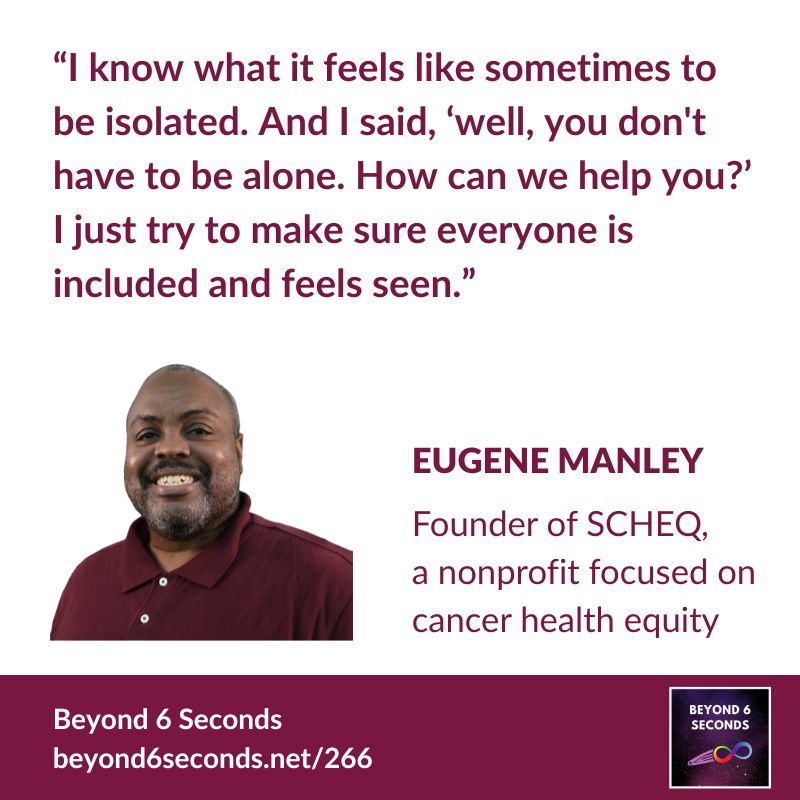
Eugene Manley: Yep. And you know, that’s also another thing with a lot of ADHD people when we’re focused. We are receptive to everything. It’s just a matter of what we actually respond to, but, and I just tend to respond to isolation or maybe I just know what it feels like to sometimes to be isolated.
And I just said, “well, you don’t have to be alone. How can we help you?” And, and I just try to make sure everyone is included and feels seen.
Carolyn Kiel: Yeah. That’s really awesome. Wow. Well, thank you again for the work that you do.
How can people get in touch with you if they wanna learn more about the type of work you do or get involved or learn more about SCHEQ?
Eugene Manley: Thank you. You can find us on our website SCHEQ, SCHEQ.org. We also have a donate button if you want to donate and a button to reach out if you want to volunteer. We have our socials, LinkedIn, Instagram, and Facebook are S-T-E-M-M-C-H-E-Q. And then you can also follow and find me on LinkedIn, Eugene Manley, Jr. PhD. And if you just reach out, I’ll probably, I’m working on creating a, a flyer on how to navigate healthcare. When they just say they were on the show, I will send that to people.
Carolyn Kiel: Okay. Fantastic. That’s awesome. Well, yeah. Eugene, thank you so much for sharing your story and talking about the really awesome and important work that you do. So yeah, wishing you all the best with success with SCHEQ and yeah, thanks again for being a guest on my show.
Eugene Manley: Thank you so much Carolyn. It was a pleasure to be here and you’re doing such a great job.
Carolyn Kiel: Thank you.
Carolyn Kiel: Has this podcast had an impact on your life, your heart, or your perspective in some way? If so, I’d love to hear about it. Send me a message on social media or through my website at beyond6seconds.net/contact. Your feedback means a lot to me, and it helps keep me going with this show. Thank you.
Thanks for listening to Beyond 6 Seconds. Please help me spread the word about this podcast. Share it with a friend, give it a shout out on your social media, or write a review on Apple Podcasts or your favorite podcast player. You can find all of my episodes and sign up for my free newsletter at Beyond6seconds.net. Until next time.