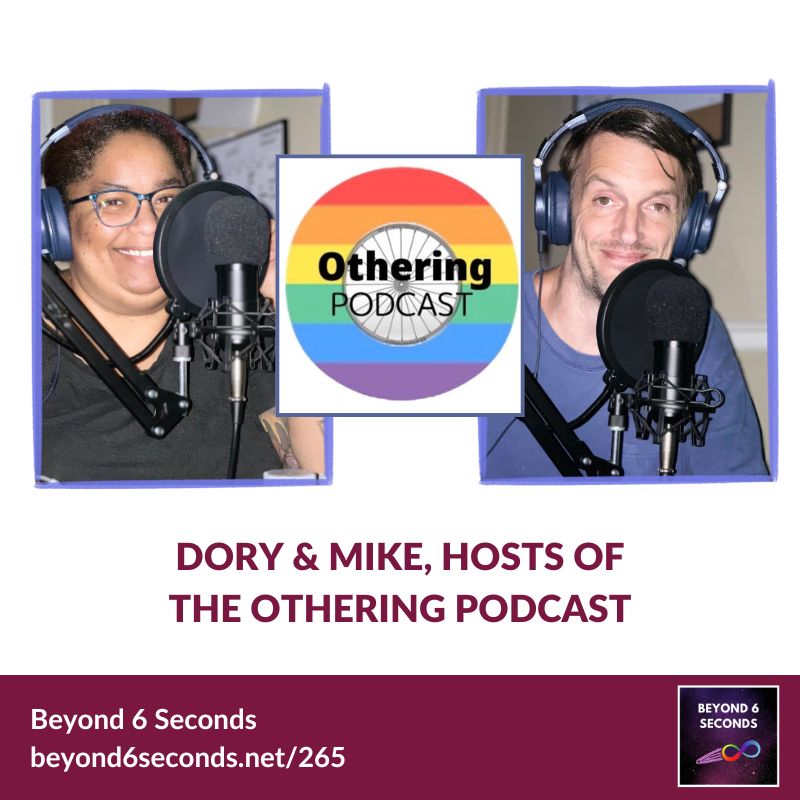
Episode 265: Your voice makes a difference – with Dory and Mike, hosts of the Othering Podcast
-
play_circle_filled
Episode 265: Your voice makes a difference – with Dory and Mike, hosts of the Othering Podcast
Carolyn Kiel
As the hosts of the Othering Podcast, Mike and Dory advocate for marginalized communities. Their podcast provides a platform where neurodivergent, disabled and LGBTQ+ people can share their stories.
During this episode, you will hear Dory and Mike talk about:
- Why they started the Othering Podcast, and how they came up with the name of the show
- Sharing their own lived experiences of neurodivergence and disability on their podcast
- How they select their podcast guests and topics
- Why is it important to amplify the stories of disabled and LGBTQ+ people
- Learning from the feedback they have received about their podcast
- The long-term impact they want their podcast to have
Listen to the Othering Podcast interviews with Joseph Kibler and Mychal Threets that were mentioned in this episode.
You can find all episodes of the Othering Podcast at OtheringPodcast.com.
Contribute to Carolyn’s tip jar to support this podcast at BuyMeACoffee.com/Beyond6Seconds!
Follow the Beyond 6 Seconds podcast in your favorite podcast player!
Subscribe to the FREE Beyond 6 Seconds newsletter for early access to my latest podcast episodes!
*Disclaimer: The views, guidance, opinions, and thoughts expressed in Beyond 6 Seconds episodes are solely mine and/or those of my guests, and do not necessarily represent those of my employer or other organizations. These episodes are for informational purposes only and do not substitute for professional medical advice. Consult a medical professional or healthcare provider if you are seeking medical advice, diagnoses, or treatment.*

The episode transcript is below.
Carolyn Kiel: Welcome to Beyond 6 Seconds, the podcast that goes beyond the six second first impression to share the extraordinary stories of neurodivergent people. I’m your host, Carolyn Kiel.
Carolyn Kiel: On today’s episode, I’m speaking with Mike and Dory, the hosts of the Othering Podcast. They advocate for marginalized communities, focusing on disabled and LGBTQ+ people by providing a platform for their podcast guests to share their stories.
Mike has a long history in internet radio and podcasting. 15 years ago, he ran his own radio network and several podcasts. Today he lives with neurodivergence and several learning disabilities. Dory lives with Complex Regional Pain Syndrome or CRPS. She’s an ambulatory wheelchair user, has autism, ADHD, asthma and several other disabilities.
Mike and Dory, welcome to the podcast.
Mike & Dory: Hello. Thank you for having us. Yes, thank you.
Carolyn Kiel: Yeah, I’m, I’ve been following your show for a while. I know we connected on social media, so I’m really looking forward to talking with you and learning more about the story behind your podcast and your own personal stories as well. So, I guess to start out, like, what inspired you to start the Othering Podcast?
Mike & Dory: Well, it started because for a while we were trying to come up with something to do. We wanted to do a podcast. We missed doing the radio ’cause we used to do it when like, you know, years ago and we wanted to do it again, but we couldn’t figure out what exactly we wanted to do. Like we were thinking, do we wanna start another radio network? And we were just like, no, that took too much time.
And so then we started thinking about podcasts. And at first we were gonna do just like a generalized podcast. ’cause so many people kept asking us, well, your children are so great and wonderful, how do you raise them? And it’s like, well, okay. But there really isn’t that much to it other than, you know, we talk to them like they were children, like they were humans . So we were thinking about that and then we’re like, hmm, that’s not long enough.
Then the regime came in and we decided, you know what? Always when things go wrong, the first people that are always the first to unfortunately be hurt are disabled and LGBTQ plus people. And so we said, why don’t we focus on them, especially since we’re both disabled and I am also bisexual, so why don’t we focus on that? And that’s how we came about.
I’m gonna say it was mostly her idea to start with, because she has CRPS and is becoming, or was at the time becoming, an ambulatory wheelchair user. She was really feeling down and angry with the world and she reached out on Instagram to find people in similar situations to find a community. And from there, that’s where she started to get the idea and where it came from.
And she proposed it to me and I thought it sounded great, but I questioned if we could get enough guests. So I told her, reach out to the people you’re talking to on Instagram, see if there’s interest in it. And we got really good feedback. So that kind of went from there. But yeah, it was, it was all Dory to start with, and then I helped bring it to life.
Carolyn Kiel: Very cool. How long has the podcast been in production?
Mike & Dory: Since May of 2025. So we’ve been doing it for a little bit and we’ve gotten a great response.
Carolyn Kiel: Yeah, that’s fabulous. And the name is so interesting, the Othering Podcast. Can you tell me about how you came up with the name and, and what that means in the context of the show?
Mike & Dory: That was all her again.
Well, growing up in a predominantly white area all of my life, areas all my life, made me feel like I was other, the other person, the token type of thing. And I never felt like I fit in. I didn’t realize I had neurodivergence at the time, but I never felt like I fit in at all. It was always just like, um, this feeling of I’m a shell of a person just looking in. And it made me always feel like an other person, not really a part of anything. And so when we were talking about how do we name this, I said, well, they always talk about everybody being an “other,” you know, different from the main group that’s supposed to be the one that we want to be like. And so it made sense to name it Othering Podcast because we are the other people and you know, we’re not going down silently.
And I said, that sounds awesome and it’ll work for marketing, so let’s go with it!
Carolyn Kiel: All right. Yeah, totally see the connection there and with both your own experiences and it sounds like the experiences of the guests that you host on your podcast. Yeah.
When I was doing your introduction, talked very briefly about some of your own lived experience of neurodivergence and disability. And I’d love to learn more about how you share that lived experience on the podcast. I know you do a lot of interviews, but how do you share it from yourselves?
Mike & Dory: Yeah. I feel like that’s a very important part of our podcast to show that we’re on their side, that we know what we’re, I guess to, not to sound mean, but we know what we’re talking about, we’ve been through it, so we’ll throw in our stories of the way that things have affected us, especially Dory. She does a lot of the talking, a lot more than me. So she’ll talk a lot about her CRPS or being in a wheelchair and such. And then with mental health, which is more of where I fall in with depression, bad depression and anxiety. And then as stories kind of unravel, I can talk to my lived experience to help show I understand and guide the conversation that way.
Carolyn Kiel: Yeah. That makes a lot of sense. And Dory, I know you shared your story about having CRPS and I think one of the important things is, you know, a lot of times people are born with disabilities, but other times acquire them as well. And I feel like CRPS is not something that’s really that well understood in the general public, and I know you acquired that later in life, so I know there’s a story behind that as well.
Mike & Dory: Yes, I’m a klutz. Let’s start with that. Um, I have always, always had some sort of crutches or cane growing up in my house. In fact, like it was just within the last five years, my parents finally got rid of my collection of crutches from when I was growing up. I always sprained my wrists and my knees and my ankles because I, like I said, I’m a klutz. You know, if a leaf gets in my way, I will trip over it. And playing sports, I, you know, fell down a lot. So that also caused a lot of sprains.
And it was the one sprain that just caused it all to happen was I was playing soccer with our kids in the front yard and I found the one hole that nobody else has managed to find except me and I twisted my ankle. It was a, one of those really bad high ankle sprains and it just never got better. I had to be in a boot for about two months and, it wasn’t completely torn, so there was no need for surgery, but it just never healed right. And it kept getting worse. That happened in 2012, and then it was about 2017 when after a bunch of tests to make sure that my blood was flowing correctly and my nerves were right and all of this stuff that they decided that based on exclusion that I had CRPS.
It’s not a new disease, syndrome I mean. But it’s been around in, it was first talked about during the Civil War when patients were, you know, having these mass casualties and mass events of disablement, and it just never was researched since then. And usually a lot of veterans, those types of people end up with it. And for some reason, I, I don’t know why, but they still just didn’t research it much. It’s starting to now get more of a highlight of it, a spotlight. I mean. But for me. It started in my ankle and then it spread to my knee and now it’s in both of my legs from the knee down.
Carolyn Kiel: Wow.
Mike & Dory: And it’s one of those things where like sometimes the day I, I’m good. I could probably, you know, clean the kitchen and clean the, the whole house up top to bottom and I’d be fine. And then of course I would pay for it, you know, the next few days.
And so would I.
Yes, yes you would. But and it’s one of those things where you have to learn your limits but it’s tricky because sometimes it doesn’t tell you exactly. Some days you can do it, and then other days if you even think about doing something, the pain, you know, just radiates and causes you to have to lay down or just give up on that day.
Carolyn Kiel: Yeah, I think that conditions like CRPS and other chronic pain conditions and autoimmune conditions and related disabilities that are chronic but not always the same intensity every day. Yeah, that’s something that I’ve definitely heard from guests more and more on my show when I talk with them, and I think, again, it’s something that people need to understand a little bit better.
Even the concept of like ambulatory wheelchair users is that, you know, people don’t have to be, don’t have to need a wheelchair a hundred percent of the time or 0% of the time. There is like a, a flux depending on people’s pain and energy levels.
Mike & Dory: Right! I mean, and even if you are paralyzed, you can still move sometimes. I mean, it depends on the type of injury that you have. But yes, ambulatory wheelchair users exist. We can sometimes move our feet. We can, you know, stand up. It just whether or not you can stand up for long periods of time or even walk for periods of time. Like for me, I cannot walk for long periods of time.
Carolyn Kiel: Mm-hmm.
Mike & Dory: It just, my body gives out and now it’s to the point of where my legs will give out on me
Carolyn Kiel: Wow.
Mike & Dory: and I will fall, and which exacerbates the problem even more. So it’s better if I, you know, stay to a wheelchair if I have to go for far distances or sometimes even just short distances.
Carolyn Kiel: Yeah, I think that’s definitely important for people to realize that there are those differences in people’s ability, sometimes depending on your energy and your, and your pain level and all of that.
In terms of how you select the guests that you talk with on your show and, and the topics, how do you go about doing that? I know you mentioned that at first you were reaching out to people who had reached out to you on social media, but are you still, now that you’ve been a few months into the podcast, are you still doing that? Are you getting more spontaneous requests for people to be on?
Mike & Dory: Both, we’ll reach out to guests that, like, say we find someone or start talking to someone that we really like. We’ll reach out to them and invite them on the show. Or a dream guest, someone certain that we were looking for, we’ll invite them. We’ve gotten a lot of guests just by putting a post out on social media saying we’re looking for guests. A lot of them come that way and some just come to us at random. So it’s a little bit of everything.
As far as criteria, it’s basically if you’re disabled and or LGBTQ or even strong advocates, we will talk to them as well.
Carolyn Kiel: Yeah. And I have to say, you know, especially for a new show like yours, you have had some amazing guests on with like huge profiles. You had Joseph Kibler on who is someone that I love following and absolutely love his content. So that was an amazing episode.
And I think I saw, do you have Mychal Threets coming on soon?
Mike & Dory: Yes we do.
Carolyn Kiel: That’s awesome.
Mike & Dory: He’s coming January 22nd. Yes, the 22nd.
Carolyn Kiel: Oh my goodness. Yeah. So that’s really cool. And for those who may not know, he’s the new host of Reading Rainbow. Yeah, he’s just such a wonderful, warm and extraordinary personality, and I follow him on social media too. Your episode with Mychal Threets will already be available by the time this episode airs.
Mike & Dory: Yeah, he’s extraordinary. He’s just so, so wonderful.
Great person.
In fact, all of our guests have been just amazingly wonderful people. Honestly, I’ve learned so much from them.
Me too.
And they give so much of their time and I just, I, I can’t stop gushing about them because I get to talk to them and like, I feel so blessed to be able to talk to them.
And of course, I fan girl over pretty much all of them because like, I see them as, you know, a lot of them have major followings, or in their own right, they’re famous. And I think it’s just amazing that they’re taking the time to talk to us about important topics and, you know, humanizing these groups of people that are always the first to be dehumanized is honestly, you know, just like a thrill.
Carolyn Kiel: And, and kudos to you for doing that reach out! ‘Cause, you know, it’s a reminder to all indie podcasters is that, if you admire someone, you really want them on your show, sometimes just reach out. Like the worst they can say is no, or have no response, you know?
Mike & Dory: Yeah, there’s plenty of people that have just not responded at all to us or said we can’t do it right now, or we have to do it at this time and it didn’t work for us. Or, yeah, it goes every way, but doesn’t hurt to try.
Yeah, it never hurts to ask. I mean, if you don’t ask, then it’s always a no.
Right.
Carolyn Kiel: Right, right. Yeah, absolutely.
When you have your discussions with your guests, do you talk a lot about the intersections with, you know, disability, neurodivergence, LGBTQ identity, with other parts of your identity?
Mike & Dory: Yes, yes, yes. That’s important too because we, we like talking about that because so many times, so many things intersect. It could be the color of your skin or your height or just your gender. And so many things intersect in our lives normally. The fact that you know, when we were researching whether or not we were gonna do this and what the name of it all was, and how would we stand out, the important part was the intersectionality of, yeah, you might be LGBTQ, but you’re also a human. You know, what is that other part of you that makes you, you. And you know, some of them have been Black, some of them have been Hispanic, some of them are mixed race. And those are important aspects of these people as well, because you can’t just isolate one aspect of somebody. Nobody is just one thing.
And, and there are episodes where we will talk for half an hour just about like what they do as a singer or as a comedian, and never really mention the disability, like Dory said, just to show the, that they’re human. They’re no different than everybody else. They’re just a human and just as beautiful as everyone else.
Right.
Carolyn Kiel: Yeah, that, and that’s, that’s really important to be able to highlight. One is to show humanity and help de-stigmatize and, and just help people understand that, you know, people in the end are people. While also recognizing that the identities that you hold impact the way that you live and move through society. So, you know, the experience of like a late diagnosed white, autistic straight woman like me is different from, you know, a Black autistic boy who lives in a different part of the country. There are just different things that we’re subjected to and our experiences are different.
Mike & Dory: Yeah, and all these different podcasts are so important to spread the word and to share the stories. Yours, ours, all of them are equally as important to get the word out there.
To shed light on, you know parts of the world that don’t always get a chance to have a voice. ’cause a lot of times, you know, you’re silenced because you’re female or you’re silenced because you’re short or a little person or you know, you’re just too tall and you know, there’s always a too something.
And to, we all get to highlight those people that are on the outskirts, so to speak, or that are othered and bring their stories to light. And I think all of that is important, even if it’s just as mundane as you work in New York City and walk along Fifth Avenue type of thing. And, you know, all of those stories are important to know.
Carolyn Kiel: Yeah, absolutely. Yeah. We need to understand the full breadth of people’s experiences. It helps towards acceptance and understanding towards the end. Absolutely.
What are your favorite kind of guests to interview on your podcast, if you have a favorite?
Mike & Dory: Honestly, it’s like just everybody. We’ve had such luck in finding incredibly gracious people. And all of them are incredibly just brilliant in what they’re doing. I love talking to artists because they are always quirky and funny. You know, like Joseph Kibler. He’s funny. I love his “Crip Tips.”
Carolyn Kiel: Love those!
Mike & Dory: And authors are really great. And actually all of them have been artistic people.
Yeah.
Which is another aspect of importance because art helps us, you know, see life in a different way instead of just your one point of view. Not that that’s not important, it is, but sometimes it’s nice to see what other people see when they’re looking at the same horizon or the same story. You know, how do you see it? And all of them have been able to share that with us.
I have to admit that some of my favorite, favorite ones were British because I am obsessed with the British accent. I love the British accent, so I, I do have to admit that part. Otherwise, I, I love talking to everybody and anybody is welcome to talk to us because it’s just, it’s awesome.
Yeah.
Carolyn Kiel: That’s really cool. And yeah, that’s cool that you get to talk to people from different parts of the world as well. Yeah. Yeah.
So, you know, you’ve been in production for at, at the time of this recording, a couple months. What kind of feedback have you received about the Othering Podcast so far?
I.
Mike & Dory: It’s 99% been really, really, really good. I had one little drama episode, but that’s in the past. But otherwise it’s been really good. A lot of positive feedback. We’re actually on three internet radio stations being broadcast on three different internet radio stations. One that’s based outta South Africa.
Carolyn Kiel: Wow!
Mike & Dory: And it’s in the works that it may be broadcast on FM and Pennsylvania later this year.
Carolyn Kiel: Oh, that’s really cool.
Mike & Dory: So that’s really got a lot of good feedback and a lot of good progress.
And you know, the one mishap that we did have we fully owned up to it. And I just wanna say, you know, sometimes mistakes happen and nobody’s perfect. Nobody’s ever gonna be perfect. And we have to sometimes give ourselves grace when we mess up and just own it and move on.
Carolyn Kiel: Yeah, I think at some point in time, if you’re doing a show like this where you’re talking about, you know, different important social issues that people have strong opinions on, you know, at, at some point there’s always something that you, experienced a situation where you can learn from other people and learn more. And as you said, own it and move on and learn from it. And I think that’s important. ’cause I think that’s, that’s hard for a lot of people to do, at least from what I observe on social media. And yeah, it’s, it’s important because, you know, if you hold back and you’re afraid of saying the wrong thing, then you are really not sharing your full gift of interviewing and sharing your true story and you know, you can’t be afraid to make mistakes and as long as you own them and learn from them. Yeah.
Mike & Dory: Exactly.
And other people learn from our mistakes too. So then that way they know going forward, okay, this is what I don’t do.
Carolyn Kiel: Yeah.
Mike & Dory: And you know, to insult somebody or, you know, to hurt somebody’s feelings and which is what we don’t want to ever do. But, you know, sometimes unfortunately you get into the heat of things or you’re not always paying attention to certain things, and you do make those mistakes. And you know, like you said, it’s important to share those mistakes because then it shows that we’re, we’re human.
Carolyn Kiel: Yeah. No, absolutely. And we’re always, we’re always learning or we always should be learning anyway, so, and that’s important. Yeah, absolutely. Yeah.
Mike & Dory: Yeah. If you think you already know everything, then you’re no fun.
Carolyn Kiel: exactly. Yeah. No one wants to hear from someone who knows like every single thing already, so, yeah.
Long-term, what are your goals for the Othering Podcast?
Mike & Dory: To make a difference.
Yes, to make a difference and to take over the world.
Carolyn Kiel: Yes!
Mike & Dory: But in a way, to conquer the world in the good way into making a difference so that everybody in every corner has a chance not only to share their voice, but to also force countries into understanding that there are going to be people who are LGBTQ+, there are people who are going to be disabled. And no matter what, we’re always here, we’re always going to be here, and if you’re so focused on worrying about disabling things, then make life better. Stop trying to do wars, stop trying to force people into boxes that just don’t fit because you’re just making more disabled people.
And we want millions of listeners, because we wanna make the difference. Not for the money. We’ll take the money, but we don’t want it for the money. We’re not in it for the money. We’re in it to make that difference and to be heard or guests to be heard.
Carolyn Kiel: Mm-hmm.
Mike & Dory: Yeah, that’s why we push so hard and promote so hard for it.
Carolyn Kiel: Yeah.
Mike & Dory: We don’t want any more regimes.
It’s tiring.
Carolyn Kiel: Yeah. And that’s one of the great things about podcasting is that, anyone can set up a show. There’s not a lot of gatekeeping. It doesn’t rely on any one particular social media platform or a corporation. And it’s important to get other voices out there because sometimes the loudest voices are not, let’s just say, the most helpful voices or the ones that have the best intentions.
Mike & Dory: Right! And the quiet people deserve to be heard too. And they always talk about the “silent majority,” and we need to stop being silent.
I’m a very introverted, always been a very shy, quiet person, which as you probably, if you listen to the podcast, you notice who talks a lot more. That one. But having done internet radio and now doing this, and especially with this, I’ve just learned so much about how much of a difference one voice can make.
Like for a long time, I was one of those people where I didn’t quite understand the difference of one person. What, what good is that doing? That doesn’t matter. But now I understand that it’s not just you. If a million people are just one person, that’s a million people. So I understand it makes such a difference to have that one voice and to go vote that one vote, whatever the case may be, it makes a world of difference.
Carolyn Kiel: Yeah, yeah. I think especially now, it’s important to remind people that they, they do still have a voice and you should use it however you’re able to, you know, certainly by voting and, and if, you know, if you wanna do something like start a podcast or even just write or share or talk to your friends and family and neighbors. You know, it’s important to not be that silent majority. Because yeah, you’re right, that usually is what happens, is that the few loud voices are the ones that tend to shape policies.
Mike & Dory: Yeah. And, and we can’t have that anymore. We don’t want regimes, you know, we fought against it over 80 years ago, and we don’t want that again. We have to keep talking and we have to keep raising our voices so that more and more people are like, oh my God, they’re right. You know, they are human. Why are we allowing this to happen?
Carolyn Kiel: Yeah, and I think in talking about regimes, is that one source of power for regimes is making people feel hopeless. Like nothing they say or nothing they do can make any kind of difference at all. ’cause they’re just one person and they’re up against so and so powerful.
But, you know, altogether, if we’re doing even small things, whatever we’re able to, yeah I mean, that’s how regimes get changed. That’s how social policies get changed. That’s how it works. So just to remind people that they still have that power and to not give up hope. ’cause that’s probably the worst thing you can do.
Mike & Dory: Exactly. That’s what they want is you to give up hope. Because when you have no hope, you just become complacent. And as long as we keep, you know, there’s always gonna be that one person that says something and that sparks something in somebody else. And if we can end up being a part of that spark, then I’ve realized my main goal, is that I’ve sparked other people into action. I’ve sparked other people into realizing that they are worthy and that no matter what people say to them, even if they don’t understand or whatever, that there is always a community that does.
Just like the protests. If so many people go out, it makes a difference. And same with just being on a podcast. If enough people speak up, say something, it makes a difference.
And the other thing is that we have to realize that to make change, it’s not always marching in the street. Sometimes it’s putting up a flyer. Sometimes it’s just being the person that they can call. It could be that simple. And, you know, every little thing counts and every little thing helps, whatever you’re able to do.
And, you know, a lot of times when these marches and things happen, they always neglect to include disabled people.
Carolyn Kiel: Yeah.
Mike & Dory: And we have to be a part of that too because we are the largest minority ever. And all it could take, it could be as simple as the government decides that you are disabled. They could say that, even if you are not in any way, shape, or form. But if they decide you are, you’re disabled now. And so you should always want to strive to make sure that the disabled people are okay because you can at any point be included in that group.
Carolyn Kiel: Yeah.
Mike & Dory: And if you don’t wanna be tied up and you know, held down and stripped of your humanity, you know, think about the ones that really are disabled.
Carolyn Kiel: Yeah. And, that’s not just a theory that, that is part of the history of this country is dehumanization of disability and extending disability to other more marginalized groups so that even if you’re not disabled, you, you fall under that classification and now you are someone that the regime does not want to have rights, or civil rights or human rights. So, yeah, it really is important for people to listen to disabled voices, and certainly in a lot of ways include people who are more marginalized.
And I know some of us may have woken up and be like, “oh my God, what do we do? What do I do?” Well, there are plenty of people, plenty of organizations who are already doing the work and plenty of people who could totally use your help, whether it’s making flyers or writing letters or donating money or just being there for support or doing childcare. Like anything. There are people doing that work and they could absolutely use your help. You don’t have to start your own thing. They, they need it.
Mike & Dory: It could be as simple as baking a casserole, if that’s what you can do to help, because you know it keeps fueling people. And you know, even if it’s just to make ribbons, that’s good too. Yeah. Every little thing helps because you’re giving somebody hope. And if you can give just one person hope, that person can then give another person hope. And it spreads. It doesn’t have to be, you know, hang gliding off of the Empire State Building. You know, you don’t have to do that. And it has to be within your ability, because if you burn yourself out, that doesn’t help either.
Carolyn Kiel: Absolutely. Pace yourself with all of this, ’cause it, it can be overwhelming.
It sounds like you’re doing really amazing work with the Othering Podcast. How can people get in touch with you if they wanna learn more about the Othering Podcast?
Mike & Dory: You can listen pretty much wherever you get your podcasts, Spotify, Apple Music, Amazon, all the different places. You can visit our website at OtheringPodcast.com and you can contact us through there, there’s a form on there. And we’re all over social media at otheringpodcast, maybe othering.podcast on TikTok, I think. I don’t remember. I can’t keep track of them all. You’ll find us. And thank you so much for having us today and talking to us.
Carolyn Kiel: Thank you. Yeah. I’ll put a link to your website in the show notes so people can probably get to your socials and your podcast and your show from there.
Dory and Mike, is there anything else you’d like our listeners to know as we close out or anything they can help or support you with?
Mike & Dory: Just keep fighting, keep getting up every day. Keep waking up. Find a way to smile and laugh because that helps so much on so many different levels. Not just fighting fascism, but fighting that overwhelming darkness that sometimes comes with learning about yourself with a disability or just being different.
Carolyn Kiel: Yeah. That’s an important reminder. It’s okay to feel joy and, and in fact it’s important to find those moments of joy and peace and rest and self care. Especially in times like these.
Mike & Dory: Yeah, because it’s radical. It shouldn’t be, but is.
Carolyn Kiel: It is. Yeah. And in our society that really prioritizes being productive, it sometimes is not looked on as valuable, but it truly is. So, yeah.
Mike & Dory: We can’t produce anything if we become stones, you can’t, you know, like the saying, you can’t squeeze blood from a stone. So you know, if you are too tired or you can’t think or things like that, you can’t produce anything. But even if you can’t do anything and you’re bed bound, you’re still worthy.
Carolyn Kiel: Absolutely. And I know there’ve been virtual protests sometimes if you are literally bed bound, so there are ways to get involved with that too.
Mike & Dory: There are bed-ins, there are sit-ins that, you know, all of that helps.
Carolyn Kiel: Yeah, absolutely. All right. Yeah. Well, Mike and Dory, thank you so much for being on the podcast.
Mike & Dory: Thank you.
Carolyn Kiel: Yeah, it was great. And congratulations on the success of your show. I’m looking forward to hearing more episodes.
Mike & Dory: Thank you.
Carolyn Kiel: Has this podcast had an impact on your life, your heart, or your perspective in some way? If so, I’d love to hear about it. Send me a message on social media or through my website at beyond6seconds.net/contact. Your feedback means a lot to me, and it helps keep me going with this show. Thank you.
Thanks for listening to Beyond 6 Seconds. Please help me spread the word about this podcast. Share it with a friend, give it a shout out on your social media, or write a review on Apple Podcasts or your favorite podcast player. You can find all of my episodes and sign up for my free newsletter at Beyond6seconds.net. Until next time.