Episode 268: Disability representation in music – with DEĀ EX MACHINĀ
-
play_circle_filled
Episode 268: Disability representation in music – with DEĀ EX MACHINĀ
Carolyn Kiel
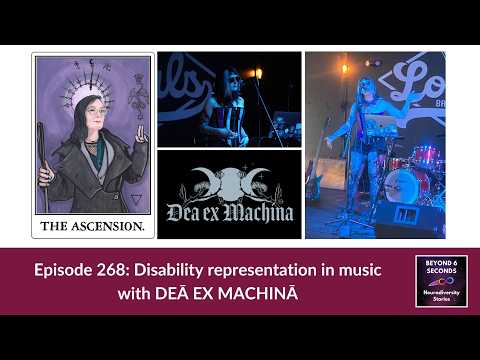
Torina Gedler is a musician who is also known as DEĀ EX MACHINĀ, which means “Goddess from the machine” in Latin. With their lush synth-pop sound, DEĀ EX MACHINĀ promotes harmony and inclusion in society through authentic Disability representation in music.
DEĀ EX MACHINĀ advocates for the arts, LGBTQIA+ rights and Environmental and Disability Justice. Their debut EP, APO/THECARY, comes out on July 29, 2026.
During this episode, DEĀ EX MACHINĀ discusses:
- Their work as a musician before and after being disabled by a brain injury
- Why it’s important to have disability representation in music
- The main themes of their debut EP
- How joining RAMPD (Recording Artists and Music Professionals with Disabilities) influenced their work as a musician
- Their EP release party on July 29 in Des Moines, Iowa
Learn more about DEĀ EX MACHINĀ at www.DeaExMachina.music and listen to their music on Subvert, Spotify, Apple Music and Bandcamp.
Learn more about Recording Artists and Music Professionals with Disabilities (RAMPD) at RAMPD.org.
Listen to other Beyond 6 Seconds episodes with neurodivergent musicians: Adin Boyer (episode 227) and Kaishawna (episode 187).
Contribute to Carolyn’s tip jar to support this podcast at BuyMeACoffee.com/Beyond6Seconds!
Follow the Beyond 6 Seconds podcast in your favorite podcast player!
Subscribe to the FREE Beyond 6 Seconds newsletter for early access to my latest podcast episodes!
*Disclaimer: The views, guidance, opinions, and thoughts expressed in Beyond 6 Seconds episodes are solely mine and/or those of my guests, and do not necessarily represent those of my employer or other organizations. These episodes are for informational purposes only and do not substitute for professional medical advice. Consult a medical professional or healthcare provider if you are seeking medical advice, diagnoses, or treatment.*
The episode transcript is below.
Carolyn Kiel: Welcome to Beyond 6 Seconds, the podcast that goes beyond the six second first impression to share the extraordinary stories of neurodivergent people. I’m your host, Carolyn Kiel.
On today’s episode, I’m speaking with Torina Gedler, the musician also known as DEĀ EX MACHINĀ, which means “goddess from the machine” in Latin. With their lush synth pop sound, DEĀ EX MACHINĀ promotes harmony and inclusion in society through authentic disability representation in music.
Along with earning grants for their songwriting, DEĀ actively advocates for justice of all kinds, especially disability, through their work as a professional member of RAMPD, which is Recording Artists and Music Professionals with Disabilities, as well as Allies in Advocacy of Des Moines. They advocate for the arts, LGBTQIA+ rights, and environmental justice in their work and lifestyle, and are passionate about their local community in the Des Moines, Iowa metro area. Their debut EP, APO/THECARY, comes out on July 29.
DEĀ treated music like an extreme sport as a child and thought there was no chance of pursuing a career after a brain injury rendered them disabled. Now a professional musician at the age of 31, DEĀ’s story is one of resilience and hope for all who face adversity. DEĀ, welcome to the podcast.
DEĀ EX MACHINĀ: Hi, Carolyn. Thank you so very much for having me.
Carolyn Kiel: Yeah, I’m really excited to learn about your story and, and how you became a musician, and to learn about some really exciting work that you have coming up very soon.
You have a really interesting musical persona, DEĀ EX MACHINĀ. Could you talk more about what the meaning of that is and kind of where that came from for you?
DEĀ EX MACHINĀ: The name DEĀ EX MACHINĀ figuratively means to rise from the machine-like systems that are put upon us when we are born, like capitalism, the patriarchy, sexism, ableism. And literally, like you had said, it means “goddess from the machine” in Latin. It originated in Greek tragic theater. Critics would use the term “god from the machine” to describe a kind of trite ending that tragic plays had, where a god or an actor playing a deity would come into the play at the end and solve all of the problems. They were lifted onto the stage with a riser or lowered onto the stage with a crane. And so the term to describe this god who solved everything very quickly and almost y- you know, unrealistically, it just seemed like a cop-out to the critics. That, that term was the god from the machine.
My name is Goddess from the Machine, which is the feminine derivative. So it’s a nod to feminism and marginalized communities that are underrepresented in the narrative of history.
Carolyn Kiel: Right. That’s really cool. So you kind of have this spirit in the systems and the machine that exist in our world. So that’s, that’s really fascinating.
DEĀ EX MACHINĀ: Yes, this project is very spiritual as well. The imagery is inspired by Greek goddesses as well.
Carolyn Kiel: Awesome. Yeah, well, that’s really cool, and I’m so excited to learn more about your music. You’ve been a musician since a very young age, so how did you discover your interest in music?
DEĀ EX MACHINĀ: I was classically trained as a musician, and my family is very musical, so I have known how to read music since I knew how to read.
When I was a musician early in my life, it was more like sports, and I did it to compete and I did it because I was good at it. I didn’t become so passionate about it until I had my brain injury at the age of 14. That was when I stumbled on writing music, and I composed – choral music at first, but that transformed into songwriting now. And that is the project that I am the most focused on.
Carolyn Kiel: Mm-hmm. So yeah, I was gonna ask how your disability through your brain injury impacted your music, you know, as well as the rest of your life. And it sounds like it kinda had this shift from maybe exclusively performing to also songwriting or focusing on creating music as well, or, how else was it impacted?
DEĀ EX MACHINĀ: Yeah. I was a performer at first before I had the brain injury, and the, the brain injury slowed down my willingness to be a performer at first. But then I saw the existence of RAMPD, and I learned about what they stood for, and I thought, “I’ve gotta start sharing my art.” So I, I started writing, writing, writing, and that is what drove this, this synth-pop project that we are talking about today, DEĀ EX MACHINĀ. It really is a passion project for me.
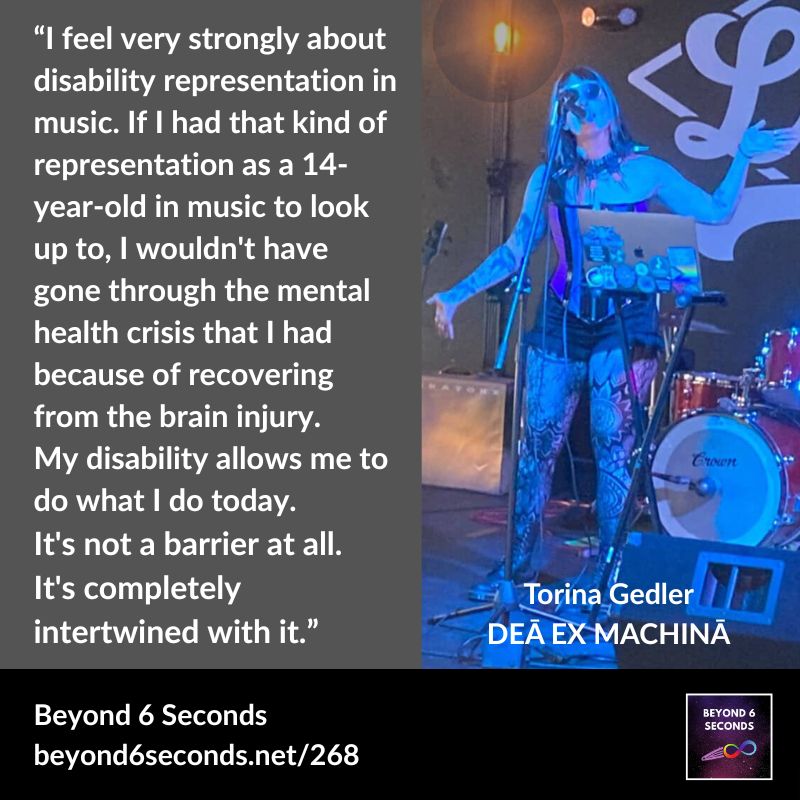
I feel very strongly about disability representation in music. If I had had that kind of representation as a 14-year-old in music to look up to, I wouldn’t have gone through the mental health crisis that I had gone through because of recovering from the brain injury. To sum it all up, my disability, I feel like, allows me to do what I do today. It’s not a barrier at all. It’s completely intertwined with it.
Carolyn Kiel: Wow. So yeah, and you have a new EP coming out, which is actually your debut EP coming out very soon. It will be coming out in just a few days. So I’d love to learn more about that. What are some of the main themes that you focus on through the music that’s on this EP?
DEĀ EX MACHINĀ: The main themes of the EP are fantastical imagery that act as a vehicle for my own emotions about the world that we live in right now in 2026. The songs themselves on the EP, five of them, were written in 2022 and 2023, and basically they walk you through my life as a closeted neurodivergent and queer child into being self-actualized and empowered in my identity. And it, it’s also very spiritual. There are a lot of themes of spirituality, especially in the last two songs of the EP.
The very first song of the EP is kind of about my frustration with perfectionism and the expectations placed on me as an AFAB person. Musically you hear me kind of explode out of all of that, exploding from people-pleasing, even though I still have a long ways to go in overcoming my people-pleasing tendencies.
The second song is about my neurodivergent youth specifically. I was not diagnosed with, with anything, but I am in the process of trying to get some kind of neurodivergence diagnosed, whether that be ADHD or autism. I have talked to therapists about it. It’s been a journey, but the more I learn about these conditions, the more I learn how to adequately care for myself. And ultimately, when we care for ourselves, we care for the world around us, right?
Carolyn Kiel: Right.
DEĀ EX MACHINĀ: So that is that. The third song is about me learning to love myself as a disabled person. For a long time, I didn’t even want to accept that I’d had this brain injury. The brain injury that I did have, by the way, is called an AVM, or arteriovenous malformation. It’s a ruptured blood vessel in the brain. Mine was in the brain stem, so everything just takes longer to go in and longer to go out. But ultimately, I think the same way I used to. It’s just harder to get my words out sometimes. So in a way, this brain injury has exacerbated the autistic symptoms that I experience. Yeah, the lyrics and music together, they tell a story of overcoming internalized ableism, perfectionism, and homophobia to become spiritually enlightened and self-actualized as a disabled person.
The fourth song on the EP is about how I found empowerment through witchcraft, and then the fifth song kind of ties it all together about being spiritually awakened.
Carolyn Kiel: That’s great. It’s so deeply influenced by your own personal experiences. The songwriting and the recording process sounds like a really great way to sort of process and reflect on a lot of things you’ve gone through in your life. So that’s really cool.
DEĀ EX MACHINĀ: Thank you. Thank you so much.
Carolyn Kiel: You mentioned that you wish you had had music role models when you were much younger who were in the disability space or, or who were queer who you could relate to, and that you probably wouldn’t have struggled as much. When you got involved with RAMPD, was that around the time that you were writing these songs? Like how did getting involved with that group, because there’s so much great representation there, how did that influence your writing?
DEĀ EX MACHINĀ: Yes. So I found out about RAMPD pretty soon after it was founded in 2022. I was preparing a workshop on disability and music for a community organization that is called Girls Rock Des Moines. I was teaching this workshop to kids from age 8 to 18. So yeah, it’s a pretty wide range of abilities and attention spans.
But that’s how I found out about RAMPD. It was the first thing that popped up on a web search when I put in my browser, “disability and music.” From there, I searched that database, and I did see some amazing disabled musicians like Gaelynn Lea. She came to my state not too long ago too. There’s of course Lachi, the CEO of RAMPD, who is amazing, and they’re all just so supportive too and have really rooted me on and, and believed in, in me, and that belief in me has just helped kindle that flame. I learned about RAMPD about three months before I started doing most of the songwriting. So the timing was actually uncanny.
My sister is an incredible songwriter as well. She lives in Chicago now. At the time, she was still going to school. She welcomed me into this songwriting group with her songwriting teacher from her music school. It had nothing to do with the school. It was just this creative challenge that she ran, and that’s where I wrote all of those songs. And I, I wrote them with the intention of expressing myself. I didn’t even think about being an artist at the time. But I had been following RAMPD, and the more I saw from them and the more I thought about them, the more I thought, “Geez, maybe I should, I should release some of these. Maybe I should try harder to produce them first before releasing them.” So that was eventually what led me to have my first release in 2023.
If all of this would have come together in my mind faster, maybe I, I would have jumped into a career as a songwriter. But I w- I was also studying music therapy in 2022 at that time, so I hadn’t completely let go of that career. But I found out that songwriting is more aligned with what I want to do, and it just serves my needs better as well. In the end, that’s how I chose songwriting over music therapy.
Carolyn Kiel: Do you work with a band or do you, do you play all the parts and sing? Like, how did that work for the EP?
DEĀ EX MACHINĀ: Oh, that’s such a great question. I do consider myself to be an amateur producer. I can get the bare bones of my songs into a DAW or Digital Audio Workstation. But they don’t sound radio ready when I put them in the DAW. So I actually connected with another RAMPD member. When they perform their music, they go by the name Medusa. They helped with the production of this EP. They are amazing., so it’s it’s a really cool opportunity.
Carolyn Kiel: That community sounds like it was really helpful to find other people with the producing and quality, so yeah. Oh, that’s really great.
So now your EP is coming out on July 29th. Are you doing a local tour, like performances to help promote it? Or is it mainly sort of digital distribution that you do to share that it’s out there?
DEĀ EX MACHINĀ: I have some tentative shows lined up in the fall, but nothing is set in stone yet. I do have a release show itself. It’s taking place on Wednesday, July 29th at XVK in Des Moines, Iowa. The show is at 7:00. The doors are at 6:00. I’m having three other artists perform with me at this show. They’re local. It’s gonna be a big show and it’s gonna be great. I also have a tarot reader who’s gonna be there when the doors open so people can get their cards read if they wish. It’s gonna be a good time!
Carolyn Kiel: That sounds really great. That’s so much fun to be able to have a live show for the release date and to finally see your creation go out in the world.
Like, where can people buy your EP or can they go somewhere to find out about live performances that might get scheduled like for the fall later on?
DEĀ EX MACHINĀ: I plan to sell vinyl of my EP from my website. My website is DeaExMachina.music, so D-E-A-E-X-M-A-C-H-I-N-A.music. Future shows will be listed on there as well.
Carolyn Kiel: Okay, perfect. Yeah, I can put your website in the show notes of the podcast so people can just click on it from there when they’re listening to this episode.
DEĀ EX MACHINĀ: Wonderful!
Carolyn Kiel: And for your EP, are you also doing any digital distributions anywhere, or is it mainly vinyl?
DEĀ EX MACHINĀ: Yeah, it’s going to be available for streaming on streaming platforms for now, like Spotify and Apple Music. I’m going to have copies available for download on Subvert and Bandcamp. Subvert is this new platform that is trying to get away from the corporate mindset that Bandcamp has. I’m hoping eventually that I can just use Subvert. I think that’s the best thing out there right now to get my music heard. That and playing live. But since I’m still really new and no one really knows my music yet, I’ve been advised to still release my songs on Spotify and Apple Music and Bandcamp and, and all of that. Just cast a wide net.
Carolyn Kiel: Yeah. To make it available to as many people as possible. That makes sense. So people, even if they’re not in the Des Moines area, if they don’t have a chance to see you live, they can get your music no matter where they live, so that’s really cool.
DEĀ EX MACHINĀ: Absolutely. I would love to have as many listeners as possible from around the US. I have friends across the nation in RAMPD and from other music business endeavors. And I hope to eventually be able to, to go on tour. I don’t know how practical that is as a disabled person, but we will see!
Carolyn Kiel: Yeah, well I think it’s a great start, and yeah, congratulations on your new upcoming EP. So that, that’s really exciting.
DEĀ EX MACHINĀ: Thank you!
Carolyn Kiel: DEĀ, is there anything else that you’d like our listeners to know or really anything else that they can help or support you with?
DEĀ EX MACHINĀ: Well, it would really help me if people in general hired more disabled artists and didn’t use AI. They hired artists instead. It would help me if people went out of their way to love each other and have more empathy ’cause you never know what anyone else is going through. And if you do feel like it, spread the word about my EP too.
Carolyn Kiel: Okay, wonderful. Thanks again, DEĀ, for sharing your story and your music journey and all of the really exciting work that you’re doing. And I’m really looking forward to your EP coming out, in just a few days! So congratulations again, and yeah, thank you again for being on the show to talk about your music.
DEĀ EX MACHINĀ: Thank you so much, Carolyn. I’m honored to be here.
Carolyn Kiel: Thanks for listening to my interview with DEĀ EX MACHINĀ. If you enjoyed this episode, you might also enjoy listening to some other interviews I’ve done with neurodivergent musicians. Check out episode 227 for my conversation with Adin Boyer about his experience competing on American Idol as a musician with autism, and episode 187 for my interview with Kaishawna, a Deaf Black Autistic woman who plays clarinet. You can find links to those episodes in the show notes.
Has this podcast had an impact on your life, your heart, or your perspective in some way? If so, I’d love to hear about it. Send me a message on social media or through my website at beyond6seconds.net/contact. Your feedback means a lot to me, and it helps keep me going with this show. Thank you.
Thanks for listening to Beyond 6 Seconds. Please help me spread the word about this podcast. Share it with a friend, give it a shout out on your social media, or write a review on Apple Podcasts or your favorite podcast player. You can find all of my episodes and sign up for my free newsletter at Beyond6seconds.net. Until next time.