Episode 269: Dissociative identity disorder, psychotic depression and Mad Liberation – with Kantu
-
play_circle_filled
Episode 269: Dissociative identity disorder, psychotic depression and Mad Liberation – with Kantu
Carolyn Kiel
Kantu (they/he) is the founder and co-owner of the social media presence known as the Angry Autist. Indigenous to the Andes in Abya Yala, Kantu is Quechua and is racialized as a visibly Native person. Kantu is autistic, has dissociative identity disorder (DID) and has experienced psychotic depression.
When founding the Angry Autist, it was their goal to bring awareness to their experience as a multiply and visibly disabled, racialized, and medium support needs autistic person. Since then, he has become further radicalized as explicitly anti-racist, anti-ableist, and anti-saneist, drawing inspiration from the ten principles of disability justice, the CripplePunk movement, Indigenous philosophy, mad liberation, and fat liberation.
During this episode, you will hear Kantu talk about:
- How they discovered they have DID
- How DID stereotypes affect real-life perceptions of DID
- How their autism affected their own experience of DID
- Their experience with psychotic depression symptoms and treatments
- The meaning and significance of mad liberation
To find out more about Kantu and his work, follow them on Threads @angry_autist and Instagram @angry_autist. They can also be reached by email at angryandautistic [at] gmail [dot] com.
Listen to other Beyond 6 Seconds episodes about dissociative identity disorder (DID): Amber Louise Ainsworth (episode 194) and Crystals Multifaceted (episode 215).
Contribute to Carolyn’s tip jar to support this podcast at BuyMeACoffee.com/Beyond6Seconds!
Follow the Beyond 6 Seconds podcast in your favorite podcast player!
Subscribe to the FREE Beyond 6 Seconds newsletter for early access to my latest podcast episodes!
*Disclaimer: The views, guidance, opinions, and thoughts expressed in Beyond 6 Seconds episodes are solely mine and/or those of my guests, and do not necessarily represent those of my employer or other organizations. These episodes are for informational purposes only and do not substitute for professional medical advice. Consult a medical professional or healthcare provider if you are seeking medical advice, diagnoses, or treatment.*

The episode transcript is below.
Carolyn Kiel: Welcome to Beyond 6 Seconds, the podcast that goes beyond the six second first impression to share the extraordinary stories of neurodivergent people. I’m your host, Carolyn Kiel.
Before we get started with today’s episode, this is just a reminder that the discussions on this podcast are not a substitute for professional medical advice. Consult a medical professional or healthcare provider if you are seeking medical advice, diagnoses, or treatment.
On today’s episode, I’m speaking with Kantu, the founder and co-owner of the social media presence known as The Angry Autist. Kantu uses they/he pronouns and speaks English and Latin American Spanish. Indigenous to the Andes in Abya Yala, Kantu is Quechua and is racialized as a visibly Native person.
Kantu is autistic, has dissociative identity disorder, or DID, and has experienced psychotic depression. When founding The Angry Autist, it was their goal to bring awareness to their experience as a multiply and visibly disabled, racialized, and medium support needs autistic person. Since then, he has become further radicalized as an explicitly anti-racist, anti-ableist, and anti-sanist, drawing inspiration from the 10 principles of disability justice, the CripplePunk movement, Indigenous philosophy, mad liberation, and fat liberation. Kantu, welcome to the podcast.
Kantu: Hello. It’s great to be here.
Carolyn: Thank you for being here today. I’m really interested to talk more with you about your background, specifically how your neurodivergence manifests and what inspires your activism.
One aspect of your neurodivergence is that you have dissociative identity disorder, or DID as it’s sometimes abbreviated. Can you first tell me more about what that is?
Kantu: Yes. So basically, as a child, you are not one whole person yet. Now, you are a person, but your brain is composed of multiple fragmented parts, and this is quite normal for children. It’s how we’re all born, and as you develop, typically you all fuse into one whole, not fragment, but one whole.
And unfortunately for some people, that is not always the case, and that was not the case for me. So instead of existing as one whole, I exist as multiple fragments, each with a personality, an identity, a set of experiences that is unique from the other fragments, and that is what’s known as dissociative identity disorder. And it is considered a dissociative disorder because these fragments are separated by amnesia barriers, typically due to trauma in childhood.
Carolyn: How did you discover that you’re a system of multiple selves?
Kantu: I remember in my I would say mid-teens, I saw online videos of, like, someone with multiple personality disorder switching personalities. Then that led me into, like, a rabbit hole of just, you know, learning about dissociative identity disorder. I’m like, “Wow, this is cool.” And that was it. Like, that was the extent of what I related to the content, was, “Oh, this is interesting. This is cool,” but a cool science fact.
And then I never thought it was me. Like, I never thought, like, this was me, because a fun fact, I guess, is that most cases of dissociative identity disorder are very, very covert. I think the statistic is about 90% of cases are covert and not easily identified.
So I just had that little factoid of information that, you know, I found interesting, and eventually I was diagnosed with PTSD, and I saw a trauma therapist. And after, you know, a few weeks, he was like, “Hey, I think you have this.” And he explained it to me, and I’m like, “Wait a minute. Like, I know what this is.” I just didn’t realize that all of my symptoms were, like, related to this. And then my trauma therapist explained it in a way that wasn’t sensationalized, in a way that explained the more covert presentation of it.
And that’s when it started to finally make sense for me, is that, oh, like, this is like– it’s not always, you know, and it can be for some people, but for me personally, it’s not looking very different every day and each, quote, “personality,” they’re not really personalities, but each identity always dressing differently immediately right when they switch in or having these very, you know, immediate switches that are so visible to everybody. It’s more complicated than that for a lot of people, and it’s more covert than that for a lot of people. For a lot of people, it’s just constant mental blurriness and having gaps in your memory and having people introduce themselves to you and you don’t recognize them or, you know, you went by a nickname all of high school, but that nickname was really just another part that was more dominant at that time.
Carolyn: Yeah, that’s a really important point that you bring up, is that I think the stereotype that people have of dissociative identity disorder, which used to be called multiple personality disorder many decades ago. It’s sort of the- the same concept. But basically, people have that stereotype of the immediate switch and the distinct personalities, but as you said, for most people it really is more covert, and I think that’s probably why it can take some time for people to realize that they have DID.
Kantu: Yeah, and I think part of it is because on social media, what does get the attention is these more overt presentations. And not that they’re not valid, but that is not the majority of people living with DID. And I believe the statistics are that DID is present in 1 to 2% of the population, which is not rare by any means. I mean, if you go to an auditorium with 400 people, that is 4 to 8 people in there that have DID, statistically at least.
Carolyn: Mm-hmm.
Kantu: So that’s a lot of people, but most people are not represented by the representation that we do see on social media accounts, because what gets attention is not a covert presentation. People like sensationalism, and they like this romanticized, very dramatic view of things. And again, while that is genuinely how some people present, it is not the majority.
Carolyn: Yeah, absolutely. And, you know, you were just talking about this a little while ago, but for you personally, what does it feel like being a system of multiples or, or identities?
Kantu: I guess one way to describe it would be busy and loud.
Carolyn: Mm.
Kantu: Because I’m not alone in here. Like, I have, quote, “other people in my mind” to bounce things off of, to bounce ideas off of, to chat with when I’m bored, to sound ideas off of, to argue with.
For example, when I’m doing homework, I’m talking with a few people as to, like, “How do we phrase this?” And then I’ll hear a little suggestion in my mind like, “Oh, just, you know, rephrase it this way.” If you do have an internal voice, like internal narration, it’s kind of like having multiple of those that you’re not controlling, right? It’s each part is controlling their own.
Carolyn: You mentioned amnesia barriers between some of the identities. Is there always an amnesia barrier? ‘Cause, well, it sounds like you’re able to have conversations or interact with some of your other identities, but I guess does it kinda depend on the situation?
Kantu: It definitely does. The strength of the barriers are different in between different parts. So, like, I might be able to, for example, see a memory that someone has experienced that wasn’t me. Maybe I can just feel the emotions of that memory, but I don’t necessarily have all the details. Or maybe I know one thing about that memory, but I don’t know where it took place. Or maybe I have some kind of, like- I know the, like, narrative story of the memory, but it doesn’t feel like it happened to me.
And I think that’s a big one that clues a lot of people into the idea that they might have this condition, is that I know it happened, but it doesn’t feel like it happened to me. Like, it doesn’t feel like it was me. It feels like I was watching a movie. And that’s actually one thing that it might be more difficult for an autistic person to understand this diagnosis, is because it’s spoken about in such figurative, such non-literal language, and that’s why it took me so long, I think, to actually understand it, is because it’s talked about like, oh, everything is foggy. Everything is blurry. It feels like you’re watching a movie. Like, it doesn’t literally feel like you’re watching a movie, at least to me, but unfortunately, that is, like, how most people describe it, and that’s the best way I can describe it, too. So because it’s talked about in such figurative language but it’s not explicitly stated that this is figurative language, these are analogies, I feel like a lot of autistic people who either have it or are just trying to understand the condition, not necessarily that they do have it, it’s just a little bit harder because it’s such an abstract idea.
Carolyn: Yeah. I could see how, as an autistic person, and, and I should also say you, you are also autistic.
Kantu: Yes.
Carolyn: And how that could be confusing between, you know, the impressions that people have in, in the media and that sensationalized version, and then when people try to explain it, you know, using that more figurative, descriptive language when literally it, it may not translate to how you’re actually experiencing it.
Kantu: Right. And I think that is kind of unfortunate because there is a lot of research showing that autistic people are more likely to experience symptoms of trauma, symptoms of PTSD, and all of these trauma disorders that are associated with PTSD. Autistic people are more vulnerable to abuse and trauma and all of these things, and we form traumatic memories more easily. So the fact that a lot of this language is not accessible to us is kind of problematic, is a word that I would use.
Carolyn: Yeah. I think it’s something that’s not really well understood even in the, the therapeutic community. I have also heard those statistics that it’s around 1 to 2% of people who have dissociative identity disorder, so it’s a lot more common than we realize. And I think, uh, treatments are trying to catch up, certainly in understanding and then in types of therapies that help with that.
Kantu: Absolutely. And I think also there’s this idea that people have that treatment means gluing all the pieces back together and you’re one again. That’s not necessarily how it works, and it is how it works for some people, and some people might prefer that, but a lot of people like myself, we just kind of work on lowering the amnesia barriers.
And sometimes that might, yes, involve a fusion between parts, but a lot of the times it doesn’t, and it just means we’re able to communicate more easily, we’re able to share memories more easily, and we’re able to work together.
Carolyn: Does that type of therapy involve remembering and, and addressing and resolving a lot of lifelong trauma?
Kantu: Yes. It definitely does. It’s kind of also like family therapy because you’re literally learning how to work as a family.
Carolyn: Well, that makes sense. And then do you have identities that kind of come and go, or is it always consistently the same people?
Kantu: For me, I have, like, a collection of parts, probably around 50 or so, but not all of them are, like, as big or as well-rounded as others.
Like, some literally only exist to do one tiny specific task, like get me ready for bed, and that’s literally all they do. They don’t talk. They don’t really do anything except for that. And then there are other parts who are very well-rounded. They have personalities, identities, specific knowledge about my life, and they do complex tasks and socialize.
Now, the parts that are more well-rounded, they’re kind of here to stay. They stick around for a long time. They don’t disappear off into the ether. They’re kind of close to what I call the “front” or what a lot of us call the “front,” which is accessing the body and current working memory. So they’re usually closer. If they’re not in the front, they’re able to access it if they so wish.
And then these other parts that are very small, the small fragments that really do one thing or hold one memory or don’t really have a full personality or identity, they can come and go. Sometimes they, you know, fuse with one another to make a more well-rounded part. Sometimes they’ll go dormant, which means, for me, it’s just kind of like permanent sleep. It’s not really death. Like, they still exist there. They’re still holding the memory, but they’re just not interacting in the head space.
Carolyn: Okay. Yeah, that’s interesting, the whole interplay between your different parts, and that it sounds like many of them play a specific role.
That’s something I’ve heard from a couple of other people that I’ve talked with who have DID as well, is that some of them are there to play a role of either a, a protector or to hold a certain memory or to perform a certain task. And again, it, it can be fluid. I think that’s also important for people to know that it’s not always the same parts or the same identities that are always there, that it can be more changing over time.
Kantu: Oh, absolutely. And I think a lot of people forget that brains are very neuroplastic, that our brains are constantly changing, and your brain doesn’t stop growing when you’re 25. Your brain just keeps going. It grows and it learns and it develops, and that means all of your parts in your brain, if you have DID, are also gonna change and develop and grow, and maybe they’ll split new ones because your life is different as an adult than it is when you’re a teenager or than it is when you’re a child. Maybe you go through something traumatic again in your adulthood, and you create a new trauma holder or a new kind of protector. It’s very much a constant adaptation.
In therapy, a big part of it is learning how to work with this adaptation that your brain has designed for you. It’s not necessarily saying that this adaptation is bad and we need to get rid of it, but it’s more of like, how do we improve this for you?
Carolyn: Right. It’s your brain choosing this way to deal with and process trauma so that the brain and body can survive and, and grow in the world.
Kantu: Absolutely.
Carolyn: And then how does that interplay with your autism?
Kantu: Yeah, I mean, one big thing is because of the autism, I had a really hard time connecting with people, especially, like, as a younger child. I didn’t really speak to anybody outside of my family for a long time, until I was probably around four or five years old. And even then, like, I didn’t know how to socialize. I didn’t really make friends. I didn’t understand social connection, so I spent a lot of time playing with myself, playing with toys by myself in the corner, you know, reading my own books, making my own stories, writing my own stories.
And that eventually turned into where my brain kind of reinforced these fragments. It kind of was like, “Oh, you can talk to yourself instead of talking to other people.” So because my brain just kind of was reinforcing these same– It was almost like my inability to socialize properly was reinforcing the fragmented sense of self that children have that eventually grew into DID.
And I think, I’m generally a creative person. I’m a professional musician. That’s what I do for a living, and I don’t know, my brain just grew to write stories and create characters, and eventually those characters grew into imaginary friends, and eventually those imaginary friends became, you know, different personalities in my mind, different identities. And if I was able to socialize with people on a more neurotypical level, I don’t think I would’ve spent all that time, you know, daydreaming about this character doing this or whatnot, and my chances of developing DID may have been less because I didn’t spend all that time by myself.
And then I know you’re probably familiar with the autism spectrum as like being like a mixing board where you have some sliders that are going up and some are going down. Like, it’s not a linear spectrum, right? It’s a bunch of different traits that each have like a fader on them. And for me, each individual identity, each part has their own unique combination of traits. And as a whole, we’d all meet the diagnostic criteria for autism, and we, we do. I mean, we’ve been diagnosed twice. But within everybody meeting the diagnostic criteria, we present those criteria in different ways. We all have different special interests. Even amongst each other, inside my own head, we have communication difficulties, and we have different sensory preferences, things like that. So it’s almost like, you know, sometimes I’ll be around and I’m like, “Hmm, this sound is really bothering me more than usual. I wonder why.” And then in my head, I’ll look over my shoulder and be like, “Oh, you’re here. That’s why. Like, you’re impacting my sensory profile right now.”
And I think a helpful thing for a lot of people, if you can remember to do it, is journaling, ’cause that’s gonna help you understand different patterns. Like, okay, if I’m feeling this way about this situation, it might be influenced by this person. Or it’ll help you develop your own sensory profile and find sensory needs that fit you, and then maybe, you know, you put on an outfit that’s comfortable for you, and then when someone else’s switch is in, they might need to change their shirt ’cause it has a tag in it, or something like that.
Carolyn: Oh, yeah. That’s interesting. Yeah, I could see how that interacts. Wow. Okay, cool. Yeah, thank you for sharing more of your experience about having DID. That is really a, a lot of unique insights into what it really feels like to have DID and also be autistic, and how those interplay together.
Another part of your experience as a neurodivergent person is that you experience psychotic depression, and I’d love to learn more about your experience with that. Like, what does that feel like for you?
Kantu: Yeah. So it’s basically a severe form of depression. It’s a severe form of major depressive disorder where during the peak of your depressive episode, you experience some psychotic symptoms. So for me, a lot of it is, like, seeing shadows that aren’t there, hearing voices that are not the people inside my head, hearing voices and having delusions. Like, if I say, like, a delusion, like, “I will never be good enough,” but it’s taken to a very extreme level where it’s like I am going to, you know, end up losing all my money and being homeless and not having any family and things like that. But it’s not anxiety, it’s like a genuine belief like, “Oh yeah, this is just gonna happen to me.”
Carolyn: Mm-hmm.
Kantu: So that’s a big part of that for me at least. It’s very much like if you took depression thoughts to a, a very extreme level, combined with also seeing some minor hallucinations, hearing some minor hallucinations.
And the reason that this was identified as a psychotic depression and not as bipolar or a schizophrenia kind of disorder is because these psychotic symptoms only manifest in me when I’m at the peak of a depressive episode. So if I am, you know, effectively getting treatment and the treatment’s working and I’m being supported and I’m in a good place mentally, like, I won’t have these. But for someone with, you know, schizophrenia or bipolar, they’re going to have psychotic symptoms outside of a depressive episode.
Carolyn: That makes sense. Yeah, I was wondering if there are certain treatments that help with that specifically, or is it mainly getting treatment for depression to try to avoid being in those extreme huge depressive episodes that triggers psychotic thoughts?
Kantu: Yeah, it mainly is treating the depression, but at least for me, my depression is very treatment-resistant and atypical. So I have been on so many different medications, trying a bunch of treatments. I’ve tried transcranial magnetic stimulation, which is basically they put a real strong magnet on your head in the place where depression kind of manifests. I’ve tried SSRIs, SNRIs, very many medications, and nothing was really hitting that depression. And I’m not sure if that is a hallmark of psychotic depression or not. I feel like it might be. But once we narrowed down which treatments are gonna actually help me the most, that’s when I started to see the psychotic symptoms go away.
Carolyn: That’s good. And yeah, there are a lot of different potential treatments for people, and I guess it really depends on the person and their own experience how helpful that is.
Kantu: The treatment that I am currently on is a combination of an SNRI, a antipsychotic actually, and I also do a weekly Spravato treatment, which I’m not sure if you know what that is, but it’s a nasal spray that is very chemically similar to ketamine, and it’s a very low dose, and you do it weekly under medical supervision. And this treatment has been, like, night and day for me. This has made the most impact in my depression than any other treatment has done. And within a few weeks of this, um, Spravato treatment, I have not had any psychotic symptoms for over a year. My depression had been reduced from severe to barely mild, like barely meeting the criteria for mild. So it really has done wonders, and I’m sure that’s not gonna be the case for everyone. A lot of people respond really well to traditional medication. But this option was very life-changing for me.
Carolyn: Wow, that’s great. Yeah, it’s, it’s good that we have different options and different types of medicine because, as you said, not every treatment works for everybody, so it really is just trying to figure out what works.
Kantu: And I think also there’s just, like, this idea that, like, you know, certain medications you need to stay away from or certain medications are more scary than others. And like, yeah, some medications have worse side effects. But for example, I’ve had more side effects on, like, traditional first-line treatment depression medications than I have with the Spravato treatment, and I’ve had therapists do more damage in talk therapy than I have through medication.
So I think recognizing and holding respect for the fact that everyone’s journey and everyone’s reaction to treatment is gonna be different and respecting everybody’s autonomy to make the decision like, “Oh yeah, this one works for me, but this one didn’t work for me, but maybe it’ll work for you.”
I think having an attitude that everyone’s treatment is going to be different and everyone’s outcomes are gonna be different also is important. Because for me, for example, I was able to put my depression into a remission and not have any psychotic symptoms, but for someone, their goal might just be to lessen these symptoms, and they might be living with moderate severe depression, but their goal was to learn how to live with it. And I think that’s just as valid as, and just as much as of a success to some people as for me, you know, going into remission.
Carolyn: Yeah. And, and I think it’s also important for people to have that kind of support, and I think that’s a challenge a lot, of course, is people just trying to get even basic support for their mental health. And as you said, it sounds like you may have to try, like, several different things to figure out what works for you. You know, it’s not like you just go on the first medication and it fixes everything. I mean, I guess that’s some people’s experience, but not for most people.
Kantu: Mm-hmm. I think, like, as a society or as a community, we need to create a better solution to finding which treatment works that’s not “go to inpatient” if something goes wrong. I feel like because most traditional medications, they take a few weeks to start working, and you might not know what those side effects are, I wish we had more of a social safety net where people could, you know, take a few weeks off from work to really get back into, like, getting used to a medication, seeing if it works for them, you know, take an extra week off if they have side effects, and have a community of people, like, standing behind them, taking care of them.
I wish that was more normalized and more of a thing that we’re able to do. I mean, people can’t just take four weeks off from work to figure out if a medication is working, but at the same time, as I know, like, spending four weeks getting nasty side effects with no depression relief, waiting to see if it works, like, it’s hard to work through that. And I feel like it’s kind of unfair to have someone who has actual disability needs go through their daily life without any support.
Carolyn: Yeah. It’s not good for the person, and it’s really not good for society either. I think we just try to work everybody as, as hard as possible, and it’s the disability community that gets hurt the most from that attitude.
Kantu: I definitely agree with that.
Carolyn: And this might actually segue into talking a little bit about your advocacy and activism. In your bio, I mentioned several different movements that have inspired you over the years, and one I just wanted to talk about, mainly ’cause I haven’t talked about it on the show yet, but I’ve read a lot about it, is the movement of Mad Liberation. Could you tell me a little bit about what Mad Liberation is and why it’s important?
Kantu: Yeah. So Mad Liberation, the way I like to see it is almost a radical extension of the neurodiversity movement, but it’s more centered in psychiatric rights, the rights of people who are labeled “patients,” people who are labeled as “mentally ill.” It’s focused on our right to autonomy, to decide for ourselves what we want, what kind of treatment we want, what kind of support we need. It’s focused on abolishing psychiatric incarceration, which a lot of people might know as inpatient, involuntary inpatient, involuntary hospitalization, that kind of thing. It’s instead focused on more ground up, more community-based disability support. Because we really need to be thinking about these mental health conditions, things that are, you know, neurodivergences, we need to start thinking about them as disabilities. And instead of like, “Oh, I’m going to commit you to a week inpatient,” we should be asking the disabled individual, “Hey, how do you want to approach this?”
And of course, there’s the question of, like, what happens if someone is a safety risk? What happens if they’re a risk to themselves? Then why are we letting it get to a point where someone is a risk to themselves? Because someone doesn’t just go to bed and wake up one morning like, “Oh, I’m gonna hurt myself.” That’s not how that works. So how do we, as a community of people, build support networks and social safety nets to prevent that from even becoming, you know, a thing, and also respecting people’s bodily autonomy, and I know it sounds kind of backwards and, but people should be able to do with their bodies what they so choose. And I think more people would actually choose to, you know, not harm themselves if they had a community of people supporting them and letting them make decisions for themselves.
Carolyn: Yeah. That’s a really important point, and I’m glad you brought up the whole concept of safety issue, ’cause I think that’s where a lot of people jump to in terms of, like, well, “what if the person just doesn’t wanna be committed, but they need to because something bad is gonna happen, and we know what’s best for them.” But yeah, your point of why do we let it get to that point, and I think a lot of it is that there really isn’t enough support for most people to help people early on in the process. And two, there’s so much stigma, especially with psychotic disorders and addiction and a lot of things like that where people may try to hide it or, or nobody wants to talk about it, and people try to deal with it on their own or quietly, and then the types of systems and supports they have just don’t help everybody.
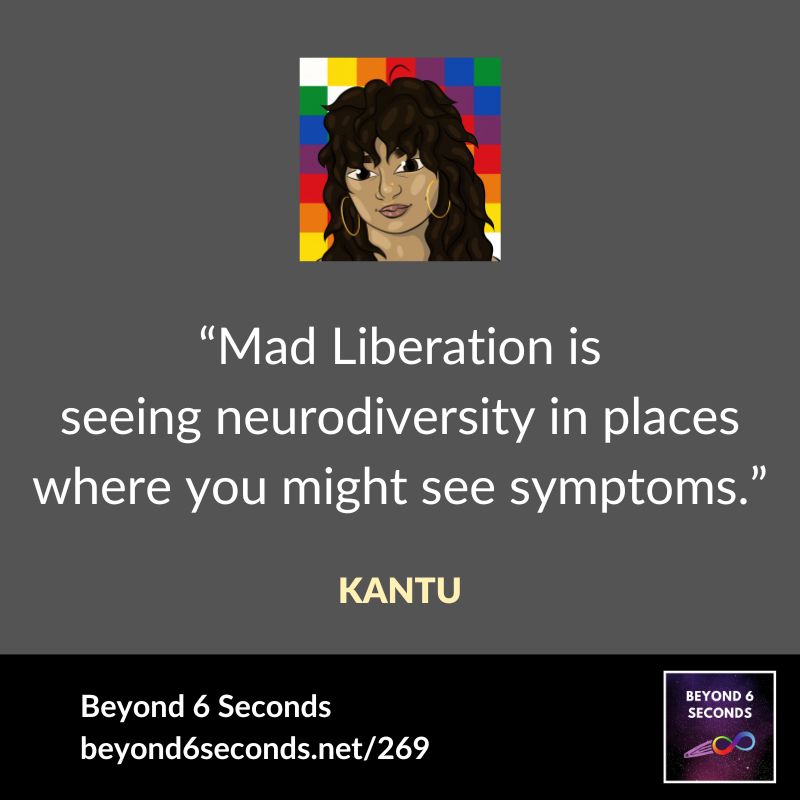
Kantu: And I think the big thing about Mad Liberation is also seeing neurodiversity in places where you might see symptoms. For example, a lot of people with psychosis, their goal isn’t to get rid of their hallucinations. Their goal is to be able to live with the hallucinations. Their goal is to be able to make a friendly hallucination instead of an angry one. For example, in a lot of cultures, people with schizophrenia don’t experience their hallucinations as evil, as harmful, as destructive. They experience their hallucinations as neutral or even positive. So if these hallucinations are positive, why are we encouraging people to get rid of them when they could be very happily living with their psychotic symptoms and be very supported by their community and live a happy, fulfilling life?
I think a good way for people to think about it who are just starting to get familiar with the neurodiversity movement is how a lot of autistic people don’t wanna cure our autism because it’s a part of ourselves. And just extending that line of thinking, like, you know, a person might have OCD and they wanna learn to live with their compulsions, maybe not necessarily, like, completely erase them.
And of course, that’s not true for everybody. I think everybody should have the fundamental right to do what they want with their neurodivergence. For example, if you have OCD and you wanna get rid of it, by all means, get rid of it. Like, you do you. But I think that’s the core of Mad Liberation is you decide what you do with your brain. You decide, do you want to learn to live with this? Do you want to get rid of it? Do you want something in the middle? It’s all up to you. And that’s where I think a lot of psychiatric treatment modalities fail, is that they’re centered in getting rid of what makes someone diverge from the norm, rather than actually having that person live a happy, fulfilling life.
Carolyn: Right. It’s more about conforming to what is considered, quote-unquote, “normal” in society.
Kantu: Yeah.
Carolyn: When you were talking, I also thought of people who have ADHD who are sometimes wary to seek treatment because they love the way that their mind works and makes creative associations and they’re worried they’ll lose their creativity if they do certain treatments.
Kantu: Mm-hmm. I definitely think there is a bit of a stigma around ADHD medication, but a lot of that stigma is because the pharmacological industry, and especially psychiatry, has a history of erasing neurodivergence rather than supporting it. So I think there is a stigma, but a lot of the wariness isn’t unfounded.
I think ADHD meds are great. They’ve been great for me. I just think there is a bit of a reason why people might be avoidant to them at first, and we need to listen to their reasoning and create more healthcare providers who are more flexible and more open-minded.
Carolyn: Yeah, absolutely. And then, of course, there’s the issue of other people who may or may not have ADHD who abuse that same medication, and so the medication gets a stigma of like, oh, people just wanna get high, or they just wanna, like, stay up and work harder because they’re taking it. It’s like, no, this is life-saving medication for a lot of people!
Kantu: Mm-hmm. And I think a big problem is that because we view addiction, which is a neurodivergence, we view addiction as such a bad, horrible thing, and it is. It ruins lives. But at the same time, we moralize it. We see people who are addicts, we see them as bad people fundamentally. That adds to the stigma of ADHD medication because these addicts who we deem as inherently morally bad, we attach that stigma to the medication.
Carolyn: Yeah. And then how does the concept of anti-sanism relate to mad liberation?
Kantu: So sanism is basically the, if, you know the root of the word sane, it means mentally well, mentally sound. Insane is the opposite. It means, you know, mentally unwell, mentally ill. Mad liberation is the protection and support of people who are deemed mentally ill, whether that be through a chemical imbalance, through a traumatic disorder, through a combination.
Anti-sanism is fighting against the stigma and the structural inequities given to people who are labeled as mentally ill, and mad liberation is the liberation of people who are labeled as mentally ill and insane.
Carolyn: Yeah. So there’s definitely a, a close tie there.
Kantu: Mm-hmm.
Carolyn: Yeah, thank you for sharing more about that. I think that may be a very new concept for a lot of people.
Kantu: Absolutely. It’s definitely a radical idea to think about, but I personally view it as a very logical extension of neurodiversity. That’s just the way I see it. I see it as neurodiversity affirming, really.
Carolyn: Yeah. It’s basically having the right to diverge from what is considered typical or quote unquote “normal” in society, and that’s part of it.
Kantu: Absolutely, yes.
Carolyn: Yeah, well, Kantu, thank you for this discussion. It’s been really enlightening and, and educational. I’ve learned so much about a lot of different topics we haven’t had a chance to talk about on the show before.
If people wanna find out more about your advocacy, is there somewhere that you’d like to share that you do it online or, or someplace that they can find out more about the type of work you do?
Kantu: Yes. So I am mainly on Instagram. My handle is angry_autist, and that account is where I post all of my musings, all of my little rants and things. I also have a Threads account that’s, like, attached to that. But that’s where I hang out online. And you can also send me an email if you have any specific questions at angryandautistic@gmail.com.
Carolyn: Yeah, I can put that information in the podcast show notes so people can find it there.
Kantu: Perfect.
Carolyn: Thanks again, Kantu. This was such a great discussion, and I appreciate you sharing your experiences so openly with my listeners.
Kantu: Of course.
Carolyn: If you enjoyed this conversation, you may also enjoy my other episodes about dissociative identity disorder: episode 194 with Amber Louise Ainsworth and episode 215 with Crystals Multifaceted. You can find links to those episodes in the show notes.
Has this podcast had an impact on your life, your heart, or your perspective in some way? If so, I’d love to hear about it. Send me a message on social media or through my website at beyond6seconds.net/contact. Your feedback means a lot to me, and it helps keep me going with this show. Thank you.
Thanks for listening to Beyond 6 Seconds. Please help me spread the word about this podcast. Share it with a friend, give it a shout out on your social media, or write a review on Apple Podcasts or your favorite podcast player. You can find all of my episodes and sign up for my free newsletter at Beyond6seconds.net. Until next time.