Episode 244: Deaf and OCD representation in audio drama — with Caroline Mincks of Seen and Not Heard
-
play_circle_filled
Episode 244: Deaf and OCD representation in audio drama — with Caroline Mincks of Seen and Not Heard
Carolyn Kiel
Caroline Mincks is a writer, director, and voice actor who is best known for their audio drama “Seen and Not Heard,” which is about navigating hearing loss as an adult. Seen and Not Heard features disability representation, including deaf, obsessive-compulsive disorder (OCD) and autistic characters. Caroline also works as a consultant, assisting other creators in making their shows accessible to as many people as possible.
During this episode, you will hear Caroline talk about:
- How their own experience with hearing loss inspired them to create “Seen and Not Heard”
- How they use sound design to help listeners better understand what it’s like to interact with the world as a deaf person
- Using their lived experience with deafness, OCD and autism to write their audio drama’s characters
- Challenging stereotypes and misconceptions about deafness, OCD and autism
- How they cast voice actors for their audio drama
- The importance and impact of authentic disability representation in media
Listen to Seen and Not Heard on Apple Podcasts, Spotify or wherever you get your podcasts, and follow the show on BlueSky and Tumblr.
Follow the Beyond 6 Seconds podcast in your favorite podcast player!
Subscribe to the FREE Beyond 6 Seconds newsletter for early access to my latest podcast episodes!
Support or sponsor this podcast at BuyMeACoffee.com/Beyond6Seconds!
*Disclaimer: The views, guidance, opinions, and thoughts expressed in Beyond 6 Seconds episodes are solely mine and/or those of my guests, and do not necessarily represent those of my employer or other organizations. These episodes are for informational purposes only and do not substitute for professional medical advice. Consult a medical professional or healthcare provider if you are seeking medical advice, diagnoses, or treatment.*

The episode transcript is below.
Carolyn Kiel: Welcome to Beyond 6 Seconds, the podcast that goes beyond the six second first impression to share the extraordinary stories of neurodivergent people. I’m your host, Carolyn Kiel.
Carolyn Kiel: On today’s episode, I’m speaking with Caroline Mincks, a writer, director, and voice actor based out of Virginia. They are best known for their audio drama, Seen and Not Heard, which is about navigating hearing loss as an adult. They also work as a consultant, assisting other creators in making their shows accessible to as many people as possible. Caroline, welcome to the podcast.
Caroline Mincks: Hello. Thank you so much for having me.
Carolyn Kiel: Yeah, I’m really excited to meet you. I feel like we’ve been following each other on social media, probably around the time a couple years ago when we both started podcasting, or at least when I started podcasting. So,
Caroline Mincks: Yeah. I started 2019, so yeah, right around the same time.
Carolyn Kiel: Yeah. Yeah. Right before you, 2018. So yeah, I’m excited to finally get to see you in, in person over the internet and and have a chat.
Caroline Mincks: Finally!
Carolyn Kiel: I know! After all these years.
I recently listened to all of season one of Seen and Not Heard, and then the episodes that are out so far for season two. And I, I just love it. It’s captivating and I’m really excited to just hear about how you put the show together and, and what inspired it. So, you know, initially how did you get the idea for writing Seen and Not Heard?
Caroline Mincks: Oh my gosh. Well, the idea of it went back. I mean, I’ve been working on it for years. I mean, I started when I was about 19 and I, that was, so, I started losing my hearing when I was a teenager when I was in high school. And when I was in college, I got really into the idea of working in deaf theater and learning sign language and doing that. And that didn’t quite pan out for me, but I was like, I love writing, I love playwriting. Maybe I’ll make a play about this and that didn’t quite work. And then like the other play I tried didn’t work, the comic book version didn’t work, the novel version didn’t work.
And then I finally found podcasting and I thought, wouldn’t this be interesting? A purely audio medium telling a deaf story that could be kind of cool and maybe I, it won’t work, but it’s worth a shot. So I just, I just went for it. I just said one day I’d do it, and then I did, and I, I committed publicly so that I couldn’t back out. I said it on the internet, so it had to happen because that’s how that works.
Carolyn Kiel: Mm-hmm. So was this the first, I guess, audio drama or anything like this that you wrote about deafness?
Caroline Mincks: About deafness, yes, specifically. I had made another kind of training wheels show just to get the hang of it. But this was the first one that I really, and it was a pretty vulnerable show to do. It’s like your first big thing that attaches your name to it. And, and, but yeah, I just, I, I went for it.
And since then I’ve done several other kind of consulting things or episodes of things that have to do with deafness in podcasting. So that has been really cool.
Carolyn Kiel: That’s awesome. And so we mentioned like the one sentence summary in your bio of what the show is, but tell like, tell me more about the premise of the show.
Caroline Mincks: So I always say it’s about hearing loss, deaf gain, navigating the world through changing circumstances. So what it really, though, is about is what it’s like when frankly the rug gets put out from under you. You know, it’s about the protagonist who I voice, her name is Bet. She’s really driven, she had a whole career plan, like she did the college thing, then the working after college thing, and that didn’t work. So she did the culinary school thing and she was just about to start her career, got sick, lost about half her hearing. And that just changes everything. It’s a whole adjustment period. And the show picks up about a year after that has happened. So you don’t actually go through the hearing loss and the immediate experience of that with her, because I felt that that was so secondary to what happens next.
And it’s all about, you know, how does this change your relationship with people? How does it change how you relate with new people that you meet versus people you used to know and your family and, and so on and so forth. And it was, I don’t know, it was challenging to kind of figure out what’s the ideal version of that and then what’s the realistic version of that, and how do I go somewhere in the middle, because that’s where aspirational reality lies, I guess you could call it.
Carolyn Kiel: Mm-hmm.
Caroline Mincks: So I try to present that in the show, like, look, we get that it’s not gonna be perfect, but ideally we could at least try. And I’m hoping that it gave people a sense of sort of what it’s like to be my version of deaf and how you can be supportive.
Carolyn Kiel: Yeah, it really gives a lot of new insights, at least for me as a listener, as someone who’s not deaf, just really kind of getting immersed in getting kind of a first person view, because you’re really seeing things through Bet’s eyes for this whole season and all the series. So and, and there’s just so many things that, like small things that you don’t really think of if you’re someone who hasn’t experienced deafness before. And it really kind of puts them into that whole, you know, perspective and really kind of guides you through that experience. It was a really great learning experience and I, I really appreciate it. Enjoyed it.
Caroline Mincks: Oh, I’m so glad to hear that! We have a really amazing sound designer, Tal Minear, who I like, just an incredible, incredible sound designer, and they worked really closely with me to figure out what those soundscapes sound like, because I didn’t want it to be a gimmick. We really, both of us felt really strongly, we don’t want this to be gimmicky. We don’t wanna be like, “and now you know what it’s like to be deaf!” Like, no, but you will get a sense of, “oh, that’s what it sounds like. Okay, so maybe I can be a little more patient when someone needs me to repeat myself over and over.” Or like, “if it seems like someone’s not paying attention, maybe they just didn’t hear me, and I can just assume that, instead of thinking the worst.” You know, and it, it hopefully will be helpful.
And I’ve had people say that they’ve used some of those scenes to show people what it’s like for them. And I was just like, “Tal! You’re not gonna believe it!” Like it’s the best. It’s such a good feeling to know that it’s helpful.
Carolyn Kiel: Yeah. And, I know there are certain parts of the episodes where the sound design actually mimics sort of what your, what your experience of hearing is so that the, you know, the listener can actually experience not being able to hear someone when they say something. So it’s not just like I’m telling you about it. It’s like, no, you’re experiencing it with Bet, the main character. So that was so interesting. It’s like I can’t imagine how to recreate something that I hear but then like I wanna make sure other people hear it the way I hear it. So that’s a lot of creativity with that.
Caroline Mincks: It, it was a whole thing. Because I was like, gosh, do I have enough hearing to actually judge if this sounds correctly deaf? Like what a weird pretzel of a question to ask yourself.
Carolyn Kiel: Mm-hmm.
Caroline Mincks: Thank goodness for really good headphones and hearing aids ’cause we got there.
Carolyn Kiel: And then, you know, I think some people may have assumptions or stereotypes when they hear the word “deaf.” They think like a hundred percent no hearing at all, like complete silence. But that’s actually what I’m, I’m learning recently, really not the experience of probably most deaf people or people who are hard of hearing.
And that’s another thing that you get to experience through this podcast. ’cause there may be some people listening wondering like, how can you be deaf and make a podcast and, and hear enough be able edit the sound? But really there’s, deafness is really a spectrum like so many other disabilities.
Caroline Mincks: Yes! We love spectrums. We are all about spectrums. There’s nuance to everything. Yeah. And it’s true. That is something that a lot of people don’t understand. So when I tell them, oh, I’m deaf, and they’re like, oh, but you’re talking and listening to me, I’m like, yes, but also I am deaf, like the two things are true.
And yeah, profound deafness, which is like a hundred percent no hearing whatsoever, is not super common. Most people have at least a little bit of hearing, or they have some on one side and less on the other. It really varies from person to person, just like anything else.
Carolyn Kiel: Yeah, definitely. And you really get that experience through the show of, you know, as you said, you didn’t wanna make something that was like over the top or preachy or like, this is what it’s like! But because it is first person, you really do get the experience of kind of the, the big moments, like misunderstanding and why it’s so frustrating when people don’t wanna repeat themselves and dismiss it. Like things that you learn about, it’s like, oh, actually, that’s really annoying if it happens to you several times a day, every day, and this is why.
Caroline Mincks: Yeah, Yeah.
Carolyn Kiel: Mm-hmm.
Caroline Mincks: Yeah. That was really important to me. ’cause I think that there is that feeling of, of dismissal a lot. It’s something, we call it “dinner table syndrome” as well, where you just kind of are, you’re there, but you can’t really participate ’cause no one’s trying to include you or they’re not thinking to, like, they’re not bothering to repeat themselves or they repeat themselves, but they don’t quite say it the way they did before. So the message is different. So you’re still lost. It’s like, just repeat yourself, please.
Carolyn Kiel: Yeah.
Caroline Mincks: Make it easy on us both.
Carolyn Kiel: Mm-hmm. And although it highlights a lot of the challenges and the experience of someone who is navigating their own deafness that’s sort of a recent change and a recent development for them. It’s, you know, it’s not a depressing show. Like there’s a lot of really you know, I don’t wanna be like, oh my gosh, it’s so sad. But no, it’s, it’s amazing ’cause you see the character grow over the course of season one and, and you know, the character meets people and their relationships with people in their life change significantly and they change. So it’s really great character development too.
Caroline Mincks: Thank you. Thank you. I had a really good time working on it. And I love slice of life in general because it lets you really dig into kind of what could be really mundane, but is actually really, really important. Like there’s a whole conversation that my character has with her dad. They’re talking about bagels for like a minute. They’re not really talking about bagels, but that is, those are the words they’re saying. And it’s nice that this genre lets you do that and that feels really good. And I think that that’s probably one reason people kind of connect with it a little more. ’cause it does feel more real, I think, in a lot of ways.
Carolyn Kiel: Yeah, absolutely. And although really, I’d say the main focus is around the main character Bet and how the character navigates deafness. There’s also some other themes in there, and the reason why after I listened to the first season, I’m like, oh, there’s actually like a neurodiversity connection in here too! Because there is a main character in the show who has OCD or obsessive compulsive disorder. And that’s another thing that’s widely misunderstood, is often the butt of joke in media. Or you know, people say, it’s another thing people kind of say things about and don’t really think about what they’re saying.
Caroline Mincks: Mm-hmm. “Oh, I’m OCDI put my clothes in color order!” It’s that’s, that’s just pretty. Like, that’s not, that’s not what that means.
Carolyn Kiel: Right! Yeah, exactly. So to also be able to experience another main character in the show and what his particular type of OCD is, because, you know, there are different types and different experiences of it as well. And is that also, is OCD also part of your own lived experience that you wrote into the show?
Caroline Mincks: It sure is! Yes, I am. My, my, my therapist one time said, “no wonder you diagnosed yourself when you were 12. You’re a textbook.”
Carolyn Kiel: Mm-hmm.
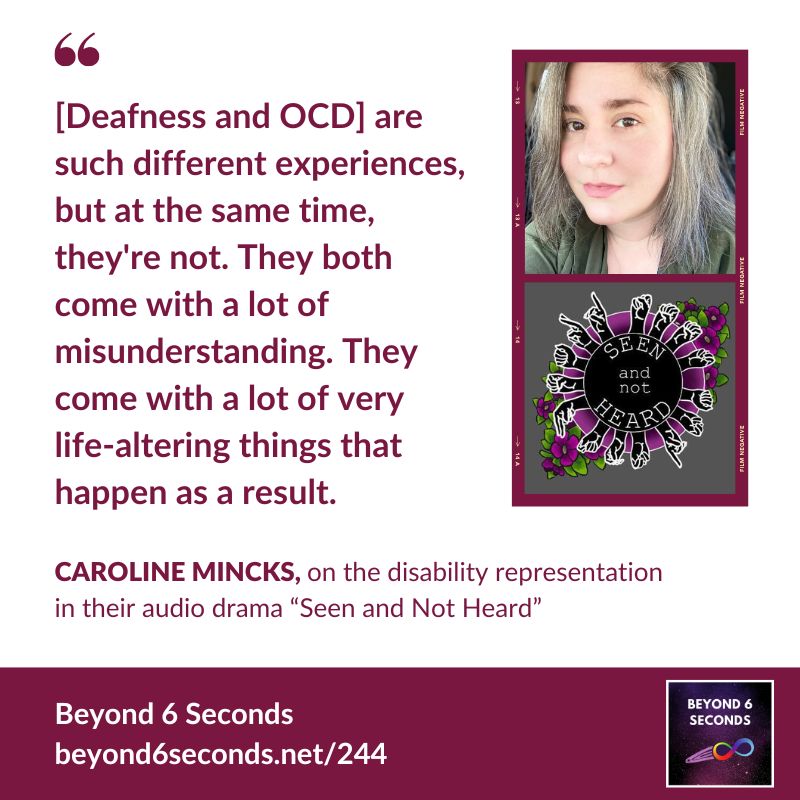
Caroline Mincks: She goes, “yeah, yeah, you’re spot on.” And originally when I, in some iterations of the story, Bet was the one with OCD and the hearing loss. And the whole thing with her was like, “didn’t I already have enough on my plate? Is it this, like, why do I also have this?” But I felt like it kept getting a little too muddy. So I really liked the idea of splitting these two things. ’cause they’re, they’re such different experiences, but at the same time, they’re not. They both come with a lot of misunderstanding. They come with a lot of very life altering things that, that happen as a result of them. And so to have these two characters who can play off each other, Bet with her deafness that sometimes David’s not great at understanding, and David with his OCD that sometimes Bet doesn’t understand. And there’s more to, there’s gonna be a lot more about that in season two specifically, we’re gonna focus a little more on where, where David’s at. But being able to kind of explore both of those things in the same show was really interesting for me and, and frankly, very cathartic.
Carolyn Kiel: Yeah. Wow, that’s really great. And yeah, it’s a lot of vulnerability on your part as the writer and director and voice actor and, and really the person who’s creating this show.
Caroline Mincks: Putting it all out there! Yeah.
Carolyn Kiel: But it really kind of rounds it out. It makes it feel very real because you, you bring other parts of your life experience into the show as well. Like, you know, you were mentioning the conversation with the main character and her dad about the bagels. So obviously bringing your Jewish culture and background into that. You know, there’s also several characters who are queer. So that’s part of it as well.
Caroline Mincks: Lots more of that in season two.
Carolyn Kiel: Okay. Yeah.
Caroline Mincks: It gets a lot gayer.
Carolyn Kiel: At the time of this recording, some of the episodes, the first episodes of season two are out. So definitely seeing those themes in there. That’s really cool.
Caroline Mincks: Yeah, we have some, some prologues coming, and then we’ve got some full episodes on their way.
Carolyn Kiel: Awesome, awesome. So how did you cast this? Like, did you specifically look for voice actors who had lived experience of the themes you talked about in your show?
Caroline Mincks: Well, deafness, I, I had some characters, and I said priority will be given in general to deaf actors. But these, there were some specific roles that were like that you, they will have to be played by deaf or hard of hearing actors. And that, that’s the same in season two. I’ve got some really great people coming in.
As far as how I cast it though. I left it pretty open to interpretation. I didn’t even like assign pronouns to any characters or much, some characters didn’t have names yet. I just was like, I know I want the, like, I had like “the artist” and I was like, I know want “the artist” in here at some point. But all the characters potentially could change just depending on who I heard and what sparked something.
So I just put out a casting call. I wrote some lines. Some were from the show, some were not, and I just said, let me see what you got. Give me some just as I wrote it, but also you can ad lib a little bit or you can, you can try something on for size if you want. I don’t care about accent, I don’t care about any of that. I don’t care if you have a speech impediment, bring it! And we got some amazing people! Like it was really hard to narrow it down ’cause I was like, oh, there’s some great voices in here. This is really hard.
Carolyn Kiel: Mm-hmm.
Caroline Mincks: But it, it, it was both easy and hard to cast. It was easy because everyone was good and it was hard because everyone was good.
Carolyn Kiel: Yeah.
Caroline Mincks: For the family and David, they were the most, like, if they fell apart, the whole thing falls apart.
Carolyn Kiel: Yeah.
Caroline Mincks: So I, I was picking voices apart and putting mine with them and, and splicing things together in Audacity just to listen to what the voices sounded like. And I, I just lucked into this, these voices that sound like a family. ‘Cause like I sound a lot like Sena. We have similar pacing in our talk. She plays my mom. And then Steven and, and Leslie who played Joe and my, and my sister Sarah, they have slower paces and more gentle voices. So it’s like, oh, Bet takes after her mom. Sarah takes after their dad. Okay. You know? And it sounds like a family. And then Sean with his beautiful velvet voice as David, I love his voice. Oh my God.
Carolyn Kiel: Yeah.
Caroline Mincks: He sings, he sings opera in real life. And like, you can tell, when he talks.
Carolyn Kiel: I can hear it. Yeah.
Caroline Mincks: It’s so pretty. And his voice cut through. I had no trouble understanding him, and usually I have at least a little trouble understanding speech, and I had no difficulty with him at all. And that felt so important. I was just like, oh, that would immediately be comfortable with someone. She doesn’t have to work so hard around.
Carolyn Kiel: Mm-hmm.
Caroline Mincks: And just, it made that choice a lot easier.
Carolyn Kiel: Yeah. No, that’s, that’s great. ’cause you get to see, you know, Bet and David navigating their own disabilities and their own experiences, but also learning about each other. So neither of them come in with like a, a perfect understanding of the other’s challenges. get to watch them learn through it, and it’s just, yeah, it’s really interesting.
Caroline Mincks: Yeah, they both put their foot in it a few times. Bet will a little more in season two, like spoiler, but mm-hmm, girl. I wrote one line and I was like, girl, I know I’m in charge here, but like, you didn’t have to do that.
Carolyn Kiel: It’s like, why’d you say that? I was like, oh, I wrote it.
Caroline Mincks: Like gosh! I know technically I’m in charge, but sometimes it doesn’t feel like it.
Carolyn Kiel: When season one came out, it’s been out for now a few years. Like what was the audience reaction when season one came out of Seen and Not Heard?
Caroline Mincks: I was so overwhelmed ’cause it was such a positive reaction right away. It was so funny ’cause I’m such a, a very social person. I’m very out there, but I like kind of shut down for a day. ’cause I was like, this is too many compliments! I can’t handle it! And like, I was stressed! Because then I was also like, what if they hate the next episode? They like this one. It’s a strong start. What if the next one’s bad? Or something. Thankfully that’s not what happened. People seem to have overall received it really, really well.
But I was, I was really surprised by how many people listened to it. And just then getting attention from like, like it was on a list in The Atlantic. And I was so confused, ’cause I clicked on one day and I was like, all these people all of a sudden are like listening to the show. What do you mean I got so many new people? What happened? And my my ex-husband, his, his dad called and said. Do you have a podcast or something? And I was like, yeah, why? He, so my secretary found your name at The Atlantic and was like, is this one of yours? I was just,
Carolyn Kiel: wow!
Caroline Mincks: Yeah. I was like, oh, everyone knows now. Okay. And, and just being in articles like that, I was like, what do you mean I’m in the, what?
And and that was exciting and all, but it was more like getting messages, like private messages from people saying that they, not to like do the title thing, but they felt seen and heard and they felt, they felt like they were understood. And people who aren’t deaf or don’t have OCD or aren’t autistic still felt seen in some ways ’cause they’re like, oh, this is what having a disability feels like sometimes and this is what it’s like for me, even though it’s a different disability. And that felt really, really good.
The conversations about accessibility that came out of it and the conversations about, you know, including deaf actors, not necessarily just to play deaf characters and things like that, that I feel so strongly about, getting to kind of use the show as like a springboard to get to talk about that stuff was, was huge and it all happened at the same time.
Carolyn Kiel: Mm-hmm.
Caroline Mincks: It all happened really fast.
I’m just glad to know people are, are enjoying it and that it, it means something to them, ’cause that’s, that’s what matters to me.
Carolyn Kiel: That’s great. And it’s great that it resonated not only with people who are deaf or hard of hearing themselves, but also people who have other disabilities or don’t have any disabilities at all. Because, one, it’s a great way to learn and experience what someone is going through that may have different experience than you, but two, there are plenty of other relatable experiences. Like everybody’s probably had an argument with their mother or parent about some core part of them that’s very important to them. And that’s in there. And you know, it doesn’t matter what it is, but I think
Caroline Mincks: Yeah.
Carolyn Kiel: everyone can relate to what that feels like.
Caroline Mincks: Yeah! Every, everybody knows what it’s like to lose something. Everybody knows what it’s like to have a sudden change in your life that you have to adjust to, and it’s really hard. You just sometimes just wanna throw a tantrum ’cause you just don’t wanna do it. And like everyone knows what it feels like to feel dismissed. A lot of the things that we talk about in the show, I think are just straight up human experiences, not necessarily exclusive to disabled experiences.
Carolyn Kiel: Yeah. And did you mainly hear from people who are deaf themselves? Like did you also hear from people who had OCD and who are autistic? ‘Cause there’s an autistic character as well.
Caroline Mincks: Yeah, I was, I was so excited. ’cause I, I did get some messages from people and, and that was the part that made me really, really happy. Because I think it was a little fraught to write about OCD. It’s something that’s hard to portray because it can present so many different ways. Same with autism. Like my variety of autism looks very different from my sons, right? So, and my variety of OCD looks very different from my best friends’, et cetera. And so writing about these experiences that are already so misunderstood and often come with a lot of stigma and to have it received well, felt really good. There was a huge relief. ’cause I was like, okay, whew. Like it’s coming across right. It’s coming across in a, not like, I don’t mean like a, it’s a positive thing, but it’s not, it wasn’t a harmful representation. That’s the biggest thing for me. I’m like terrified of the idea of doing harm. That’s also an OCD thing. Hey! Just to tie that in. But it, it is something that I, I think about a ton, maybe more than is normal or healthy. But to get the feedback that what was being done on the show was not, just, not only not harmful, it was actively helpful.
Carolyn Kiel: Mm-hmm.
Caroline Mincks: That meant the world to me. And that was such a, just my shoulders went down and I exhaled as soon as I got those first, you know, few comments about that specifically. That meant a lot.
Carolyn Kiel: Yeah, that’s great. ’cause even thinking specifically about OCD, I can’t think of a piece of media that really portrays it in a way that’s not either inspirational or gimmicky or sensational or,
Caroline Mincks: Monk.
Carolyn Kiel: Monk. That’s literally all I can think. I’m like…
Caroline Mincks: Yeah!
Carolyn Kiel: I didn’t watch that show. I don’t know how… I don’t think it seems, like, super great.
Caroline Mincks: I love Tony Shalhoub, but… yeah.
Carolyn Kiel: Yeah. And you know, with autistic characters, I think some media we’re starting to get things that are a little better, but…
Caroline Mincks: Let’s go, The Pitt!
Carolyn Kiel: Oh, yeah.
Caroline Mincks: Oh, The Pitt’s got some good representation.
Carolyn Kiel: Really? I need to watch that show.
Caroline Mincks: It’s fantastic. It’s very good. It’s a very good show.
Carolyn Kiel: I keep getting clips in my Instagram feed of The Pitt and I’m like, okay, I think this means I’m supposed to watch it.
Caroline Mincks: It absolutely, the character Mel and, and her sister will resonate with you for sure. It’s, it’s really good. Yeah, I loved it. I was so excited. ’cause I was like, oh, I can relate to Mel directly and I can relate on all these different levels both as myself and as someone who is a caregiver for someone with autism.
That was really, really exciting. But there are some portrayals where it’s like, oh I don’t know if you know any autistic people in real life.
Carolyn Kiel: Yeah. Mm-hmm.
Caroline Mincks: It’s like, ooh. I’m glad we’re seeing more and I’m glad we’re seeing better.
Carolyn Kiel: Yeah.
Caroline Mincks: But oof! We do have a ways to go with that one.
Carolyn Kiel: Yeah, definitely.
Caroline Mincks: With all of them, really.
Carolyn Kiel: Any media that has like a, you know, a, I don’t even know how to summarize it. I don’t wanna say positive, but like, almost like a realistic portrayal of …
Caroline Mincks: Yeah.
Carolyn Kiel: …what someone’s experience could be or is, understanding that there are many different experiences.
Caroline Mincks: Yeah, I think that’s, that’s where I go back to what I call the aspirational reality, where it’s like the best case scenario of what is realistic to expect at this point in time with what we know and what we have and what, you know, what people’s attitudes are. Like Bet’s parents for instance, you know, spoiler again, but like, they’re not learning sign language and they’re, they’re not really meeting her where she’s at. Her mom is kind of actively in denial a bit. And that sucks, but that’s pretty realistic. If I didn’t include that, it would just, there wouldn’t really be a show. There wouldn’t really be anything for her to navigate and it wouldn’t be a realistic portrayal. Like I, I have people in my own life who I’ve known for years, I’ve known longer than I’ve been deaf. So like they were definitely there, and they still don’t quite get it. They’ll talk to me from another room with the faucet going and then be like, “why aren’t you listening?” Like, what, do you mean? What do you mean, why am I not listening?
Carolyn Kiel: Yeah.
Caroline Mincks: I physically cannot.
Carolyn Kiel: Mm-hmm.
Caroline Mincks: It’s perfectly normal for people to, to just not quite get it, and it doesn’t make them inherently bad. It doesn’t necessarily mean that they’re like evil and working against you. And so I think when you talk about what makes you a good ally or a good partner or whatever it is that you’re trying to be, I don’t think anyone’s asking for perfection or for you to know everything. But you gotta, you gotta try and you gotta work with what you have and once you’ve figured out how to do all this with what you have, go find more and go find better.
Carolyn Kiel: Yeah. And as an ally who’s learning, you have to, you know, you have to try and not be terrified of getting things wrong, which is very hard for me.
Caroline Mincks: Oh it’s the worst!
Carolyn Kiel: like, oh my God, if I just say like, something that is really upsetting and horrible to someone ’cause I didn’t know better or just,
Caroline Mincks: Oh, I’ll think about it for months. It’s terrible.
Carolyn Kiel: Yeah. Same. Same here, for sure.
Caroline Mincks: It’s awful. And it’s so hard ’cause you’re like, I promise I didn’t mean, I promise I’m trying! And, that’s the thing. People know if you’re coming in good faith and they are not assuming the worst of you, I think we, you know, we can all maybe agree to like, assume the best unless otherwise proven, generally. Not always, but generally I think is a, is a good approach here. Because I think most people don’t wanna be jerks, like most people really don’t. And I think it’s natural too, to feel defensive when you make a mistake. And, that’s a natural human instinct, real quick. Like defensiveness is not inherently bad. It’s just you have to manage it.
Carolyn Kiel: Yeah.
Caroline Mincks: It’s absolutely normal because you wanna protect yourself. And that’s okay. There’s nothing wrong with that. But you know, when you mess up, listen. I tried to give an example of that in the very first episode with David. Like he really, he really steps in it. And he gets a little defensive, not overly so, but a little like, “oh, I didn’t mean to!” And she’s, that’s where we get that whole monologue about the darts and the,
Carolyn Kiel: Yep.
Caroline Mincks: you know. And, and that’s, that’s a big thing where, that’s explaining like, I know you didn’t mean to, but I deal with this all of the time and I’m tired. So like, don’t, don’t do that. Just fix the problem and we can move on. And, and that’s really the best you can do.
Carolyn Kiel: Yeah.
Caroline Mincks: And that applies to so many things.
Carolyn Kiel: Definitely, yeah. The defensiveness, as you said, it’s, it’s a very human and very automatic for, for many, many people, and it doesn’t make you a bad person, but it’s something that you just, you know, if you’re keeping that like learning mindset, you just have to be aware of it.
Caroline Mincks: Mm-hmm.
Carolyn Kiel: It’s like oh, I’m feeling defensive. Like, what does that mean? Maybe I should just like, you know, be aware of it and change what I’m doing.
Caroline Mincks: Yeah. Where’s it coming from really? Yeah, because I think it’s always coming from somewhere, probably somewhere else.
Carolyn Kiel: Mm-hmm.
Caroline Mincks: And probably nothing necessarily to do with that situation. Or if it is, it’s probably not that exact moment that’s making you feel that way. So if you can kind of isolate the moment you’re in and be like, okay, I’m feeling this way. How can I kind of channel that energy into something good.
It’s like stage fright. I feel stage fright constantly. I’ve been acting since I was five and I’ve never gotten over stage fright, but when I’m feeling it, I try to channel it into just having a lot of energy for the performance and trying to like, you know, okay, I’m feeling really jittery. I’m going to use this and really hit all those dance moves, if it’s a musical. If it’s not, don’t be dancing. But if you, but you know, try to use that and try to, try to make it work for you in some way.
And I think if you’re, if you’re feeling that kind of defensiveness and that kind of anxiety that rises so quickly when you make a mistake if you can kind of have it bounce back and just say, okay, instead of, instead of shutting down because anxiety is a paralytic, I’m going to take this anxiety ’cause it’s coming from a desire to do better or I wouldn’t be feeling shame. So I’m gonna use it and just be like, Hey, I feel terrible. How can I not feel this way next time? What can I learn from this and do better next time? And then, you know, a while from now, you’re not even gonna remember it happened in the first place.
Carolyn Kiel: Yeah.
Caroline Mincks: ’cause you’ll be doing better consistently.
Carolyn Kiel: Yeah. Yeah, I, and I think the defensiveness does come from something tied within you, or maybe for some people it could be like the desire to be seen as a good person. So how could I possibly have hurt someone? I’m a good person! So I need to argue that. It’s like no, you don’t need to argue. It’s okay.
Caroline Mincks: Just be it.
Carolyn Kiel: Just, just, you know, just, just sit with it and it doesn’t mean that you’re bad, as you know, we’re all learning.
Caroline Mincks: Yeah.
I think that’s the thing too, that like, that’s what we see in Bet’s mom a lot. Like she’s, that’s where she really is struggling. And we explore a little bit with her dad in season two, because he’s very emotionally supportive, but in practical senses, he’s really not. He’s also not doing the actual work to meet his daughter where he is at. Which is so hard to like, ’cause he’s such a sweet character and I just love how Steven plays him, he’s so adorable. But it’s, it’s like, oh, I hate talking bad about Joe, but like he’s not doing the damn work.
Carolyn Kiel: Yeah.
Caroline Mincks: And, and that’s just the reality of it. And we’re gonna get into that in season two and kind of talk about why someone who loves their kid this much and knows what they need, just isn’t delivering it.
Carolyn Kiel: yeah.
Caroline Mincks: And it comes from a shame place. Yeah.
Carolyn Kiel: Wow. Yeah. That’s a lot to explore because ableism, out of all the many isms, is just so ingrained that you don’t even realize where it is. It’s, It’s everywhere.
Caroline Mincks: Oh, yeah.
Carolyn Kiel: It’s in everything.
Caroline Mincks: Mm-hmm.
Carolyn Kiel: So it’s really hard to become aware of it.
Caroline Mincks: Oh yeah.
Carolyn Kiel: And then do better from that. Yeah.
Caroline Mincks: Yeah, it really is. And even very well-intentioned things can be a harmful thing. Like, you know, sometimes my son is, he, he’s not nonverbal, but his verbal capacity’s very limited. And people will say things like, “he’s in there somewhere.” I’m like, what do, he’s right here. Like, what do you mean?
Carolyn Kiel: He can hear you!
Caroline Mincks: He’s literally three feet away.
Carolyn Kiel: Mm-hmm.
Caroline Mincks: Like, and, and I, I know what they mean by that, but I always make sure to say something about it. ’cause I’m like that, that that’s just not the attitude to have. And when it is something that comes so naturally to all of us, ’cause like, I’m sure, I can’t think of a specific example, but I’m sure I’m guilty of the exact thing that I now scold people about. And it is such a natural thing for people and it is so normalized, and examples of it can just go complete, like I just said, I’m like, I can’t think of an example, but I’m sure I’ve done it.
Carolyn Kiel: Mm-hmm.
Caroline Mincks: The more we can pluck out specific examples and like put them in our media, in our entertainment, in our regular conversations, the easier it becomes to identify other versions of that.
Carolyn Kiel: Mm-hmm.
Caroline Mincks: And it just becomes a lot easier to have these conversations.
Carolyn Kiel: Yeah. Because even when I think specifically about deafness, I think society’s perception, and there’s a big part of ableism in this and saviorism is, “oh, let’s fix this. That’s the ideal. We will fix with like, technology.”
Caroline Mincks: Ughhhh.
Carolyn Kiel: You know, and “we will teach speaking instead of sign language because speaking is ‘better’ because” I don’t know why. That’s another, that’s an issue in the autistic community too.
Caroline Mincks: “It’s easier for me.”
Carolyn Kiel: It’s for yeah, because it’s easier for other people. So, and that’s a big challenge. And people just assume like, “oh, of course, like if you were deaf, why wouldn’t you wanna hear? Why wouldn’t that be a great thing?” And like,
Caroline Mincks: Ugh.
Carolyn Kiel: There’s a lot of reasons why it might not be great.
And Bet struggles with her hearing aids at the beginning, so that’s part of the show
Caroline Mincks: Mm-hmm.
Carolyn Kiel: too.
Caroline Mincks: Yeah. Yeah. And that’s the thing as well. ’cause I don’t want to necessarily take an anti-technology stance, because it has its place. And they’re, and it’s a deeply personal thing. Like I can’t see myself ever getting implants. I don’t think that’s for me. But I know people who have them and they’re very happy with them. And they’re like, “I love that this has, you know, this has changed things for me in a really good way.” And then I know people who had of it and they regret it, or think they want it, but it’s so expensive and it’s, it’s not accessible to them. So it’s, it’s not that I am anti that entirely. I think you should be an adult,
Carolyn Kiel: Mm-hmm.
Caroline Mincks: just because of what that entails.
And I think even hearing aids can be a tricky thing to navigate sometimes, because people do see them and they’re like, “oh, so you can hear.” No, I really can’t.
Carolyn Kiel: Mm-hmm. Mm-hmm.
Caroline Mincks: Mine are off half the time.
Carolyn Kiel: Mm-hmm.
Caroline Mincks: They’re in my ears, but they’re not doing anything a lot of the time. And they, they help. But they don’t fix it.
And, and yeah, people want an easy fix and a lot of parents want an easy fix and a lot, and, and I, I get it. I understand. I get, as a parent, I understand where that comes from, because you just want everything to be easy for your kid. You want them to have the easiest possible time on earth that you can give them. And it sucks when there’s any challenge in the way. It’s hard. It’s hard just because, you know, the world’s not set up for it. But yeah, there is, there is that whole thing about technology and about speaking and, and all the things that make it easier for hearing people or for neurotypical people, but they actively make it harder for the people it’s actually affecting.
Carolyn Kiel: Mm-hmm.
Caroline Mincks: So what are we doing? How about we find something that works for everyone? Just a thought.
Carolyn Kiel: Yeah.
Caroline Mincks: Like sign language maybe?
Carolyn Kiel: Yeah, or even things, you know, like closed captioning and transcripts and subtitles, which are things developed for, you know, largely the deaf community, but helps everyone. Like I’m, I watch everything with subtitles
Caroline Mincks: Oh, they’re the best.
Carolyn Kiel: now, you know?
Caroline Mincks: I love subtitles. I love them. I love them. I love them.
I hate when they cover a foreign language being spoken and translate it with just “foreign language.”
Carolyn Kiel: Yeah.
Caroline Mincks: But otherwise, for the most part, we’re good.
Carolyn Kiel: Mm-hmm.
Caroline Mincks: That gets me every time.
Carolyn Kiel: Yeah. And of course, Seen and Not Heard itself has transcripts as well, so it’s accessible in that way
Caroline Mincks: Yes.
Carolyn Kiel: too.
Caroline Mincks: Yeah. And fun fact, there’s more in the transcripts than there is in the show! Because the, the dialogue that is muffled is also transcribed. So yeah, anytime you’re gonna hear things in the, in the background or through Bet’s hearing, you can find out what’s being said if you read the transcript. Which I did on purpose ’cause I want people to read transcripts, so.
Carolyn Kiel: Yeah, transcripts are great. Yeah, I’ve been doing transcripts for my show for several years, so there will be one for this episode too.
Caroline Mincks: Yay! Love to hear that.
Carolyn Kiel: Yeah. So, Seen and Not Heard, season one’s been out for a few years. Season two had just started coming out a couple months ago.
Where can people find Seen and Not Heard if they wanna learn about the show or your other audio work?
Caroline Mincks: Well everything that I have made is on Spotify, Apple, all the pod catchers we’re on all them. It’s, it’s that very, like “wherever you find your podcasts,” but there’s, there’s some truth to that.
Carolyn Kiel: Yeah.
Caroline Mincks: But I’m, I’m, I’m popping around on the socials. I deleted Twitter because, yeah. And I have tried to keep up with Tumblr, but it is, I, I, it, my eyes go crossed every time I, I get on Tumblr, but I am on there. You can find Seen and Not Heard on there. And there’s some posting. And I’m gonna try to be a little better about that.
All of our transcripts are linked in our show notes. And you can find all sorts of other links to things. We’ve got interviews with some of the cast members as well, and we talk to our sound designer. I’m hoping to do more of that after season two, if I have the time. We’ll see.
Carolyn Kiel: Yeah.
Caroline Mincks: But yeah, I’m, I’m, I’m everywhere. If you search “Caroline Mincks podcast” I’m gonna show up. I’m in there.
Carolyn Kiel: Okay. Very cool. And we’re connected on BlueSky. Some of the episodes say Twitter, but now it’s BlueSky.
Caroline Mincks: Yeah they, yeah. Unfortunately.
Carolyn Kiel: If you are someone who has moved from one platform to another, that’s where that is.
Yeah.
Caroline Mincks: Yeah. And we are on there. I’m, I’m a little sporadic about posting on there, but I’m going to try to get a little better about it.
Carolyn Kiel: Awesome. Well, yeah, Caroline, it’s been great talking with you. As we close out, is there anything else that you’d like our listeners to know or anything they can help or support you with?
Caroline Mincks: Oh gosh. I probably should have prepared something for that, shouldn’t I? No, not really at the moment. Just like root for me. ’cause I’m, I’m doing the, the single parent and full-time school and doing this thing and that’s a lot of things. So, so be patient with me. The show is coming, I promise.
But the best way to support me, I guess, is just go check out the show and let me know what you think. ‘Cause I love talking it to death with people. Ask any of my friends.
Carolyn Kiel: And we’ll put a link to your show on some of the platforms or, or just a way for people to help find it.
Caroline Mincks: Awesome, thank you.
Carolyn Kiel: Yeah. Well, Caroline, again, it was really great talking with you. I’m so glad.
Caroline Mincks: It was so good to talk!
Carolyn Kiel: We finally got to talk after all these years!
Caroline Mincks: Me too! Let’s not wait five years again.
Carolyn Kiel: Yeah, let’s not, for sure.
Caroline Mincks: Thank you. This was lovely.
Carolyn Kiel: Thanks for listening to Beyond 6 Seconds. Please help me spread the word about this podcast. Share it with a friend, give it a shout out on your social media, or write a review on Apple Podcasts or your favorite podcast player. You can find all of my episodes and sign up for my free newsletter at Beyond6seconds.net. Until next time.