Episode 259: From Undercover Boss to children’s book author – with Pastiche Graham, autistic advocate
-
play_circle_filled
Episode 259: From Undercover Boss to children’s book author – with Pastiche Graham, autistic advocate
Carolyn Kiel
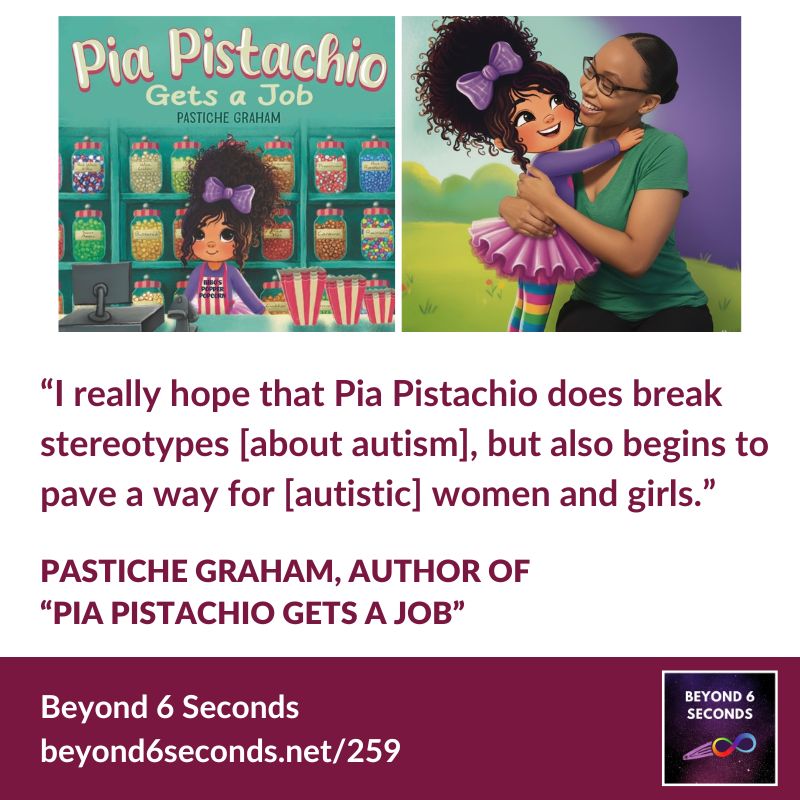
Pastiche Graham is a proud autism advocate, emerging motivational speaker, children’s book author and powerhouse for change and inclusion. After being featured on the CBS Television show Undercover Boss in 2022 (Season 11, Episode 4), Pastiche’s platform pivoted towards a lifelong journey of advocacy. Pastiche’s first book, “Pia Pistachio Gets a Job,” features much-needed representation of autistic girls in children’s literature.
In this episode, we talk about Pastiche’s journey from disheartened autistic child to enthusiastic autism advocate & author, the impact of appearing on Undercover Boss, and the inspiration for “Pia Pistachio Gets a Job.” Pastiche also discusses the importance of autism representation: specifically for autistic women and girls in literature, and for autistic adults in the workplace.
Learn more about Pastiche at PasticheGraham.com and buy “Pia Pistachio Gets a Job” on Amazon or wherever books are sold.
Follow Pastiche on Facebook, Instagram, TikTok and Threads.
Contribute to Carolyn’s tip jar to support this podcast at BuyMeACoffee.com/Beyond6Seconds!
Follow the Beyond 6 Seconds podcast in your favorite podcast player!
Subscribe to the FREE Beyond 6 Seconds newsletter for early access to my latest podcast episodes!
*Disclaimer: The views, guidance, opinions, and thoughts expressed in Beyond 6 Seconds episodes are solely mine and/or those of my guests, and do not necessarily represent those of my employer or other organizations. These episodes are for informational purposes only and do not substitute for professional medical advice. Consult a medical professional or healthcare provider if you are seeking medical advice, diagnoses, or treatment.*

The episode transcript is below.
Carolyn Kiel: Welcome to Beyond 6 Seconds, the podcast that goes beyond the six second first impression to share the extraordinary stories of neurodivergent people. I’m your host, Carolyn Kiel.
On today’s episode, I’m speaking with Pastiche Graham. From the high stakes world of national television to the imaginative pages of children’s literature, Pastiche is a powerhouse for worthwhile change and inclusion.
After being featured on the CBS television show Undercover Boss, season 11, episode four, back in the year 2022, they pivoted Pastiche’s platform towards a lifelong journey of advocacy. Now as a published children’s book author with Deep Waters Books, Pastiche’s latest work, Pia Pistachio Gets a Job, invites young readers on a continual journey of discovery and acceptance.
As a proud autism representative and an emerging motivational speaker, Pastiche is dedicated to turning personal autism experiences into universal movements, proving that no matter how deep the waters are, this should remind everyone that their strength awaits them to include each other. Pastiche, welcome to the podcast!
Pastiche Graham: Thank you so much for having me. Thank you. And thank you to everyone that will be watching this in terms of what I will be speaking on today. So this is gonna be very exciting.
Carolyn Kiel: Yeah, I’m looking forward to this. I know we’ve been following each other on social media for a while, and I’ve been getting to see parts of your journey as it’s evolved, and I’m really excited to talk to you, especially at this point in your journey after all of the really cool work that you’ve been doing and, the advocacy that you’re continuing to grow.
Pastiche Graham: Thank you so much. Thank you.
Carolyn Kiel: Yeah, I guess just to start out from the beginning of the story, when did you realize that you are autistic?
Pastiche Graham: Oh boy. When I got my autism diagnosis, I did not get a chance to find out what day of specifically that I was autistic because at the time my family, child psychologist, and their team did all the finding out for me as I was only around four to five years of age at the time. However, by the time I’ve started going to public schools, it was about mid third grade to early fourth grade was when I found out, that my world universally shifted into this aha moment, that I was autistic, but already has been diagnosed, already been diagnosed. So my educational background was very different from majority of the school, who always took regular classes. I took life skills classes and special education, and yet had IEP meetings and evaluations for autism and how it impacted my adaptability to education and for the future.
Carolyn Kiel: You were very young when you, it sounds like when you got the autism diagnosis. Were you told later in life about it or was it shared with you in stages?
Pastiche Graham: It was shared with me in stages, of when I was growing into my childhood and then as I’m continuing to go to grade school. So that’s how I ended up finding out as time persisted.
Carolyn Kiel: What was it like growing up autistic, like in school, with your friends and family, things like that?
Pastiche Graham: So growing up autistic was emotionally difficult in all personal places, from the three examples that was listed of like school, friends and family. When I was a little autistic girl, I fully placed true resentment on autism and envied a non disabling lifestyle without the need for help and support that specifically an autistic person would need for their whole life, and even later in life if diagnosed maybe as like a 7-year-old and as they persist growing up.
I felt if autism was going to be involved in every aspect of my life, then I just, at the time, I just did not wanna be a participant in society for the future because I gotta have the right typical mindset with correct adult language that will be ready to go make sense, to go make sense of for people to understand me. I gotta make sure that my social performances and outcomes were down packed to look exactly like theirs. But most importantly, making this big world that we’re in way too comfortable by suppressing the real autistic parts of me.
Carolyn Kiel: Yeah. Yeah. So it sounded like you felt a lot of pressure to sometimes what we call “mask” or just as you said, conform to neurotypical expectations.
Pastiche Graham: Yes.
Carolyn Kiel: Yeah. Wow. So that seems pretty distant from where you are today as an autism advocate. What kind of shifted in between feeling, that pressure growing up to really conform and mask a lot of your autism to being a proud advocate for autism?
Pastiche Graham: So I guess, and I guess I wanna start this off too, like in conclusion, like my hate and resentment for autism on my end of the world, because I know there’s plenty of autistic individuals in different parts of the autism spectrum that have a different universe of how they see autism and how they see fit. But all in all, my hate for autism on my end of the world was because that autism reminded me how little my opportunities were gonna be for me to live them.
Carolyn Kiel: Okay. Yeah, so with that context, if you feel like your opportunities are limited and that’s the messages that you’re getting, yeah, I can see why you would feel that way growing up.
Yeah. As an adult, you’ve really done quite a lot in the stages of your journey for autism advocacy. You recently wrote a book, a children’s book called Pia Pistachio Gets a Job. And I’d absolutely love to learn more about that.
Pastiche Graham: Of course. Yeah. I did create a story, a children’s storybook called Pia Pistachio Gets a Job. And it’s about a little autistic girl who dreams of employment at her favorite popcorn store, and she ends up finding a better understanding that an autistic person does belong in the big business.
What I got inspired by was my 2022 segment that I guest starred in on the CBS TV show Undercover Boss. At the time, when it aired on national television, not only my segment viewed my upcoming storybook and the way I showcased what the future could look like with an employed autistic person running a large business, but I also got to rewrite autism representation for girls and women who don’t get spotlighted when making autism awareness, and that’s what made me wrote Pia Pistachio.
Carolyn Kiel: That’s really cool. The representation touches on a lot of different things. One is autistic people in the workplace and what that looks like, ’cause I think probably a lot of people have certain ideas in their head about where autistic people can work and what types of jobs autistic people can have. This is really great to see this representation of someone working at a place that they love and how they fit into that and how their skills help with the employment there.
And then of course the representation of autistic girls and women in books. We, we need more of that everywhere in media, so that’s really exciting too.
Pastiche Graham: Yes. Thank you so much.
Carolyn Kiel: Yeah, yeah. Something that inspired the book that you just wrote, you had an appearance on Undercover Boss, and I remember watching your segment when it first came out a couple years ago in 2022 and I really enjoyed seeing your performance on there and your experience. I would love to learn more about your appearance on Undercover Boss. Like how did you get selected to be featured on the show? Like how does that work?
Pastiche Graham: Oh man, it’s so interesting. So yes, being able to go from watching Undercover Boss at home with family, to actually getting on set to star as myself on that show was very unexpected, but worthwhile. But it was just such a worthwhile experience. It was honestly beautiful to be part of, to be part of that.
And as far as from what I can remember, the camera crew and everyone involved to create the episode never told me I was gonna be on a well-known television show until after an Undercover Boss that I’ve trained on set revealed herself to me as the CEO of Rita’s Italian Ice. I got selected based off of who would fit the reality of the episode, and I was only prepared in my mind, thinking it was gonna be a news segment, like a piece for a news segment. And so I just went with it. I went with the whole game plan and did the show.
Carolyn Kiel: Wow. Yeah, I was wondering how they explain like, why are there cameras here and what are we filming? That’s, yeah, that’s, really cool.
So you were basically there, I think in your segment you were training and working with the CEO of Rita’s Italian Ice, who was undercover at the time, and sharing, I guess sharing a lot of your, like your goals and your dreams and what it was like working as an autistic person for Rita’s and things like that. I guess it must have really left a really strong impression with the CEO.
Yeah. What was it like during the big reveal? Like I assume it’s like a pretty big surprise for almost everyone, but what was that part like for you?
Pastiche Graham: I think what really shocked me is how you just could not tell it was the CEO of Rita’s. That’s how much undercover she actually was. And I think like once she revealed herself to me, who she really was under that disguise and being able to watch me through that disguise of how I was running her business and the franchise alone. Honestly I was just left with this “I feel honored” mark, like kind of imprint on me. And she was just so amazing and she just felt, she, and like you said, like she felt very inspired by what was happening in the store and why my employers that have employed me to the franchise saw that “okay, I now know why they have her [Pastiche] as a trainer for the front and the back of the franchise, like front of the store and back of the store training everybody.” From what I’ve learned, is because there is not a lot of big companies that would give an autistic adult a chance to showcase all of that to showcase to the world: wow, I didn’t really had in mind that an autistic person could really do those things. And it really I think touched the CEO’s heart in that light because there’s still today, there’s still workplace discrimination. And unfortunately, there’s still so many unemployed autistic adults that really deserve employment, I know equal opportunity, but more so equal employment and belonging. And that’s where the advocacy lies. And I think that’s what needs to be said to some of the biggest companies in our society.
Carolyn Kiel: And that’s a really important message because I think a lot of people’s impressions about employment for people who are autistic or any kind of disability related employment programs, a lot of times some people see it as like charity. But really there are so many people who are autistic, who have other disabilities who are completely capable with the right supports of doing almost any kind of job.
Pastiche Graham: Right.
Carolyn Kiel: It doesn’t have to be like you’re doing it as an employer just to be nice or something. Like it’s great. But really they, we bring so much value to the workplace.
Pastiche Graham: Exactly. That’s one of the biggest reasons why this episode had to air, was because a lot of these employers today still don’t see value in a neurodivergent, autistic person of what we can actually put on the table for them to make their business succeed. I just think that this world needs to do a lot better on learning how to interview an autistic person. What are their needs and accommodations so that we can take those things and implement those things into the workforce but still doing everything in the correct order, in the way that things are supposed to operate.
Carolyn Kiel: Yeah, for sure. Yeah it’s really great representation for employment of autistic people.
I know during that sort of final scene where the boss is revealed, and it’s like the one-on-one interviews, usually the employee shares like a goal or a particular dream or something that they’re working towards. So how did the show support your goals in that way?
Pastiche Graham: When the CEO was undercover and my segment showcased my upcoming children’s book, she wanted to get to know who I was as a person and what my goals were through Rita’s, and even more so after Rita’s. I think that’s where she started to get soaked up and get in into this inspiration, was getting soaked up by the inspiration that I was doing. I think that’s how she ended up funding everything for me to pursue what I’m doing now.
Carolyn Kiel: Oh, that’s awesome that you have that support behind that
Pastiche Graham: thank you.
Carolyn Kiel: And that now you can publish your children’s book and continue your impact even further.
What kind of reaction did you get from viewers who saw your segment on Undercover Boss?
Pastiche Graham: Yeah, so I am very glad to say that everybody who’s watched gave it an A plus. And they thought that was by far the best Undercover Boss episode that they have seen in a while, that it was one of the most prominent, and yet most laser focused episode that they’ve seen in the, in their entire televised watch premiere. A lot of them were very impacted by how I was, again, representing unemployed neurodivergent adults on the autism spectrum. A lot of these reviews and reactions came from parents who felt, who still feels to this day that their kid may not have a future, which also ties, going back to what I used to feel, how autism was going to basically minimize my opportunities to just live them. And parents just had a lot of hope right after. And, it is just amazing how one segment can change a whole life. And I think that’s what parents were gravitating towards was the way that I carried, not only how I carried myself through the episode, but how they saw their kid in me: “You know, hey, that can be, that is my kid running a franchise for their boss. Or “that is my kid representing a really big company” that most people wouldn’t want a specific face for running their company.
Then on the other side of the world that has watched, I got a lot of feedback, great feedback from people that don’t live in the world of autism at all, but still continued to watch because it was me or it was just because of the show in general. They said that they were really impacted and inspired by the entire message that was given throughout the segment. And that made me feel overjoyed and made me feel good to know that.
Carolyn Kiel: That’s great. So you had a really huge reach with that show, which I guess is not surprising. It’s a very popular show. All kinds of people watch it, but yeah. That really touches on the importance of representation and all different kinds of representation of autistic adults in all parts of society. Because as you said when you started out, you felt really discouraged as a child thinking that autism was gonna limit almost all of your opportunities as an adult. And then now as an adult, you’ve clearly proven that wrong and you’re helping to show that there are many possibilities for people with autism. So I I can understand why parents would see that and then see, maybe see parts of their children in you and just see one more example of, “oh, my autistic child or relative can be employed and they can use their strengths.” It just seems so obvious to say, but it’s so critical for people to see that and to help break down some of those stereotypes and assumptions about autistic people.
Pastiche Graham: Absolutely.
And I wanted to say something else about my children’s book character, Pia Pistachio, and how that kind of ties in with my segment. I think that my character, Pia Pistachio is working overtime, paving the way for girls and women through breaking gender crossroads and how sexist the diagnostic industry can actually be. I feel like autism has always been major male focused, that it’s just super rare hearing about autism traits being focused on girls and women. Even when autism traits in general can be showing both areas of a person, there’s still autism traits that happen way more often in girls and women that aren’t spotted at all versus boys and men.
Carolyn Kiel: Yeah.
Pastiche Graham: And I think Pia Pistachio will also scream to psychologists and researchers that it’s time to do better and get girls diagnosed so they can go on with their life knowing that I can actually thrive in the real world, whether that’s employment, school, just anything, and actually have that validation for themselves that we are believed and we do exist, and we can showcase to everybody that we are leaders and we, can do this, we can do a task at a job. We can do something in college, we can go pursue what we wanna go pursue without being knocked out.
And I feel like with my segment on Undercover Boss, that’s what it all ties into. So I think it, everything just combined, everything is just binded into one. And I think at this point it’s up to me to rewrite the narrative, which that is the goal.
Carolyn Kiel: Yeah, absolutely. Throughout most of recent history, a lot of the research and a lot representation of autism has been very male focused. And it’s only really recently that we’re starting to see more women and girls one being diagnosed more often correctly, and two, and representation in media.
But still, if you think of just like autistic characters in the media, you’re probably gonna think of a lot of male characters too.
Pastiche Graham: Absolutely because you don’t see, and that’s so true because again I think as you said earlier, you don’t really see autistic girls being the main character. You don’t really see that. And again, it goes back to sexism and it goes back to how the industry, the entire diagnostic industry has worked and is somewhat still working. But may, I don’t know what their thoughts are now, but I just know that still to this day, autism is still male focused, and it’s rarely you just hear about an autistic daughter or an autistic girl, or an autistic woman being spotted for their traits or being showcased for their traits.
So that’s why, even after Undercover Boss, like I had to rewatch my segment, with all my, all of my previous illustrations that were once going to be my illustrations, now that it’s Pia Pistachio, now that’s a different story. But the way Pia Pistachio actually came about was from rewatching that segment of mine over and over, where all the illustrations were laid out. And honestly, I did not feel good in my stomach for some reason, and it was because I was so, like in this understanding the way society has always preached, oh, this is what autism shows in my son, and this is what autism is. But people are saying, this is what autism is only from a male perspective and not what can autism be in both boys and girls.
And so I, honestly, that was my fault. I will say it is my fault for showcasing in my mind, like I still didn’t know, but I should have known that there are autistic girls that were still not, and still don’t get enough awareness. So I do apologize to the girls and women on my end because I just put in an autistic character that usually gets talked about furthermore than a character that was a girl and ended up being a secondary main character, but that should be a main character, as the world doesn’t really read much about autistic girls.
And so that’s why I took a couple years off and remade the whole story from scratch and decided to really reevaluate the story, and take the secondary main character, which again was the girl because having autism in a boy as the main character, this is what everybody’s gonna pick up a book on autism about. And I just decided to reevaluate my reality and what just happened on Undercover Boss. I just decided to take my segment and reevaluate the whole story and decided to create Pia Pistachio. Because I had to question myself what I was gonna publish, and I had to question myself, Pastiche is this the right thing to do? Do you know that there is already 10 thousands of children’s storybooks on autism with the boy as the main character already.
Carolyn Kiel: Oh.
Pastiche Graham: And then I had to go get on Google and look up all these children’s books on autism. And it does turn out that the boy is the main character of every autism story. And so that’s why I had to deconstruct my whole story that was televised on Undercover Boss and take that story and reconstruct it into a story that actually came from within experience, but also rewrite the narrative. And that’s why I did what I did.
Carolyn Kiel: Wow. Okay. So if I understand correctly, your original idea for the story featured a male autistic as the main character?
Pastiche Graham: As the main character. And then the girl as the secondary main character. And that’s where I felt, something in my gut told me this isn’t right. You didn’t make a story from experience and that’s why I had to take two years off and deconstruct the whole thing and just reconstruct the entire story from scratch. What can your main character in your story represent from an authentic place? And that’s where Pia Pistachio had to become about, because every single children’s book has a boy or a male as the main character. And this time around I did not want that.
Carolyn Kiel: Yeah. Wow. It sounds like you have been really thoughtful about what kind of message you wanna put out in the world and to learn from the experience on Undercover Boss and say, actually, I want the representation to be different. I think that’s really powerful. So yeah, that’s really, cool.
And I have to say that there’s so much pressure when you are creating something like this for characters that don’t get a lot of representation, because there isn’t a lot of representation, it’s hard to feel like you’re getting every single thing right. Because you
Pastiche Graham: Yes.
Carolyn Kiel: can’t fall back on all of the other examples that are out there! It’s just these few ones.
What goals do you have for your book? Whether it’s in terms of what you want people to learn from it or how you want people to feel, who should read it, anything like that.
Pastiche Graham: Oh my goodness. Yes. So my biggest goal for my book, but I should say my first book, is to bring a rewritten autism representation into big working successful companies, and have stigma about autism going into a very big breakup. Because it’s important at this point to challenge employers and anyone who still stigmatizes autism to hire and let them know they do belong and are believed.
And I want my rewritten narrative to become reality.
Carolyn Kiel: That’s really cool. And to show that example of an autistic person working in the workplace. I know some people tend to think of special programs that hire autistic people for certain things and those are great and they actually absolutely have a purpose. Also just, just hire us for any kind of jobs that we’re qualified for.
Pastiche Graham: Exactly!
Carolyn Kiel: It doesn’t have be a special program necessarily.
Pastiche Graham: Right.
Carolyn Kiel: Yeah. So that’s, wow, that’s really cool.
Pastiche, it’s been really great talking with you about your experience on Undercover Boss and your book that’s just coming out. How can people get in touch with you if they wanna learn more about your book or if they wanna buy your book?
Pastiche Graham: Oh, absolutely. Pia Pistachio and I want you to keep sparkling in any place of the world. If you wanna be in touch with me, or if you wanna get more updates about my next Pia Pistachio book, which by the way, that is in the works, just follow me on any social media platform, on Instagram, Facebook, TikTok, Threads, and wherever else you can find me.
If you would like to email me about your autism experiences, or if you have a friend or a mom, dad, just anybody who could be autistic and you’re suspecting that they could be, but you don’t know, or if you just wanna be in touch with me for emotional support, I’m able to be there. I’m able to email you when I can, and I am available to respond to any questions. Even if they may be a little difficult, I may just shorten it, but give some motivational boost to you and hopefully that part of my advice will help.
But yes, feel free to get in touch with me if you would like, and we’ll be more in touch about this soon. So I’m excited.
Carolyn Kiel: Awesome. Yeah, that’s very generous of you to open yourself up to be someone for people to talk to. ’cause I think, yeah, a lot of people really need that. So that’s definitely much appreciated.
I will put links to your social media in the show notes of this podcast when it comes out.
Is your, I should say, your first book now, Pia Pistachio Gets a Job, is that something that people can go purchase now?
Pastiche Graham: Absolutely! So if you loved this podcast today, and you think that my children’s book, Pia Pistachio Gets a Job, is actually a good fit for your kid, whether your child’s a girl or a boy, or brother, sister, any, or this book could just be for someone to learn about autism.
It’s available online at Amazon, Barnes and Noble, Books a Million, Walmart and wherever books are sold. But now you can go up a little plot twist with Barnes and Noble. Now you’re able to go up to your local Barnes and Noble, and place a special order of my book, Pia Pistachio Gets a Job, in person. So you are now free to go do that if you would rather not purchase from Amazon.
Carolyn Kiel: Okay. Very cool. Yeah, that’s great. And you don’t even have to go online. I guess you can go to Barnes and Noble and put that request in and they’ll get it for you, and you can buy it there.
Pastiche Graham: Yep, absolutely.
I really hope that Pia Pistachio does break stereotypes, but also begins to pave a way for women and girls, which I believe in my soul that she is going to do just that.
Carolyn Kiel: Yeah. That’s awesome. Yeah. Congratulations on your first book and,
Pastiche Graham: Thank you so much.
Carolyn Kiel: The representation is great, and I’m excited to hear that there’s another Pia Pistachio book in the works!
So thank you, Pastiche. It’s been really great talking with you today, so thanks for being on my show.
Pastiche Graham: Thank you so much!
Carolyn Kiel: Has this podcast had an impact on your life, your heart, or your perspective in some way? If so, I’d love to hear about it. Send me a message on social media or through my website at beyond6seconds.net/contact. Your feedback means a lot to me, and it helps keep me going with this show. Thank you.
Thanks for listening to Beyond 6 Seconds. Please help me spread the word about this podcast. Share it with a friend, give it a shout out on your social media, or write a review on Apple Podcasts or your favorite podcast player. You can find all of my episodes and sign up for my free newsletter at Beyond6seconds.net. Until next time.