
Episode 260: Sharing autistic people’s stories – with Amy Richards of the Squarepeg podcast
-
play_circle_filled
Episode 260: Sharing autistic people’s stories – with Amy Richards of the Squarepeg podcast
Carolyn Kiel
Amy Richards is a queer autistic podcaster and business owner from Cardiff in the UK. Amy became self-employed in 2015, after multiple burnouts culminated in a breakdown that ended her previous career as a high school English and Media teacher. With her business hat on, she offers business strategy sessions, builds websites and supports online business owners with their websites, email marketing and automation.
In 2020, Amy started a podcast called Squarepeg, where she chats with one autistic guest at a time about their autism discovery journey and what they’ve learned along the way. Amy is also a Nervous System Regulation practitioner, working with other autistic adults to help them become better regulated, less anxious and have more energy.
During this episode, you will hear Amy talk about:
- Her life before her autism diagnosis, including the first moment she strongly suspected she was autistic
- What inspired her to begin sharing her autistic experiences publicly and start her podcast, Squarepeg
- Her approach to selecting her guests and editing her podcast episodes
- The importance of including a diverse range of guests on our podcasts
- How a listener’s email led Amy to make a major change to her podcast
- The most significant things she has learned while working on her podcast
Learn more about Amy and her podcast on the Squarepeg website at Squarepeg.community or by email at hello [at] squarepeg.community .
Contribute to Carolyn’s tip jar to support this podcast at BuyMeACoffee.com/Beyond6Seconds!
Follow the Beyond 6 Seconds podcast in your favorite podcast player!
Subscribe to the FREE Beyond 6 Seconds newsletter for early access to my latest podcast episodes!
*Disclaimer: The views, guidance, opinions, and thoughts expressed in Beyond 6 Seconds episodes are solely mine and/or those of my guests, and do not necessarily represent those of my employer or other organizations. These episodes are for informational purposes only and do not substitute for professional medical advice. Consult a medical professional or healthcare provider if you are seeking medical advice, diagnoses, or treatment.*

The episode transcript is below.
Carolyn Kiel: Welcome to Beyond 6 Seconds, the podcast that goes beyond the six second first impression to share the extraordinary stories of neurodivergent people. I’m your host, Carolyn Kiel.
On today’s episode, I’m speaking with Amy Richards. Amy is a queer autistic podcaster and business owner from Cardiff in the UK. Amy became self-employed in 2015 after multiple burnouts culminated in a breakdown that ended her previous career as a high school English and media teacher. With her business hat on, she offers business strategy sessions, builds websites, and supports online business owners with their websites, email marketing and automation.
In 2020, Amy started a podcast called Squarepeg, where she chats with one autistic guest at a time about their autism discovery journey and what they’ve learned along the way. Amy is also a nervous system regulation practitioner working with other autistic adults to help them become better regulated, less anxious, and have more energy. Amy, welcome to the podcast.
Amy Richards: Hi Carolyn. Thank you very much for having me. This feels like it’s been a long time in the kind of planning, I suppose.
Carolyn Kiel: I was gonna say! I, you know, we were just chatting beforehand and we’ve been following each other for a while on social media and I’ve been listening to your show for a while. Yeah, I’m just excited that we were able to finally connect one-to-one and I’m happy and excited to learn more about your story and share it with my listeners on my podcast today.
Amy Richards: Fantastic. Looking forward to it.
Carolyn Kiel: I guess kind of starting from the beginning, so how did you realize that you are autistic?
Amy Richards: Hmm. So, I mean, I’d always been aware, as I’m sure many of us are, of being a bit different. But I grew up in the sort of 1980s, 1990s, and nobody was talking about autism back then, really. I mean, the only representation I’d seen was in the film Rain Man.
Carolyn Kiel: Yes.
Amy Richards: Which obviously, you know, I didn’t relate to that in any way, you know. It never occurred to me.
So I qualified as a teacher in 2003 and my first teaching post was in a rural school that had the Asperger’s (as it was known then) unit for the whole county. So they would bust these kids in every day from all over the, the county. And there was a special unit where they had a classroom where they had special teachers so they could have, you know, withdrawal from lessons or if they needed some support, but they were taught in mainstream for most of the time. We were all teaching these kids in our mainstream classes.
And I sort of found myself identifying with them a little bit and sort of feeling quite an affinity with some of them. I didn’t really think much of it. And then we eventually had some training, the whole school, whole staff had some training on how to integrate these kids into our lessons, how to support them. And they started by putting up this list of traits on a projector on the wall. And I’m sitting there and I was probably, what was I, 25, 26 at the time? Sitting there sort of reading through this list of traits. And I’m like, oh. ’cause it was like reading a list of my own personality.
Carolyn Kiel: Yeah. Mm-hmm.
Amy Richards: My own traits. And it never occurred to me. And I was just, I, I could feel almost the color draining from my face as I was sitting there reading it. Because this is a time when there was stigma, and these were special education kids, and this was nothing that, there was nothing around neurodiversity out there at the time. You know, so I had a lot of internalized ableism. Not that I knew that, that term, that phrase then, but it was there. So that was the first kind of insight that I had into my own autism. And I sort of hid from it for a long time. I did a little bit of research. Every now and again, I go and do a little bit and, and read some things and get a bit scared and run away.
And eventually I found Samantha Craft’s list of traits, and Aspergirls by Rudy Simone. Not necessarily my favorite now, but at the time, so relatable! For the first time I was hearing autism described in a way that made sense to me.
But I still sat in it for a long, long time. So it took, long story short, it took about 10 years plus to actually go from that point to getting an actual assessment.
Carolyn Kiel: Oh wow.
Amy Richards: And that was most, well mainly because, because I had a couple of burnouts. The second one was particularly bad in 2014. And it culminated in, in a full breakdown, which put an end to my career as a teacher.
I got my first canceling off the back of that, and it was through that process, although I already kinda understood myself as autistic by this point. That was what allowed me to voice it for the first time.
Carolyn Kiel: Oh okay!
Amy Richards: And to actually say to anybody who, I’d never spoken about it before, you know, to say to another person, this is what I think. We were talking about school and teaching and how difficult I found it and why. And then at one point she just turned to me and said, you keep using this phrase, “it’s the same for everybody.”
Carolyn Kiel: Oh.
Amy Richards: Actually, I don’t think it is the same for everybody. I think it’s different for you. It is harder for you. And we need to work out why that is.
Carolyn Kiel: Wow.
Amy Richards: And it was the phrase that changed my whole life. ‘Cause I basically sat there and said, I think I know what it is. I think I know what the reason is.
Carolyn Kiel: Yeah. Yeah. Sometimes it’s a, a long process, that realization, a whole process of education and just becoming aware. Because I also grew up in that like 1980s, 1990s era where you have to learn and unlearn your assumptions about what autism is. Because yeah, there was just a very narrow view of it at that point in time.
And obviously, you know, a lot of things have changed and expanded and we’ve kinda gotten better at identifying it in children and adults these days. But yeah, it takes a while to really understand it and then come to terms with all the emotions and, and what it means for you and your own life once you basically realize and reconcile what it means within yourself.
Wow. When you were experiencing the burnouts, were you already pretty convinced that you were autistic or were you kind of like, well, I’m still exploring this. It might be something.
Amy Richards: That’s a really good question. I think, honestly, deep down I knew that this was case. It was more that I didn’t want to fully admit that to myself because of the internalized ableism and stigma and what that might mean. I didn’t know autistic burnout was a thing, you know, at this point. I was having these experiences. I was being diagnosed with depression and anxiety. And I look back now and I can see the pattern, you know, this cycle of burnout that so many of us find ourselves in.
Carolyn Kiel: Yeah, yeah. And I think also it gets misdiagnosed or just read as, as different things when we do wind up seeking help or saying Hey, I think something, you know, I’m, I’m having trouble right now. What does it mean and such?
And yeah, the perspective of you saying that “well, it’s like this for everybody” because yeah, we only really deeply know our own experiences, so a lot of times we may assume that it’s the same for everybody. Or sometimes honestly, people tell us that. It’s well, you know, I get really anxious in this situation. It’s “oh, oh, everybody feels anxious.” Not exactly the same! Sometimes it’s the magnitude or how it may stop you from doing other things or those particular feelings. So it’s, yeah, that’s why it takes so long sometimes to to figure out.
Amy Richards: Yes. Or in my case, you know, “well, all teachers are tired. We all work hard, you know, we’re all exhausted all the time.” Which is true, but I was like a special kind of exhausted, you know?
Carolyn Kiel: Yeah. It’s yeah, it’s like you’re exhausted, but you know, if you take a couple days holiday or you just get a good night’s sleep, then you can come back. But this is not the same thing, like it’s a deeper exhaustion that just builds on itself.
Amy Richards: This was like a spiral downwards that constantly, it was getting worse and worse and worse.
Carolyn Kiel: Right, exactly. So, yeah.
What actually inspired you to start talking more openly about being autistic and to start actually a podcast, Squarepeg,
Amy Richards: Mm.
Carolyn Kiel: about it?
Amy Richards: Yeah, so, so I was actually formally identified as autistic in, was it 2016? And around that time, so leading up to that assessment and around that time, I’d started a blog to talk about it. And it was, it was kind of my way of firstly processing it for myself, I think, and also a way of kind of coming out to my family, friends, so I didn’t have to have the same conversation over and over again with all the different people. It kind of fulfilled those two things.
And as a result of that blog, and it was, it’s not even that many posts. I think it’s about maybe eight or something in the end. As a result of that, two different people I knew from two completely different parts of my life both got in touch with me and said, oh my goodness, this describes me. I’m going to go and get an assessment.
Carolyn Kiel: Wow.
Amy Richards: And they both ended up having their assessment and being confirmed as autistic. And it just made me realize the power of just sharing things and sharing our truth and sharing our story. And there’s unexpected things that can come out of that.
Of course now there are lots and lots and lots of people talking about this, but there weren’t that many back then. So it felt “oh, hang on, I wanna do this more. I think this is important, and if I can help two people just in my own circle, then surely I can help more people by doing this a bit more widely.” But I mean, it took a while to get to the point of actually thinking a podcast.
Carolyn Kiel: Yeah. What made you pick a podcast as opposed to a, I don’t know, because there’s a lot of YouTube channels, there’s obviously blogs and Reels and all kinds of books, things like that. What was it about a podcast that sounded like this is a good way to share stories?
Amy Richards: Yeah.
I think for me it was, I’ve always enjoyed writing and I enjoyed doing the blog, but I’ve become a real podcast fan in the interim. And it just felt like a natural, I thought, oh, I think I’d enjoy that, to create something like that where I’m actually speaking to a person.
But also when I was first diagnosed, the one thing that I really wanted and couldn’t seem to get at the time was to be able to talk about it with somebody that understood, that had that similar experience, and that would be happy to hear about it. Because of course when you tell friends and family, even supportive ones, they didn’t really know what to ask, what to say, how to take that information. And you always, I always felt at risk of, I suppose boring people by going on about it a lot. You know, monologuing and info dumping about this thing that was very important to me, but not necessarily something of interest to other people.
So that was part of it. The idea of just wanting to connect with other people and then thinking, okay, I would like to talk to people and hear their stories, but also other people might wanna share that and have a forum to actually talk about it as well. So that, that was what it was. A shared sharing experience, I suppose, of what are these stories, and just meeting other people that were like me.
Carolyn Kiel: Yeah, I know for me as a podcast host, one of the most fun things about it is the conversations, just meeting and connecting with other people. And even if their experiences are very different from my own, there’s always something, some commonality or some connection that we’re always able to make with each other about the types of situations we’ve been in and the things we’ve gone through.
So, yeah, absolutely.
Amy Richards: Yes. Yeah, that’s exactly, that’s one of the things that I’ve always noticed is that there’s always something identifiable and relatable in everyone’s story that I’ve spoken to. Even when the stories are so different.
Carolyn Kiel: Yeah. And I am really curious about the whole breadth of experience. ‘Cause everybody’s experience it really depends on their own situation, what kind of life they led, what other identities they hold and identify with.
And it’s important to share those stories and it’s great to have a platform where you can do that with people.
Amy Richards: Yes. Yes, absolutely. Absolutely.
Carolyn Kiel: How do you usually select your guests? What kinds of things do you consider or look for when you’re picking people first Squarepeg?
Amy Richards: I love this question and I wanna, I’d love to know about you as well.
Carolyn Kiel: sure Ok sure!
Amy Richards: Yeah, so I think on the whole, for me the biggest aspect has always been a bit of a gut instinct, honestly, of just, you know, do I get a good vibe? Is it something I’m really compelling about the story or how they speak about themselves?
Something that captures my imagination. You know, some people send really long sort of stories to me, really long pitches. And that can be really helpful and you get a real sense of the person. And of course a lot of autistic people, we tend to give a lot of information, which is lovely.
But equally, you know, I’ve, I’ve also had people, one in particular I can think of that literally sent me like a couple of sentences and it just grabbed my attention and I just thought instantly, yes, I definitely wanna talk to that person. And it turned out to be one of my favorite episodes I’ve recorded.
But you know, who I look for has actually evolved quite a bit in terms of, you know, really thinking about who to ask. I first started off just asking on a Facebook group when I first had the idea of thinking where am I gonna get five guests from my pilot? And I asked on a Facebook group. And at the time, it’s quite funny when I look back because I, I found it the other day, the actual, my, the actual thing that I wrote. And it’s quite funny now looking back, ’cause I was actually looking for, apparently, autistic women who are self-employed, run their own businesses, work with other autistic people or in the autism fields, any capacity, or who’ve excelled in their chosen field or turned a special interest into a job or business. And it just makes me laugh now. ’cause that’s, that is a lot of the people I’ve talked to have been like that, but also the breadth of experience and, and people is much greater than that.
And I think at the time I was very interested in that. And as time has gone on, I’ve become much, much more interested in just people’s stories and their personal journeys, whatever that might be. So it does amuse me that at the beginning I was quite, you know, quite specific about what wanted. Whereas now it’s more about, you know, people from all walks of life and just providing something relatable, something people can listen to and think, you know, even though that story’s not, as you said just now, even though that story is not mine, there are things that I can relate to and, and, and this makes me feel like part of a community, part of something bigger.
Carolyn Kiel: It’s helpful at least to be able to give sort of a, a narrow and specific prompt, you know, at first, and then you can always expand and, and move on from that. Because I found, and I’m sure you’ve found too, that if you’re ever on social media and you put out a general call for podcast guests, you’ll get like a hundred responses. And then I just go hide. I’m like, I can’t write back to 100 people! It’s too much So, this, the, the specificity I think definitely can be helpful, you know, even if you do wind up moving and, and shifting on from that. I mean, you’ve been podcasting for, is this like the 10th year? I guess if you started in 2016?
Amy Richards: So the podcast I started in 2020, it’s yes. About, it’s about five and a half years. No, ’cause it started in September, 2020, so yeah.
Carolyn Kiel: Wow. Yeah. So then your guest mix and focus changes, as you know, with every season. So that’s great. As the show evolves.
Amy Richards: Yeah. And also another thing that I’ve learned is that, you know, it hadn’t, and to my shame, it had not occurred to me in the first very early seasons, but at some point somebody pointed out to me very gently that my earlier episodes really lacked diversity. So since then I’ve been much more proactive in trying to find people, you know, more diverse, you know, people of color, et cetera. So that’s become a, a, a part of it for me is trying to showcase the stories of a more diverse group of people, I suppose.
Carolyn Kiel: Yeah. Yeah. I mean, I think even in my own guest selection, you know, as I book guests, you know, I keep track of who’s on the show and what we talk about, and I’ll look back and just sort of check like, do I have a good mix of experiences over the past several guests? Like I think recently I realized, like I haven’t, I haven’t had a lot of men on the podcast recently, so I just went out and like now I have a few more coming up that will be released later this year in terms of interviews with, with other neurodivergent men. But it is something that I have to be mindful of because I think if, if we don’t think about things like that, we just tend to talk to people who are more like us, like whatever that means, what they look like us, they have very similar experiences. So it is something to be aware of, as a podcast host in general.
Amy Richards: Yes. Yeah. And, and that’s the thing, especially these days, you know, with, with algorithms and, and things that we are shown. When this is pointed out to me,
Carolyn Kiel: Yeah.
Amy Richards: I was thinking, okay, so do I actually know any autistic content creators or anybody at all that are people of color? And I didn’t. So I made it my business to go and, and find them because the algorithm wasn’t showing me that on my social medias, for example. And that’s not, that’s not an excuse, but it was, you know, that was the experience I was having. It’s just interesting how, you know, our lives are kinda curated in that way.
Carolyn Kiel: Yeah.
Amy Richards: And you have to make some efforts sometimes to break out of that.
Carolyn Kiel: Exactly. And then, yeah, another thing I always think of is, well, I find a lot of my guests through social media. But again, there’s only a certain selection of neurodivergent guests who are out sharing their stories on social media or, you know, there, there’s tons of other, say for example, autistic people who are just living their lives and not sharing stories or creating social media content. I wanna hear those viewpoints too, but then how do you find people? So yeah, I dunno, it’s just something I think about all the time. So I really try to
Amy Richards: Oh yes.
Carolyn Kiel: find that and, yeah. ’cause I do wanna hear everyone’s stories.
Amy Richards: Yeah. Same. I’ve been lucky in that a lot of people get in touch with me because they’ve listened to the podcast. It’s like a lot of requests from people who are not, as you say, not in the public eye, not putting their stories out there, but are still willing to come on and talk to me. But it was really interesting, fairly recently, sort of towards the end of last year, I actually had an email from a listener, a lovely listener, lovely email. But saying that she was increasingly kind of put off by the level of perceived privilege of a lot of my guests.
Carolyn Kiel: Yeah.
Amy Richards: You know, that they weren’t very relatable. Their lives seemed out of reach. And I was really upset by it because that’s one of the things I’d always said from the beginning, that I want it to be relatable.
Carolyn Kiel: Yeah.
Amy Richards: And here was someone saying, that’s not actually how I’m receiving this anymore.
Carolyn Kiel: Yeah.
Amy Richards: And I think a lot of it was honestly to do with the fact that I have been sort of teetering on the brink of burnout for a little while, last couple of years. And I think my ability to be proactive about it had diminished a bit and a lot of people who pitch you tend to be, in your experience my experience, a lot of people who pitch me tend to be people who are, you know, “successful” (inverted commas). You know, people who are the kind of people who’ve got time to pitch, who’ve got a business to sell, or a book to sell or something that they want to promote on a podcast, which is absolutely fine, but it means that that’s a very self-selecting group then of people. And I think that is what kind of had happened a bit.
But yeah, so it was a really, it was really good to have that email ’cause it really was a bit of a moment, a wake up moment for me of oh, okay, this is something I need to re-look at again. It’s, there’s the next season coming up, I think it’s looking a lot more mixed. And I’m really excited about what that email has allowed me to do. It was just this catalyst for something new.
Carolyn Kiel: That’s great. It’s something as a podcast host that I think we always should be keeping in mind is how can we evolve, how can we make our shows quote unquote “better?” And getting that listener feedback is really valuable. Because a lot of times with podcasting, because there’s no central place usually to leave comments, you know, as opposed to a YouTube video or something on a social media platform where people can easily leave comments. With a podcast, a lot of times it’s, you know, you’ve got that extra step where the listener has to go find you and reach out to you. So anytime our listeners do, it’s just really valuable. One, just to remind us that oh, yes, people actually are listening and finding value from the show in general. And two, just to hear what interests them or what could we do better or differently. Really, really valuable stuff.
Amy Richards: And I always kind of think if, if one person gets in touch about something, the likelihood is it’s gonna be a lot of other people who are not getting in touch. ’cause let’s face it, many of us don’t do that, but also thinking the same thing. And I actually asked my community about it and so many of the responses I had back basically echoing the same thing and saying, all very kindly, but saying, yes, actually I would like to have more content from people that I find more relatable.
Carolyn Kiel: That’s great.
Yeah. One of the many great things about your podcast is that you’ve also built this community around it so that you can be in closer touch with your listeners and people can more honestly and easily share their feedback like that. So yeah. That’s great. That’s really valuable.
Amy Richards: Yeah. No, it really is. Yeah, it feels very supporting. And the ability to be able to ask questions like that and have people give really honest feedback that still feels kind and supportive is really lovely.
Carolyn Kiel: Yeah. Well that’s great.
Another podcast related question I wanted to ask you is when you’re editing your episodes, how much do you edit either your guests or yourself, or how do you make those decisions? Because, I know for me, it’s different if I were doing like a pure business podcast where everybody wants to sound perfectly polished and that I would potentially do like really heavy editing on it, but these are people sharing their real stories and not everybody has that super polished, like perfect, ideal public speaking voice. I, I wouldn’t even want that, honestly, for all of my guests. So, how do you make editing decisions like that?
Amy Richards: That is another really good question. So, honestly in the beginning I think I probably over edited. And it wasn’t that I was changing what people were saying or anything like that, obviously, ’cause as you say, they are people’s personal stories. So you wanna be true to that. But I, I think I was probably editing out a lot of long pauses and trying to just make it feel a bit more, well I said it to be, I think professional, I suppose, which I look back now and I think, hmm, yeah, I no longer agree with that. And I think it was probably just coming out of, you know, a lifetime of, of receiving those messages about professionalism and perfection.
Carolyn Kiel: Oh yeah.
Amy Richards: And actually now I’m editing less. I’ve realized that at the end of the day, this is a podcast with an autistic host and exclusively autistic guests. For me now, I think it should feel as naturally and authentically autistic as possible. So if me or my guest, you know, takes a long time to think about an answer or come up, that’s fine. That should be kept in. Unless it’s so long a pause that somebody might think something has gone wrong, you know? But other, but otherwise, I think it’s nice to leave that stuff in. And just people’s natural expressions, because these are ordinary people, and people use fillers, and they say things in particular ways, and that’s, that should be authentically in there.
I mean, what I do think is that I’ve always been quite keen to keep the audio as clean as possible, so that can be a tricky one, especially when you’re interviewing kind of ordinary people, the kind of people that don’t have professional audio setups and good microphones and that sort of thing. So if you found that, that that can be a bit tricky sometimes trying to clean up the audio of someone who is saying perfect, what they’re saying is fine. It’s not that. It’s just that the audio itself, the quality is not brilliant. And I’ve had some people, so even though I’ve tried to ask them to do it quietly, you know, stimming for example. So I’ve people, I’ve had, I, especially early on where people might be doing something with a stim toy and it makes a noise and that’s constantly all the way through the recording and things like that. But that sort of thing, I try, if I can edit it, I will. But increasingly now I try not to edit what people, you know, the, the gaps, the pauses and the, the stutters and the just normal things that people do, you know?
Carolyn Kiel: Yeah. Yeah, absolutely. I think for me, similar to what you do, if I think it might be something that might distract the listener, like if it’s a very long pause or a lot of particular what they call filler words or, or whatever, I might take those out. But I don’t clean it up so that it sounds, you know, you know, ’cause then it super edited if you clean it up too much. So, yeah, so I do try to that authenticity. And even, I know even for my show, because I interview other people who aren’t just autistic. Like I’ll have guests on who have Tourette syndrome. So if they have vocal tics, I, I leave those in. I might condense the volume so that if it’s like a loud tic, it won’t burst out in the audio, that again, for the listener experience. But I do leave it in. I’ll just level out the audio, just like I normally would for audio in general for all my episodes. So yes. Decisions like that is saying like, how do you, yeah, how, how do you make decisions? So, no, that’s interesting.
Amy Richards: And especially with autistic audiences, you know? ’cause the majority of people listening to my podcast are autistic, and obviously a lot of us have got issues with, sensory issues with certain sounds and things. I’ve had people talk about, oh, there’s too many mouth noises in this episode, for example, and it’s, that’s really hard. It’s well, I know you can take some of that out, but then often you’re gonna compromise on quality of the sound, perhaps, or, yeah. So it’s a balancing act I think sometimes between, as you say, making it listenable, especially for autistic audience, but also keeping it authentic, I suppose.
Carolyn Kiel: Yeah.
Amy Richards: Yeah.
Carolyn Kiel: Yeah. The mouth noises and the mouth clicking does, you know, it’s something that’s hard for me, and I’m usually the one who’s doing it the most when I’m recording my show. So I, when I edit my audio, I have a declicker, so that, that actually helps a lot. Because yeah, I don’t, again, I don’t want that to distract from the message of the show, so, yeah.
Amy Richards: No, no. I see often my, if I’m editing off it, I notice it because I have these audio things myself.
Carolyn Kiel: Yeah.
Amy Richards: If it’s annoying me, it’s gonna annoy other people.
Carolyn Kiel: Yeah, oh exactly.
You’ve been doing your podcast now for about five and a half years. What are some of the biggest things that you’ve learned from doing your podcast?
Amy Richards: Oh, so many things. So. I think one of the biggest ones actually is how much of a bubble I was living in myself and how little I really understood about other people’s lives. So, you know, just speaking, having spoken to so many people now and people who’ve been, you know, inpatients in mental health institutions, you know, held in a police cell because of a meltdown,
Carolyn Kiel: Yeah.
Amy Richards: You know, misdiagnosed and medicated or sectioned, you know, for things, conditions that they don’t even have. It just really opened my eyes, I suppose, to like the reality of life for, you know, a lot of people, actually. A lot of autistic people seem to have these kinds of experiences. So that’s been a real learning experience for me. Just, and just having gone through some things myself, but nothing like that, just understanding a bit of my own privilege, I suppose, as well.
Carolyn Kiel: Yeah.
Amy Richards: What else? I think just the amazing things that could happen when you go outside of your own comfort zone.
Carolyn Kiel: Yeah.
Amy Richards: I don’t know about you, but when I first decided to do this, I was so excited about it and so wanted to do it, and I wanted to do it for ages. But the first episode I recorded, I was so terrified and anxious about it. I felt really sick. I was really, really like in “fight flight” doing it. And I think the first episode was 30 minutes long because I was kind of enjoying it, but also really nervous and kind of wanting it to be over at the same time!
And just, you know, I think finding the courage to do things that terrify us. I think we often do better than we might expect. You know, kind of the last person that, that on paper could have been doing something like a podcast. You know, I’m such an introvert. I’ve got an auditory processing delay. So often, you know, guests will say something to me and I don’t hear it.
Carolyn Kiel: Yeah.
Amy Richards: And I will listen back to the episode when I edit it and go, they just said the thing! Why didn’t I just respond to that thing they said?
Carolyn Kiel: I do the same thing.
Amy Richards: That was really good!
Carolyn Kiel: Sometimes I’ll ask a clarifying question, and then when I’m editing, I realize the guest answered the question
Amy Richards: They’ve already answered!
Carolyn Kiel: Five minutes before I asked!
Amy Richards: Yes, I’ve done that so many times. Yeah.
Yeah. Asking a question they’ve already answered. Yeah. I’m very good at doing that.
And you know, I’ve got a slight speech impediment, a bit of a stammer, so there’s so many things that do not point to podcast host. But I’m so glad I did it and I think I, what I’ve learned is just, if you’re really drawn to doing something, just give it a go. Because the result, you know, what’s happened as a result of this for me personally, for people who’ve emailed me, you know, on numerous occasions over the years, you know, I think it was so worth doing.
What else? So I talked about internalized ableism at the beginning of this conversation. And I think this has been a real antidote to that. You know, when you put yourself out there in this way. And also talking to other people with similar experiences has been really helpful in that as well. So, you know, as I said earlier on, you know, I used to edit out when you know, if I would cover up my own long pauses or if I took a while to process what the guest has said and all those sort of things. So learning not to do that and just to accept the way that I speak has been a real big change for me. Yeah. Yeah.
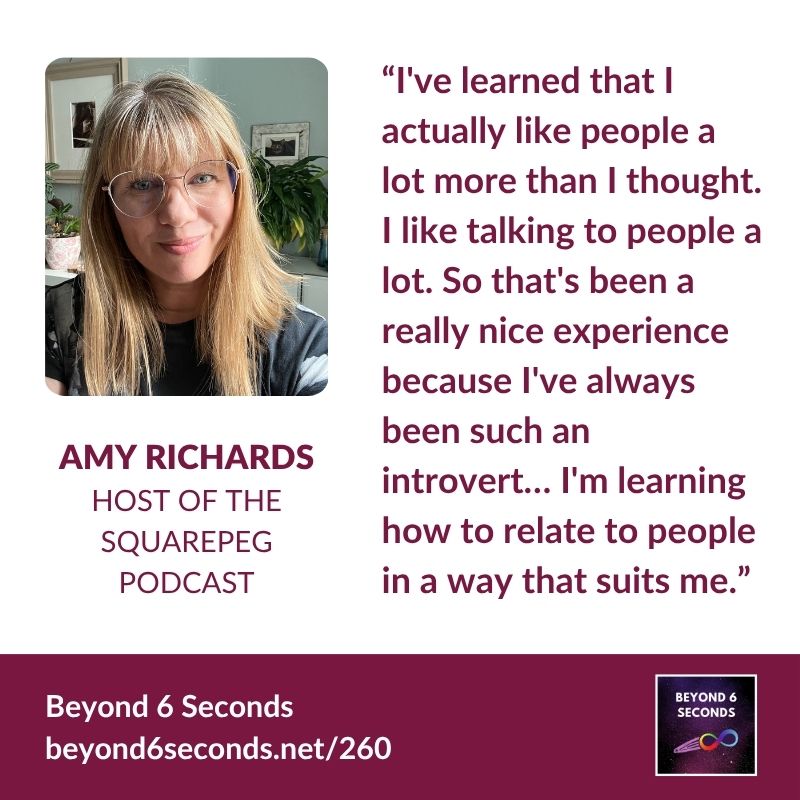
I’ve learned that I actually like people a lot more than I thought. I like talking to people a lot. So that’s been a really nice experience because I’ve always been such an introvert. And I’ve often thought, oh, do I just not like people? You know? actually, no, I do, but I just, I, I, I’m learning how to relate to people in a way that suits me.
Carolyn Kiel: Yeah.
Amy Richards: In a way that works. Mm-hmm.
Carolyn Kiel: Yeah. I think I read somewhere about podcasting specifically about who, you know, who tends to succeed or be comfortable with certain types of podcasts. And they found that people who are introverted tend to do really well with the one-on-one conversations with things like, oh, well that makes sense! I guess that’s why this works for me, because I’m also quite introverted myself.
I had kind of similar experiences as an introverted person when I started my podcast back in 2018, before, you know, before I knew I was autistic, before it even focused on neurodivergence. So I was, I was in like a walking group. We would walk every Sunday. So I told them that I was starting a podcast and, and some of the women were like, “wow, I didn’t even know you talked! Like Carolyn started a podcast!” And it’s well, because you all talk a lot and I just kinda listen. And ’cause again, if it’s a group conversation or if it’s someone who’s like very chatty and gregarious, I usually take the role of just kind of listening and not trying to interject because it’s, it’s always been hard for me. So I kind of start my podcast to see if I could even have conversations with strangers, quote unquote strangers. Could I even do this?
So yeah, it’s, it’s fascinating. You, you know, you listed a lot of things that you really learned about yourself. What your strengths are, what you enjoy, and challenging your own beliefs. Like ableism, again, was not something I was that familiar with even a few years ago as a concept. And now the more you talk to people, the more you realize just how embedded it is in our society and culture. Even in so much of our language, like you don’t even realize it. So it’s been very eyeopening and I’m constantly just trying to challenge my own you know, whether it’s use of language or, or assumptions or beliefs. It’s a constant learning process. So, it’s really good.
Amy Richards: Yes. Yeah, yeah, absolutely. Yes. Just getting over that professionalism and perfectionism and all of that stuff, which is all tied up in that, I think as well.
Carolyn Kiel: it is. Yeah, because so many of us went through, you know, like I was in public speaking clubs and you learn what is the quote unquote “correct” way to speak publicly, you know? And honestly, as long as you can get your point across, I think that’s really the best way to go. That’s the ultimate thing that you wanna do. And whether you have a lot of ums and ahs doesn’t matter as much as, are people relating with you and, and hearing what you have to say and understanding it?
Amy Richards: Yeah. Yeah. And I’m sure it probably puts a lot of people off as well, the idea that we have to be perfect.
Carolyn Kiel: Yeah. ’cause it’s terrifying. I think it’s one of the top fears or phobias of people in the world is public speaking, so you know, there’s a reason for that. Yeah.
Amy Richards: I was just gonna say, just reminded me of something, which I think is a very autistic thing perhaps. I used to be in a business networking group and it involved every week you’d have to stand up and do like a, a sort of 60-second sort of elevator pitch to the room. And then we used to do chit-chatting and, you know, networking and talking to people, all of which I absolutely hated. the one thing I didn’t mind was doing the 10 minute presentation to the room.
Carolyn Kiel: Yeah!
Amy Richards: Because actually that was fine, because I knew what I was gonna say and it was prepared and I had a PowerPoint. Whereas I’d rather do that than do my 60-second elevator pitch with no, with, with, you know, no resources. Just me standing there having to speak in a kind of off the cuff way.
Carolyn Kiel: Yeah. Yeah, there’s definitely a, a difference. I mean, certainly for me, between the sort of prepared presentation, so even if I’m presenting to a huge group, it’s less scary than trying to talk to a group of three people because I just won’t talk.
Amy Richards: Oh, yes!
Carolyn Kiel: I have no idea.
Amy Richards: Absolutely. I’ve literally, you know, served assembly at school to like a, a, a big hall full of 300 kids,
Carolyn Kiel: Yeah!
Amy Richards: And didn’t mind it. It was fine, you know, I didn’t love it. It wasn’t my favorite thing to do, but I would do it.
Carolyn Kiel: Yeah.
Amy Richards: But sitting in a staff room with a couple of teachers trying to make small talk, oh no, kill me now, you know?
Carolyn Kiel: I know it’s such a stereotype to complain about the weather as part of small talk, and it, it annoys people but at least, you know, in, in the part of the United States I live in, we’re always having some sort of weather issues. Like right now we’re like buried in snow. So honestly, that a lot of times we just wind up complaining about the weather and that’s our small talk. I have no idea what else to say. Like I’m like, maybe this will warm up and we’ll think of something else to ask each other, but I don’t know.
Amy Richards: Yes. No, I, I know what you mean is that doing very small, small talk is kind of okay, but it’s bit in between.
Carolyn Kiel: Yes. The bridge between.
Amy Richards: Especially if you know people. If you don’t know people, that’s easy. Meeting somebody for the first time, I can do that. ’cause you can ask them anything because you don’t know anything about them.
Carolyn Kiel: Right!
Amy Richards: But then asking them, meeting them, sorry, for a second or third time, the more times you meet, the more difficult I can find that.
Carolyn Kiel: Yeah.
Amy Richards: For various different reasons, but it’s obviously, it’s I don’t know how to navigate the bit between completely new person and friend I’ve known for 10 years.
Carolyn Kiel: Yeah. That is hard. Because yeah, it’s always well, how are you doing? Oh, I’m, I’m good. How are you? Good. I’m like, I should have prepared a story or some topic that I was going to share about my life before I came here. ’cause now I’m just like, I don’t know. I don’t know what to talk about. Yeah. So, yeah. No, it’s, it’s, it’s small talk is not that small and maybe it’s an autistic thing to think well, I should prepare for the small talk and that’ll make it easier. It’s well, yeah, I guess. I don’t know. I don’t know if other people are doing that, but it, I find it helpful.
Amy Richards: Having a little social script.
Carolyn Kiel: Yeah, no, for sure. Yeah.
So, you know, it sounds like you’ve learned a lot about yourself and, and other people from hosting Squarepeg. What are some of the biggest lessons that you want your listeners to learn from listening to Squarepeg?
Amy Richards: Oh, okay. So I think it maybe depends a little bit on the listener. So I think most people are listening are probably autistic themselves. And I think the most important thing I want them to take away from it really is just this sense of a shared experience of community, of knowing that, you know, then weird little things are not necessarily a unique experience and that lots of other people have got these, you know, challenges and experiences as well.
And also I think really just, I, I’m, I always hope that there’s enough kind of balance and nuance in it that people understand that, you know, late diagnosed autism or high masking autism is not necessarily a superpower.
Carolyn Kiel: Yeah.
Amy Richards: Although obviously aspects of it can be, and some of our traits can be like little superpowers sometimes.
And also it isn’t all sort of doom and gloom either. You know, like all things, there are challenges and there are joys, and I always hope that that comes across that, that balance, you know, that all of our lives are unique and that we all have challenges and we all have negative aspects and experiences, but also so many joys from being autistic as well.
I always try and ask people that, you know, what are your autistic joys? Because I think it’s so important to celebrate that.
Carolyn Kiel: Yeah, for sure.
Amy Richards: Every episode at the end of the episode, I always ask the same question to finish off, which is about if people could go back in time and talk to their previous undiagnosed self, would they wanna go back and what would they wanna say, et cetera. And I think actually those, I I, I, I’d really love to compile all those answers actually into something because I think there’s so much there.
And I also think at the end of the episode so many times, I think, well, if that’s the thing that people are left with, that message from that guest, I think that that is enough. They often sort of bring tears to mind. They’re so beautiful, you know, about giving their child selves some love, some encouragement. They’re always a message of hope. You know, you’re not broken, you’re not bad, you’re just different. There’s always variations on a theme. And the one that stands out the most to me is actually one guest who said she wouldn’t wanna say anything to her child herself, but she would just wanna sit quietly and draw next to her, and just be quiet together. I thought that was just so beautiful. I just, I just love the answers to this question, even though they’re often quite similar, but they always just seem to leave us with just beautiful message of just self-acceptance,
Carolyn Kiel: Yeah.
Amy Richards: which really, I suppose is, is the reason I’m, I think this is so important is because probably that is the key thing here that I wanna leave people with actually is that, that hope of self-acceptance and, and just, we are our full autistic selves, and that’s enough.
Carolyn Kiel: That’s a really powerful message. I think especially for autistic people who discover later in their life that they’re autistic. ’cause that’s a sort of a very specific type of journey of learning and education. Yeah, but even, even for people who were diagnosed at a very young age, that often is a very different journey and comes with a lot of challenges around acceptance and, you know, and feeling different. It, it seems like it’s a lot of the same challenges that we face, but the ways that we react because of, you know, the age we are at the time or the different circumstances that we’re in, that varies. So it’s really powerful to have that collection of self-acceptance and self-reflection from a whole variety of different people and just from different backgrounds and understanding. Like, yeah, this is, this is how I processed it, this is how I came through it, and what I would do to kind of help comfort my younger self. Yeah.
Amy Richards: Yes. Yes. Because I mean, all the people I, I talk to, I think pretty much all of them have been late, late diagnosed. But the course, the breadth of experience within that in terms of, you know, how they found out they were autistic, how they process it, how old they were, as you say, that’s, that’s all informing how we feel and we relate to this. Yeah.
Carolyn Kiel: Yeah, absolutely. Well, Amy, it’s been really great talking with you and, and learning more about Squarepeg and just all of the amazing stories that you share on your show. How can people get in touch with you if they wanna learn more about, well, either the work you do or listen to the podcast?
Amy Richards: So the best way to do it is to go onto my website, which is Squarepeg.community. And also you can find the podcast obviously on Apple and Spotify and all the usual, usual places. If people wanna email me, they can do that at Hello at Squarepeg dot community.
Carolyn Kiel: Okay, cool. Yeah, I’ll put the website and the email in our show notes so people can click on that and get to it easily. Very cool.
And as we close out, is there anything else that you’d like our listeners to know or anything they can help or support you with?
Amy Richards: I have brilliant support, as I’ve already said, from my podcast listeners in the form of, you know, messages and emails to my Patreon and, you know, people who’ve been supporting me since the beginning. And it just means a lot to me just knowing that people care and wanna help.
So I mean, if you do listen, if you do decide you wanna listen to an episode and you know you have something to say about it, I would love to hear from people. I really love getting emails from people about the show.
I think, you know, so many neurodivergent creators doing this work, we’re doing in our spare time.
Carolyn Kiel: Yeah.
Amy Richards: Often for free or almost for free.
So, you know, I think just in general, if you’re listening to any kind of content from independent people, you know, if you can’t support financially, you know, just supporting by sharing it, by letting people know “I’ve listened to this episode. It’s really good.” That’s so helpful. Or just to say, getting in touch and let me know that, or let us know that you’ve enjoyed an episode. Yeah.
Carolyn Kiel: Absolutely. I second that as, you an independent podcaster. Yeah, that feedback is so important. And yeah, of course if you can’t, if you can’t support financially then, you know, sharing it on social media or sharing it with a friend or someone else who might enjoy a particular episode, any kind of way to get the word out is just so valuable for us.
Amy Richards: Absolutely. And even, you know, if you, if you think, oh, I could, I would like to be a guest on this. Or even if you think, I know somebody who’d be a great guest. I’ve had so many people email me and say, oh, this, talk to this person. This would be a good person to talk to. You know, I’ve interviewed people, and also interviewed their therapist. Yeah. Because they had, they made the connection and go, oh, my, you know, I, I’ve passed you onto this person, could be a really good person to talk to. So it’s that kind of lovely network, that kind of web of communication and connection that has grown up around it. That’s really important.
Carolyn Kiel: Yeah, that’s really great. Being able to make those connections is really rewarding, so that’s awesome. Very cool.
Yeah, well Amy, it’s been great speaking with you, and thanks so much for being a guest on my show today.
Amy Richards: Oh, thank you so much. I’ve enjoyed this a lot.
Carolyn Kiel: Has this podcast had an impact on your life, your heart, or your perspective in some way? If so, I’d love to hear about it. Send me a message on social media or through my website at beyond6seconds.net/contact. Your feedback means a lot to me, and it helps keep me going with this show. Thank you.
Thanks for listening to Beyond 6 Seconds. Please help me spread the word about this podcast. Share it with a friend, give it a shout out on your social media, or write a review on Apple Podcasts or your favorite podcast player. You can find all of my episodes and sign up for my free newsletter at Beyond6seconds.net. Until next time.