Episode 251: Disability advocacy and political representation – with Nieta Greene
-
play_circle_filled
Episode 251: Disability advocacy and political representation – with Nieta Greene
Carolyn Kiel
Nieta Greene is the Chief Executive Officer and Founder of Disability Community for Democracy, Inc., an organization focused on safeguarding the rights of individuals within the disability community and providing a platform for political engagement founded on intersectional disability justice.
She is a resilient and proud Disabled Puerto Rican, Black, gender non-conforming, gay woman. Nieta openly champions her identity as she advocates for inclusivity and belonging on behalf of those unable to voice their concerns.
During this episode, Nieta talks about:
- Her experience growing up with multiple disabilities in the 1980s, and becoming involved in disability and LGBTQ+ advocacy
- Founding Disability Community for Democracy, Inc. after the 2024 U.S. election
- Systemic challenges that disabled people face in the United States (employment, healthcare, housing, etc.) and how politics impacts those challenges
- The importance of coalition building
- How to increase the disability community’s political power in the United States
Learn more about Nieta and Disability Community for Democracy at DisabilityCommunityForDemocracy.org, subscribe to Nieta’s Substack Nothing About Us Without Us and find social media and other links on Linktree.
Contribute to Carolyn’s tip jar to support this podcast’s disability advocacy at BuyMeACoffee.com/Beyond6Seconds!
Follow the Beyond 6 Seconds podcast in your favorite podcast player!
Subscribe to the FREE Beyond 6 Seconds newsletter for early access to my latest podcast episodes!
*Disclaimer: The views, guidance, opinions, and thoughts expressed in Beyond 6 Seconds episodes are solely mine and/or those of my guests, and do not necessarily represent those of my employer or other organizations. These episodes are for informational purposes only and do not substitute for professional medical advice. Consult a medical professional or healthcare provider if you are seeking medical advice, diagnoses, or treatment.*

The episode transcript is below.
Carolyn Kiel: Welcome to Beyond 6 Seconds, the podcast that goes beyond the six second first impression to share the extraordinary stories of neurodivergent people. I’m your host, Carolyn Kiel.
Carolyn Kiel: On today’s episode, I’m speaking with Nieta Greene, a dedicated advocate for inclusivity and a sense of belonging. Nieta holds the position of Chief Executive Officer and Founder of Disability Community for Democracy, Inc.
She has experienced various disabilities since childhood that influence her daily existence, yet she remains resilient and proud as a Disabled Puerto Rican, Black, gender non-conforming, gay woman who openly champions her identity. Nieta’s steadfast confidence precludes the need for her to apologize for her authentic self as she diligently advocates for those unable to voice their concerns.
Nieta, welcome to the podcast.
Nieta Greene: Hello, Carolyn. I’m happy to be here.
Carolyn Kiel: I’m really happy to have you here on the show today and to learn more about your life and your advocacy that you’re very much involved in.
What was life like for you growing up as a neurodivergent child?
Nieta Greene: It was very interesting. I was born in the seventies, like we just celebrated the 50th anniversary of the signing of IDEA. So I was born in the seventies, but after that. So I never went to school not having access to, now they call it accessible education, but we used to call it special education. So I never went to school not having access, but it was very different. Because it also really, even more so then than now, it really mattered where you live.
My neurodivergence, especially my ADHD at the time, they called it hyperactivity. This was the eighties. So they called it hyperactivity. Girls did not get diagnosed with hyperactivity unless you were outside of the norm. So I was outside of the norm. I was the kid that needed stimulation, but also didn’t like being around a bunch of people at the same time. So I remember that teachers would let me play by myself. But I was also talented and gifted in certain areas like math and science. So it was really hard for me as a child also having a learning disability of dyslexia and dysgraphia, which got more pronounced as I got older.
And that really hit in middle school. And when I was in middle school, it got to a point of, of like, okay, I need to have resource room. And you didn’t have a choice, right? There was absolutely no accommodations without being in resource room at a bare minimum.
And so by the time I hit high school, which was in the nineties, I was one of the first students to be declassified with supports. You are no longer in resource room, but you get your reasonable accommodations. But that was because of the ADA. The ADA required state and local governments, which includes school districts, to provide reasonable accommodations.
And then of course, you get into the late nineties with, you know, the Supreme Court case, you know, basically saying that a person with disability has a right to be in the least restrictive environment possible. I understand that was related to people being institutionalized, but that also translates into special education too. Right? You can’t say a kid that needs accommodations needs to be pulled out of the class an hour a day, if that’s not one what the kid wants, and two, not what the parent wants and all they need is accommodations like extra time. They don’t need to learn tricks, how to study.
And for me, when this was all going on, I was in that transition phase. So nobody knew what to do with me. Ninth grade was the last year I had resource room. And then 10th grade, 11th grade, and 12th grade, I had all of my accommodations, but I didn’t have to go to resource room. So if I needed extra time, I just had a note from like the guidance counselor. And I had my resource room teacher who was like my contact, but I didn’t have to go every day. I just went just to take exams or if I had study hall, I would just go to a resource room because I didn’t wanna sit in the cafeteria to study. It was quieter.
But it’s definitely, definitely was not how it is now, where girls are getting tested at earlier ages, more often. And in terms of me figuring out more and more about my neurodivergence, it, it like progressed. So first it was the hyperactivity, then it was the reading and the writing. Then it was the extra time, then it was being on the autism spectrum, right? Like, because obviously there was a lot of overlap between all of that, but there are some differences too.
And so I also had a parent who, who didn’t believe in making me eat things that I didn’t want to eat. And that’s, again, rarity in the eighties, right? If you were a kid of the seventies, eighties, and nineties, if you are a Gen Xer or millennial of any age, right? Especially if you’re a elder millennial, you ate what your parents made for you. We didn’t have a lot of money growing up. My mom had me as a teenager, she got married as a teenager. And so my mom was like, well, she’s not going to eat. She will not eat, and I’m gonna have to give her what she wants.
And I had this conversation with my mom about this. My grandmother hated cooking separate meals for me when we lived with her, but my mom’s like, she’s not going to eat and this is my child. I’m not gonna make her eat things she doesn’t want to eat. So for example, I would eat Chef Boyardee spaghetti sauce, spaghetti out of the can. Right? As I got older, my mom would introduce her homemade sauce. Instead of meatballs, it would be meat sauce. And I’m like, I don’t want that. And my mom would be like, okay, try it. Right? And she wouldn’t, like, she would just introduce it slowly. It wasn’t, wasn’t totally forced. It was like, okay, you are gonna try it, but if you don’t like it, I won’t make you eat it. And so I would try it. It’s the same thing, but instead of it being in a can and a package that I’m familiar with, she, my mom made it.
And so eventually she’s like, oh, you already eat my sauce because you eat my lasagna. It’s the same sauce, but it’s just a different format. It’s still meat sauce. You eat meat sauce already. It’s spaghetti instead of lasagna. So it’s like, oh, okay.
And then of course, when my mom made the lasagna, she would make it completely from scratch. If my mom made spaghetti sauce, sometimes she made it completely from scratch. Sometimes it was a hybrid from scratch with some jar sauce. And that’s how my mom still got me to eat my safe foods. But she was able to just cook them for me instead of buying spaghetti for me that’s different than the spaghetti that she was gonna cook, for example.
Carolyn Kiel: Oh yeah. That’s interesting how she knew to gradually introduce you and get you comfortable with those similar types of foods to help expand your palate, but without forcing you to eat things that you really didn’t want to eat. That’s really good that she was able to support you in that way.
It’s interesting that you were going to school during that time in history where we had changing legislation with the introduction of the ADA, which I think was like 1990. And then having the other earlier protections in the eighties and how that evolved over time.
Now you are very much involved in disability advocacy and I’d love to know more about when did you start your disability advocacy?
Nieta Greene: So there’s the self-advocacy, which I’ve always done. But there, there’s kind of, sort of a split in the disability community between the mental health track and the general disability advocacy because of the differences between how physical disabilities and intellectual and developmental disabilities are treated versus disabilities around mental health disorders.
And so, because I also struggle with mental health issues, I started my advocacy there. I was a peer advocate. I worked for, like the nonprofit no longer exists, called Westchester Consumer Empowerment Center when I lived in New York in Westchester County. And so my advocacy was mainly around mental health.
I’m also a member of the LGBTQ community, so some of my advocacy was actually around HIV and AIDS. This was the nineties. I came out in the nineties when, it was hard to, nobody came out then in high school. I was in high school when I came out. And so I had friends when I would go into New York City who lived in low income neighborhoods, like in Bed-Stuy and east Harlem who, I’m just gonna be honest, they were turning tricks. These were Black gay men. And a lot of them who I, who I was friends with, ended up dying of HIV. HIV is a disability. We don’t talk about it as a disability, but it is one. And so my advocacy was around educating people around safer sex practices, giving out safer sex kits to my peers. These were my, my peers in my age group primarily, some of them a little bit older, but mainly my peers. We were giving out condoms and dental dams.
And so those were like the two things I did advocacy wise in terms of disability. And then then as I have obviously gotten older and life happens, I then switched into doing just general LGBTQ justice things and, and advocacy and just advocating for disability in, in spaces, making sure, hey, things are accessible, things like that.
But really was the 2024 election cycle that really ticked me off, to the point of regardless whoever was going to win, I was gonna do more around general disability advocacy. I’ve also, as I’ve gotten older, I’ve also developed physical disabilities. So I had a head injury before the age of 22 that’s impacted my life. I also have something called Functional Neurological Disorder, which impacts all of the neurodivergent things that I go through because my nervous system is over or understimulated all the time. I don’t know what, what my day’s gonna be like.
And so, looking at what we’re going through now. We have someone in the White House who decided to use the R word, and that ticked me off. And I don’t even like calling it the R word because the problem when we call something the R word or the N word, we take away the power and the harm that it causes. But at the same time, I am not going to say it because I don’t wanna give this man energy. But I remember being called the R word when I was a kid because of, of the fact that I read really slow because I’m dyslexic. And so that upset me because I’m like, really? We’re back to humiliating non-disabled folks with disabled slurs. No, I, I’m just, and I knew that was gonna happen.
That’s why I started Disability Community for Democracy. We have people in this current Congress that have disabilities, but we don’t have representation politically. And this is something I have learned as being a person of color, being LGBTQ, if you don’t have people with a strong presence, more than one or two people in politics at, at the federal level, specifically representing you, your interest, people don’t necessarily care because you don’t have political power. And I understand that.
And this is why I started Disability Community for Democracy. ’cause I, I know nobody’s coming to save us. We need to save ourselves. And especially in this environment where we have people spreading mis and disinformation about autism, saying that it was caused by acetaminophen. And we have somebody who can’t even say acetaminophen. I might not be able to spell it, but I could at least say it! And I’m like, don’t give medical advice if you cannot say acetaminophen, please!
Carolyn Kiel: Yeah.
Nieta Greene: Please.
Carolyn Kiel: Yeah. And yeah, and we have political figures who have disabilities, like Abbott and Fetterman and even RFK Junior, who has spasmodic dysphonia that impacts his voice, who do not advocate at all for the disability community. So it’s, yeah, we, we need people who are there and involved and I feel like really all political parties really don’t do a great job, at least in this country, in the US, advocating or supporting people with disabilities. And I kind of feel like they get ignored a lot. And that’s probably something that you’ve encountered through your advocacy as well, and I’d love to hear your thoughts on that.
Nieta Greene: Part of our mission statement, we fight for democracy, liberal democracy, and civil rights, no matter who’s in power at the federal, state, and local level. Because I understand that this is not the eighties, late eighties, nineties, early nineties where people understood they needed to do the right thing, because it was just the right thing to do. Kind of, sort of in the 1960s where, Lyndon Baines Johnson was a racist. Like, why don’t we just call it what it is. Right? He was a racist. He had used racial slurs towards Dr. King. Like that’s been documented, but he also cared about his legacy. So he was like, okay, we’re going to get the Civil Rights Act of 1964 signed. Then the Voting Rights Act of 1965, which is being, has been gutted and is probably gonna be even more so in the Supreme Court with upcoming decision around that. And then there’s the Civil Rights Act of 1968, which was a lot around housing and things like that. But he was the president who did all of that, right? But he cared about his legacy.
And, and Nixon, same thing, right? People will say, well, he was trying to distract from Watergate. And, you know, he vetoed it the first time. I said, I don’t care. At the end of the day, Republicans have always been the party for people with disabilities because they understood, we as disabled folks just want to be able to have equitable access. So we can actually go to work, we could go to school, we can go to the doctor, we can have a life. And the ADA is the floor. And we didn’t have any civil rights as disabled folks.
I say this all the time. If you were a person of color, if you were, and I’m going to use Black specifically, if you were a Black person, you might have civil rights based on race, but you still don’t have civil rights, especially before 1973, when all of this process started, because you still couldn’t get an education, you still were able to be segregated based on your disability.
And I am grateful for the fact that, that, that the work around civil rights was the framework for disability. But it’s not the same. And I will say this all the time. Waiting for someone to sue, ’cause that’s how the ADA is now, around, okay, you need access to something, therefore you have to file a complaint and file a lawsuit, and you gotta do the work. For people with disabilities, that’s difficult. If it’s a racial discrimination suit, yeah, it sucks. But, you know, it’s not acceptable to be racist. Even in this environment. We have, we have totally somebody who is a white supremacist in the White House. But he will never use the n word on his social media posts. Didn’t do it when he was president the first time. Because he knows that it’s not acceptable. But it’s acceptable to spread mis and disinformation about people with disabilities. It’s acceptable to criminalize disabilities like mental health disorders and addiction, while someone’s homeless or unhoused, whatever term you wanna use. Because we don’t have political power. And political power is what is going to save the day for us.
Carolyn Kiel: Yeah, absolutely. Yeah. I think many people probably don’t realize that until very recently, for most of the 20th century, there were things called Ugly Laws where people with disabilities literally could not be out in public, nevermind getting an access to education and all of the things that, you know, the ADA and other related legislation helped people with disabilities get. So it is still very socially acceptable to be ableist, unfortunately. And that’s why you see a lot of this resurgence of, you know, language. And it’s not just language, it goes far beyond that in terms of just like maligning people. And it touches every category, as you said. People who are homeless or unhoused because such a huge population of those people have disabilities.
And just, you know, it just really touches every area of life. So it is always surprising to see how deeply that ableism and that bias runs in even people who would think of themselves as very progressive in their thoughts. It’s just so much baked into our society at this point.
Nieta Greene: This is what I think about left versus right on disability issues. As far as I’m concerned, I don’t care how progressive or how conservative you are, my humanity is not up for debate. And the humanity of the disability community is not up for debate.
But it is always up for debate. New York State budget got held up because they wanted to expand involuntary commitment, in terms of if they can’t take care of themselves. And I’m like, you are basically saying if you can’t take care of yourself and, and they really wanna apply it for people who are out in the street. I’m just like, I know where you’re going with this. People who are out in the street unhoused, I understand from my own personal experience due to intimate partner violence and yes, I have family and I could have stayed. I couldn’t stay with them ’cause it was not safe for me to stay with them.
Shelters are not accessible. Even services for people who are trying to navigate the system as intimate partner or domestic violence survivors, those shelters are not accessible either. And so sometimes you end up unhoused not because of disability, but because of another situation, but having a disability makes it worse. And takes away access to certain services you might be able to get, but you can’t get them because the building’s not accessible or they can’t accommodate you.
And this is somebody like me. When I was navigating this at the time over 10 years ago. I understood how the system worked. I was an advocate. One of my family members worked in government around social services. So it wasn’t like I didn’t have access to information. It was literally disability that was the barrier.
And it’s frustrating because what ends up happening is you end up in the street longer or, or wherever, a place that can take you longer because you need accessible housing. And so I ended up moving out of state.
Carolyn Kiel: Oh. Mm-hmm.
Nieta Greene: I’m in Massachusetts because I couldn’t get anything accessible where I was in New York.
Carolyn Kiel: Wow.
Nieta Greene: No matter where you lived, it was like a 10 year wait list and I’m like, no. Versus like a three or four year wait list. Yeah. I’m going to move out of state.
And they have better services up here! Yeah. It, it’s, on the one hand, the shelter services are not great, but housing, even though there’s a major shortage, if you can get housing, it is better than in New York.
Carolyn Kiel: Yeah. Wow. You don’t realize how things really do vary state to state and there really aren’t enough resources. And some resources, as you said, are not accessible. Some are too violent for people to go to, and they’re actually safer on the streets. There’s just so many things to take into account, so it’s, it’s a really difficult situation, you know, especially if you’re disabled. Yeah.
Nieta Greene: Yeah, I mean, I was safer in a drop in, sleeping in a chair for almost a year than I would’ve been in a women’s shelter. And I couldn’t do the “climb the beds” and do all of that anyway.
So it’s like, and, and the reason why I talk about that piece of things, because I do think it’s important. ‘Cause some people will be like, oh, why are you talking about that? What does that have to do with your advocacy? And I said, it plays into why I do the work I do, is it could happen to anyone. And when you have a system that is stacked against the disability community, no matter what type of disability you have, you are not going to succeed if you don’t know how to navigate. Sometimes navigation means moving, and that’s hard when you have a disability. But sometimes navigation also means, okay, I’m going to put up with things that a non-disabled person wouldn’t put up with because I don’t wanna lose my healthcare, my shelter. And, and I don’t think we talk enough about that.
You can’t have a liberal democracy if you have about 30% of the population, and that’s CDC stats, not having equitable access to education and healthcare and things like that. And people will say, well, people of color don’t either. But there’s a caveat, and I say this as a person of color, if you do not have a disability, you have the opportunity to switch economic classes, right? If you have a disability, and especially if you are reliant on Medicaid and Medicare and SSI and SSDI, you are forced to be in poverty because the calculations are still from the 1970s. I say this all the time. They’re still calculating how people get benefits from a time period that no longer exists.
Carolyn Kiel: Mm-hmm. And you can’t have savings for emergencies because you’ll lose your benefits.
Nieta Greene: You can’t. I had a friend who literally had to drain their 401k and their IRA that they had put so much time and money in, while they were in the process of getting disability. And they had to take that money out and live on it, so they didn’t get penalized. They had to drop it down to the amount that they were allowed to have.
Carolyn Kiel: Mm-hmm.
Nieta Greene: which in the long run harms them when they get older.
Carolyn Kiel: Yeah. It’s related to what you said before of just sort of knowing how to navigate that system. That’s another way to navigate the system, which is, you know, how do I get money without getting penalized? But eventually it harms you in the long run, but you do what you have to do in order to survive in the moment with the resources that you have.
Nieta Greene: Yeah. And then there’s also the, the, what I call the gray, right? There are people with disabilities like myself, who are disabled, who can’t work a full-time job like 52 weeks a year, who work a part-time job, right? But you also gotta watch how much money you are earning because a lot of part-time jobs don’t have health insurance.
Carolyn Kiel: Yep.
Nieta Greene: So you have to watch how much money you’re earning, so you could have health insurance through Medicaid.
Carolyn Kiel: Yeah.
Nieta Greene: Right, because, because the way the system is, you could have a disability, ’cause it’s happened to me. Yes, she’s disabled. Her disability interferes with her life, but not to the point of her not being able to do certain types of work.
And the problem is, is that okay, I can do that type of work, but can I find that type of work? There’s not, there’s not the reality of like, okay, does that work even exist anymore?
Carolyn Kiel: Mm-hmm.
Nieta Greene: Again, they’re using standards of what the work is that doesn’t even exist anymore.
Carolyn Kiel: Right. Yeah. I’m sure anyone lately who’s been out job searching and trying to find work can attest to the fact that it’s even harder now for everyone to find the kind of work that we need to sustain ourselves. And it’s just so much harder for people who are disabled who maybe can only work a few hours a week or can’t work that like, you know, 40 plus hours a week every single week of the year.
Yeah, I feel like everything’s just getting squeezed and that people with disabilities are usually the first ones to feel that, like the pain of the systems being either eroded or collapsing in on each other.
Nieta Greene: You know, there was a saying in the Black community, they said, “when everybody else gets a cold, Black folks get pneumonia.” I have a saying for the disabled folks. “When everyone gets a cold, we end up in the ICU.” Not even pneumonia, ’cause pneumonia, you can treat, right? Like you can have pneumonia and not end up in the hospital. We end up in the ICU. That’s how bad it is.
I’m thinking about how they’re trying to now fix the subsidies around ACA and I’m like, and I am gonna say this, I blame Democrats for why we’re here with the ACA in the first place in the subsidies. They decided to make them not permanent. And I don’t wanna hear about, well, it was this person’s fault or that person’s fault. I don’t care whose fault it is. It was a political decision. And you were hoping that Biden was gonna be able to run and you were gonna have Democrats in both the House and Senate again. And that’s a problem. We have a healthcare system and, and I say this all the time, you might be able to get healthcare in other countries, but they have their own issues. We have like the best, like people come to United States to get care from other countries because they can’t necessarily get the care in their country that they can get here.
Problem is is that is so expensive for us. People keep talking about, “we need universal healthcare.” We need healthcare that’s accessible. I don’t care if it’s a private public partnership. I am definitely not for Medicare For All, because there’s holes in Medicare. People say, “well, you need Medicare For All.” I’m like, hmm, I know the holes in Medicare. Home care is one of those major holes. Also, you have a copay. If you have part B of 20%, are we going to eliminate that? ’cause that, like you, like people talk about, they don’t, you know, oh, Medicare for all, but everybody gets Medicare. I’m like, mm, and if you are on Medicare, you pay for part B.
Carolyn Kiel: Hmm.
Nieta Greene: So are we saying we don’t pay for, you know, part B? And you know, like, or, or, or? For me, I would say Medicaid for all, which is more extensive than Medicare and what it covers. But again, it depends on the state you live in. Like in my state, Massachusetts, I could go to pretty much any doctor for the most part and get seen. I don’t have these long lists. But if you go to another state, if you get to a doctor who takes it, you’re kind of stuck because you have a long wait list. And so it’s that piece of things that I think we don’t talk about.
I think also for me, which upset me during the government shutdown, I was saying to people, they’re playing with people’s food, right? Like, I said this during the shutdown and I, I was not popular at the time, but it’s the truth. You can’t eat health insurance, right? Like they’re playing with people’s food because they knew people would want to eat. And, and now you are saying I can’t eat.
And this is what people don’t understand. Like you can be mad at the senators all you want to, but if their senators, if they’re getting calls from their constituents, and I’m gonna say this, honestly, if I was in the Senate and they were playing with people’s food, I would’ve said, you know what? Enough. We gotta make sure people eat. Like, I really believe people need to eat.
I believe healthcare is a right. But if I don’t have food, clothing, and shelter, healthcare is not gonna help me if I don’t have a place to live. Healthcare is not gonna help me if I don’t eat. Food is medicine. Like we gotta think about this broader than how we’ve been thinking about things.
Carolyn Kiel: Mm-hmm. Yeah. And plus with SNAP, that had funding that was separate from the whole shutdown and budgets going back and forth, and then, you know, our government or the White House specifically decided to play around with that and use that as additional leverage to punish people.
So it’s almost like we really didn’t have to go through all of that, with taking away people’s food. That was protected, and they just decided that, hey, people don’t need to eat and we’ll just play our games over here. And I don’t know.
Nieta Greene: You are absolutely right. I mean, there was, there was separate funding for that and they did that on purpose.
It’s like, okay, you don’t have to care, but we need people in office who do care. For me, doing this work is hard. It’s hard because everyone who volunteers for the organization, literally they are dependent on something. Either Medicaid or SNAP or, or both, or Social Security Disability or SSI. They’re dependent on something, right? So it’s not just, Hey, we’re just volunteering our time because we wanna do the right thing. We are trying to save ourselves and do this work at the same time.
Carolyn Kiel: Yeah. So how do we get politicians to care more about supporting the disability community?
Nieta Greene: Well, it’s a two-prong answer, right? First we need, the disability community needs to build coalitions. It needs to do a better job of building coalition with other groups. And other groups need to build coalition with us. Because we are not a monolith. No group is a monolith, right? LGBTQ isn’t a monolith. Black folks aren’t a monolith, Latinos aren’t a monolith, right? But I think we start with coalition building.
Like we gotta look at history. What did we do in history that worked? How did slavery end? Right? Black folks who were either free or escaped slavery in the south, or even certain parts of the north technically, were able to build coalition with white abolitionists, right? And their motives were not a hundred percent pure. You know, they wanted slavery ended so they could send Black folks back to Africa. But this was not everyone who were abolitionists. But some abolitions believed in that.
Or the NAACP, you know, for example. There were Jewish people who were involved with that. Or the Civil Rights Movement of the 1950s and sixties. There were Jewish young adults who were Silent Gen or older Baby Boomers. A lot of ’em were descendants of, of people who escaped World War II. They left Europe in either World War II or their grandparents left Europe in the late 19th century, early 20th century, because of the antisemitism in Europe. And so they heard the stories. And so Jewish people stood with Black folks and Black folks built coalition with the Jewish community.
So we as people with disabilities have to be willing to build coalition. And also we have to be willing to make people feel uncomfortable, ’cause coalition building is not comfortable. And, and the disability community has a lot of work to do around racism, and homophobia and transphobia. And there’s a lot of work that needs to be done in other spaces around ableism, right? And other marginalized groups.
So how do we get there? We have to start saying, what things do we have in common? What is gonna help all of us in order for us to have human rights? And we need to figure out how that’s going to work. And until we do that, we are not gonna get political power. Remember, political power, there were Black folks who were in office, they were Republicans. This was when the Republicans were the liberal party, and Democrats were the conservative party during Reconstruction, right? They got the right to vote. Black men got the right to vote before, actually, before white women did. And then they also ran for office, right? And so we had a taste of political power. And so that didn’t go away.
We’ve never really had political power. Yes, we had the ADA and we had the Capitol Crawl and we had some protest, but there are some differences. We’ve had political power, we’ve had economic power, Black folks, you know, my people have had that power and, and, and built it out themselves. And then unfortunately, racist white folks would go in and destroy it. But people with disabilities have never had that opportunity to do that. And, and even now, like there’s organizations that have been around since the mid nineties that are basically organizations that remind me of like, like the Senators and the House, when there’s mis and disinformation, they’re writing a letter saying, “we don’t agree with what he’s saying.” I’m like, what are you gonna do about it?
Carolyn Kiel: Mm-hmm.
Nieta Greene: Like, put together a lobby day. Put your bodies on the line. This is deeper than, than curb cuts and not being able to take a bus. I’m not saying those things aren’t important ’cause they are important, right? I rely on paratransit myself.
Carolyn Kiel: Yeah.
Nieta Greene: But we need to say enough is enough. Cuts to healthcare are gonna kill our community. The SNAP work requirements and the additional paperwork, our people are gonna lose benefits because you’re requiring us to do it every six months. That doesn’t make any sense. Disabilities generally don’t change unless they’re temporary and, and, you know, that’s documented. My disability is not gonna change. Mine is permanent.
Carolyn Kiel: Mm-hmm.
Nieta Greene: I’m not on SNAP, but mine is permanent. If I was, you know, and I have been on SNAP, but I’m not on SNAP right now. And so if I need SNAP again, I’m now gonna have to fill out every six months that I’m disabled and I don’t need to do the work requirements. Like, it’s ridiculous. It’s basically saying, oh, it’s eliminated fraud, waste and abuse. No.
It’s the Ugly Laws, right? It’s the Ugly Laws without having the Ugly Laws on the books. . That’s how I see all of these cuts. It’s like, okay, well we can’t put the Ugly Laws on the books because of a Supreme Court decision. We can’t hide disabled folks. But what we can do, we can make it so difficult for them that they will say, okay, I will figure out if I can get into some sort of institution, or I will stay in that abusive situation with my family member instead of trying to be independent. I know for some people they’re like, how is that ugly? It is ugly. It is the ugliest form of lack of humanity that I’ve ever seen in, in life. At least back between the early 19 hundreds and 1974, they were released straight up about it. They’re not being straight up now. They’re playing in people’s faces saying it’s fraud, waste, and abuse. No, it’s the ugly laws. You don’t want to take care of us. So go into an institution.
Carolyn Kiel: Mm-hmm.
Nieta Greene: Go hide. Stay in your house. Have your family take care of you.
Carolyn Kiel: Mm-hmm. Yeah. I mean, I think it’s kind of a similar thing with the bathroom bills for the trans community. If you think about the implication of that, that’s an Ugly Law. If you cannot safely go to the bathroom anywhere, you cannot go a very large distance from your house or wherever you’re living. Like that absolutely limits being in public, which is, you know, what the Ugly Laws did with disabled people back in the day. So it’s these things that, as you said, they’re not being straight up about like, Hey, this is what we’re doing, but they’re accomplishing it in kind of a, a sneaky way.
Nieta Greene: Exactly. And it’s difficult because one of the things I think about, and I will say this, is that how do we move, right? How do we fight back? We can’t no longer say, I don’t have spoons to do X, Y, and Z because no one’s coming to save us. We don’t have allies really anymore in the federal government like we did with the ADA. Or even in ‘ 08 when they had to do the updates to the ADA, we had allies who actually gave a damn.
Carolyn Kiel: Yeah.
Nieta Greene: We don’t have that now. We have a Republican party that is completely inept because, and they care more about power than doing their job. And we have a Democratic party who literally is like, well, I don’t know what to do!
Carolyn Kiel: I’ll write a letter!
Nieta Greene: Yeah, I’ll write a letter! I don’t know what to do, I’ll write a letter!
And I’m not saying this is all Democrats or all Republicans, but it’s the majority of both parties are inept in their own ways. And the people who are being harmed are us as disabled folks, right? I mean, they keep talking about, for example, which has ticked me off, how much the lack of attention in people with disabilities and their unemployment rate. We have the highest unemployment rate in the country! Higher than any other group. Regardless if you compare Black women to people with disabilities, ours is higher. Black men, ours is higher. If you break it down by race among disabilities, people of color who don’t have disabilities versus people of color that do in unemployment, ours would be higher, right? Like, like people with disabilities who are people of color have higher unemployment rates than those who are people of color who don’t. And so we don’t talk about that.
We also have, overall, I think it’s between like a 20 to 25% rate of employment with people with disabilities overall. I think it’s between 60 and 70% for non-disabled folks. And so why is that? Because, because of the way the system is built. And yes, am I concerned about Black women being taken out of the job market? Of course! I am a Black woman in the United States. But I also have a disability. And every time I get a new job or I have to do something, I have to hope and pray that I’m going to be able to go to the doctor when I need to go or anything like that.
I mean, if I didn’t have a disability, I would have to navigate racism. But I wouldn’t have to navigate my work schedule. I mean, obviously if I have kids or sick family member. But I’m talking about overall that I need care for me as the employee to be able to work. I have to hope and pray, as a person with a disability, then my job’s gonna let me go to the doctor.
Carolyn Kiel: Mm-hmm. Yeah.
Nieta Greene: Leave early to go to the doctor. Or do I not go for two or three months and pray that my health doesn’t deteriorate if they say no?
Carolyn Kiel: Mm-hmm.
Nieta Greene: Those are the choices you have when you have a disability.
I’ve been terminated from jobs due to disability, like blatant. I had to file a lawsuit at one point for a job because of it. I’ve never had to do that based on race or sexual orientation.
Carolyn Kiel: Mm-hmm.
Nieta Greene: And, and it was so hard when you are dealing with disability because you are trying to navigate your own health and trying to stay employed.
Carolyn Kiel: Mm-hmm. I really appreciate you tying in your own experience with this and the real challenges around, you know, being someone who’s disabled and existing in the world and how all of the systems that are built are working against the whole community and how challenging it really is.
Yeah, so I think we somehow need to get back to that point where we had representation in government with people who were allies or people who actually cared about doing the right thing for the disability community, the largest population in the country, so people should care.
Also, as you said, we do need to work together with other groups and form coalitions. Like part of the whole reason that the sit-ins worked in the seventies with the disability groups is because the Black Panthers were helping supply food to the people doing the sit-ins. Otherwise, that never would’ve worked.
Nieta Greene: Or, and also not just the Black Panthers. There were the lesbians as well who would go in and wash their hair and bring them shampoo. Like these are things that people forget and leave out of the story. And, and I will say this all the time in terms of like political power, all the Black activists that have disabilities that I’ve learned about was through white disabled folks. And I don’t learn about disability in Black spaces and the role disability played in their story.
The only way we are going to get, we’re almost at a point of no return to be perfectly honest. I’m gonna just say, but almost doesn’t mean we’re there. At the federal level, we’re almost at a point of no return. At the state level, depends on your state. And I do think politics are local. And so, so I will end with this.
First and foremost, if you’re not registered to vote, do so. And don’t say, “well, my vote doesn’t count.” Now I understand that you might live in a state if you have been part of the legal system, and you might have lost your right to vote. If you can figure out a way to get your rights back, there are organizations that do that work. So I will say if you are a person who has been, who has a felony, and you live in a state, once you’re convicted of a felony, you lose your right to vote. There are organizations that will work on that. Every state’s different. So, but a lot of those states are in the south, unfortunately. But that does not surprise me because, you know, that’s how they’ve always rolled, right? And most of the people who are impacted by those laws are poor Black and brown folks, and a lot of them have disabilities. So, so just wanna say that.
If you’re registered to vote and you do not rely on Social Security Disability, you do not rely on any assistance at all, think about running for office. And it doesn’t even have to be Congress. if you have a commission, run as a commissioner. Run for school board. Run for city council. The more people with disabilities are represented in government, the less they can pull this nonsense, right? We need to be in every facet of government.
And the last thing I will say is volunteer. If you can make signs for the protest and you only have an hour and you can do one sign, that’s one sign somebody else doesn’t have to make. Call your member of congress and your senator and call your state senator and state representatives. They might call it an assembly person, depending on the state. Go to your city council meetings if you can. Now, a lot of them are live streamed, so you don’t even have to go to city hall anymore. Those are things you can do. And, and those are the most important things.
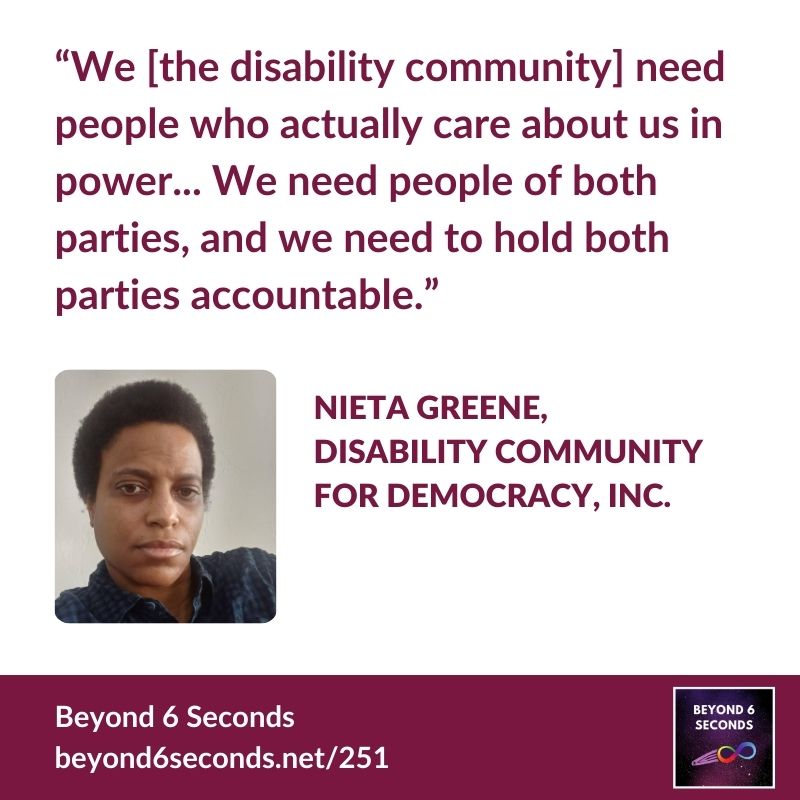
Until we as a community start building our own things, we are going to have what we have, which is press that doesn’t pay attention to us unless we’re inspiration. And we have one day stories where we have the current occupant of the White House using the R word, and the current occupant who can’t say acetaminophen. And we have RFK Junior saying that Tylenol causes autism and wants to create a registry for people with autism. And so we need people who actually care about us in power. We need people in both parties. We can’t put our eggs in all in one basket. We need people of both parties and we need to hold both parties accountable.
We’re here as a community because we said, okay, we have the ADA. Now what? Like it was like, okay, we have the ADA, we don’t have to do anything else.
Carolyn Kiel: That was supposed to be the starting point, the ADA!
Nieta Greene: Yeah. The ADA was supposed to be the starting point, not the end point. And so, that’s what I would say.
And last, but certainly not least, take care of yourself in this process, right? Civics is hard. Civics is hard, and it takes a long time. And I’m saying it’s hard because, think about it. Reconstruction ended, and I’m giving a history lesson because it’s important. Reconstruction ended in 1876. There was about a 90 year period or so where Black folks had little to no rights. Especially in the south, legally, Jim Crow. In the north it was, you know, different, but it was mainly custom in the north. But in the south it was definitely on the books, legal to discriminate. Right? And also the federal government with redlining and who can get a GI Bill and all of that stuff, right? It was everybody that was discriminating.
But Black folks did their thing. They built communities, they built their own press. They did all these things. And so if we want to have political power, we need to look back at what happened. Why do Black folks still have the political power that they have? Because they did not stop just because the Civil Rights Acts were signed in the sixties. They didn’t stop. They ran for office. They still kept fighting. And I think that’s the difference.
Most people know the NAACP, right? Anybody know about any of the disability orgs, the national ones? Not really. Right? Like nobody, I mean, unless you’re part of the disability community, you’re doing the work. But everybody knows who the NAACP is. People know who Al Sharpton is.
Carolyn Kiel: Mm-hmm.
Nieta Greene: Right? We know who Al Sharpton is, even before he had his show on, he has a show on MS Now, it used to be MSNBC, right? He has a weekend show. People know who Jesse Jackson is. Do we have people in the disability community that people will know who they are, like if you mention them? No. Right? Like unless you’re in it, the work.
So we need to have, we need to elevate that. And the way they elevated that is because they had their own press. Think about it. They had their own press. So if you have a organization that has a newspaper, has a substack, right? And they have subscription, even if you can get it for free. And I, and I say, and I get it, is, oh, it’s not important. Guess what? If you don’t support your own community, even if you have limited resources, then nobody’s going to help you.
And the thing I will say is that Black folks also had limited resources back in the day, right? You know, there wasn’t a ton of wealthy Black folks. There was some, but most Black folks were working class. And so they put together their few pennies and would contribute. And you make the choice on how you’re going to spend your money. And if you want to survive, and you want your community to survive and thrive, you as a member of that community need to invest. Even if you say, I’m going to invest $5 a month to a disability organization that’s doing the work, or I’m going to subscribe to a substack, somebody who has disability, they have a substack and they’re doing the work and they have a tip jar or, or a subscription. Those are things that you can do. And without the fourth estate, without the press to document the horrors of what Black folks went through. Without documenting the lynchings and what happened during, you know, the bus boycott and in the fifties with Rosa Parks and documenting all of these things, you know, segregation, desegregation of schools in the 1950s. If you don’t have the press to document it, and I’m not talking about mainstream press, I’m talking about your own press, because mainstream’s always gonna twist it, but it, we need to tell our own stories as disabled folks. And if we don’t support that, like this podcast, right? I don’t know Carolyn, if you have a tip jar. But if you have a tip jar, right? If Carolyn sends this out and has a tip jar, support her podcast. ’cause guess what? Zoom isn’t free! Recording, editing isn’t free, right? These things aren’t free. And if you want our stories to be told, you have to support the people doing the work. And people will say, oh, I don’t have it. Well, Black folks didn’t have it either.
Carolyn Kiel: Mm-hmm. Mm-hmm.
Nieta Greene: and they figured it out. We need to get out of that learned helplessness and figure out how we are going to survive. So that’s where I’m gonna end it there.
Carolyn Kiel: Yes, definitely. And I do have a tip jar, it’s my Buy Me A Coffee page. The link is in the show notes. I always appreciate anyone who wants to support this podcast. It truly does help.
Thank you, Nieta. This has been an amazing conversation and I really appreciate you sharing your expertise and your experience and giving us a really important education about disability advocacy and, and what we need to do more of.
How can people get in touch with you if they wanna learn more about the type of work that you do?
Nieta Greene: So if you want to find us, we are on Instagram, Facebook, Threads, BlueSky. We’re also on Substack. We have a newsletter called Nothing About Us Without Us. You can find us there. We do have a website, which we’re in the process of updating, but it’s really basic. It’s DisabilityCommunityForDemocracy.org, but we’re in the process of updating it.
So if you want really like up to date information, your best bet would be to follow us via our social media, Instagram, Facebook, Threads, BlueSky, or subscribe to our Substack, which is free. We do have a paid subscription.
And also if you go to our Instagram, we have a LinkTree link and we have there plenty of volunteer opportunities. We do have a store. We have like merch that says like, ” if you can’t say acetaminophen, don’t give the public medical advice.” We have shirts that have different sayings around, have like autism registry with a red X through it, my love language is accessibility. We have those in hoodies too.
And the most important thing I will say is the work is gonna be hard, work’s gonna be long, but it’s fun. We have a lot of fun at Disability Community for Democracy. We just don’t do work. You know, it’s, we, we laugh, we do fun events. We do a lot of educational events. We’re getting ready for Black History Month. We’re doing a Black History Month event called Being Black and Disabled is our Superpower. That’s happening in February.
And we’re also on YouTube, so we’ve uploaded some of our events on YouTube, so if you want to watch some of our older rallies, you can. We’ve had elected officials at those rallies.
Carolyn Kiel: Thanks again, Nieta for being on my podcast and, and sharing all these resources. I really enjoyed our conversation today.
Nieta Greene: Thank you.
Carolyn Kiel: Has this podcast had an impact on your life, your heart, or your perspective in some way? If so, I’d love to hear about it. Send me a message on social media or through my website at beyond6seconds.net/contact. Your feedback means a lot to me, and it helps keep me going with this show. Thank you.
Thanks for listening to Beyond 6 Seconds. Please help me spread the word about this podcast. Share it with a friend, give it a shout out on your social media, or write a review on Apple Podcasts or your favorite podcast player. You can find all of my episodes and sign up for my free newsletter at Beyond6seconds.net. Until next time.