
Episode 241: Dyspraxia, dyslexia and autism – with Charis Hawkley
-
play_circle_filled
Episode 241: Dyspraxia, dyslexia and autism – with Charis Hawkley
Carolyn Kiel
Charis Hawkley is an award-nominated disability advocate with dyspraxia, dyslexia and autism. She enjoys discussing her experiences as a neurodivergent woman through writing articles, guesting on podcasts and speaking at events. She has been editor of the Dyspraxia Magazine since September 2024 and enjoys helping others to find their voice and tell their story. She was diagnosed later on in life at 18, and as result explores how late diagnosis affected her life and her experiences as a neurodivergent woman.
In this episode, Charis talks about:
- What dyspraxia is and what it was like growing up with undiagnosed dyslexia, dyspraxia, and autism
- How she became a writer for Dyspraxia Magazine, and became involved with the additional seasonal events
- How she has found a sense of community with other people with dyspraxia
- How her disabilities have affected her daily life and education
Follow Charis on Instagram and LinkedIn.
Learn more about Dyspraxia Magazine on Facebook, Instagram and DyspraxiaMagazine.com.
Follow the Beyond 6 Seconds podcast in your favorite podcast player!
Subscribe to the FREE Beyond 6 Seconds newsletter for early access to my latest podcast episodes!
Support or sponsor this podcast at BuyMeACoffee.com/Beyond6Seconds!
*Disclaimer: The views, guidance, opinions, and thoughts expressed in Beyond 6 Seconds episodes are solely mine and/or those of my guests, and do not necessarily represent those of my employer or other organizations. These episodes are for informational purposes only and do not substitute for professional medical advice. Consult a medical professional or healthcare provider if you are seeking medical advice, diagnoses, or treatment.*

The episode transcript is below.
Carolyn Kiel: Welcome to Beyond 6 Seconds, the podcast that goes beyond the six second first impression to share the extraordinary stories of neurodivergent people. I’m your host, Carolyn Kiel.
Carolyn Kiel: On today’s episode, I’m speaking with Charis Hawkley. Charis is an award-nominated disability advocate with dyslexia, dyspraxia, and autism. She enjoys discussing her experiences as a neurodivergent woman through writing articles, guesting on podcasts and speaking at events. She has been editor of the Dyspraxia Magazine since September 2024, and enjoys helping others to find their voice and tell their story. She was diagnosed later on in life at 18, and as a result, explores how late diagnosis affected her life and her experiences as a neurodivergent woman. Charis, welcome to the podcast.
Charis: Thank you for having me on.
Carolyn Kiel: I’m excited to talk with you today. So yeah, I would love to start out by learning a little bit more about your story. What were your, say, school experiences like growing up with undiagnosed dyspraxia, dyslexia, and autism? And also maybe talk a little bit about what dyspraxia is in case people aren’t familiar.
Charis: I’ll just start with a little note to say I’m British ’cause I know obviously you are American and you’ll have primarily an American audience.
So I am 26, so I was born in 1998. So in the two thousands it was seen as a bad thing to be autistic, in particular if you were female. I know that’s still a problem now, but obviously it is slowly getting better. My mom said a specialist came out to see me when I was young, probably no older than six or seven. And they took one look at me and was like, “she’s fine,” and left. My mom says they didn’t even speak to me. That’s obviously because autism has a male centric, well boy centric particular system, and that’s not how it works for girls or fully grown adults either.
So I don’t actually have my formal autism diagnosis, but I’ve been involved with people in the past through friends or family who are SEN teachers or occupational therapists and things like that, and they’ve always suggested autism, but because I was originally told it was a bad thing, I used to get really irate about it. And I was probably 23 and I decided it actually, it’s not a bad thing. That’s fine. And then I decided to write an article about it called “my struggle to accept my autism” like two weeks later. Last year I was nominated for the Learning Disability and Autism Leaders List, and I was actually a finalist because of that article, which was good.
Carolyn Kiel: That’s awesome.
Charis: I’m actually diagnosed with dyslexia, dyspraxia, as you said, I was 18, so that would’ve been 2016 or so when I was studying um, bachelor’s in history at Nottingham Trent University. It’s not the first time dyslexia that would be mentioned though, because my mother is dyslexic. My uncle is dyslexic, and my grandfather was dyslexic.
So my mother was always trying to get them to help me and to test me, but they kept saying there was nothing wrong with me and I couldn’t be dyslexic because I could read. Anyone who’s dyslexic knows that old adage. But because I was hyperlexic and could read books considerably higher than my actual age, which can actually be a sign of neurodivergence, they said, no, she’s fine.
Carolyn Kiel: Yeah.
Charis: Dyspraxia, obviously it’s in the “dys” family. Dyscalculia, dyspraxia, dysgraphia. They’re all in like a family. But dyspraxia is movement based, and it’s to do with things like spatial awareness coordination mapping. I struggle with things like telling the time, fine motor skills, so difficult to tie your shoe laces, for example, took me longer than, you know, an average person. I don’t sew. just not gonna do it. My husband does it though, so that’s fine. But people will say, oh, I’ve never heard of dyspraxia. Do you mean dyslexia? And you’re like, no. Or people say, is that the movement version of dyslexia? And you’re like, no.
Carolyn Kiel: Mm-hmm.
Charis: Or you get things like: you are just lazy. Everyone’s a bit clumsy. You should pay more attention. And things like that. And you’re like, this is not how that works.
Carolyn Kiel: Mm.
Charis: So one of the articles that I wrote for the Dyspraxia Magazine a while ago was called, I’m Not Just Lazy. Various of my articles I’ve written as basically anger responses. The things people have said. So I’ve got one called, I’m Not Just Lazy. I’ve got one called We Are Dyspraxic and We Are Sick of Judgment. And that piece was actually nominated for the National for the Student Publication Awards for best comment piece in I think it was 2022. That’s when I was studying my Master’s degree in History of Warfare at University of Birmingham.
Carolyn Kiel: Mm-hmm.
Charis: I started writing for the Red Brick, the university newspaper. Found out I was actually pretty good at it. So I started writing for a bunch of other people, including a site called Freshered, which was a student news site, Dyspraxia Magazine, Dyslexia Scotland, Harness Magazine.
I’ve also written articles on the history of dyspraxia and where it comes from. The idea of dyspraxia goes back to the Greeks, but it’s been through various different incarnations.
So at one point this was in the, between probably the sixties and the eighties, but it does spill over a bit. They used to call it clumsy child syndrome, which obviously is not a great narrative for it.
Carolyn Kiel: Hmm.
Charis: I wrote it ’cause a lot of people, including dyspraxic individuals, don’t actually know the history of their disability. So I thought, well, I write history articles, I write disability articles. Let’s make them go together. Um, and I did really enjoy that.
Carolyn Kiel: I’d love to include a link to that in, and I can put it in the show notes, ’cause that’s fascinating. Yeah.
Dyspraxia, I feel like is not as well known.
Charis: No, but it affects between six to 10% of the population, you can’t put an exact figure on it ’cause researchers disagree with each other. Which would actually put it into one of the higher neurodiversity types, but no one knows about it.
Carolyn Kiel: True. Yeah. And I would just say in the United States, I think it is more commonly known as Developmental Coordination Disorder.
Charis: Oh, DCD. Yeah.
Carolyn Kiel: Yeah. DCD,
Charis: It’s the clinical term.
Carolyn Kiel: Yeah. So if you’re in the US you may have heard that term before, but yeah, it’s, it’s the, the same, so dyspraxia is the general term.
Charis: My educational psychology report from when I was 18. It says dyslexia with motor neuron dyspraxic tendencies.
Carolyn Kiel: Oh wow.
Charis: So they, they quantify it in different ways, which isn’t necessarily the most useful. But yeah, DCD is the clinical term. Dyspraxia is the nonclinical term.
Carolyn Kiel: Yeah. You mentioned that you were very involved with Dyspraxia Magazine and involved with a lot of other related communities too. Yeah. Tell me about the magazine.
Charis: I didn’t make the magazine. A good friend of mine called Krystal Shaw did, in 2020. But I’ve been a longtime supporter of it basically since then.
So Dyspraxia Foundation closed a year ago, which was the only national charity in the UK for dyspraxia.
Carolyn Kiel: Mm-hmm.
Charis: So that then left a massive void, which made a lot of the dyspraxia community panic. It’s not that there was nothing there for there, so obviously there are advocates such as myself, Krystal, the Black Dyspraxic, there are researchers as well. I work with some of them. There’s a charity in London called Dyspraxic Me. So it’s not that there was nothing, but instead of having a joint effort, basically there was lots of different people doing lots of different things. So the community became very worried about that. So, and in October, it’s Dyspraxia Awareness Week. So Dyspraxia Magazine ended up stepping up to take it on to run it, to be at the helm of it. And Krystal asked me as a long-term supporter to join her for that. So we ended up putting on 14 events totaling 4.4 K views in October. All the videos are on YouTube if anybody wants to watch them. I’m actually in one of them. I am in the lived and experience panel.
Every single year, we’ll put on four editions of the magazine. It’s, it’s seasonal. And they’re available online for free. And we’ve just published our first physical edition, which is a four pound 50 plus postage. We do ship it globally, but obviously the shipping will be more. And some of the articles are online, are online on the site for, for free access as well, including some of the ones that I’ve mentioned that I’ve written. And I’ve really enjoyed being a part of it.
Carolyn Kiel: Mm-hmm. And that sounds like such a great resource and also an opportunity to meet and build community with other people with dyspraxia. Like as an adult, how did you meet other adults with dyspraxia and build communities?
Charis: When I was diagnosed at 18, the university treats it as the end of the process, when it’s not. They basically say to you, here’s your diagnosis. This is what you can get. So basically put you in a little box if you like, and say, this diagnosis equals A, B, C, and D. There’s no regard for individuality at it.
So for example, I was offered some software, but I didn’t know how to use it. I was offered to record lectures because of my dyslexia, because you need to sort the intellectual property rights. But I had to buy the equipment. And you’re like, well, that’s ludicrous.
Also societal views on it weren’t great. So I didn’t necessarily use some of this stuff that was on offer for me because I didn’t want to be seen as different, whereas I’m not so bothered now because self-acceptance and awareness is very different to diagnosis. In some ways it’s actually more important. So I was diagnosed at 18, but I wouldn’t actually find out there were other people like me until I was probably 21, 22.
Carolyn Kiel: Wow.
Charis: That was during COVID because I was bored and searched on the internet.
Carolyn Kiel: Mm-hmm.
Charis: So I think I joined the Dyspraxia Foundation in either 2020 or 2021. Found I really liked it. Found other people like me. Wanted to be part of the community and stand up for the community and things like that. So I became a youth ambassador for Dyspraxia Foundation in 2022, something I’d do for them until the foundation closed. And in 2022, I was also awarded the Matthew Hunt Award for Dyspraxic Services to the community under the age of 25.
Carolyn Kiel: Wow.
Charis: Matthew Hunt was an individual who did a lot for the community, but he, he passed away.
Carolyn Kiel: Oh.
Charis: That’s why there was an award named after him.
After I finished my master’s, I kind of took a step back because my master’s was a lot! I enjoyed it, but it was a lot. And then I decided to come back.
Carolyn Kiel: The internet has had a powerful way of bringing together people from different communities who didn’t even know that each other existed or that there were other people like you out there.
Charis: So I think when you’re diagnosed by a school or the N HS, although you can’t actually be diagnosed with dyslexia, dyspraxia on the NHS. It’s an educational process.
Carolyn Kiel: Oh, oh.
Charis: Autism you can. And you normally have to pay for it, but I didn’t have to pay the 500 pound fee. Nottingham Trent University paid it for me. But it’s not the same for everybody, which can therefore make a diagnosis unattainable. That’s one of reasons I didn’t have one as a kid, because we didn’t have the money and we didn’t know where to get the help. ’cause nobody would actually answer my mom’s questions.
Carolyn Kiel: Wow.
Charis: So when I got my diagnosis, she felt really bad and was like, I’m so sorry I couldn’t help you. And I was like, no, you, you did good enough, it’s fine. She says that a doctor actually mentioned to her when we were at a party that I could be dyspraxic, but she said, well, what can I do about that? And he said, she’ll find coordination of things hard, but make her do them anyway to teach her things like perseverance. So I did, I still learn to roller blade, for example. Swim. Didn’t like swimming. But my mom was like, you’re gonna go so you can swim because it’s a life skill and you won’t drown.
Carolyn Kiel: Yeah.
Charis: Soon as I could swim, no more swimmers.
Carolyn Kiel: Yeah, that’s it. I learned it.
Charis: But not much else came of it.
Dyslexia would first be taken seriously when I was 17. So when I studied my A Levels, my psychology teacher, who was actually the head of sixth form called Mr. Cornell and my history teacher who taught me Russian, called Mr. Halligan. He was also on the senior leadership in SEN. Realized there was something wrong with my handwriting in particular.
Carolyn Kiel: Oh.
Charis: Because obviously your brain’s going faster than your hand can, so you get really screwy with handwriting. Plus with dyspraxia, it can actually physically hurt your hand. So I took a test, and the test basically is black and white. It says you are in this percentile, so there is something wrong with you or you are not in this percentile, so you are fine. It doesn’t tell you what’s wrong. You, it’s a black and white test to be able to access certain support. So that meant I could type my exams, I no longer had to hand write them, and I could have 25% extra time.
Mr. Halligan came up to me on Results day and says, you’re dyslexic. It just wasn’t in my power to prove it. So then he wrote me a a letter on school headed paper, and then I went back and forth with the support services at Nottingham Trent University saying, send us your things to say you’re dyslexic. And I was like, no, no, you’re misunderstanding. I want to be tested. But in the end they understood and says, yes, yes, we’ll test you. Obviously you need some sort of evidence to get tested because otherwise you could just make it up, couldn’t you? And it costs the university money. But they took this letter and said, yes, that’s fine. Because he spoke about the fact he was SEN, had taught me for two years, had put that support system in place when I was finishing my A levels.
I really struggled with my A levels immensely. It’s not that some of the teachers didn’t try to help me, but obviously you, I do wonder nowadays, if there was proper support system in place, even though they did try, bless them, maybe I could have got higher than Ds. But then again, your A levels don’t actually matter. They’re the middle bit between GCSEs, so that’s what you study at high school for you guys, I guess? And university. Like no one cares what I got at A level. They just want to know about my GCSEs. And my mainly maths and English, which I have a B and a C in. I did not get on my maths. Not at all. Took me three attempts, two teachers and a tutor to pass it, but I did.
But obviously if you’d have told me when I was younger that I would go to a university made in the 1900s, which is a Russell Group University, one of the best universities in the country to get my master’s degree, I’d probably laugh at you! But I did and I got a merit, which is the mid grade. It’s past merit distinction. And I studied history of warfare. And the thing that I like to study the most is women’s contribution to war.
Carolyn Kiel: Mm-hmm.
Charis: So in the future I wanna write a book on the Women’s Drill and Army Corps,
Carolyn Kiel: Oh, wow.
Charis: but I’m not there yet, but hopefully in the future. Because I do historical reenactment as well. ‘Cause you find with a lot of neurodivergent people, they have something they really enjoy. The hyperfocus, if you like. I really like reenactment. As I put it, I like wearing dead people clothes and seeing other weird people.
Carolyn Kiel: Oh, that’s really awesome. And that’s, yeah, that’s great that you were, I mean, eventually able to get at least some supports to be able to get through. And so interesting that that teacher recognized that you had dyslexia.
Like how does dyslexia manifest for you? ’cause I think a lot of people just assume it’s reading and spelling and that’s it.
Charis: I don’t like to read on the computer. It makes my brain hurt. So like when I was doing my bachelor’s degree, when I was doing my dissertation, I could get books on the library loan scheme, and they always just say to me, do you really need the book or can we get a scanned copy? And I’m like, no, I want the book.
Carolyn Kiel: Mm-hmm.
Charis: It’s ’cause it costs money to get it sent to the university. And they’re like, oh fine.
When I was at university that there were some lecturers who were really supportive and some that weren’t. Like, I honestly owe my bachelor’s degree to a chap called Professor Martin Bennett ’cause I misunderstood when my assignment was due. And I was in absolute tears, ’cause I realized I’d missed the deadline. And I emailed him and was like, please, can I have another day? And he was like, it’s fine, don’t worry about it. How long do you want? And I was like, A couple of days. And he was like, no. How long do you want? I was like, a week? And then he was like, Nope, how long do you want? And I was like, two weeks? And he was like, Nope. How long do you want? And I was like, two weeks are fine. Two weeks is fine.
Carolyn Kiel: Wow.
Charis: But normally if you miss the deadline, they can still mark it, provided you put it in like a day or two later, but it’s capped to a third, which is the lowest grade you can get. He didn’t cap it. So I went to, I went to him and was like, you know, thank you so much. Not everybody would. And he was like, it’s all right. You know, I wouldn’t be a professor if someone hadn’t done it for me. And I was like, yeah, but not everybody would.
Carolyn Kiel: Yeah.
Charis: I didn’t get on with all the lecturers though.
One of them wouldn’t speak to me until I could spell properly.
And you’re like, oh, that’s ridiculous.
Carolyn Kiel: Wow. Yeah. Like what kind of assumptions did teachers and peers make about you because of your neurodivergence?
Charis: Adults and the systems can’t always tell children or adults are different, but children are fickle things and they will notice other children are different and they will bully you for it. So I was bullied like most of my life. And people will tell you when you are a child, it will be different when you are an adult. It won’t. The kind of people used to bully you as a kid will bully you as an adult, except now it’s worse ’cause they’re adults.
And then you get things like cliqueiness and you don’t quite fit in, so you get left out and things like that. That’s not technically bullying, but it’s not nice.
Carolyn Kiel: And it’s exclusion. Yeah.
Charis: Yeah. You do still get adults who will bully you because you’re different, which is just ridiculous. But normally they’re people who didn’t move on from school basically.
Carolyn Kiel: Yeah.
Charis: I did have friends, but I went through a lot of friends.
Having support systems is really good though. So obviously I’m married now. I’ve been married nearly four years, and he’s really supportive and my mom was really supportive. Like attracts like, so I’ve got some other neurodivergent friends and stuff as well. Like you don’t always necessarily know you are, but then sometimes you look at your friend or whatever and you’re like, ah, I do that.
Carolyn Kiel: Yep. Yep. Mm-hmm.
Charis: And my husband likes to say to me, they’re not Pokemon, you don’t need to collect them all. So after you get comorbidity, like you pull on one string and then you’re like “oh no” with some other stuff, like hardly anybody just has one.
Carolyn Kiel: Yeah. It’s interesting how that happens, but yeah, that, true. It’s so common.
Well, Charis, you have so many different interests and I appreciate you sharing your story. How can people get in touch with you?
Charis: Well, Dyspraxia Magazine has a Facebook, an Instagram, a website. And if you want the magazine digitally, which is free, it’s a subscription, so you put your email in and you’ll get it when we make it.
I’m on LinkedIn. People can find me on Instagram as well. On Instagram, I’m that _historygirl. And I’m always happy to speak to people.
Carolyn Kiel: I can put your social media links and other links in the podcast show notes so people could find them there.
As we close out, is there anything else that you’d like our listeners to know or anything they can help or support you with right now?
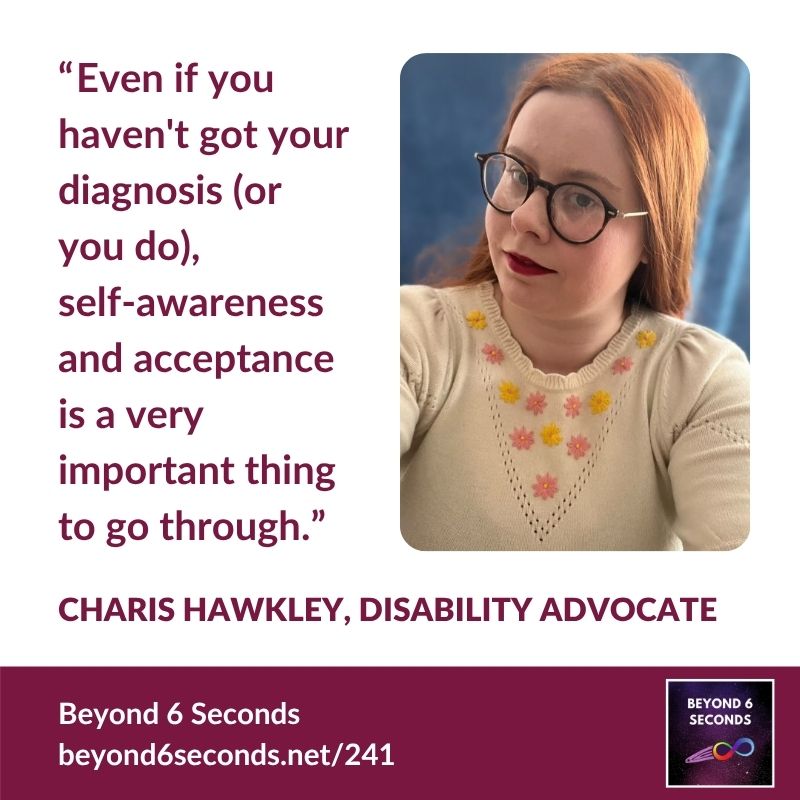
Charis: I’d probably say like some advice to people is obviously, even if you haven’t got your diagnosis or you do, self-awareness and acceptance is a very important thing to go through. Find people like you. There are Facebook communities for things like dyspraxia, dyslexia, autism, ADHD. Maybe speak to them. You’ll probably have common ground, and then you’ll be able to come to grips with your neurodiversity a lot more. Obviously there are books out there about it as well. You can do things like writing if it helps you. Making sure you’re surrounded with people who really help you is important as well.
And it’s important to be who you want to be, and really having an understanding of self. Like I don’t think you can ever really know truly who you are, ’cause you’ll spend your entire life working that out. But having a good understanding of who you want to be and who you are and what sorts of things you’re interested in is really important. Like neurodivergent or non-neurodivergent, really.
Carolyn Kiel: Yeah, definitely. Really great words of advice and things to keep in mind, so yeah. Thanks. Thanks again, Charis, for being on my podcast today.
Charis: Thank you.
Carolyn Kiel: Thanks for listening to Beyond 6 Seconds. Please help me spread the word about this podcast. Share it with a friend, give it a shout out on your social media, or write a review on Apple Podcasts or your favorite podcast player. You can find all of my episodes and sign up for my free newsletter at Beyond6seconds.net. Until next time.