
Episode 248: Deafness, Disability and Mental Health — with Kellina Powell
-
play_circle_filled
Episode 248: Deafness, Disability and Mental Health — with Kellina Powell
Carolyn Kiel
Kellina Powell, known as the Deaf Queen Boss, is a podcast speaker, best-selling author, and passionate advocate for the deaf and disability communities. She empowers young adults with disabilities to chase their dreams, breaks down barriers around mental health, and educates others about deaf culture and inclusion.
During this episode, you will hear Kellina talk about:
- What it was like for her to grow up deaf from an early age, and her exposure to deaf culture
- How she educates people about the deaf community and mental health issues
- The coaching work that she does for people with disabilities
Learn more about Kellina and her work at KellinaEmpowerment.com and follow her on Instagram and LinkedIn.
Follow the Beyond 6 Seconds podcast in your favorite podcast player!
Subscribe to the FREE Beyond 6 Seconds newsletter for early access to my latest podcast episodes!
Support or sponsor this podcast at BuyMeACoffee.com/Beyond6Seconds!
*Disclaimer: The views, guidance, opinions, and thoughts expressed in Beyond 6 Seconds episodes are solely mine and/or those of my guests, and do not necessarily represent those of my employer or other organizations. These episodes are for informational purposes only and do not substitute for professional medical advice. Consult a medical professional or healthcare provider if you are seeking medical advice, diagnoses, or treatment.*

The episode transcript is below.
Carolyn Kiel: Welcome to Beyond 6 Seconds, the podcast that goes beyond the six second first impression to share the extraordinary stories of neurodivergent people. I’m your host, Carolyn Kiel.
Carolyn Kiel: On today’s episode, I’m speaking with Kellina Powell, known as the Deaf Queen Boss. Kellina is a podcast speaker, bestselling author, and passionate advocate for the deaf and disability communities. Through her podcast, she empowers young adults with disabilities to chase their dreams, breaks down barriers around mental health, and educates others about deaf culture and inclusion. With over 200 podcast appearances, Kellina uses her voice to inspire, uplift, and create lasting change. Kellina, welcome to the podcast.
Kellina Powell: Thank you so much for having me. I’m excited to be here.
Carolyn Kiel: I’m really excited to learn more about your story and the advocacy that you do. What was it like for you growing up deaf?
Kellina Powell: It was very difficult. So for those who don’t know, I actually became deaf at the age of four due to an infection. However, that lead me to very hard moment to kind of learn about what it’s like to be, you know, “normal” again, as a 4-year-old. And so communication was very difficult for my family ’cause my family had to find out and figure out how do I communicate through vocal or sign language? And so my family had to make all those decisions for me as a 4-year-old.
And, you know, I went through a lot of mental health challenges because I was going through anxiety and depression, and especially not knowing how to communicate and advocate for myself in the hearing community. So it was a little bit challenging when I was growing up, but overall, my experience was not a rainbow, but it was up and down.
Yes.
Carolyn Kiel: Yeah. Were you able to participate in any kind of like deaf culture or deaf community coming up? Whether that was learning sign language or having deaf friends and role models?
Kellina Powell: Yeah, so I actually went to two different schools: a deaf school in the morning to learn my sign language, be introduced to the deaf culture. And then the afternoon, I actually went to the hearing school just to really help me balance in communication style. And my family did that because they wanted me to learn how to be independent. And they also wanted me to understand who I am, as being a deaf person. And so I did, did a lot of activities in soccer, basketball, rugby. And so my family did put me in a lot of sports, because they were trying to help me to create my independent and also letting me be myself.
Carolyn Kiel: That’s really cool that you were able to participate in, in deaf culture as well as be, you know, part of hearing culture as well. ’cause I know sometimes that can be a challenge for people who are deaf to just feel like they belong in both communities. So that’s, that’s really important.
What is the intersectional experience of being a Black deaf woman like for you?
Kellina Powell: There was a lot of barriers for me just because it’s double layered. So for example, you know, when I’m asking for accommodation or looking for a job, it was really hard because, you know, obviously as a woman of color, it was very hard to really, I guess, put myself out there. It was very difficult because, you know, women of color, like we always get set back 10 times. Especially when we ask for something, sometimes they’ll be like, oh wow, you just say that because you’re Black, you know?
And so it was very difficult, especially for me, but however, I did not face too much of challenges compared to a lot of people I know, just because I come from a very multicultural family. And so it, it was up and down, I would say. But, you know, I was getting there.
Carolyn Kiel: Yeah, that’s, that’s good that you have that, that support and, and such, ’cause it can be quite a challenge. Absolutely.
And so you do a lot of advocacy now around teaching people about the deaf community and advocating for people with disabilities. How do you educate people about the deaf community?
Kellina Powell: Yeah, so I teach them about the basic sign language and then I go in deeper in understanding why do we use sign language? What is the difference between ASL and language? So a lot of people don’t really understand it. Why do we use sign language?
I also teach about the importance of getting their attention, understanding the flag. ‘Cause apparently a lot of people don’t know that there’s a flag for the deaf community. And so I also, I do teach them about ways to advocate for someone who is deaf and/or hard of hearing. And that’s what I do teach them about.
Carolyn Kiel: Oh wow. Yeah. I didn’t know there was a flag for the deaf community either, so yeah, that’s really interesting to know. And so you actually do teach sign language to people?
Kellina Powell: I don’t do it like fluently, but I do the basic one that we should be knowing how to sign. So I just teach the basic like: how are you, the colors, you’re welcome, how are you? Like, you know, the basic signs to really look out for.
Carolyn Kiel: Mm-hmm. That’s really cool. Because I think it’s also helpful for people to understand that, you know, people in the deaf community have different ways of communicating. So not every deaf person knows sign language or knows it fluently. Not every deaf person even necessarily reads captions or subtitles. So it, I guess it really depends on you know, who you are and where you’re from.
And also, American Sign Language is different from sign language in other parts of the world too.
Kellina Powell: Exactly. Yeah. Some people don’t know this, but everywhere in the world, sign language is so different compared to the UK and also Africa have their own sign language, which I had no idea. Yeah. And then Australia also has their own. It’s very cool to see how sign language can be very different in different countries.
Carolyn Kiel: Yeah, definitely. So that’s really great education that you do to help people learn more about the experiences of people in the deaf community.
Another part of your advocacy is around mental health. So what kinds of mental health issues do you talk about?
Kellina Powell: So I really just talk about how the disability community, I would say, how they have a higher number based in mental health. And I do also talk about what is the rate that we can help one another to overcome their mental health while being disabled.
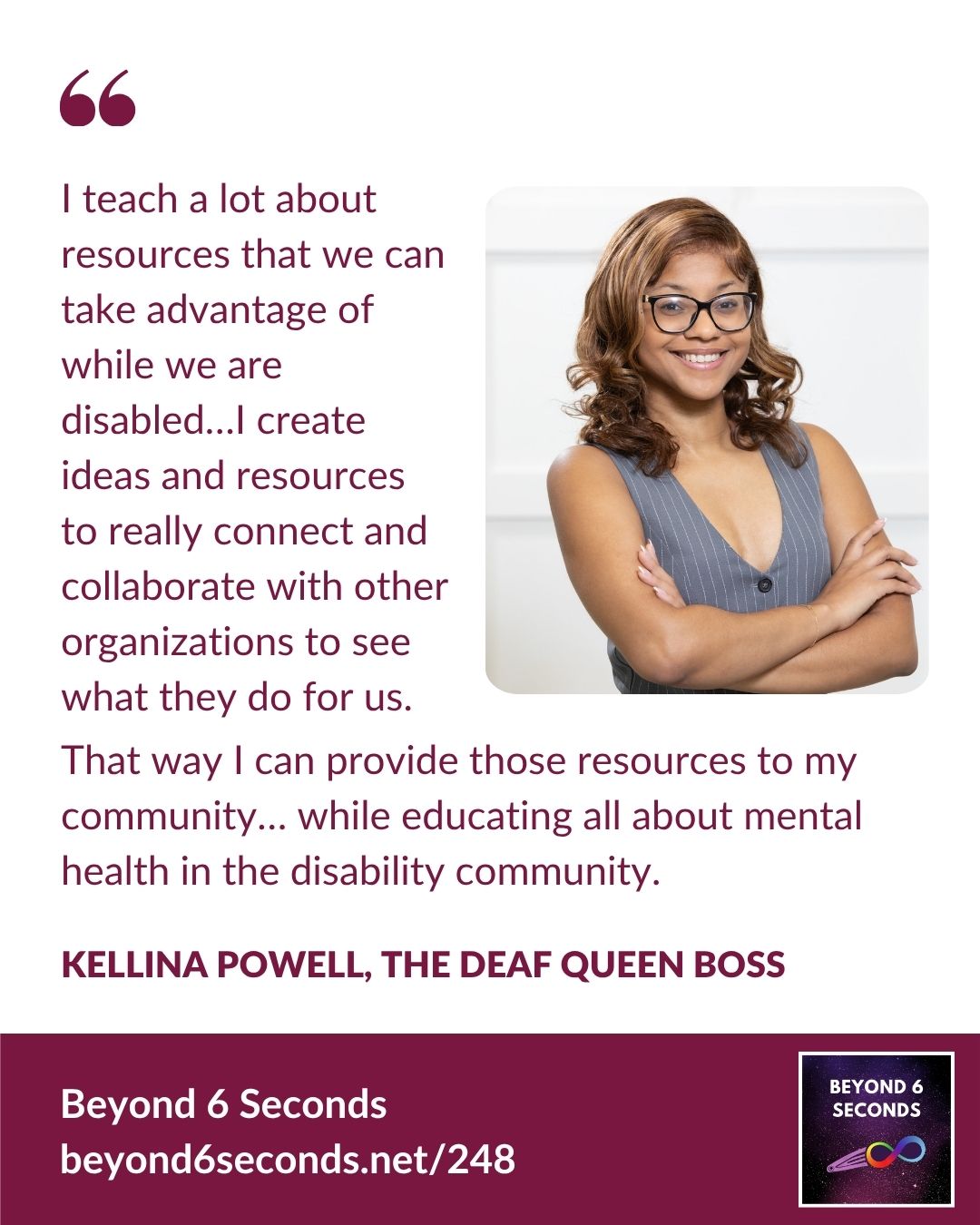
And also too, a lot of time it’ll come down to the advocacy work, the support system, the resources. So I teach them a lot about what are some resources out there that we can actually take advantage of while we are disabled. I know a lot of people are not able to afford a mental health person. So I create ideas and resources to really connect and collaborate with other organizations to see what they do for us, and that way I can provide those resources to my community and then that’s what I do with my presentation while educating all about mental health in the disability community.
Carolyn Kiel: One thing I’ve learned through interviewing people on this podcast is about all of the different mental health and other support resources that exist out there for different types of disabilities that I know I wasn’t aware of. So I think it’s always exciting to have people like you who are sharing information like that. ‘Cause not everybody knows where to go for help.
Kellina Powell: Exactly, exactly. Not everybody does.
Carolyn Kiel: You also do a lot of coaching with people who have disabilities. What kinds of things do you help coach people about?
Kellina Powell: So I help people coach on different things. So I know some people may come to me with anxiety, depression, and sometimes they just need help to get into their end goal, the destination. And I know a lot of us, especially with people with disability, we don’t like talk about path. We just trying to figure how do we get there?
Like sometimes we need guidance, how to get to the next step and that’s where I help people on with the coaching. And I know for example, a lady who’s disabled, but she also started a business and she didn’t know how to start with that. And, but because her mental health was in that. And she’s like Kellina, I want to do business but I can’t ’cause my mental health is affecting me. She said it was very hard and she felt like people was not looking up towards her. She felt like people were not giving her the part that she deserved to be paid. And so I had to go over that as well with her. And so I just provide some homework with her and I did one hour once a week to figure out what is it that I can do to provide resources and support for her. We actually walk through together one by one, step by step, how do we get from A to B and then B to C. How do we get there? So that’s what I really do with my clients.
Carolyn Kiel: That’s really great. How did you get your experience in, in coaching to be able to help people reach their goals like that?
Kellina Powell: Exactly, yes. So it, it’s very rewarding experience because I feel like when, for me, when I was growing up, I was not able to look for people, you know, it was hard for me to look for people online. Even like, I’m in Canada. For those who don’t know, a lot of Canadians, there’s not a lot of disabled profession compared to United States. A lot of the time, I feel like United States has a lot more numbers than Canadians.
Carolyn Kiel: Oh wow. Do you work with people with disabilities all around the world or mainly in Canada?
Kellina Powell: No, actually all over the world.
Carolyn Kiel: Very cool. That’s great. Yeah, a lot of people have challenges reaching their goals, and I think it’s great that you can use your own experience as someone who grew up with a disability and the types of mental health challenges that you face to kind of bring into your own coaching and help other people reach their goals too.
Kellina Powell: Thank you.
Carolyn Kiel: Yeah. You mentioned the one example where you coach someone on their business and asking to be paid a fair rate and negotiating. Are there other types of challenges that you help people with, or is it really just whatever they come with you kind of help them think through and, and coach them?
Kellina Powell: I ask them what they need help with, but however my particular when I’m looking to help clients, it’s actually going over their mental health and also mentorship as well. I do help with mentorship for youth as well to overcome any struggle that they face. So specifically owning for people with mental health.
Yeah.
Carolyn Kiel: Do you work with kids and teenagers on mental health or mainly adults?
Kellina Powell: Yes. So I do work with people from age 15 to 35 years old.
A lot of them, I noticed it that they come with me to talk about their particular mental health problem and they just wanna figure out how do they come out of that bubble, basically from that. But I also do a lot of partnership as well with different organization where their clients who are disabled would come to me and we would book like a group session with them. I do it for like three months to six months, and then we just all talk about the problem and have the guidance and what they can do.
Carolyn Kiel: Do you run official workshops or is it mainly whatever people need, you set up?
Kellina Powell: I, so it’s very funny ’cause a lot of people would ask to me like, “Kellina, you should do a workshop like just once a month where people can just come in and see you and meet you.” And so I haven’t done a workshop just yet, but I’m actually in a process of creating that right now. As of right now, people just come to me one-on-one or group.
Carolyn Kiel: How can people get in touch with you if they wanna learn more about your coaching or the type of advocacy that you do?
Kellina Powell: Yeah, people can reach out to me on Instagram, deafqueenboss. Or LinkedIn, I know a lot of people use LinkedIn to reach out to me, so Kellina Powell.
Carolyn Kiel: Okay great. I can put links to your LinkedIn and your other resources in the show notes of this podcast.
So yeah, Kellina, it was great talking with you and learning about the types of coaching and advocacy that you do. Is there anything else that you’d like our listeners to know or anything that they can help or support you with?
Kellina Powell: Yeah, I would honestly, I just want listeners to know that you have one life to live. No matter what life throws at you, it does not mean it’s end of the world. You can continue, keep moving forward. If I can do four books, be international speaker, be an author, do a lot of things on my plate, knowing I’m a hard of hearing person, I never back down. Right? If you’re listening, I just want you to know that you can fight it. Life is too short to give up. And I highly recommend you to not be so into yourself, into your mind. However, it is hard. But I would say that there is someone who loves you and who is waiting for you. That’s my last word I would say to any of the listeners.
Carolyn Kiel: Thank you Kellina. Really appreciate your words of advice and support. It was great talking with you. Thanks so much for being on my podcast.
Kellina Powell: Yes, no problem.
Carolyn Kiel: Thanks for listening to Beyond 6 Seconds. Please help me spread the word about this podcast. Share it with a friend, give it a shout out on your social media, or write a review on Apple Podcasts or your favorite podcast player. You can find all of my episodes and sign up for my free newsletter at Beyond6seconds.net. Until next time.