Episode 258: Connecting disabled leaders and advocates – with Max Barrows
-
play_circle_filled
Episode 258: Connecting disabled leaders and advocates – with Max Barrows
Carolyn Kiel
Max Barrows is an award-winning disability rights leader and advocate based in Vermont. As the Outreach Director for Green Mountain Self-Advocates, Max mentors people with developmental disabilities to speak up for themselves and become leaders. Max is also the Assistant Director of Technical Assistance and Outreach for the Self-Advocacy Resource and Technical Assistance Center (SARTAC), where he works to strengthen local and state self-advocacy organizations across the United States.
During this episode, you will hear Max talk about:
- What life was like growing up as an autistic person
- How he became involved in disability advocacy
- Why self-advocacy and peer-to-peer connections are essential for people with disabilities
- How he grew more comfortable with public speaking as part of his advocacy work
- His role in helping to educate law enforcement about autism
- The harmful impact of negative rhetoric about autism
Learn more about Green Mountain Self-Advocates and the Self-Advocacy Resource and Technical Assistance Center (SARTAC), where Max works.
Contribute to Carolyn’s tip jar to support this podcast at BuyMeACoffee.com/Beyond6Seconds!
Follow the Beyond 6 Seconds podcast in your favorite podcast player!
Subscribe to the FREE Beyond 6 Seconds newsletter for early access to my latest podcast episodes!
*Disclaimer: The views, guidance, opinions, and thoughts expressed in Beyond 6 Seconds episodes are solely mine and/or those of my guests, and do not necessarily represent those of my employer or other organizations. These episodes are for informational purposes only and do not substitute for professional medical advice. Consult a medical professional or healthcare provider if you are seeking medical advice, diagnoses, or treatment.*

The episode transcript is below.
Carolyn Kiel: Welcome to Beyond 6 Seconds, the podcast that goes beyond the six second first impression to share the extraordinary stories of neurodivergent people. I’m your host, Carolyn Kiel.
On today’s episode, I’m speaking with Max Barrows. Max is the Outreach Director for Green Mountain Self-Advocates. He mentors youth and adults with developmental disabilities to speak up for themselves and become leaders. Max is also the Assistant Director of Technical Assistance and Outreach for SARTAC, the Self-Advocacy Resource and Technical Assistance Center. In this job, he works to strengthen local and state self-advocacy organizations across the nation.
Max received a White House Champions of Change Award in 2015 and the Champion of Equal Opportunity Award from the National Association of Councils on Developmental Disabilities in 2019. In 2020, the Autistic Self Advocacy Network honored Max with an award for service to the self-advocacy movement. In 2022, Max was invited as a guest of Vice President Kamala Harris at her residence, as well as a guest of President Joe Biden at the White House Rose Garden Celebration of the 32nd Anniversary of the Americans with Disabilities Act.
Max, welcome to the podcast.
Max Barrows: Thank you so much for having me.
Carolyn Kiel: I am really excited to learn more about your advocacy and all of the really great work that you do and about your own personal story as an autistic person as well. So I guess to start out from the beginning, when did you realize that you’re autistic?
Max Barrows: First of all, that’s a really good question, but I would say like I was first told that I was autistic when I was in my teens.
I didn’t know what my disability was, but I knew something was different about me because I was functioning in not so typical ways. At the time I would hide, you know, that, and whenever I struggled, I would keep it to myself. You know, I would falsely, you know, tell my, any of my teachers that everything was fine. You know, I didn’t want people to think that there was something mentally wrong with me.
But as time went on, I started to realize I can’t hide my struggles anymore, and I want to know why I felt so different.
Here’s how I describe my experience being autistic. My brain takes time to process information. The way I see it is this: there’s a shield that develops around me. It does not let too much get into my head. My brain can only take so much information and process it properly. So don’t try and shove too many words in my head when they don’t fit. They just bounce off the shield and fall onto the floor.
It really was later in my early twenties when I finally had more awareness and knowledge of autism.
Carolyn Kiel: Mm-hmm. Yeah. Your description of the shield kind of blocking out a lot of the information is, is a really interesting one. I’m wondering what was life like growing up autistic? Like I’m imagining in school, there’s so much information being, you know, sent to all of us as students. What was that like for you?
Max Barrows: Oh when I was younger, it was a mysterious time in my life trying to figure out, trying to figure myself out and at the same time, just trying to fit in. And knowing that I operate differently in ways that are still not quite understood in this world has its challenges. But I love it though. You know, I love being unique and everyone is unique and this is just something that makes me that way, you know?
And I’ve learned much more about myself. I know myself well now and use that to, you know, just be happy with who I am. And I encourage people with disabilities who I connect with feel the same.
Carolyn Kiel: Did you know other autistic people when you were growing up or have autistic peers, or was that something that you mainly met more autistic people as an adult?
Max Barrows: When I was in high school, there were other individuals with on the spectrum and disabilities. And that was through like just some special ed classes that I took, which made up like 1% of less classes that I had. But you know, that was like the very, very first I would say connection that I’ve had with other, you know, individuals with disabilities in my high school.
But it was when I was getting out of high school when I ended up, you know, really connecting with more people with disabilities. And that includes people on the spectrum.
Carolyn Kiel: A huge part of the work that you do is around self-advocacy for people with disabilities. And, you know, you’ve, you’ve been recognized and, and won so many awards for the great work that you’ve done over the years, and I, I’d love to learn more about how you became involved in disability advocacy.
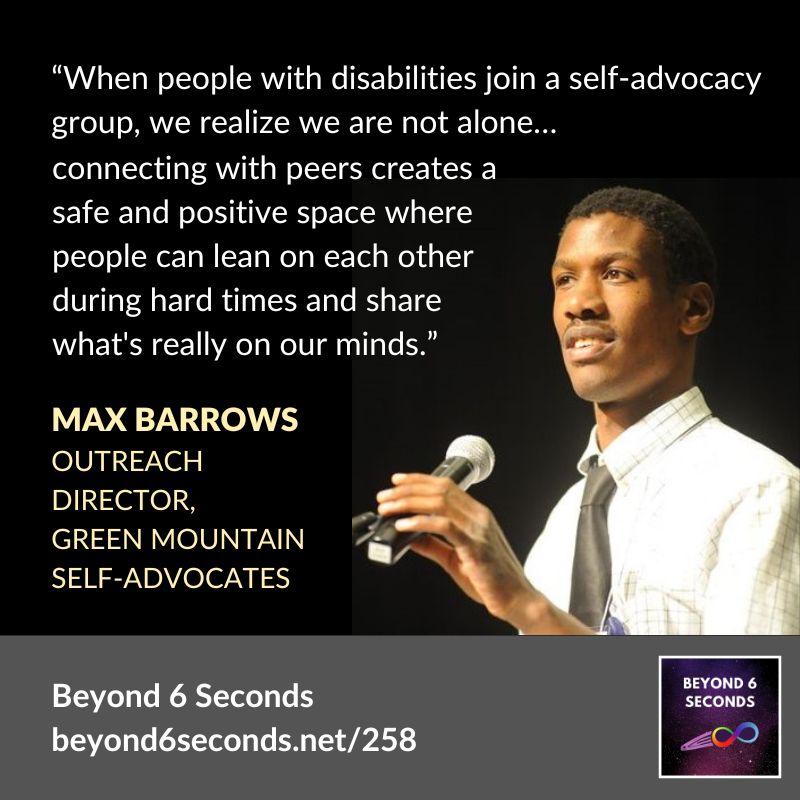
Max Barrows: Yeah. When I was getting out of high school, and this is where my connection with people with disabilities expanded or began to expand, when I was getting out of high school, I was part of a program that taught independent living skills. And through that program, a few of us started spending time together. And before long, we were going to disability rights conferences and events, and all of it fits into what I call the peer-to-peer connection. And what I mean by that is simple. When people with disabilities join a self-advocacy group, they realize, or we realize we are not alone. They’re not alone. And connecting with peers creates a safe and positive space where people can lean on each other during hard times and share what’s really on our minds. And without feeling timid, like the way we sometimes do around people who are not our peers. To be honest, help from people who are not our peers can sometimes feel, you know, sugarcoated, biased or controlling, even when it’s well intended. With peers, the truth, you know, comes from us. You know, a peer might be more willing to admit they made a mistake to another peer. Because many of us fear punishment or judgment when and if we say the same thing to a, you know, a provider. And that’s the power of peer-to-peer connections. We understand each other because we, you know, we’ve, we’ve grown up with disabilities. We know what we face. We know what our peers are likely to face too. And, and I connect with peers who understand me. They learn from me and I learn from them.
And joining a self-advocacy group and later becoming president of my local group changed my life for the better. And it’s a two-way street. I give to the group, and the group gives back to me. And learning from my peers help me feel proud of who I am, and it helped me accept that it’s okay to be different. I’m not afraid to say that I have autism. I, and I’ve discovered strengths like public speaking that I didn’t even know I had.
And peer-to-peer connections, you know, help us become better leaders and we believe in one another because we see each other’s strengths and we give real feedback to each other, and have high expectations for each other, and that’s what peer-to-peer connection is all about. Learning from each other, telling the truth and building leadership, you know, from, you know, the inside out.
And about the president thing, you know, that was one time in my group I was president. I’m not the president anymore, but still, I mean, I, I have really, you know, benefited from being involved in self-advocacy and connecting with the peers in my local group as well as peers throughout the state and country that I meet and connect with. So, yeah.
Carolyn Kiel: Yeah, those peer-to-peer connections are really important because, you know, even though everybody has their own different experiences, you still have a lot in common. So I imagine it’s really helpful to be with people who really relate to and understand and in many cases may know how you feel about certain things or just, you know, like understand your reactions because they’ve gone through many of the same types of things.
So, yeah, that’s powerful. Wow.
Max Barrows: Yeah.
Carolyn Kiel: You talk a lot about self-advocacy. It’s a lot of the work that you do. And I think you started talking about it just now, but I wanted to explicitly ask like, why is self-advocacy so important for people with disabilities?
Max Barrows: Self-advocacy is important for people with disabilities because it’s a movement. We are the main force in the movement and we know what we want. We have a voice, we believe in each other, and we have each other’s backs.
You know, self-advocacy is, you know, it’s a family.
Carolyn Kiel: Yeah, and I, I think there may be some assumptions out there about people with disabilities and going, going back to what you said about providers sometimes meaning well, but not always providing the best or most helpful support. As a self-advocate, it is important to say like, this is what I need, this is not working for me. Like, this would be more helpful. And it’s, it’s a skill like people, you know, not everybody does that naturally. So yeah, it’s really important to, to be able to do that.
Max Barrows: Yep. Absolutely.
Carolyn Kiel: Yeah. You do work around self-advocacy for, I think, two groups right now that we mentioned in your bio, the Green Mountain Self-Advocates and SARTAC. So what you do as part of your work for those organizations?
Max Barrows: I’m the Outreach Director at Green Mountain Self-Advocates. That’s the organization that I work for, like I said. And I do all kinds of things that have to do with disability awareness and acceptance.
We support 20 groups throughout Vermont that I visit a couple times a year to see how they are doing and give them, you know, any news on topics that they request us to talk about. Other things that I do, I pay attention to what’s going on in the legislature. And if there is something that is brought up to our attention, I let self-advocates know. I also testify to the legislator if asked or if need be. And I also serve on state committees and boards that have to do with policies and developmental services. And when decisions are made about our lives, we need to be at the table.
Other stuff I do disability awareness and acceptance presentations to the public. I have spoken on panels, I spoke at rallies. I have spoken to first responders, future doctors, teachers, high school students, et cetera. And all of this work is based on civil rights for people with disabilities.
I also encourage people with disabilities to find their voice to speak up, and I do many things through my work toward that. And as was mentioned about SARTAC, I also help run a national project called SARTAC, the Self-Advocacy Resource and Technical Assistance Center. For the past six years, you know, I have been hosting a Zoom meeting once a week with self-advocates from up to 35 states, and we share ideas on how to make their organizations and groups maintain and get stronger. And we discuss what is on our minds and share what is important to us.
So, yeah, that’s, that’s what I do as a part of my work with Green Mountain Self-Advocates, GMSA and SARTAC, the Self-Advocacy Resource and Technical Assistance Center.
Carolyn Kiel: Wow, that that really is a huge breadth of influence that you have. And with the legislative involvement you have, is that legislation in the state of Vermont or national legislation?
Max Barrows: I would say in the state of Vermont mainly. Sometimes we, you know, we may have moments where some national thing comes up. And we encourage, you know, self-advocates on a national level to sort of say like, well, this is what’s going to happen. And we have that may be a topic, there may be a topic presented on one of our calls about, you know, something going on that’s going to affect you know, say services that people get on a national level. And then we encourage them to say, you know, this is why you need to talk to your state representatives in Congress.
But legislative work really is like focused more in the state, really state issues, because our local groups we keep in touch with. And whenever something happens in the state, you know, I could just go and testify if need be, ‘Cause you know, I’m not too far from it. But we also encourage self-advocates at times to do the same and stay in touch with local and state representatives in that regard. So the legislative work we do is pretty much the, like the state, on the state level.
Carolyn Kiel: I think it’s really great that you encourage self-advocates to speak up for themselves and, and speak up when there are legislative changes or issues that impact them to talk about it and share their voices. And the work that you do with, you know, rallying people and educating them, and then testifying yourself and public speaking.
For some people public speaking is, is a little scary and intimidating. So how did you get comfortable with that? Was it just something that you naturally gravitated towards or were there ways that you helped get comfortable and get other people comfortable?
Max Barrows: Well, what comes to mind about that is, it was a strength that I was not as aware of. And when I first got involved in self-advocacy after leaving high school or when I was leaving high school, some of the conferences and events that we would attend, other group members and I would like, you know, do presentations on certain topics. But also I did some public speaking at some of the events that I first attended while I was transitioning out of high school into, you know, the world when I first got involved. And I think just over time there was, you know, an opportunity for me to, you know, do this job that I took when it was open.
And I think over time, when it comes to public speaking, I do get nervous. I mean, that’s natural. But what I was taught and what I teach other people when they public speak is, you know, nervousness is great. Nervousness is not a bad thing. Nervousness is something that you should not be, you know, ashamed of or feel bad about. It means you want to do well. And that’s what I have to remind myself, but also I encourage people who also do public speaking whenever they feel nervous about it. Like just, it means you want to do well if you’re nervous. And that’s kind of how I keep my nervousness in check, but also encourage other people who may do public speaking or do public speaking that express their nervousness. I, I tell them like, it means you want to do well, so don’t feel like you can’t be nervous. It’s okay to be nervous.
Carolyn Kiel: Yeah, that’s a really important point about speaking in public because I think the nervousness makes people not want to do it. But you’re right, at least a little bit of nervousness, it does mean that you care and it’s not bad and it doesn’t mean that you can’t go up and share. And almost everybody, even if they’ve presented a lot or for many, many years, you know, a lot of people still get nervous every single time they get up. But it’s still important to share your voice and it, it really is okay to be nervous. Yeah.
Max Barrows: And the other thing I wanna point out is some people, some people have told me like, you know, or have said to me that “you don’t look nervous.” And I’m like, it’s not, it’s a hidden thing. But I, like I have to say to them, like, I’m nervous whenever I get up. But again, you know, it’s, it means you want to do well, so.
Carolyn Kiel: Yeah. That’s important for people to realize too, is that sometimes speakers may not look nervous when they’re up, but a, a lot of people are. It doesn’t mean that you can’t speak publicly if you get nervous. It’s, it’s okay. Thank you for sharing that. That’s really important.
Max, you do such amazing work, and if people wanna get in touch with you to learn more about the work that you do, what, what’s the best way for them to do that?
Max Barrows: People can get in touch with me by looking me up online. The organization that I work for, you know, is Green Mountain Self Advocates. Our website, you can find me there. Sometimes I just talk about my work with people that I know and meet and I network with people.
Carolyn Kiel: That’s great. I can put a link to your two organizations in the show notes of this podcast so people can learn more about the work they do and the work that you do there as well, and they find you through those.
Is there anything else that you’d like our listeners to know or anything that they can help or support you with?
Max Barrows: We are smart in our own way. There’s no certain way to be smart. Everyone is smart in our own way, no matter where we are on the spectrum.
Yeah, in terms of other things, there’s been some topics that I’ve been very passionate about. . One of the things that I have been paying attention to and I’m passionate about is like policing and police and autism. And on a state level, I, you know, every six months I go to the Vermont State Police Academy and I do it with a disability rights lawyer. We present disability awareness and acceptance to new recruits, new people that are going into police departments throughout, you know, the state on how to better communicate, work with and you know, interact with people with disabilities. And I also have been part of project, working on a curriculum on a national level, on changing how law enforcement interacts with people and works with, and communicates with people with disabilities in terms of a bigger project, putting an end to violence against people with disabilities.
And a lot of the things that have come up through that work is just from what I’ve learned is how the way autism affects… like how we communicate through socializing can be seen as, you know, non-compliant in terms of the so-called “behaviors”. And that is very concerning to me because, you know, there has been incidences where force has been used on people who are on the spectrum, I believe, or I think, and also people that have mental health conditions. And misunderstanding autism for someone not complying with order given to them by someone who works for law enforcement has been a issue of concern that I have been addressing as an autistic person. I have not experienced that at all as an autistic individual, but I know that happens throughout the country and even the world. And I just think that it needs to be put on the table when it comes to changing how law enforcement is, you know, done in this country.
Again, you know, I just think that when we talk about police, especially with like issues that have happened in the last 10 plus years from police misconduct used on individuals of color. I think it’s more than that. It’s also people with disabilities that can be subject to police misunderstandings while interacting with officers. And I think that we need to continue to speak up about that. We want to work with police and I think in order to help them, you know, protect and serve their communities, I think this is something that would help them when they understand that just because somebody may not, it may not look like someone is, just because it may not look like someone is listening to commands given to them doesn’t mean that they’re not, doesn’t mean that they’re not listening, you know? There could be something, you know, going on, which they need to be aware of. I think honestly it is just one of those things that we need to like, put into their agendas and hopefully in the future it will be, and I’m hoping for it to be a mandate where they are trauma informed and more trained and also trained more to better and appropriately interact with people with autism and disabilities. So they wouldn’t think that the way autism, and I will include also mental health challenges, means that somebody is not listening to them to where they first ask you what to do. Then after that, telling them what to do and then, then making them do it. It’s like this three strike thing that it feels we’re all having to follow when there’s more to it than that, that could be, you know, missing, if that makes any sense.
Carolyn Kiel: Yes. That’s a really important issue and it’s such a, a large issue and yeah, I I think it’s really great that you’re doing that education with law enforcement because it’s true. There are, and, and I don’t remember the statistics anymore, but it’s a very high proportion of people who are. injured or, or killed in interactions with, with law enforcement who have disabilities, which, you include autism but other disabilities, mental health challenges, things like that.
So it’s important to understand the reasons why behind that. And part of it is that, as you said, sometimes what’s called behaviors are misinterpreted as non-compliance where it may be a processing issue or someone’s nonspeaking,
Max Barrows: Yeah.
Carolyn Kiel: or someone can’t hear, or like a whole number of things
Max Barrows: Yeah.
Carolyn Kiel: That need to be part of it.
Yeah.
Max Barrows: Yeah. Absolutely.
Carolyn Kiel: Yeah.
Max Barrows: Absolutely. And. Another thing too that I wanted to discuss is just, just within the last, like, seems like a couple of years now, or like within, like recently there’s been a lot of hurtful terms and language and discussions around autism on a national level, where I’ve heard more said about how, you know, autism is this epidemic and like it’s, you know, destroying families. And just, you know, I am hurt by that language personally because it just sends out the wrong ideas and messages about autism. And I feel like in reality, if there’s anything that makes growing up with a disability challenging for families and even the individuals is not just, it’s not the disability itself, it’s the environment. It’s not having enough support and accommodations, resources in place, not enough resources in place to help families of individuals with disabilities, as well as the individual itself. And it’s just when people talk about, when some people talk about autism, like it’s this plague or this disease or like there, you know, needs to be a cure for it. It just makes autism sound like it’s bad for the world. And unfortunately I feel that that message has resurfaced,
Carolyn Kiel: yeah.
Max Barrows: and we need to say why it hurts us and continue to advocate for what the world can do better for individuals with autism and disabilities and their families. And just continue to remind the world that it’s, it’s not the disability that’s at fault. And it’s not the individual that has a disability that’s at fault. It’s, we, we grew up in a world where, you know, was not, our society was not created to include people with disabilities. It wasn’t, you know, it was assumed that everybody could see, walk, hear. But it’s, it’s not the case, because people are born disabled or they get their disability later after they’re born.
Carolyn Kiel: Yeah.
Max Barrows: And I think we need to just continue to kind of put that message in the forefront that, you know, our society was never inclusive of people with disabilities. So we really need to be at the forefront when we talk about these things. But yes I just wanted to point that out because there’s been hurtful terms and language used about, you know, autism again, calling it an epidemic, saying it’s, it’s a disease. And then, you know, terms like “profound autism,” you know, just like those just. It, it, it feels like the spectrum has been put in a bad spotlight when really there’s a lot of things that, you know, autism’s existence really should be put in a good spotlight. It comes down to the world just, it needs to be more inclusive of us just as a whole.
Carolyn Kiel: Yeah, absolutely. And that’s where the self-advocacy piece really comes in, because I think, at least in the case with autism, I think people still tend to think of it as. Like, you know, a childhood condition and then you grow up and, and all the autistic adults just kind of disappear, which is obviously not what’s happening. We, you know, we do become adults. And being able to hear people talk about their experience and what they need is critical.
And yeah, I agree with you that it really does seem like the conversations about disability and autism have taken a turn that seems to be more concerning in terms of language being used to describe it. The problem is once you start dehumanizing people, bad things happen from that. That’s like a doorway to, you know, really bad, unfortunate things. And, and, and you’re right, so much of it is systems just not being set up or not existing to be able to support families with children with disabilities or adults with disabilities, that we just need so much more. And a lot of that is really the, the struggles that we’re, that we’re seeing. It’s a big and incredibly important topic. So I’m so glad that you talk about that when you’re doing your public speaking and, and sharing with others. ’cause that’s, that’s really, it’s very important.
So yeah. Thank you. Thank you for bringing up those two topics around law enforcement and language image of autism and disability that’s coming society. It’s really important.
Max Barrows: No problem.
Carolyn Kiel: Yeah. Well, Max, it was a really great conversation. I enjoyed learning more about you and the advocacy work that you’re doing and all of the issues that you help educate people about regarding self-advocacy and disability. So yeah, thank you again for being on my podcast. Great talking with you.
Max Barrows: Thank you for having me.
Carolyn Kiel: Has this podcast had an impact on your life, your heart, or your perspective in some way? If so, I’d love to hear about it. Send me a message on social media or through my website at beyond6seconds.net/contact. Your feedback means a lot to me, and it helps keep me going with this show. Thank you.
Carolyn Kiel: Thanks for listening to Beyond 6 Seconds. Please help me spread the word about this podcast. Share it with a friend, give it a shout out on your social media, or write a review on Apple Podcasts or your favorite podcast player. You can find all of my episodes and sign up for my free newsletter at Beyond6seconds.net. Until next time.