
Episode 255: Addressing food insecurity – with Kevin M. Yates from Meals in the Meantime
-
play_circle_filled
Episode 255: Addressing food insecurity – with Kevin M. Yates from Meals in the Meantime
Carolyn Kiel
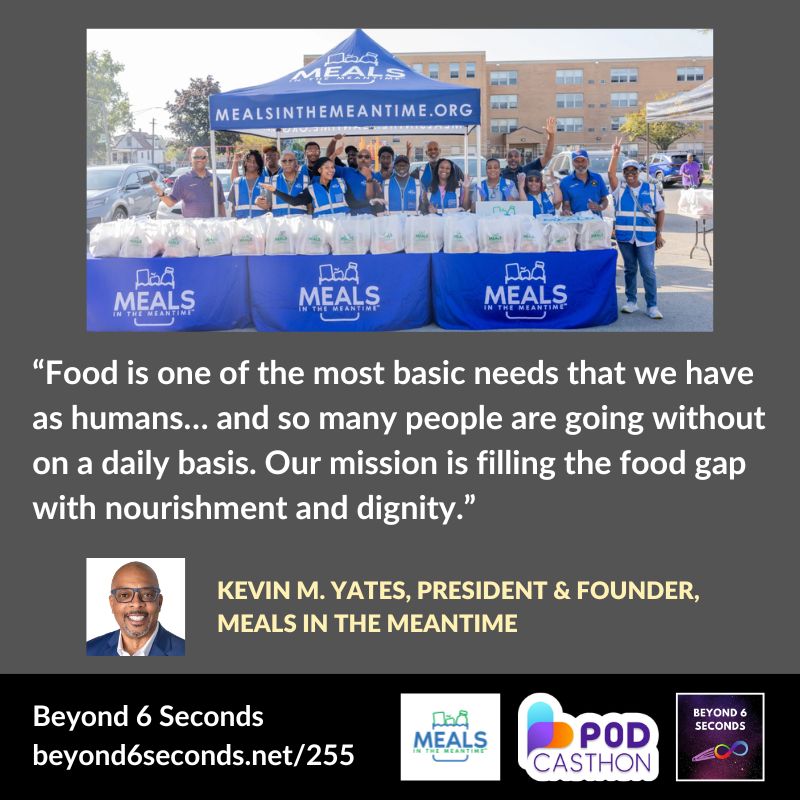
This is a special Beyond 6 Seconds episode for Podcasthon, where for one week, thousands of podcasts highlight a nonprofit of their choice to raise awareness and encourage support for charities around the world. The focus of this episode is Meals in the Meantime, a nonprofit organization addressing food insecurity in the Chicagoland south suburbs. Meals in the Meantime provides free, fresh, healthy, high-quality grocery bags of food at drive-thru, pop-up food pantries.
I interviewed Kevin M. Yates, President and Founder of Meals in the Meantime, about:
- What inspired him to start Meals in the Meantime
- How Meals in the Meantime achieves its mission of “filling the food gap with nourishment and dignity”
- How the nonprofit’s philosophy of “What Would You Eat” (WWYE) influences the types of foods that Meals in the Meantime provides
- Why Meals in the Meantime is different from other types of food banks and food pantries
Learn more about how you can support Meals in the Meantime at MealsInTheMeantime.org and follow them on Facebook, Instagram and LinkedIn.
Visit podcasthon.org to discover charities through the voices and talents of podcasters from around the world!
Contribute to Carolyn’s tip jar to support this podcast at BuyMeACoffee.com/Beyond6Seconds!
Follow the Beyond 6 Seconds podcast in your favorite podcast player!
Subscribe to the FREE Beyond 6 Seconds newsletter for early access to my latest podcast episodes!
*Disclaimer: The views, guidance, opinions, and thoughts expressed in Beyond 6 Seconds episodes are solely mine and/or those of my guests, and do not necessarily represent those of my employer or other organizations. These episodes are for informational purposes only and do not substitute for professional medical advice. Consult a medical professional or healthcare provider if you are seeking medical advice, diagnoses, or treatment.*

The episode transcript is below.
Carolyn Kiel: Welcome to Beyond 6 Seconds, the podcast that goes beyond the six second first impression to share the extraordinary stories of neurodivergent people. I’m your host, Carolyn Kiel.
Carolyn Kiel: Today’s episode is a very special episode. It’s a special one that I’m doing for Podcasthon. So this year marks the fourth edition of Podcasthon where for one week, thousands of podcasts are highlighting a charity of their choice.
And today on Beyond 6 Seconds, I have the pleasure of welcoming Kevin M. Yates to the podcast. Kevin’s known in the global training, learning and talent development community as the L&D Detective. He’s used his measurement expertise and roles with world renowned brands, including Grant Thornton, Kantar, McDonald’s, and Meta.
Kevin is also president and founder of Meals in the Meantime, a nonprofit organization addressing food insecurity in the Chicagoland south suburbs. Kevin, welcome to the podcast.
Kevin M. Yates: I am happy to be here, excited to be here, and it is so good to see you again.
Carolyn Kiel: Yeah, it’s great to see you. So you’ve actually been on my podcast, I think this is your third appearance. So over the years we’ve talked about several different topics, activities that you’ve been working on and experiences that you’ve had in your life. So I’m really excited to talk about your nonprofit, which I know you’ve been running for a few years now.
Kevin M. Yates: Yeah, actually this is our five year anniversary.
Carolyn Kiel: Wow.
Kevin M. Yates: 2026 is a really important time for us. It’s a time for celebration, a time for reflection on our impact in the communities we serve. So we have a few things lined up to commemorate the moment on our five year anniversary. So I’m really excited about 2026.
Carolyn Kiel: That’s awesome. Yeah. That’s so cool to hear that you’ve been working now for five years and really making an impact in the community for that period of time.
You have a very long and recognized career in learning and development. What inspired you to start a nonprofit focused on food insecurity, Meals in the Meantime?
Kevin M. Yates: Yeah it’s an interesting story because it’s a divine inspiration, I believe. And so it was Tuesday, March 6th or 9th, can’t remember the exact date, but it was back in 2021, when we were still living in pandemic times. And I just remember laying in bed and just reflecting on my own personal success, my own professional success. And to be quite honest with you, I felt a little empty, just because of all that I had accomplished for me either on my behalf for my personal brand or for what I was doing with the L&D Detective. And it just felt like I needed to do more, like I needed to have a greater impact, no pun intended, since that’s what I measure, but it just felt like I needed to have a greater impact in the world. And so again, I believe that there was divine inspiration for me to help people who need food. Because what we know is that as human beings, food is one of the most basic needs that we have as humans. We need food to sustain and nourish our bodies. And so many people are going without on a daily basis.
And so I am grateful for the inspiration. I’m grateful for the assignment and I am so very grateful for the work. Because Meals in the Meantime is making a tremendous impact in the communities that we serve. To date, we’ve given away more than 32 tons of food, and that covers five major food groups: fruits, vegetables, grains, dairy, and protein. So across those five categories, we’ve given away 32 tons.
So we know that we’re making a difference. We know that we are impacting communities and most important, we know that we are helping people who need food and that’s why we exist. That’s what we do, and that’s all we do.
Carolyn Kiel: Wow, that’s awesome. And I know the topics I talk about on my show most recently are around things that impact the disability community and neurodivergent communities. But really food insecurity unfortunately impacts almost everyone, across every demographic, all kinds of backgrounds, doesn’t matter where you live. So that is a really foundational need as you said, for people to just basically have food, one of their basic needs to be met.
Kevin M. Yates: It’s a very foundational need again, just because of the fact that we are human.
Our bodies need food to survive, to live, to exist, to dwell, right?
Carolyn Kiel: Mm-hmm.
Kevin M. Yates: And so hunger and food insecurity is not just something that impacts one country or one region. Global food insecurity is a problem. In some small way, we believe that we are in the good fight, the fight against food insecurity. So we’re doing what we can in our little corner of the world.
Carolyn Kiel: That’s awesome. So how does Meals in the Meantime help people who are experiencing food insecurity? Like in terms of being out in the community, or how do you help supply food to people who need it?
Kevin M. Yates: So I love that question. And the way in which we serve really revolves around our mission. And so our mission isn’t just like one of those slogans or statements that just is cutesy and sounds good. Our mission is filling the food gap with nourishment and dignity. And so that means something for us because that is how we execute and that is how we operate.
And we do that via mobile popup food pantries, where we go directly into the communities that we serve. We bring our volunteers, we bring our tent. We bring our food most important, and we set up shop in these different communities. And what we provide is free, fresh, healthy, high quality grocery bags of food.
So when we talk about filling the food gap with nourishment, it means that we are intentional about the kinds and the types of foods that we give away. I mentioned earlier that we’re focused on the five major food groups, and so within those five major food groups, we ensure that there’s representation across those five food groups in each one of our bags.
And not only that, we provide an information card in the bag that identifies the specific food items as well as the nutritional value for each one of those food items. So there’s a little bit of pantry education there, in terms of here’s what you’re getting and here’s how what you will eat will serve your body from a nutritional perspective. So when we talk about filling the food gap with nourishment, that is what that means. And then when we talk about filling the food gap with nourishment and dignity, dignity means that we honor the humanity of who we see. We honor the humanity of who we serve.
Because we know that food insecurity is a condition, not a condemnation. And quite often there is this perception or this view of who it is that is experiencing food insecurity. There’s stereotypes and all that, so we don’t pay any attention to that. We honor the humanity of who we see. We make sure that every pantry visitor feels welcomed, that every pantry visitor hears “hello,” “good morning,” “thank you for being here,” “we’re glad you’re here.” So what we do is just try to create a place of safety and help, and even, I would say joy. Because the joy of our work, we want that to transpire to the pantry visitors, because we don’t want them to feel any heavier than they might already be feeling. Because for some people it may be hard to have to go to a food pantry. It might be difficult, it might be a struggle. So we wanna relieve them of that if only for a few moments. And so that is how we fill the food gap with nourishment and dignity.
Now we are able to find our different places within the communities and the neighborhoods that we serve by partnering with local townships. By partnering with community-based organizations, faith-based organizations. We take a look at where there is the greatest need and we reach out to organizations and people in those communities with whom we can partner to distribute our food. Our motto is “all we need is a space and a place.” And so when we have the place for where we can distribute the food, that is where we make the impact in the communities that we serve. So that’s how we do it!
Carolyn Kiel: Yeah. So you’re really going directly out into the community. So it sounds like people don’t have to necessarily find you and go to you. You try to go to where people are.
Kevin M. Yates: That’s correct. That’s correct. We’re mobile and we’re popup.
And so we promote our pantries via social media, newspapers, television, word of mouth. That’s how the word gets out in the communities that we visit.
Carolyn Kiel: Yeah, that’s great. think the focus on nutritious and fresh food is really important because I think a lot of that, a lot of that stuff tends to be much more expensive than processed food or quote unquote “junk food.” And
Kevin M. Yates: Yeah.
Carolyn Kiel: if you need calories, a lot of times it’s hard to get the high quality food.
Kevin M. Yates: Yeah. We have a guided philosophy and it is WWYE. Can you guess what that means?
It’s not a test.
Carolyn Kiel: What Would You Eat? I don’t know!
Kevin M. Yates: That’s exactly it!
Carolyn Kiel: Oh is that it?
Kevin M. Yates: That’s exactly it.
Carolyn Kiel: Got it!
Kevin M. Yates: So WWYE means What Would You Eat? And so what that says to us is, we’re not giving away the scraps. We’re not giving away the leftovers. We’re not giving away food items that may be two or three days past expiration. We only give foods that we would eat ourselves, and that’s where the dignity part comes in. Yeah, WWYE is What Would You Eat, which means that we would not give anything to anyone that we would not eat ourselves. And so that’s where the dignity piece comes in.
Carolyn Kiel: How do you get the sources of different fresh foods? is it purchased through donations that you get, or do you have sponsors who help you with that?
Kevin M. Yates: Yeah, so we have a grocery retailer who is our partner. And we rely on that grocery retailer partner to provide us the food that we give at our pantries. And this particular retailer has a great and awesome reputation for its fresh produce. So their product, their food product aligns very closely with our brand and our mission, meaning free, fresh, healthy, high quality food.
And so through the partnership that we have with this grocery retailer, we are able to remain true to that. And it’s interesting because on some levels we’re almost like a middleman, because we pick up the pantry food items the morning of the pantry. So it goes direct from the grocery retailer to our pantry site. We have a great partnership. Our values are aligned and that is what makes the work that we do together that much more valuable and important.
Carolyn Kiel: Oh, that’s fabulous. That’s great. What a great resource for people who desperately need it. And that’s really cool.
You’ve probably touched on this already during our conversation, but I’m curious, like how is Meals in the Meantime different from, say, other food charities or food banks that operate in this space?
Kevin M. Yates: Yeah, so I, I think the good news is that there are a lot of organizations that are out there across the world really doing the work of helping people who need food, fighting food insecurity.
I think that one of the things that makes us unique is our mobile popup model. So we are able to be scalable, if you will, because we are literally going boots on the ground into those communities. And we know that there are some people who are challenged with transportation, ways in which to move around and get around. And so we try to remove that challenge by going directly into those neighborhoods. And so I think that one of the things that makes us different is that we aren’t stationary, that we’re literally going out into the communities, directly into the communities, and we’re setting up our pop-up pantry so that people who live in those neighborhoods, a lot of times these are neighborhoods that are food deserts or just don’t have access to free, just fresh and healthy food. So that’s a problem that we’re solving.
I think that the other thing that makes us unique is that we are intentional about the five major food groups, again, fruits, vegetables, dairies, proteins and grains. So we wanna make sure that we are covering bases, all those bases with our food.
And I think the other thing that makes us unique is this whole idea of What Would You Eat. So to be very clear, for someone who is experiencing food insecurity and someone who is hungry, maybe a food item that is one or two days past expiration, that’s fine. And we choose to give fresh fruits, fresh vegetables. So for someone who is hungry, a can of green beans is absolutely fine. I don’t want to dismiss that. We just choose to do fresh because we know that when we have fresh foods that have not been tampered with in terms of their nutritional value, that’s just gonna be better for our bodies. So I think that those are some of the things that makes us a little different.
Carolyn Kiel: Yeah. That’s great. And you operate in the Chicagoland area?
Kevin M. Yates: Yep. So we operate in the Chicagoland south suburbs. So there are many suburbs in Chicagoland that some people don’t even know exist because they’re smaller. They are low income areas and so they don’t get all the attention that they deserve. They don’t have all the resources that they need in their communities and in their neighborhoods. And so we choose to stay focused on the Chicagoland south suburbs as our area of focus in areas that we target for our mobile popup food pantries.
Carolyn Kiel: That’s great. Yeah, a lot of people living in those surrounding suburbs who definitely need the support. So that’s great that you’re able to focus locally within the community. And there’s plenty of need and a lot of really great impact you can have there, for sure.
Kevin M. Yates: Yeah.
Carolyn Kiel: Yeah. So how can people get in touch with you or with Meals in the Meantime if they wanna learn, either learn more about it or potentially support the work that you’re doing?
Kevin M. Yates: Absolutely. And so definitely I would encourage everyone who is watching in or listening you can certainly visit our website at MealsInTheMeantime.org and we are on social media, on Facebook, Instagram, we have a YouTube channel. We are even on LinkedIn. So certainly if you’d like to visit our website, again, you can do that at MealsInTheMeantime.org and then join us and follow us and watch what we’re doing on any one of our social media channels, particularly this year as we celebrate our five year anniversary. We’ve got our Five Year Anniversary Gala coming up on June 6th, here in Mokena, Illinois. So really excited about that. So stay tuned and keep watching, everybody! We got some great stuff coming up for 2026.
Carolyn Kiel: That’s awesome. Yeah. And congratulations on five years. That’s a wonderful impact you’ve been able to make over those five years and yeah, that, that is so awesome!
Kevin M. Yates: Thank you.
Carolyn Kiel: Kevin, thank you for sharing the story of Meals in the Meantime. Is there anything else that you’d like our listeners to know or any specific ways that they can help or support you, even if they’re not in the Chicagoland area?
Kevin M. Yates: Yeah, that’s a great question. And so we are building a village to fight food insecurity, and as part of that village, we welcome gifts. Gifts is what helps us operate. Gifts is what helps us be able to fund food acquisition for the work that we are doing. Again, I would invite those of you who are listening, watching: please go to our website, MealsInTheMeantime.org. You’ll see a tab that says Give. And certainly that is where you can give your gift. You can be a part of the village, you can join the work that we’re doing with your gift. So thank you for asking that question. Give as much as you can, as little as you can. We appreciate all gifts.
Carolyn Kiel: That’s awesome. And I’ll put a link to your website for Meals in the Meantime in the show notes of this podcast so people can click on it and go right there when they’re listening and or watching. So.
Kevin M. Yates: Thank you so much.
Carolyn Kiel: Yeah. So yeah, Kevin, it was great to talk to you again and
Kevin M. Yates: Yeah!
Carolyn Kiel: Congratulations on the great work that you’re doing with Meals in the Meantime, and thank you for sharing on my podcast.
Kevin M. Yates: Thank you. Great to see you again.
Carolyn Kiel: Same here.
That wraps up this special Podcasthon episode of Beyond 6 Seconds. Feel free to visit podcasthon.org to discover many other charities through the voices and talents of podcasters from around the world!
Thanks for listening to Beyond 6 Seconds. Please help me spread the word about this podcast. Share it with a friend, give it a shout out on your social media, or write a review on Apple Podcasts or your favorite podcast player. You can find all of my episodes and sign up for my free newsletter at Beyond6seconds.net. Until next time.