Episode 252: Neurodivergent communication differences – with Patti Kasper
-
play_circle_filled
Episode 252: Neurodivergent communication differences – with Patti Kasper
Carolyn Kiel
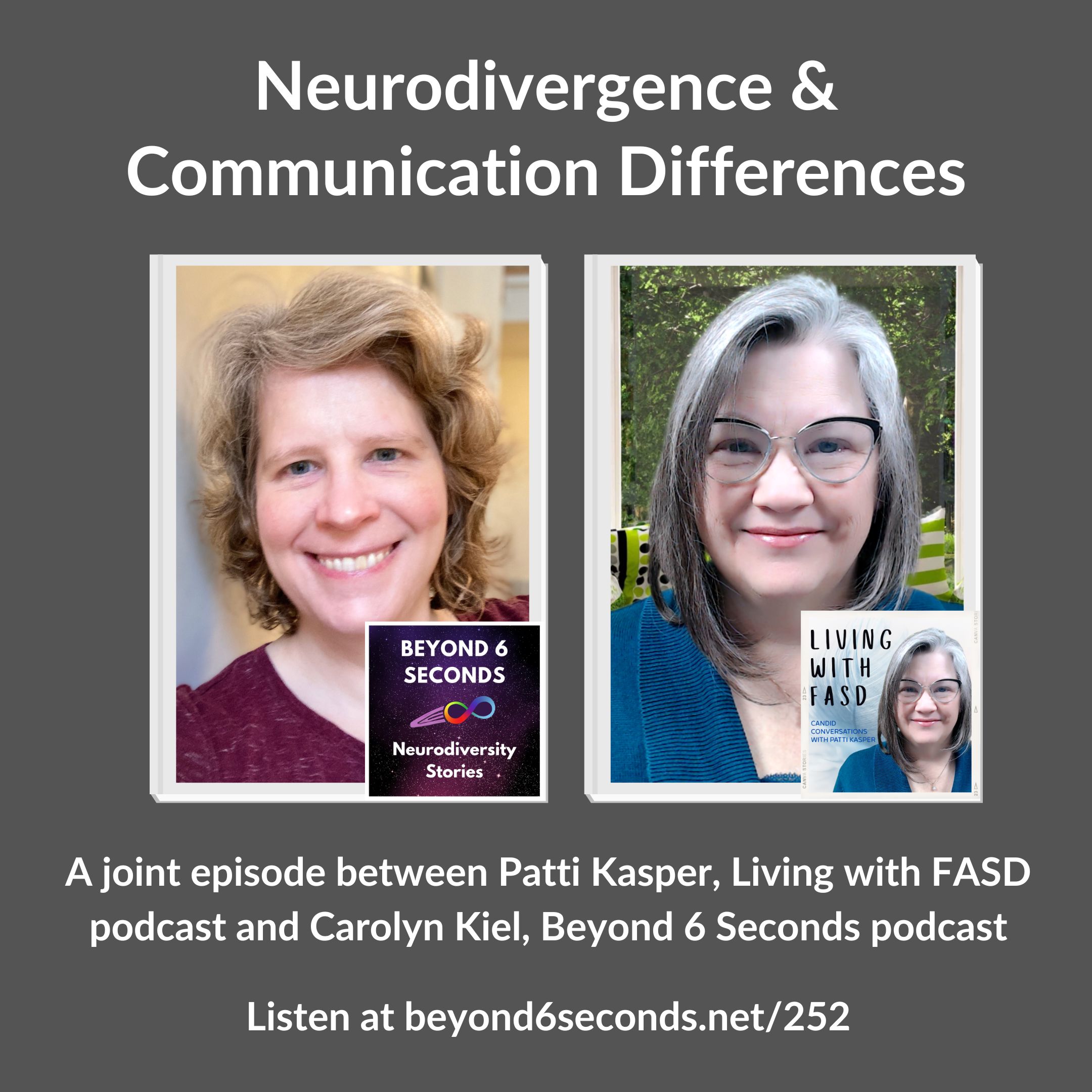
This episode is a special collaboration between Beyond 6 Seconds and the Living with FASD podcast hosted by Patti Kasper. Fetal alcohol spectrum disorders (FASD) are lifelong conditions caused by prenatal alcohol exposure that can impact physical, cognitive, and behavioral development.
FASD is a type of neurodivergence, but it’s often left out of conversations about neurodivergence. This episode is part of a series that Patti is doing on her podcast to help bring FASD into those conversations.
We discuss what communication differences can feel like for people with certain types of neurodivergence, such as FASD, autism (including apraxia in non-speaking autism), ADHD, and schizophrenia. We also explore why communication challenges can happen, and how friends and loved ones can help provide understanding and support.
A quick caveat: This conversation is not medical or diagnostic advice, and it does not speak for every neurodivergent person. Instead, Patti and I are sharing our own experiences and some insights from the people we’ve interviewed on our podcasts.
You can find Living with FASD podcast on Apple, Audible, Patreon, Pocket Casts, Rumble and YouTube, and connect with Patti at dot.cards/yourfasdcoach.
Do the things we mention in this episode match your experience as a neurodivergent person? Do you have other experiences? Let me know what you think!
Contribute to Carolyn’s tip jar to support this podcast’s disability advocacy at BuyMeACoffee.com/Beyond6Seconds!
Follow the Beyond 6 Seconds podcast in your favorite podcast player!
Subscribe to the FREE Beyond 6 Seconds newsletter for early access to my latest podcast episodes!
*Disclaimer: The views, guidance, opinions, and thoughts expressed in Beyond 6 Seconds episodes are solely mine and/or those of my guests, and do not necessarily represent those of my employer or other organizations. These episodes are for informational purposes only and do not substitute for professional medical advice. Consult a medical professional or healthcare provider if you are seeking medical advice, diagnoses, or treatment.*

The episode transcript is below.
Carolyn Kiel: Welcome to Beyond 6 Seconds, the podcast that goes beyond the six second first impression to share the extraordinary stories of neurodivergent people. I’m your host, Carolyn Kiel.
Carolyn Kiel: Today’s episode is a special collaboration between my podcast, Beyond 6 Seconds, and the Living with FASD podcast hosted by my friend Patti Kasper. FASD stands for fetal alcohol spectrum disorders, which are lifelong conditions caused by prenatal alcohol exposure that can impact physical, cognitive, and behavioral development. It’s a type of neurodivergence, but it’s not often included in conversations about neurodivergence.
Patti was a guest on my show a few years ago talking about her lived experience with FASD and all the people with FASD she interviews on her podcast. This episode is part of a series that she’s doing on her Living with FASD podcast, to start connecting and bridging conversations between FASD and other neurotypes by discussing similarities and differences in our experiences. Based on my experience interviewing neurodivergent people, and as an autistic person myself, she asked me to be on her podcast.
In this episode we talk about communication differences in certain types of neurodivergence. Besides FASD and autism, we also talk about apraxia in non-speaking autism, ADHD, schizophrenia, and dementia. We spend a lot of time talking about what those communication challenges feel like for many neurodivergent people, and explore why they may happen, and how friends and loved ones can help provide understanding and support.
A couple of quick caveats: I am not a neurodiversity or healthcare expert. I talk about autism based on the conversations I’ve had on my podcast, autistic people I’ve learned from, and of course my own experiences. I try to avoid sweeping generalizations, and I make it clear that we all have our own experiences. This conversation is not medical or diagnostic advice – it’s really just a sharing of experiences that belong to us or to the people we’ve had conversations with on our podcasts.
Please let me know what you think! Do the things we talk about today match your experience as a neurodivergent person? Do you have other experiences? Let me know – reach out on social media or on my website beyond6seconds.net.
Listen to my podcast to hear more neurodivergent people sharing their stories – including my interview with Patti back in 2024 about her own experience with having FASD (episode 219) and with Jessica Birch, another guest who has FASD, in 2025 (episode 229). And check out Patti’s podcast, Living with FASD, for more conversations like the one we’re having today.
Now here’s my conversation with Patti.
Patti Kasper: All right, Carolyn, thank you for joining me today. I’m so excited about our collaboration. Yeah, this is, this is really cool. The chance for Living with FASD and Beyond 6 Seconds to work together on something makes this a really exciting project for me at least.
Carolyn Kiel: Yeah. Yeah. Thank you Patti, for inviting me on your show.
I’m really excited to do this collaborative episode with you. Yeah, and I think it’s great that we get to collaborate as two podcasts focused on neurodivergence.
Patti Kasper: And, and I love your podcast and I’m so excited about the award that you won. Share with my audience anyway what that was.
Carolyn Kiel: Oh yeah.
I’m happy to. Yeah. Thank you so much. So yeah, in 2025, I won an award that was given out by Women Who Podcast Magazine. They’re primarily a magazine, but the editor in chief also started an awards program to recognize women indie podcasters in different categories. So my episode about Down syndrome that was actually towards the end of 2024 in an interview with a woman Sheri Brynard in South Africa, about her experience having Down syndrome. That one won in the category of Impactful Story. So I was really happy to, you know, obviously, you know, honored to get that recognition. Yeah. And just really, yeah, it helps elevate stories and my guest stories that they share even more with a wider audience. So I’m really grateful for that.
Patti Kasper: Yeah. And stories are so important, right? Because I remember one of my guests a woman named Key Warner out of Alaska. She’s been in the FASD space for so long. She’s one of the early pioneers. She has summer camps for families of people who are impacted with FASD and ’cause families they often need just as much support as the individuals, right? Because family members end up feeling isolated and everything as well. And it, it’s just a tough road.
And she mentioned to me one time, and, and I think she put it into her quote at the beginning of my book in the “what others are saying” section. She said at a conference one time, someone came up to her and said, “you know, we’ve known the facts about FASD for decades. It’s the stories that change lives.” And it’s so true because it’s the stories that are relational and that’s what really brings in that emotional learning that we need for something to truly stick in our memory. To engage with more parts of us.
And that’s kind of what I wanna do with this series on deep dives into various “symptoms” of neurodivergence and how they’re expressed or experienced within FASD versus you know, in comparison to, or in contrast to other forms of neurodiversity. Within FASD, we often feel rejected and isolated even by other types of neurodiversity. And I think it’s that lack of understanding. You know, and I think in part there’s a human tendency to want to shift blame where we can to things that are mystifying.
Carolyn Kiel: Mm-hmm.
Patti Kasper: And so I think that’s partly at play as well, but when you and I were talking about the series and the things that we could do with it in both of our programs, we kind of settled on, at least as a good starting place, communication challenges.
Carolyn Kiel: Yeah. Yeah. I mean, that is one of the major criteria for an autism diagnosis, for example, and I know it kind of plays in whether officially or unofficially with other forms of neurodivergence.
Absolutely.
Patti Kasper: Mm-hmm. Mm-hmm. What does that typically look like? I’m curious if it is as varied within the autism spectrum as it is within the fetal alcohol spectrum?
Carolyn Kiel: Yeah. Well, within the autism spectrum, again, it is one of the diagnostic criteria for getting a diagnosis, and I think it, it displays or it manifests in different ways.
So it could be for someone just having challenges you know, whether it’s communicating too directly for the context of the situation. And again, I, I hate to phrase this in ways that are so negative because that’s how the diagnostic criteria tends to do it. Yes. Because a lot of times it’s like, well, who says that something is too direct? And does it depend on, you know, a lot of times a group of autistic people might have no problems communicating with each other. It’s just sort of the mixture of other, you know, non-autistic people, right, talking with it. So it might just be trouble or challenges understanding someone else’s viewpoints or what they call like black and white thinking. Mm-hmm. So rigid thinking, which can then result in, you know, going through communications. They’re related in a certain way.
Patti Kasper: Yeah.
Carolyn Kiel: And then other people on the autism spectrum may have communication challenges that affect them much more. So there are, a large percentage of people who are autistic are also non-speaking, which in many, many, many cases, as we’re finding out as the science advances, they have the concept of language in their heads. They understand what everyone’s saying. You know, very, very aware, very capable of learning. But because there is what they call a “brain body disconnect,” those communications like the motor planning and motor coordination of speech and other movements in your body just doesn’t really give them a traditional way to either speak or sometimes communicate effectively without finding some form of like an augmentative and alternative communication, like a tablet or a, a keyboard or a, mm-hmm, you know, a letter board or some other way to be able to learn to communicate. So a lot of times, people in those situations unfortunately get very stigmatized and people tend to think that they have, you know, much lower intelligence than they actually have, and it’s just really a, a communication challenge that they have. Yeah.
Patti Kasper: And you kind of answered a question that I had floating in the back of my mind, which is, what’s the difference between someone who is nonverbal versus someone who is selectively mute and, but you answered that because it’s a disconnect between the planning section and the motor skills to, yeah, to make it happen.
Carolyn Kiel: Yeah. There’s actually a lot that goes on biologically between like having a word in your head and having it come outta your mouth. There’s a lot of, you know, right. The movement of the muscles in your mouth and your tongue and the planning like that goes into before, like it’s really, yeah. Yeah, it’s quite complicated if you break it down, so, yeah. Yeah. It’s that too.
Patti Kasper: And there’s so many different regions of the brain that are involved also. Mm-hmm. If you are like, think in a classroom setting where there’s something on the blackboard, plus the teacher is talking
Carolyn Kiel: mm-hmm.
Patti Kasper: That involves two different sections.
There’s a section toward the front that manages that visual information.
Carolyn Kiel: Mm-hmm.
Patti Kasper: Coming in, and then it’s more, you know, occipital for what is being heard. And then all of that goes to a third region where everything gets mulled over, and what would the answer be? And then there’s yet a fourth section, which is directing those motor components
Carolyn Kiel: mm-hmm.
Patti Kasper: To actually be able to get the speech back out.
Carolyn Kiel: Yeah.
Patti Kasper: To answer the question. Yeah. That’s being posed. Oh yeah. And you know, that allows, there, there’s so much track, if you will, where you can get derailed.
Carolyn Kiel: Yeah.
Patti Kasper: You know? So many places for the communication to break down along that route. And it’s, it’s very complicated.
And that’s, you know, one of the things that we see with FASD is that some people with FASD need much more processing time. Mm-hmm. And that kind of explains it, you know, it’s not just in and out of, you know, most people take our brains for granted because they do so much, so fast. There is no manmade computer that can compete.
Carolyn Kiel: Right.
Patti Kasper: Truly with, I mean, we have super computers, all of us.
Carolyn Kiel: Mm-hmm.
Patti Kasper: And we just think, in and out. Right. Yeah. And it’s, it’s that fast, but but it really is much more complex and there’s so many more places. So giving people the grace of more time can be very helpful.
Carolyn Kiel: Yeah. Absolutely.
Patti Kasper: Yeah. Yeah,
Carolyn Kiel: yeah.
Patti Kasper: So, and, and we had talked about too when we were sitting down thinking, oh gee, I wonder what we can do when we launch our first hopefully joint episode. Mm-hmm. Communication, having more set of skills than just one. Right? It’s not just a communication skills, it’s expressive language skills versus comprehension language skills.
Mm-hmm. And at least with FASD, that is where a lot of people get missed because the expressive skills are so good. You know, we can mimic the, the speech of someone who is chronologically that age or even older even though the comprehension level is years behind
Carolyn Kiel: mm-hmm.
Patti Kasper: In a lot of cases.
Carolyn Kiel: Yeah.
Patti Kasper: And that gets overlooked and I think that’s what’s behind, for instance, well, lemme back up. You know, we, we think of chronological age and we think of developmental age, but not many people realize that we really have those developmental growth ” ages” differently across different kinds of skill sets. Right? Yeah. So, for instance, if you have, you know, Johnny, who is six, he can express himself like a six or 7-year-old because he lives with older people, so he picks up the language, but he doesn’t understand what it means. Right?
Carolyn Kiel: Yeah.
Patti Kasper: Or, or think of that cute little kid who’s very precocious and knows how to use those swear words in seemingly appropriate ways. You know, we think that’s cute, but it’s actually something to pay attention to.
But physically, little Johnny might be very advanced. He might be really good at track or you know, powder puff football. You know, he might be really good, but, and as he gets older, those gaps might grow even more. As he develops physically as an athlete, he might become a superstar, right? And get looked at by colleges at a really young age. But emotionally and with language comprehension or reading comprehension, he may still be a couple grades behind or several grades behind. Mm-hmm. You know, decision making might be lagging way, way, way behind. Mm-hmm. And, and there’s a phrase that we use for kids like Johnny, and that’s “dumb jock.” Oh. Yeah, it’s, they’re, they’re so gifted athletically, but the rest of them has not caught up yet.
Carolyn Kiel: Mm-hmm.
Patti Kasper: And, you know, there, there might be something real going on there instead of just the pejorative “dumb jock.”
Carolyn Kiel: Yeah. Yeah. That’s really, that’s really interesting to think about. I had not thought about it in that way, but that makes a lot of sense.
And I think that is part of, you know. Neurodivergence or, or disability specifically is the challenge of when somebody, quote unquote, “doesn’t look disabled,” which is something, a phrase that we, we can’t stand in the community because it’s then people just, you know, if you look physically fine or maybe you’re physically a great athlete, then you know, kind of what’s wrong with you. But it, there’s all these things that people can’t immediately see, that challenges that you may have if you have, you know, FASD or if you’re autistic or if you have ADHD or, or some other form of neurodivergence and people just don’t see it. So they don’t like, they don’t understand it.
Patti Kasper: Yeah. You even people with physical invisible disabilities get that.
Yes. Right. I remember someone saying to me, “you don’t look diabetic.” I’m like, we have a look?
Carolyn Kiel: Yeah. What does that look like?
Patti Kasper: What, because I have both legs? I’m not using a red tip cane? I mean, what in the world are you talking about?
Carolyn Kiel: Yeah. Mm-hmm.
Patti Kasper: You know, or because I’m not morbidly obese.
What, what are you talking about?
Carolyn Kiel: Yeah.
Patti Kasper: You know, and it really is a, a good stark reminder that we need to not, we need to go deep. Mm-hmm. We need to not just look at the surface.
Carolyn Kiel: Yeah.
Patti Kasper: Right.
Carolyn Kiel: Yeah. And in terms, when you were talking about using words that are more advanced perhaps than your understanding at the time, it made me think of something called hyperlexia, which is common among many autistic children is the ability to just read very early in life and have a fascination with letters and love books, and maybe prefer books to toys and, and just seeming very precocious. Like I, myself, I’m autistic. I was a very early reader, like by the time I got to school, I already knew how to read and no one’s really sure how I learned how to read. You know, we, you had, you watch Sesame Street and you learned how to read. It’s like, is that how people learn how to read? But anyway,
Patti Kasper: I don’t know that Sesame Street’s that good.
Carolyn Kiel: I mean, it’s, it’s good, but it may not be quite that good. And you know, we had a lot of books at home, but still, yeah.
But hyperlexia specifically is early reading, but also not, you know, not always understanding. ’cause you are, you know, you’re a little kid, you don’t understand what you’re reading so much. You just sort of understand how the encoding of reading language works. And you can read the words, but you may not understand.
Patti Kasper: You can throw the sounds together. Yeah.
Carolyn Kiel: Yeah. Mm-hmm.
Patti Kasper: Yeah. Yeah. But the pictures might still be helpful.
Carolyn Kiel: Yes. Yeah. Pictures are good.
Patti Kasper: Yeah. We had talked, I think you hadn’t even brought up hyperlexia, but we were talking about similar things when we were planning this, and I think one of the differences that we see in terms of communication between FASD and ASD is how we use words. You know, like on one hand you mentioned being nonverbal, right? Mm-hmm. And having those, those motor gaps. Yeah. On the other hand, with FASD, we often present in ways that might be assumed to be ADHD because it’s that nonstop chatter chatter chatter.
Carolyn Kiel: Yeah.
Patti Kasper: But that chattering has a very specific function, even though it’s subconscious.
Carolyn Kiel: Oh,
Patti Kasper: and that’s, the more I’m talking, the less risk there is of me having to answer a question.
Carolyn Kiel: Oh. Interesting.
Patti Kasper: That makes me paranoid. Am I gonna be able to answer it right?
Carolyn Kiel: Oh, wow.
Patti Kasper: Because it takes me longer. Mm-hmm. They might think I’m dumb. Right? Wow. So if I nonstop chatter, I don’t risk it.
Carolyn Kiel: Yeah. That’s interesting. I know when we were talking, I do think that the quote unquote nonstop chatter might be more common or I, I’ve seen it more commonly in ADHD. I don’t have ADHD myself, so I can’t speak from personal experience. Yeah. But from people that I know who do have it, for them the talking is almost like they can’t, like they can’t stop it. Some people, not everybody. But it’s literally, it just comes, you know, there’s no, there’s literally no filter. Like, they literally just can’t stop the flow of, of the conversation. Maybe it’s the, you know, the hyperactivity part of it. Yeah. You know, that’s not just in behavior, like physical behavior, it’s also in your mind. Yeah. There’s just so much going on and so much spinning. Yeah.
And then it also could be, you know, a lot of times we see interrupting people at inappropriate times. Yeah. And sometimes that’s because, oh, I’m gonna lose my thought! I have to say it right now.
Patti Kasper: That’s it exactly! Yes. So there’s a commonality for sure.
Carolyn Kiel: Yes. Mm-hmm. Yeah, exactly.
Patti Kasper: That’s a real fear. That’s a real fear. And that has to do with the memory challenges that we have. Mm-hmm. You know, that working memory and short term memory, I might lose it.
Carolyn Kiel: Yeah.
Patti Kasper: You know, or, or if you have a list of umpteen things to do, you, you might get the first couple things done and not the rest, or maybe the last couple things and not, not everything that came before, because you can only hold so many things.
Carolyn Kiel: Yeah.
Patti Kasper: Or you can only hold things for so long.
Carolyn Kiel: Right. Yeah. Yeah, like I know even as a podcaster myself, when I’m interviewing people and they’re telling me things, I’ll have maybe three thoughts on my head. Like, you know, three ways that, three questions or three follow up comments. It’s like, I’m not gonna remember all this.
So sometimes I’ll just try to quietly write it down. Because people like, why are you writing things down while you’re talking to me? It’s like, this is great, and I’m gonna forget half this stuff. Yeah. Like, because I wanna listen to what you’re saying. Yeah. But I can’t at the same time remember everything.
Right? Yeah. Right.
Patti Kasper: Well, and and that’s actually a really good strategy. Yeah. All in all, is to write things down and circle back to them, because so much communication these days is not done with the intention of listening. You know, while someone else is speaking, you’re busy preparing your response.
Yes. You know, of course the topic may have shifted while you were busy and inside your head planning. Yeah. But, you know, which really makes you feel awkward.
Carolyn Kiel: Mm-hmm. Yes. I’ve had that happen. It’s like, oh, this is changing. I can’t really bring this up anymore. Oh well.
Patti Kasper: I wanna circle back!
Carolyn Kiel: Mm-hmm.
Patti Kasper: So when we were initially, you know, kind of kicking ideas around we had, we had mentioned that with the nonverbal bit, did that also have a strategy behind it or is it just the mechanism of not having the motor, the mind body breakdown?
Carolyn Kiel: I mean, in terms of people who are autistic,
Patti Kasper: Like, the non-stop chatter has a strategy.
Carolyn Kiel: Oh, oh, I don’t think so. From the people that I’ve spoken to and even from my own experience, what I think is happening when people are, well, obviously if you are non-speaking and you do have those like neurodevelopmental challenges, that’s not, that’s not a strategy. That’s a combination of those challenges. Plus, you know, a lot of sensory overwhelm because a lot of autistic people just, we process sensory inputs in very different ways. Mm-hmm. Sometimes things are very overwhelming for us. Like, you know, for some people it’s bright lights or very loud, unexpected noise, or just being around a whole lot of people, like a lot of things can be overwhelming. Yeah. And for some people that’s not. Like, some people thrive off that. It really just depends on the person. But the common thread is that we do experience things in our sensory systems in very different ways. So I think a lot of that is at play, even with people who are non-speaking. I think a lot of times, in addition to having the motor neurodevelopmental challenges, there’s a lot of sensory things at play. So their systems are like dysregulated and overwhelmed much more easily than say, a, a neurotypical person.
Patti Kasper: We have all that also.
Carolyn Kiel: Oh, yes. Yeah, absolutely. Yeah. And then for someone who say there’s the term selective mutism, which some people don’t like. You know, we’re, we’re still working out all our phrasing in, in the autism community, and we don’t agree on, on everything.
Yeah. But it is possible for someone who has the ability most of the time for speech to just in certain situations, whether they’re very tired, very stressed, very sensory overwhelmed, to literally lose that ability to respond or to get your motor coordination moving to get the words out.
And it’s not, I think some people see that as, oh, you’re just being difficult. You’re trying to shut down the conversation. But literally it’s like a, a like a sensory overload that some people get.
Patti Kasper: It’s a can’t, not a won’t.
Carolyn Kiel: Yeah, exactly.
Patti Kasper: It’s a can’t, not a won’t.
Carolyn Kiel: Yeah. Some people might be able to write things down or they might, you know, even use like a tablet and a keyboard. In some cases, it depends on the person.
Patti Kasper: Which also takes energy.
Carolyn Kiel: Yes. And it depends. Some people may be so overwhelmed they can’t even do that. But it really depends on the person.
Patti Kasper: I think people take for granted how much energy it consumes who live in a body that has some of these differences. You know?
And, and a lot of times, at least in the FASD space, teachers will say to parents, “I don’t see what you’re seeing. I don’t get that.” But it’s because that’s earlier in the day. The teachers are getting the kids when they have a hundred percent of their abilities and their, their daily energy allotment. Yeah. Right. And by the time the kids get home, you know, and, and they may see the, the beginnings of some overwhelm or dysregulation toward the end of the day, but by the time the kids get home, there’s nothing left. The tank is empty. Completely empty. So poor mom or dad, whoever’s home, or the babysitter gets all the expression of, you know, whether it’s the explosion or the implosion or whatever that looks like.
Carolyn Kiel: Yeah. Yeah. And I think we see something very similar for kids who are autistic and, and probably other types of neurodivergent kids as well, is that sometimes they can kind of quote unquote, “hold it together” in school because they have to, and that’s the expectation. As you said, it’s, you know, maybe it’s early in the day, they still have some energy. But then they come home and they fall apart. Yeah. And the other aspect of that is, one, they’ve been holding it in all day, just like hold it in, hold it in, hold it in. And then they go home where, you know, their parents or caregivers are. Yeah. And especially the irony is, if, if that’s a safe place, the kid will break down because you are a safe parent. Because they’re not scared they’re gonna get like horribly punished and they trust you when you have the bond, but then to you it looks like, oh my God, this kid is so good in school. Like, how am I such a bad parent that my kid is always like, falling right apart here. Yes. Know they’re falling apart because you’re safe. That’s why sometimes, so, yeah. Yeah. It’s a challenge.
Patti Kasper: And how many times does that continue into adulthood?
Carolyn Kiel: Yeah.
Patti Kasper: You know? I mean, we talk about this in terms of masking. Somehow, your brain will make everything work to keep the mask on and look normal, as “normal” as much as possible, just to avoid the unwanted attention, the teasing, the punishment, whatever.
Carolyn Kiel: Yeah.
Patti Kasper: But that continues into the workplace for adults.
Carolyn Kiel: Yeah.
Patti Kasper: There’s, you know, appropriate behavior in a board meeting or in a staff meeting or with a client, and they get home to their spouse or their roommate, and that’s safety. You get the emotional vomiting.
Carolyn Kiel: Yeah. Yeah. That’s very true.
Patti Kasper: Yeah. And it takes a lot for the spouses or the roommates or whatever, you know, the living partner to, to not take that personally. ’cause it’s hard.
Carolyn Kiel: It’s hard. Yeah. It’s hard.
Yeah. It really is.
Patti Kasper: And as neurodivergent people, we’re often attracted to other neurodivergent people. And you know, a friend of mine, Antonia Lindsey, her book is called Parenting Your Porcupine. And it came from a native, you know, indigenous person who gave her that concept of a porcupine because they, he and his little friends called themselves mighty mice or something like that. Mm-hmm. But when he’s overwhelmed, all the hair on the mouse stood up and looked like a porcupine. Yeah. You know, but how often are we like that? You know, there’s no predicting what that last straw is gonna be that takes the mask off. Mm-hmm. Mm-hmm. You know? Yep. And, and our quills come up and somebody’s gonna get poked with a quill.
Carolyn Kiel: Yeah.
Patti Kasper: Right. And, and if you are living with other neurodivergent people, that can get really ugly really fast.
Carolyn Kiel: Yeah. Because you can very easily dysregulate your other like neuro divergent roommate or spouse or whoever you’re living with, right?
Patti Kasper: Yeah, yeah, yeah. And just a poke fest for the next couple hours until somebody’s exhausted and just goes, curls up, takes a nap. Yeah. Mm-hmm. And comes back ready to try again. And hopefully everyone else has done the same thing.
Carolyn Kiel: Yeah. So, yeah. And that’s why it’s really important for us as neurodivergent adults and, you know, growing up as neurodivergent kids to find other ways to sort of decompress, whether that’s, you know, what they call stimming.
You know, even if it, even if it looks like something that’s not quote unquote “normal” for, or, you know, age appropriate or whatever, it, it doesn’t matter. If you’re not hurting anyone and it helps you kind of regulate and get your energy out and come back to, you know, yeah, your center space, you know, it’s okay if you wanna.
Yeah. Do you wanna spin in a circle or, I, I used to swing and rock a lot. That was, you know, I get too dizzy to spin in circles, but I love the swinging back and forth. Yeah. And I didn’t realize it at the time, but that was incredibly regulating for me. Yeah. So that’s what I would do after like a long day at school
Patti Kasper: Yeah.
Carolyn Kiel: And doing homework and all that. Like, listen to music and do that. It was great. Mm-hmm. So, mm-hmm. Yeah.
Patti Kasper: You know, it, it, it is very common for people to say, you know, I’ve had a long day at work. Most of my days at work, you know, they, they take a lot out of me. Yeah. So I need 15 minutes to myself upon getting home, before you ask me for anything, tell me anything. Mm-hmm. I don’t have the capacity.
Carolyn Kiel: Yeah.
Patti Kasper: Until I can just, whoa. You know? Yeah. And, and calm down and, and get that balance again.
Carolyn Kiel: Yeah. Yeah. That was my reaction too. And it’s so, it’s just, I just need a couple minutes. I don’t wanna like answer questions when I’m coming right through the door about what I was doing and what my day was like. Right. Which is funny ’cause some people really don’t understand that. They’re like, why don’t you wanna talk when you get home? It’s like, I just need a minute, or 15 minutes.
Patti Kasper: But it’s important and I want to share this with you!
Carolyn Kiel: Yeah. But I can’t even get my thoughts together!
Patti Kasper: I really look forward to your coming home! Right?
Carolyn Kiel: Yeah, exactly. Like maybe they wanna share with you ’cause they’ve been waiting all day to tell you what’s in their mind. So it’s, you know, working that out.
Patti Kasper: Yeah. Quills.
Carolyn Kiel: Yeah. Mm-hmm. Yep.
Patti Kasper: For sure.
You know, and that, you brought up another point where it’s a, it is very good practice to know which sensory systems we crave and seek more of, and which ones we are avoidant of.
Yeah.
And that can shift over time. You know, I remember as a teenager, I loved the mall. Mm. I could walk miles to get to the mall and you know, and I often did. If my parent was busy and couldn’t take me, I’d just walk. And you know, it was great. Lots of noise, lots of people, lots of movement, which is definitely part of the visual overload. Yes. You know, just lots of scents, you know, lots of everything. And I loved it.
I also loved going to the discotheque. And boy, doesn’t that date me? Who uses that word? Yes, I’m that old. But I, I loved it. You know, and that’s, that’s a challenging environment. But I find as I age, I am more averse to crowded places, noisy places, the bright lighting. You know, it’s funny ’cause I have these great big, huge panel lights.
Carolyn Kiel: Mm-hmm.
Patti Kasper: But they don’t flicker. Oh yeah. They’re not fluorescent.
Mm-hmm. So, so it’s doable. Yeah. It doesn’t overwhelm me, but you know, some people can’t, some people hear the lights. Yeah. And that’s very disturbing. It can be. Yeah. For a lot of people, so, yeah.
Carolyn Kiel: And it’s interesting because things like fluorescent lighting, like really aren’t great for any humans, like in general.
Yeah. But like a lot of people just have, you know, they don’t hear the buzzing and the light doesn’t bother them. Or maybe it like kind of annoys them a little bit. Right. But they,
Patti Kasper: Whereas other people have seizures. Yeah. It’s funny the, the variety of, of experiences we have as human beings.
Carolyn Kiel: Yeah.
Patti Kasper: And I think that’s part of the whole, the whole urging of the, the community at large, you know, broader society to be more inclusive and to recognize that diversity.
Carolyn Kiel: Yeah.
Patti Kasper: You know, and, and to, to pause and be insatiably curious. What must their world be like for them? It’s obvious it’s not like my world is for me. Right? And how much more tolerant would our society be if we could do that?
Carolyn Kiel: Mm-hmm. Definitely.
Patti Kasper: Yeah.
Carolyn Kiel: Yeah. I think people having a better understanding of other people’s experience, which is, you know, a lot of the driving factor behind both our podcasts, I think. In terms of storytelling and having people share what it’s really like for them in their day-to-day experience.
And then also, you know, I really try to have at least some understanding of myself. And I think getting my autism diagnosis a couple years ago really started that sort of uncovering of like, all right, looking back at my past and trying to understand like, well, why, you know, why do I react in this way? And I thought it was because of this reason, but it might be ’cause of, you know, that other reason. So I think being somewhat introspective, if you can be, and just sort of understanding at least like, you know, what your triggers are without judgment, it doesn’t mean you’re a bad person because you, you know, feel a certain way or behave, you know?
Right. It’s just understanding that about yourself and maybe giving yourself some grace and understanding like, you know, how do I, how do I help myself? Yeah. And how do I support myself? What supports do I need?
Patti Kasper: And that’s exactly it, because we can never begin to seek out those accommodations for ourselves if we don’t understand how we process things.
Carolyn Kiel: Yeah.
Patti Kasper: And you know, I came to understanding about FASD not very long ago. Right. I was 56 when I self-identified. Mm-hmm. 60 when I was diagnosed. Here I am two years later and, and I still have aha moments from time to time. Yeah. You know?
And as a child growing up, I came up with all kinds of reasons to explain my frequent rejections. Mm-hmm. Why I was bullied, why this, why that. I came up with all kinds of reasons, but truthfully, none of them made sense the way learning I’m neurodivergent. It enabled me to give myself grace, you know, for, for my life to truly, truly, for the first time makes sense, you know, and allow me to embrace myself the way we all need to be able to do.
Carolyn Kiel: Yeah, yeah. It is a pretty significant thing to learn about yourself. Mm-hmm. And while we’re going through it, you know, we don’t, we don’t use it as an excuse, but it really is as yet an explanation and something that often takes years to understand. Like, I’m still processing and I got my what diagnosis and was it four years ago now? Just about. So, and it takes time. Mm-hmm. And that’s okay. That’s, no, that’s a typical thing.
Patti Kasper: And we did a very similar thing. We turned it into I’m gonna make a difference for other people.
Carolyn Kiel: Yeah.
Patti Kasper: Yeah. You know, my, my book Sip by Sip came out of this process. It was learning that prenatal alcohol exposure affects me as well.
Mm-hmm. That really was like, aha, aha. But the shift from supporting kids and families on my caseload to supporting adults
Carolyn Kiel: Yeah.
Patti Kasper: Came when I looked at the stats. Right? Only 2% of kids ever get assessed for FASD. Yeah. The diagnostic rate is 0.01%, which is abysmal. Mm-hmm. You know, for, for the. The balance between that 0.01% and that 2%, those kids got diagnosed with autism or ADHD or conduct disorder or bipolar disorder or, you know, whichever “symptoms” seemed to be presenting while they were being assessed, and what label the assessor was most familiar with.
Because if you don’t ask about prenatal exposure, you’re gonna miss that that’s, that’s the thing really.
Carolyn Kiel: Yeah.
Patti Kasper: And a lot of people, they don’t touch that. A, because they don’t think about it. Or if they think about it, B, they don’t wanna make the parents uncomfortable.
Carolyn Kiel: Yeah.
Patti Kasper: Or C, if it’s an adoptee, there’s no way of getting that history.
Right. So run with the label that you do have or can get. Mm-hmm. And get supports that way, that may or may not fit. And may hurt. But may hinder.
Carolyn Kiel: Right. Yeah. That is a really big challenge. And I think especially with something like FASD, it’s, you know, in that spectrum is FAS, which has specific physical features and is quote unquote “easier” to diagnose. But something on the spectrum, you know, of FASD is, you know, there’s no genetic marker. There’s nothing to point to. And on top of the stigma of saying like, Hey, were you a “bad parent” ’cause you drank once? Like, it just is so difficult to get that diagnosis that people need for their support.
Patti Kasper: Yeah. On the other hand, if people learned how to go after sensitive information in non-shaming ways. Yeah. Like, in the months leading, you know, how far along in your pregnancy were you when you found out you were pregnant? Yep. That’s one. And, and that’s, that’s often asked, it’s the follow ups that are not asked. Like, what was life like for you?
Carolyn Kiel: Yeah.
Patti Kasper: What was life like for you during that time? Were you nourished? Were you hydrated? Were you stressed? Yeah. You know, were you drinking? Mm-hmm. You know, we ask about drugs, but we don’t ask about alcohol because it’s legal. Yeah. And yet it’s the most insidious drug out there.
Carolyn Kiel: Mm-hmm. Yeah.
Patti Kasper: Yeah. Strange just how our, our comfort level can be, you know? And, and yet if you have, I, someone was saying in a, in a room full of nurses, they were talking about this very thing. One of the younger nurses who was going for the CEUs was like, oh, “I don’t think I could ever ask my, my patients that.” And the trainer was like, do you ask about venereal disease? Mm. Well, yeah. Well, what can get more personal than that? Yeah. You know? Yeah. Mm-hmm. If you can ask about that, surely you can ask about alcohol use. Yeah. You know? Mm-hmm. Which is embraced and normalized in our society, so it shouldn’t be that hard to talk about.
Carolyn Kiel: Mm-hmm. Yeah. Yeah, that’s true.
Patti Kasper: Yeah. So any other thoughts that come to mind Carolyn, when you think of communication challenges? Maybe because you deal with so many more forms of neurodivergence than I do. You know, you’ve had guests on your program with so many different struggles that I would even be, I don’t know where you find all your peeps. Your, your show is so fascinating. I absolutely love it.
But what, what, what other ways do you see communication affecting other forms of neurodiversity?
Carolyn Kiel: I mean, again, it is such a broad, broad topic. Yeah.
And I, you know, I’ve talked recently with people who have had, or who have schizophrenia or schizoaffective disorder mm-hmm. Who, you know, obviously have, I wouldn’t phrase them as like communication issues, but literally they may have periods of, you know, psychosis where they have delusions and hallucinations.
I spoke recently with someone who had a couple times where she was hospitalized for her psychosis and went through a whole series of being misdiagnosed. But the thing that came back from her that I think is so, you know, can be very common. I’ve heard it in other guests with other forms of neurodivergences. She was telling me things like: “you know, when I was full on in psychosis people just talked about me in front of me. Like I would be in the room and they would talk about me like I wasn’t there, like I didn’t understand them.” And I’m like, oh, I immediately think of all my non-speaking autistic guests who experienced the same thing.
And my guest with schizoaffective disorder was saying like, you know, just because someone’s in psychosis, they’re, you know, one, it doesn’t mean you’re always in it. You may sort of, your, your reality shifts. It depends on the person. But they’re still capable of love and they still, you know, understand what’s going on. But the whole concept of just, you know, they may not be able to communicate in, in the clearest ways if they are in psychosis. But that doesn’t mean that you should basically dehumanize them by just assuming that they’re like, “oh, whatever. Like, this person doesn’t understand, or they’re not really all there.” You know, generally they’re very aware of what you’re saying. So that’s one thing that kind of, I was interesting to see that as a common experience across different types of neurodivergence.
Patti Kasper: Yeah.
Carolyn Kiel: Yeah.
Patti Kasper: You know, I even encounter that with my mother and her dementia.
Carolyn Kiel: Yeah.
Patti Kasper: You know, it is so easy to talk about her without her presence in the conversation, even though she’s right there. But it’s why so many of us in the neurodivergent space say “nothing about us without us.”
Carolyn Kiel: Yeah.
Patti Kasper: You know that’s very common in the FASD space to be invited to these meetings where the researchers will, you know, trot out the people with living experience and then basically say, you’re dismissed. Let the grownups talk.
Carolyn Kiel: Wow.
Patti Kasper: You know, and so there’s a group they call themselves the Adult Leadership Collaboration or ALC. Yeah, the FASD Change Makers. And that’s their mission to force a more participatory engagement in the research community. I say force, but you know, with velvet on the hammer, we will be part of this. You will learn to truly value our input. You know, because nobody can begin to understand without hearing from those living with whatever the condition is.
Carolyn Kiel: Yeah. And I think, you know, you do say force, but in a way I think society tends to tell stories about people with disabilities or people who are neurodivergent as spectators, like looking in and describing people. But we rarely ask the person like, what are you feeling?
Another thing that kind of irks me is that always around prom time, there’s always those viral stories of like, oh, my daughter or my son asked their classmate with Down syndrome or their autistic classmate to go to prom. And oh my God, what a great person and what a nice thing they’re doing for this kid!
Patti Kasper: It’s charity! Yay!
Carolyn Kiel: It’s charity. I’m sure their kid is very nice. I’m sure they’re lovely. I’m not like disparaging what they did. But at the same time, all we have to do is hear from the kid who’s being invited. Like, how do they feel? Are they excited? Hey, great! Are they conflicted about it? Do they wanna go? This person is the center of the story and you’re not even talking to that person and getting their feedback or perspective. So even just that small rotation about like, well, what does this person feel like? It like, yeah. Do they think it’s charity? Are they just excited to go to prom? Do they care? Like, yeah, I’m curious about that! And that’s part of the reason or,
Patti Kasper: Or would their response change if someone told them it was just charity?
Carolyn Kiel: Or I’m just doing it to be nice, because we should be nice to people with disabilities. But you shouldn’t just be nice just because they’re disabled! You should be nice because you should generally give people a chance.
Patti Kasper: You should ask me to the dance because you like me for me. Not because it’s the nice thing to do.
Oh gosh. Our society is so good at othering people across all kinds of different dynamics. You know, whether it’s ethnicity or political affiliation or skin color or whatever. We’ve become so focused on othering that it really is important to be so insatiably curious.
Carolyn Kiel: Yeah.
Patti Kasper: You know?
Carolyn Kiel: And to understand that, yeah, people have different experiences based on things like race and ethnicity and immigration status. I mean, we see it in the autism community. It tends to be autistic white people, you know, often like me. ’cause the women are now coming and sharing their voices more often on social media.
Patti Kasper: Yeah, yeah.
Carolyn Kiel: And a lot of times you forget that.
I recently interviewed an author who has a Black non-speaking autistic child. I guess he’s 18 now, so he’s newly adult. But when he was growing up, she had all the challenges of trying to communicate her child’s needs and bond with her child. And then, he’s had interactions with police when he was reaching for his communication device, they would draw a gun at him. Like that’s something serious, that sort of intersection of racism and ableism. And that’s not something that white autistic people really think about ever, like most of us.
Patti Kasper: Right.
Carolyn Kiel: But we have to be aware of like, that’s a serious experience of that part of our community. And we need to be able to share that.
Patti Kasper: Yeah. Yeah. You know, and, and I think it behooves us all to help those who are neurotypical to not over-help.
Carolyn Kiel: Yeah.
Patti Kasper: Right? For instance you know, parents can easily be guilty of this, but so can well-intended friends.
You know, recently I had back surgery. That’s why for half a year, my podcast was down to every other week. And, you know, I can’t drive and hubby’s gotta work. So friend took me and thought nothing of walking right beside me into the appointment itself and taking over.
Carolyn Kiel: Wow.
Patti Kasper: And to the point where I’m like. It’s my back that was broken, not my brain. I would not be here if I were not a good self-advocate in the medical space.
Carolyn Kiel: Yeah.
Patti Kasper: You know? I can manage that just fine.
Carolyn Kiel: Mm-hmm.
Patti Kasper: You know, but how often do well meaning, well intended, loving, neurotypical people do things like that, because they don’t understand the neurodivergence for what it is?
Carolyn Kiel: Yeah.
Patti Kasper: Maybe I’m overgeneralizing, but I think a lot of people don’t see beyond the label.
Carolyn Kiel: Yeah, and their intentions may be good, but as you said, it may have the opposite effect that they’re intending.
I think just asking people like, how can I support you at this appointment? Do you need my help? And maybe you don’t. You know, in what cases do you need me to step in? Like, just asking.
Patti Kasper: Yeah.
Carolyn Kiel: Yeah. Yeah.
Patti Kasper: I have another dear friend who would go with her daughter to the appointments because of the knowledge of the working memory challenges and things like that. How did she phrase it? She was the interpreter. She would interpret the daughter’s statements that maybe might seem out of context to someone neurotypical. Right?
Well, and let’s face it, medical providers, their interactions are not typical either. For a whole other reason.
Carolyn Kiel: Yeah.
Patti Kasper: So sometimes that interpretation is very important. But she would just take notes. She would sit not beside her daughter, but behind, and take notes. And that way, you know, the resource is there for the adult daughter to circle back to. You know?
Carolyn Kiel: Yeah.
Patti Kasper: And it’s especially important when your loved one is an adult and should have that autonomy.
Carolyn Kiel: Mm-hmm. Yeah.
Patti Kasper: What type of support and how much support are two very important questions.
Carolyn Kiel: Yeah, absolutely.
Patti Kasper: Kudos to you for bringing that into the conversation.
Carolyn Kiel: Yeah. Thank you.
Patti Kasper: Any other thoughts about communication? We’ve been chatting for a while.
Carolyn Kiel: Oh yeah. Oh my goodness. Yeah. I think those are my main thoughts. We, we hit on the main topic, so yeah.
Thank you for opening up this topic. I think it’s a really good discussion and, you know, exploration of how communication challenges and differences can manifest across different types of neurodivergence.
Patti Kasper: Yeah. Well, this is what I hope to do with a lot of the challenges that we face, just to do a deep dive and what do things look like? And, and the different types of divergences. And you know, and that’s part of what being on a spectrum is, right?
Thank you again for collaborating with me in this series. I’m looking forward to the next topic that we pick and get into, whenever that’s gonna be. But I hope you have a fantastic day ahead.
Carolyn Kiel: Thank you. You as well. And thanks again for inviting me on this series. It was a great conversation.
Patti Kasper: Yeah, it was. You bet.
Carolyn Kiel: Thanks for listening to Beyond 6 Seconds. Please help me spread the word about this podcast. Share it with a friend, give it a shout out on your social media, or write a review on Apple Podcasts or your favorite podcast player. You can find all of my episodes and sign up for my free newsletter at Beyond6seconds.net. Until next time.