
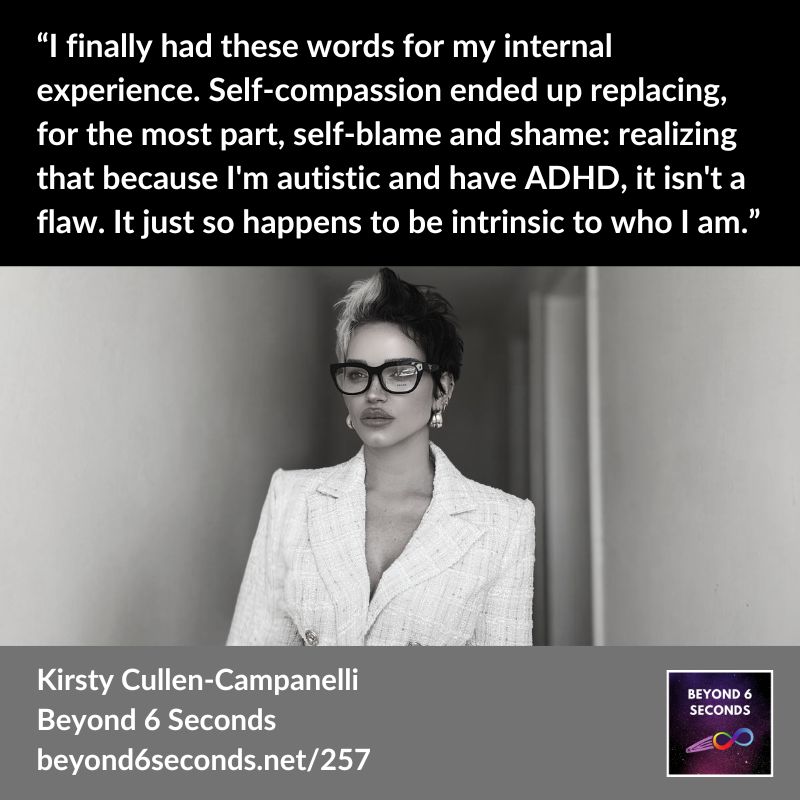
Episode 257: Neurodivergence and corporate leadership – with Kirsty Cullen-Campanelli
-
play_circle_filled
Episode 257: Neurodivergence and corporate leadership – with Kirsty Cullen-Campanelli
Carolyn Kiel
As a late-diagnosed Autistic woman with ADHD, Kirsty Cullen-Campanelli is passionate about connection, education, and advocacy. She creates space for neuroinclusivity and acceptance, particularly for those who have ever questioned where or whether they belong: as women, as leaders, or simply as human beings in the world.
Kirsty is originally from London and spent a decade living and working in the Middle East, where she built a career across media, tech, and entertainment. She’s held roles at the BBC, Netflix, and Apple. She currently lives in the United States.
During this episode, you will hear Kirsty talk about:
- How her understanding of herself shifted after discovering her autism and ADHD
- How her personal journey informed her professional growth and leadership
- What it’s like being a corporate leader as an Autistic woman with ADHD
- How neurodiversity influences her leadership style and approach to team culture
- Her advice for managing stress and avoiding burnout
- Her perspectives on job interviews from both sides of the table: as an autistic interviewer and candidate
Connect with Kirsty on LinkedIn.
Contribute to Carolyn’s tip jar to support this podcast at BuyMeACoffee.com/Beyond6Seconds!
Follow the Beyond 6 Seconds podcast in your favorite podcast player!
Subscribe to the FREE Beyond 6 Seconds newsletter for early access to my latest podcast episodes!
*Disclaimer: The views, guidance, opinions, and thoughts expressed in Beyond 6 Seconds episodes are solely mine and/or those of my guests, and do not necessarily represent those of my employer or other organizations. These episodes are for informational purposes only and do not substitute for professional medical advice. Consult a medical professional or healthcare provider if you are seeking medical advice, diagnoses, or treatment.*

The episode transcript is below.
Carolyn Kiel: Welcome to Beyond 6 Seconds, the podcast that goes beyond the six second first impression to share the extraordinary stories of neurodivergent people. I’m your host, Carolyn Kiel.
Carolyn Kiel: On today’s episode, I’m speaking with Kirsty Cullen-Campanelli. As a late diagnosed autistic woman with ADHD, Kirsty is passionate about connection, education, and advocacy, creating space for neuro inclusivity and acceptance, particularly for those who have ever questioned where or whether they belong as women, as leaders, or simply as human beings in the world.
Kirsty is originally from London and spent a decade living and working in the Middle East, where she built a career across media, tech and entertainment. She’s held roles at the BBC, Netflix and Apple. Her global background has shaped a deeply inclusive perspective on culture building, leadership and creating clarity and trust across teams.
In 2017, she took a leap of faith, moved to the US, and now lives in the Californian mountains with her husband. Kirsty, welcome to the podcast.
Kirsty Cullen-Campanelli: Hi. Thank you so much for having me. What an intro. I was like, oh, wow. Yeah. I’m, I’m listening. I was like, oh, that’s me. Thank you so much for having me. It’s so important the work that you do and, and your podcast, and I’m just super excited to be here and chat with you more.
Carolyn Kiel: Thank you so much. Yeah. I’m really looking forward to learning more, more about your story and, you know, your own journey as an autistic woman with ADHD and all of the amazing things that you do as a leader and a person in the world. So, really excited to learn more about that.
I guess we could start from the beginning or the beginning of your story of neurodivergence. So like how did you realize that you are neurodivergent?
Kirsty Cullen-Campanelli: Ugh. It’s such a great question, isn’t it? It’s, there was never, I mean I’m sure like a lot of folk, there wasn’t a single aha moment for me. I always felt different and I didn’t have that language for neurodivergency. So that difference for me gradually just became self-doubt. Like, what’s wrong with me? Right? What? Like, why, why am I so different? I didn’t understand that my brain just worked differently.
I also grew up in a complex environment, so the household was full of people all of the time. I grew up with lots of foster brothers and sisters but I didn’t have a consistent connection of love or safety as a, as a child. So I think with that, my emotions and my existence, to be dramatic, were somewhat dismissed or framed as being wrong or selfish anyway, like intrinsically as a child. So that coupled with, you know, being the eighties nineties and mental health and things like that weren’t talked about, at least in my household, I’m sure like with, you know, like a lot of folks with childhoods and environments like that in particular, I grew up walking on eggshells and feeling like I had to manage the emotion and energy and feeling of the room and my, you know, my parents.
I share all of this because as I got older, masking was intrinsic to survival with that childhood. When I got older in my late thirties and had the discover of being autistic and knowing that I was also wearing a, you know, heavily masking for that too, it was like, oh, okay. I finally, I finally understood that. But it wasn’t until my maybe mid thirties where I discovered the phrase “misophonia,” and I was like, oh God, that’s it! That’s the solve. I get it. I just, you know essentially allergic to sound or whatever. I was like, I just hate sound. That’s what it is. But it, it wasn’t enough to explain all of the other things. I was like, no, no, that’s not it. That’s not it.
And then, you know, like I’m sure like a lot of us, lists upon lists upon lists. I was writing, I was collecting information. And I came across a phrase, HSPs, like highly sensitive people. This was like five years ago, four years ago. And I was like, okay, okay. Is it this? Is this what I am? Is this, does this explain all of these reasons? And so with that overlapping with the misophonia, and then I started to find lots of things online with being autistic, I was like, I think that’s what it is. And so I ended up finding a psychiatrist who’s also autistic. And that was when I was 39 or 38, 39, 2, 3 years ago. And so that then kind of led to this explosion of knowledge, of realizing that’s who I am and that explained so much about me. So massive shout out to her because that was extremely life changing and just so validating, right? When you have somebody explaining to you like, this is why! So that was, that was the, the background there.
Carolyn Kiel: Oh wow. Yeah, and it is really important to be able to find someone in in particular, a psychiatrist or someone who’s trained to do assessments if you’re searching, but someone who has experience with assessing in adults or in women if you’re a woman or, or you know, if, if they’re autistic, that can be a bonus as well ’cause they have that lived experience.
But yeah, finding the right person to to do that assessment and help you get answers and get the language that you were looking for is really powerful.
Kirsty Cullen-Campanelli: A hundred percent. A hundred percent. And it’s also like totally valid to self-diagnose as well. I have a few friends who have self-diagnosed and I know that getting access to, you know, things like people being able to diagnose you is, is such a privilege. And not everyone has the access to that too, right?
So that is definitely something to note as well. You are totally valid if you’ve self-diagnosed. I think just for me it was, I did self-diagnose after doing all the lists and essays and things that I’d collected, but like you say, having that one extra step of this person being like, yes, this, this is what it is. Life changing.
Carolyn Kiel: Absolutely. Yeah, that’s a really important point about self-diagnosis or self-identification because of the barriers and challenges around getting a diagnosis for so many people, it’s absolutely valid. So, yeah. Thank you for bringing that up.
Yeah, So once you had the language to understand, like, you know, autistic and neurodivergent, like how did that understanding of yourself shift once you had that language?
Kirsty Cullen-Campanelli: Yeah, I mean, it changed everything, right? I finally had these words for my internal experience. And self-compassion ended up replacing, for the most part, this like self blame and shame to a certain extent, realizing that because I’m autistic and, you know, having ADHD, it isn’t a flaw. It’s, it just so happens to be intrinsic to who I am.
And so with that and with the knowledge and with the language, it enabled me to understand more about what I need to be able to just show up as myself in the world. We don’t always have the luxury of just getting that back anyway, so that’s why it’s so important the work that you do on these podcasts to inform and educate people and to create that validation.
But for me, it definitely gave me the, just the validation, which then three years later or two years later, the confidence as well to own that. To even have conversations with my husband, you know, to be like, I don’t have the spoons right now. We use spoons a lot in, in our household. All the beans, like the coffee beans, the energy, and he gets it. He knows that if I’ve had you know, a day with back to back meetings, there’s no way I’m going out to that dinner that we talked about. So things like that.
Also my sister, shout out to you, lives across the, the globe there in Australia. But I’ve been able to share things with her to, to, you know, just to have that shared understanding of different verbiage as well. And, and she understands that as well a little bit more.
So I think it just validates you, allows you to not feel broken anymore, and know that there’s other people out there that feels the same. It’s less isolating when you have that language, you know?
Carolyn Kiel: Yeah. and for me as well, it helped me be a little more gentle and understanding with myself in terms of, you know, not feeling as, you know, not broken or, or strange or like, why, why do I do that? Why do I react to things differently? It’s, it, it, it gives you that language and that structure and knowing that other people are like you and have that same type of experience sometimes.
Kirsty Cullen-Campanelli: A hundred percent. I feel like I’m a broken record when I say this a lot. I always say to my husband like, give, give yourself grace. Like, ’cause he has ADHD. And just be kind to yourself. It’s all, it is always the hardest thing to do that to yourself. Right? Listen to your own advice. But I think that’s so important.
Just be like, it’s all right. Give yourself a little hug.
Carolyn Kiel: Yeah.
Kirsty Cullen-Campanelli: Yeah.
Carolyn Kiel: Absolutely. Definitely.
How does being autistic show up in your daily life? In ways that people might not see from the outside?
Kirsty Cullen-Campanelli: I mean so many ways. Because being autistic isn’t a monolith, what can look like attitude or withdrawal or having a tantrum, there are, as we know, deep internal reasons for that, like physical feelings that are tied to those things.
So sensory processing, we already talked about that a little bit, but that is huge for me. I, I think that’s probably one of the, the largest, most affecting things that shows up in my daily life that a lot of people just don’t see because I highly mask it so much. That’s what causes so many meltdowns, which leads to burnout behind the scenes. So for example, if, if somebody doesn’t know what I mean by that, misophonia I mentioned a little bit. So sound is one of my largest triggers. Anything from typing, like clicking of typing, it doesn’t even have to be for like, oh, 15 minutes of typing like that. I can understand how that would be annoying. No, I’m talking like a couple of words. I’m like, no, no, no, I have to get outta the room! It’s, it activates my fight or flight mode because we are so, like our nervous systems that feel like, I feel like they’re so like raw and open, like everything is so affecting all of the time.
So a lot of things around sound, bright lights, textures, smells, e verything is just very overwhelming. And I was going for a walk with my husband, as another example, in the early morning, everything was really quiet. I think it was like 6:00 AM or 7:00 AM in the neighborhood. And I started talking really loudly as we’re walking and he’s like, by the way you are shouting. I always wear headphones as well. So I was like, oh, maybe that’s what it is. And I was like, oh no, it’s just because I’m walking, so I’m doing something. And also it’s really bright, so it’s loud. And he’s like, but it’s quiet, it’s not loud. And I’m like, no, no. It’s loud with the light. Like for me, all of those intakes and information as we know, we in, you know, intake a lot more information, it just is like one big information overload to me. So sensory is a lot.
Alexithymia and interoception, so not being totally attuned to the feelings in my body in those moments and having a lot of late processing for things until, you know, not realizing that I’m thirsty or hungry or need the bathroom until it’s like hours later. And just feeling that I need something to self-regulate. But I don’t know what that feeling is related to. Which makes it difficult when you’re getting sick, ’cause you don’t realize that you’re getting sick. Right? And you just push through. And then I’m like, God, like I feel, is it, am I anxious? And I’m like, no, I’m ill. That’s what it is. It’s just really hard.
Socially and cognitively, a lot is manual. And I can have difficulty reading between the lines with things. Constant behind the scenes processing outside of meetings and emails and things like that. And my bottom up thinking often means that I often rehearse or script things, even though if I know exactly what to say, I’ll still write it down because in the moment I’ll just, everything will just… I’ve even gone on to meetings before and just completely forgotten to introduce who I am and just get straight into the work. ’cause I’m like, that’s what we’re here for. Right? You forget all of those social things.
Change can be really challenging for me. Routine is really important. My autistic side craves structure, but my ADHD, like it kicks that to the curve and hates that. So in the middle it can create this inertia or paralysis where it is just this internal fight between, between the things. So there’s, there’s like a lot of things there to unpack and a lot of additional things as well. But I think those are some of the main ways.
And because you are, you have all of those internal things constantly, it’s just tiring, isn’t it? It’s just so tiring. I get burn out. I get a lot of migraines or what I call migraines because it just is like I, I call them social hangovers after spending time. It doesn’t even have to be a lot of time with a lot of people. It can just be a couple of meetings with like one person, and then I might have to lay down because it’s information overload. So those are a few ways.
Carolyn Kiel: Yeah. No, and, and definitely the sensory part of it is, is really big. I, I know I often feel like my nervous system or my nerve endings feel like raw, like that experience, just like everything, like I’m, I’m like a receptor to like every, every sense that comes
Kirsty Cullen-Campanelli: Yeah,
Carolyn Kiel: in sometimes. Yeah.
Kirsty Cullen-Campanelli: A hundred percent. I’m like, I have to, there are times where I’ll, I’ll just have to close the door and be in a dark room to just, you know, because those nerve endings do feel so raw and you don’t have anything left in your social ba or any kind of energy battery. Information overload. I just have to lock myself in a dark room under the blanket, and then a couple of hours later, it might get to some kind of semblance of a baseline. But as we know, being autistic, our baseline is on fire. So
Carolyn Kiel: Yeah!
Kirsty Cullen-Campanelli: It doesn’t, it doesn’t help.
Carolyn Kiel: Yeah, yeah. So, now you are a leader. You’ve been a leader at, at several different companies. As a people manager or, or even just as a colleague, how does your personal story help shape the safe environment that you try to create for other people?
Kirsty Cullen-Campanelli: I feel safety is built in small moments, not just these like big declarations of, “everybody feels safe here!” Right? It’s like, that doesn’t work like that.
Carolyn Kiel: ” This is a safe space!” I’m like, is it?
Kirsty Cullen-Campanelli: Yeah, and you’re like, now, now I actually feel like it’s not a safe space if you just say that out loud. It’s like, what are you gonna throw on me? You know what I mean?
But I, I feel like it’s like built in those small moments of, of building up a psychologically safe environment. And I feel like that could be a buzzword that a lot of people throw out. But it’s built over time.
And I think, you know, people do their best work when they feel safe enough to be themselves and be human. I know what it feels like to feel misunderstood and unsafe and how long that can stay in your body. So creating safety feels more like a responsibility than a, like, preference for me, you know?
I try to be really intentional about tone and pacing and how people are spoken to as well. Something that I heard a couple of years ago that I feel like it’s another one of these buzz phrases that I say often, but it’s “meet people where they’re at whenever you can.” And I feel like that helps create a safe space for people as well. Like it’s not a one size fits all when we are all different. Everybody’s different. So I hope that that shows up in the environments that I try to create as well.
I try to pay attention to people, you know, really specifically if they haven’t spoken yet or they’re quiet, but without like shining a spotlight in them, if they’re somebody who doesn’t want to be in that and feels more uncomfortable. So it is just about that, that cookie cutter thing that I mentioned about what are your strengths? How do you best work? Are you somebody who likes to collaborate more with people? Do you need extra time to go away and process? I know I do. I try to write, for example if I have a conversation with somebody about, it would be great to do, create this big program or project. I try to, for the most part, sometimes we don’t always get that luxury of time, but I try to always follow up with an email of specifically what it is. Right? Yeah. I see you nodding.
Carolyn Kiel: Yeah that’s great! Wow!
Kirsty Cullen-Campanelli: Right? Because I feel like, ’cause obviously I don’t get, I personally don’t receive that from everybody. I can’t expect everybody to act in the, the same way that I do because their minds don’t think like that. But whenever I have connections with people and I’m receiving information, as soon as that meeting ends, if I haven’t done it already, I’m writing everything down while it’s in there. And then I’ll spend some time deep thinking away from that and planning it, but. Those are kind of some ways as well.
And that’s definitely at home as well. Like my husband and I open our home, you know, for the most part, for every holiday. We really try to create a safe, welcoming environment for people as well. It’s just like a soul need for me. I just feel like I need to do that as a baseline.
Carolyn Kiel: That’s great. Yeah, and just trying to realize that different people have, you know, different preferences, different needs, different things that make them comfortable and perform in the best way when they’re at work. So keeping that in mind. And it, and it is always a little bit of a balancing act because you, you can’t always fulfill everyone’s need, but if you’re an open enough leader and people understand that first of all, that you understand that people are different and that you are willing to adjust as much as you can so that everybody gets to contribute and everybody’s on the same page and understands the direction you’re going in. That’s really powerful.
Kirsty Cullen-Campanelli: Yeah, a hundred percent. And even if it’s something where somebody isn’t able to do something in a certain way in that moment, of course I’ll lean away from that and as we talked about, but it might be a situation where they do want to do that. So it’s having those conversations again in those psychological safe environments in one-on-ones and things like that, where it’s like, where do you want to develop? It might not be a skill necessarily, right? ’cause again, it’s an operating system thing, but if someone else is a bottom up thinker and they thrive in a particular, you know, stream of work that it isn’t serving them. You know, maybe interviewing somebody on a large stage and said, I’m like, okay, well if this other person wants to do that, there are always ways of kind of flexing or like rotation onto different projects to maybe build up those skills.
It definitely does not come natural to me to public, you know, public speak and be in front of people and things like that. But I wanted to do it. Not everybody wants to and I’m not gonna force them, of course. But I really wanted to, mainly because it just kept coming up anyway in, in part, different parts of my world. And so I thought, God, the anxiety and stress I feel about doing this, not just in the moment, but the, the buildup of knowing that it’s going to happen was just horrific for me. So I thought, how can I feel less stressed about this and anxieties and ill about this? I’m going to do it until I’m just, it’s fake it till you make it. I’m just gonna make myself do this thing, which isn’t always the answer, obviously. Sometimes you just have to realize and, and be okay with and give yourself that grace of like, this isn’t for me. And that’s okay as well. There are lots of times where I’ve done that, so yeah. Yeah.
Carolyn Kiel: Yeah. And as you said, there are ways to get that experience, even if it’s something that you wanna do, but you’re, even if you’re really uncomfortable with it, if you really want to do it, there are ways, you know, like public speaking. It’s like the more you do it and the more you talk about certain topics. And like for me it’s always like, I have to be really, really prepared, unless I know the topic really well or it’s very casual, I always have to, you know, as you said, kind of write things out a lot of times beforehand or just practice a lot. Yeah, some people seem to just be able to get up and talk off the cuff. I’m not really that type of person, but there are different ways to get to your goals and, and that’s important to know.
Kirsty Cullen-Campanelli: Yeah. I was gonna ask if that was something that came naturally to you. Did you always want to do this? Were you like a, I wanna do it off camera ’cause I don’t wanna be perceived, or were you like, no, if I’m gonna do it, let’s do it.
Carolyn Kiel: You know, it’s funny, there’s the public speaking aspect, which for me, I, I tend to be way more comfortable on one-on-one conversations, like the one we’re having now. If I’m in a group conversation, even if it’s just casual, like a networking event, you’ll rarely hear me talk because I never really know, like, when my turn is or how to get into that dynamic. I’ve never been good at that. Like, it’s really so hard. But public speaking is good.
But interestingly, I actually have a lot of experience as a musician. So I perform on stage, which I personally think is a lot easier than public speaking. Because again, you get to rehearse. I’ve got like my sheet music or I’ve memorized things so I know what I’m doing. I know where I’m standing.
Kirsty Cullen-Campanelli: Oh.
Carolyn Kiel: Whereas with public speaking, there’s a lot of sort of open variables and things that can shift around.
Kirsty Cullen-Campanelli: You don’t have control. You don’t have control. A hundred percent. Networking events, mingling events. Ugh! Just, I, I start to get that feeling of burnout before I’ve even gone because I’m building it up in my head. I’m already trying to plan in my head what I will say when different people come up to me. And I don’t even know what people are gonna come up to me or we are gonna have conversations ’cause it in an event that’s in a week’s time, for example.
But yeah. Gosh, that is definitely the the thing, it, it comes down to, it comes back to one of those things I said earlier about like, not like being able to read between the lines, like the social cues, but so many people will think that it’s, oh, but you are really great with that! And you, but you, but you love, you are such an extrovert! And I’m like, I’m dying on the inside. You know what I mean? It’s like, wow, I really am great at masking. That’s not a great thing necessarily. But yeah, you gotta, that’s why you need to take that extra time to, to rest in between, I think.
Carolyn Kiel: Mm-hmm. Totally. Yeah. They can be very draining sometimes, especially if you’re kind of acting in a way that doesn’t feel naturally in order to get to a certain point. Yeah, absolutely. Wow.
So, as I mentioned before, and in your bio, you’ve worked in corporate leadership roles, many different ones across the years. Generally, what’s it like working in corporate leadership as an autistic woman with ADHD?
Kirsty Cullen-Campanelli: Yeah, I mean, like I mentioned earlier, right? We know that being autistic isn’t a monolith. So I’ll say this, listeners, this is just from my opinion, this, you know, from my lived experience, your experience may be very different and all experiences are valid, of course. I feel like for me it was, I spent so much of my life, life and still do a lot of it, masking that I felt like I have always, earlier on in my career especially, wanted to be a version of what I think a leader is or someone in a career is. And in my mind, they looked a certain way. They wore certain clothes, they said things in certain way. They were very professional. They didn’t have tattoos and things like this. They didn’t have two different hair colors, whatever it was in my head of what I thought it was supposed to be.
And over time, especially getting to 40 where you’re just much more of a, I can be myself kind of attitude, as you get older, naturally. But I feel like with this discovery about myself and unmasking in different situations where it’s safe, it’s really enabled me to, or allowed me to see that I am welcomed in those environments. And it wasn’t the idea of the worst case scenario that I thought it was gonna be. And that you can be these different versions of yourself and still be in different positions.
So representation is really important to me. Seeing, you know, lots of different kinds of people in leadership positions I think is really important, firstly. Knowing that you can flourish when you’re in the right environments for you. So not just with accommodations, but different kinds of roles that allow you to really tap into your strengths. There’s obviously a lot of parts of the corporate world in my experience that can be more tiring being autistic. We’ve talked about some being the social things and things like that. And then there are some that just, you know, just tap my brain in such the right way, like the deep dives that I can go into, that my work is my special subject. It’s my special interest, which is really helpful. That’s one of the experiences I, I’ve had as well.
It can take a toll because it can be like task switching, lots of social things, lots of meetings, when there’s travel that can be tiring. But ultimately, the impact really makes it meaningful. I happen to really love what I do and, and the things I get to do and the different types of people I get to partner with.
So that is one of my passions, and so that, that really helps. But ultimately, my neurodivergence shapes how I lead, you know, in a corporate space.
Carolyn Kiel: what kinds of things help you succeed at work, whether they’re accommodations or different systems or, or different ways to use your strengths?
Kirsty Cullen-Campanelli: It’s such a great question. And again, of course, like everybody is different. So some of these things might help more than others, but generally speaking, I feel like a lot of this could just baseline help people. So this is what really helps me. But again, I’ll say with a pinch of salt, this isn’t like, “oh wow! Well of course she’s gonna succeed because she gets all these things and I don’t get these things.” You may not get all of these things, and I certainly don’t at all times. But it’s good to know where you can flourish, because if you can introduce some of these things, or if you partner with other people or lead teams, you can introduce some of these things to them as well. ‘Cause you can’t always control the outside environment.
So, clear expectations are like a game changer, right? It, it’s a little bit like in those social environments we’ve been talking about with the mingling and networking and things like that. When you don’t, when you, you are not sure what the expectation is, it can create a lot of churn just, which isn’t great business practice anyway ’cause that’s resources and time and money and whatnot. But it’s also tiring, if you are like, I don’t, not exactly sure what this person means or they said this, but they might mean that. And you may not always be in a position where you can ask a lot of questions or ask any questions. Obviously it’s great if you can. It’s great to be curious. But if you’re able to get clear expectations from somebody. Again, you may be being brief from somebody who may not exactly know what it is that they need until they see it. This is all just part of life, different environment if you’re in a design organization and things like that, but that is quite important. So I think just like if you’re able to sit down and have a conversation with somebody, know a little bit more maybe about the context as to why they need something. They may not be able to give you the exacts, but the goal outcome. And that will just allow you a, a little bit more of a safety net of just removing some unnecessary stress.
I mentioned before about following up with an email as to what the ask is. Honestly, it’s kind of selfish too, ’cause it really helps me figure out exactly what it is that I’m asking for. ‘Cause I think it’s a little unfair if I’m asking people, especially if it’s a larger group of people for something if I don’t really know what it is. ’cause again, it’s like creating a spinning of wheels and some churn. So if I’m able to, I like to follow up with a, an email that’s a what, why, when, maybe not the how. Because I also don’t like to micromanage and I feel like autonomy is really important. So there might be a clear deliverable that we need to action on. But the how you get there and the how you work is something that I really appreciate and that helps me succeed. So, you know, the thinking behind it, you can do it in this tool, you can do it in that tool. You can use a keynote, you can use a, a Word document. You can like, and that’s just talking about specific tools, but there are so many different ways of thinking. And again, that really leans into people’s strength. So go away, think about it however you want to do it, that that works. Sometimes you do have to be really specific and do it in a certain way, and that’s fine too.
Carolyn Kiel: Mm-hmm.
Kirsty Cullen-Campanelli: So that’s autonomy.
Buffers between meetings really helps me succeed. And I’ll say this again with a pinch of salt because sometimes it depends on how I feel that day and how my energy is. But sometimes sandwiching things is more helpful. Like if I know that I have a certain amount of meetings, I might do them all on one day and have like, and this isn’t for everyone. I might have like 10 to 15 back to back meetings or something all in one day if I’m particularly energized. And the ADHD side of my brain is very, very just like, yes, yes, yes. I need to do all of this now. And just lean into that strength. If you have control of your calendar and you can do that, sometimes that is not gonna work for me and I might need to have one meeting and then a half an hour, an hour break in between where I’m catching up on my emails because I, I need to have a break from a certain amount of input in, in one way and then output in a different way. And allowing myself, if I have something to create, some kind of proposal or some deep thinking around research on something, I’ll try to carve out like an afternoon to do really deep thinking on that. So I’m not task switching to go from this, to go to this, to go to this. Sometimes I have to, and then I try to go to bed early that night to recover from it. So it’s just like the different, again, just like knowing yourself a little bit more. And you can’t always adhere to those things, but it’s helpful to know what your, where your boundaries are.
Flexibility I think is really important as well, for the same reason. Just time to think and process things. Again, sometimes things are time sensitive and it’s like, you gotta jump on this thing now. But if possible just, okay, I know what the need is, I’m gonna take this. Or I need to brief the team on something, but let’s just sit with it for a minute because I need to, I need to try and break down what those expectations are. Again, it comes down to those expectations. If they haven’t been shared with me, I need to create what the purpose of this particular deliverable is. I need time to do that. ’cause it’s, it can be taxing on the, on the old brain. So I think that’s important.
Yeah, just, just creating some recovery time in between different social kind of events and travel as well. I feel like it’s important to build in a, some buffer time of, okay, maybe I don’t go to this large networking thing the day I get back from traveling for three days, because why am I gonna do that to myself if I can help it?
So those are some of the things that help me just, you know, I feel like thrive a little bit more is, and, and that’s all things that, because I know about myself, I’m able to build it a little bit more. It’s no one’s responsibility to like give those to me, right? Because nobody can for the most part. But it’s like, okay, if this is the environment, where is the flexibility for me to be able to work to my strengths here?
Carolyn Kiel: Yeah. And that’s powerful because I think at the core is really having some flexibility, at least some level of control over how to structure your day. Whether it’s trying to prevent yourself from being in 15 back to back meetings if you’re really not feeling it that day, to being able to say like, you know, I’m gonna pass on this event and, and it’s okay because I’ll go to like other events on another day.
So I think that’s powerful. It’s really advantageous to be in an environment where you have at least some level of control over your schedule and how you work in some ways.
Kirsty Cullen-Campanelli: A hundred percent. And look, those 15 meetings, that’s extreme. That’s been a while since I’ve been able to do that too. I feel like post discovery of knowing you’re, you know, knowing you’re autistic, it opens up the floodgates of knowledge and I was no longer able to perform in certain ways that I was able to push through before.
And that’s a good thing though, because I was very, I was very much suffering because I kept doing that to myself, just being like, I’ll just, I’ll just keep pushing this, pushing this through. But the more you do that, you know, the more that comes and then it’s not great. So I don’t recommend that to anybody necessarily with the 15. But sandwiching and knowing your limits if you do have the option to move those things around is helpful.
Carolyn Kiel: Yeah. Yeah, absolutely. And you may have already talked about some of this already, but I’m curious about how does your neurodivergence influence your own leadership style?
Kirsty Cullen-Campanelli: Yeah, I, I definitely feel meeting people where they’re at, like I mentioned, is super important. Not everybody’s the same. Everyone has different ways of processing, lengths of processing time needed, different skill sets and things like that.
I try to lead with curiosity a lot as well. I think that’s important in a lot of, just in life in general. I try to assume positive intent. I feel like that’s really important as well. There’s not always positive intent in this world as we know. But I feel it helps just with teams in general to go into working relationships like that and just assuming positive intent and leading with kindness and curiosity, I mentioned.
I think seeing leadership as creating conditions, not controlling the outcomes, is really an important way of leading. And designing systems that support humans as well. And just allowing people to be able to show up as their true authentic selves is again, one of the buzzword phrases that I use a lot. ‘Cause I feel like that’s a massive part of my role. And if it wasn’t, that would be something that I take to any role or, you know, era of myself in general. And that I definitely recommend to people not only in leadership, but just in workplaces in general. So, yeah I think, I think those are some of the ways that it influences it.
Carolyn Kiel: Yeah, that definitely makes a lot of sense. Wow.
Despite all the ways that we try to control and, and take care of ourselves, work gets really stressful sometimes in spite of things. Are there certain ways that you manage stress, that really work well for you?
Kirsty Cullen-Campanelli: I mean, answers on a postcard if anyone’s got recommendations. I feel like it’s one of those things that we’re always trying to navigate! I need to be less stressed right now!
Sound baths have helped. Just taking it like, you know, outside of work for a minute. Sound baths have been a game changer for me. You know, there’s different apps for things like that as well. And, and YouTube and stuff like that. You don’t always have to go, you know, if you don’t have the access to that, you don’t have to go somewhere specific. In fact I often prefer doing it at home on my own because I’ll hear other people when I’m trying to do a sound bath and that distracts me. So things like that.
Trying to do a lot of mindfulness. Taking walks in between meetings, if I am really stressed, I say this to my husband all the time. Things like that.
I think having boundaries is really helpful for stress. And again, I’m, I’m saying all of this, but it’s not something that I always take my own advice on, but trying to have boundaries. Especially if, I think during the pandemic for a lot of people working from home, those, you know, home to work hours blurred a lot. I think people working from home as well. Or even if you don’t work from home, I feel like my brain never shuts off. So I really have to try and force it.
I’ve taken up or retaken up, ’cause I used to do this a lot when I was younger, but painting and my photography again and things like that, that is so not part of my corporate world “me,” that I can really focus on something with my hands, like gardening and stuff like that, really brings down the stress.
Spending any time with dogs and animals to me personally really helps. It’s very grounding I feel. Therapy as it just, EMDR. Big, big advocate of those things as well.
Resting, just resting, just doing nothing, which I found very difficult and particularly painful when a therapist recommended that to me like five years ago or something. Just sit, just sit on the porch and do nothing. And I’m like, oh, this is so painful. Right? So that can be a difficult, but do with that what you will. But it is important sometimes, even if it’s just like watching the TV and having a, a movie day where you are, you are doing nothing.
And I think naming stress as well, just just realizing that you are feeling stressed and you need that time and just not trying to push through all of the time, especially to the people that you share your life with. Again, I mentioned earlier about with my, with my husband, if I’m like, I’m just feeling, and he does the same with me. And I feel like because we do have that verbiage and language now, it’s, it’s easier. We understand each other more, and that’s amazing. When I’m like, you know, I’m feeling, I, I, I’m, I’m right up here right now! I, you know, I, I’m right up here! He’s like, go and, you know, go and take a walk. Go and do this, and I’ll do the same for him. So I think those are some of the ways.
How, how about you? Do, do you have any recommendations? I’m always,
Carolyn Kiel: Ha ha.
Kirsty Cullen-Campanelli: Always open for more ways!
Carolyn Kiel: Oh my gosh. Yeah, I think like resting and just trying, you know, for me it’s not scrolling on social media, like for hours on end! Because that, I dunno if that’s stress, that’s just stress relief because that usually causes stress even though it’s, you know. It’s exciting, but I notice I can feel my whole body tensing up.
So,
and again, More advice for myself that I don’t take, but as good advice, like just try to put the phone away and just spend time offline. You really do feel differently. Like, like, oh, okay. I feel clearheaded a little more now.
Kirsty Cullen-Campanelli: A hundred percent. I quit going on social media. I think it’s like two months now. I had to. Because I found even just looking at, like going on YouTube shorts or something and just looking at something that wasn’t social media, so it wasn’t comments and it was videos. So to me I was like, well, it’s like watching little TV shows or something like that.
But the feeling, the instant feeling in my chest of stress, it’s just information overload. It’s the proximity of the visuals to my face. It’s the sound. I actually started to watch a lot of things like point 75 of the speed. So it’s not the full hundred speed, it’s like points 0.75 of the speed, just really slowed down. Because a lot of people will be like, like me, blblblb, when they’re talking about things! And I’m like, huh? And then I get more stressed.
So you are right, like social media. Screen time can be in general very helpful with dopamine mining, depending on what my spiky cognitive profile’s doing to me that day, or it can be really detrimental. So again, it’s just like trying to figure yourself out and really try to pay attention to how you feel, which again is hard if you have the alexithymia and interoception.
So
Carolyn Kiel: Yeah.
Kirsty Cullen-Campanelli: We’re always working, we’re always trying to figure ourselves out, aren’t we?
Carolyn Kiel: Mm-hmm. No, absolutely. No, that’s so true.
Sometimes autistic professionals find the job interview process to be kind of challenging or stressful. What are job interviews like for you, either as the interviewer or the interviewee?
Kirsty Cullen-Campanelli: It’s such a great question. I don’t think it’s talked about enough, so thank you so much for, for thinking of it and asking it.
As an interviewer, I try to focus on the, the safety and don’t equate confidence with competence, which I think is really important. It’s not something that everybody does, right? Me, for example, eye contact’s really difficult. And so in interviews, if, if you’re looking down like this, which I’ve personally done a lot, especially early on in my career, I haven’t interviewed for a long time now, thankfully. But when I was, I’d be telling myself, look up, you need to look in the eyes because that in, in society means that you are confident. But in fact, that makes it more difficult for me to think about what I’m trying to say, and I’m more comfortable and confident when I’m looking away because I’m not trying to process what you are thinking. I’m not trying to process what your facial things mean. You might be really leaned in and looking at me and, and acknowledging what I’m saying, but to me, that might represent as, “oh no, I’ve said something wrong” and then that throws me off. You know what I mean? So I totally acknowledge that the interview process is stressful for so many reasons. It’s very intense for me in those situations when I’m being interviewed.
But when I’m interviewing people, I always like to introduce myself. You know, I like to state upfront that it’s quite, it’s gonna be quite conversational. And I hope that a little bit of my personality comes through in that way. That this is just gonna be a conversation. Can’t wait to find out more about you, da, da, da, in the hopes that it puts them more at ease as well. But again, you can only control what you can control. So I like to do that.
I also like to state upfront as well, what the structure of the interview or the conversation’s gonna be like. I try to do that beforehand too. That’s not always controlled by me. That might be, you know, a recruitment partner or something like that, but I like to try to prep them as much as possible of what the expectations are. Not all of the questions. If I could, I’d love to share all of the questions in advance too, because that’s what I love. Within reason of what you’re able to control.
So I’ll share that it’ll be conversational. I’ll share with them a little bit about the role and the, the team, whatever it is. And then I’ll ask them some specific questions and then we’ll open up time for questions at the end for any questions that they have for me about whatever it is. And I do that so they know when is their time to speak. I might pause for a moment in between my questions to them and they might think, is that my time to speak? I don’t wanna, I wanna try and remove as much of that as possible, so it can just be a conversation.
I’ll often say to them as well, “I’m gonna be looking off camera a little bit because I’m gonna be taking notes, so that’s what I’m doing. I’m fully focused on you, but I’m just taking notes.” So they don’t mix that up and think, then she’s not interested because she’s like answering an email. So it’s little things like that that I personally feel that would make me feel comfortable. And so going into interviews the way I always try and think, what would make me feel as comfortable and as confident as I can, just in the environment? Because then it’s all up to the other person. You know what I mean? But I totally appreciate that it can be really difficult.
This was since the pandemic, but I tried to do interviews just remotely as well. I feel like there may be, you know, times when they come in for interviews, but I personally prefer them remote as well being autistic ’cause I can have my notes up. Again, I know, I know my resume, I know where I’ve worked and what I’ve done. But it will go completely out of the window if you ask me. Like even now, I’m like, “I’ve done nothing with my life! Who am I? What have I done? Like nothing.”
Carolyn Kiel: Ha ha ha, mm-hmm.
Kirsty Cullen-Campanelli: You know, having a second screen and things like that, or a phone, whatever it is that I can have some bullet points on, those things for me have been I, I think are really helpful for people.
Carolyn Kiel: Yeah, that’s really important because I remember like back when I used to have to interview, like go in person to an office, I would bring like a whole portfolio with my resume and I would write notes to myself. But when I’m sitting in that room, it better be in my head ’cause there’s no chance that I’m gonna be able to look at what I’m holding. So, yeah, it’s easier to have it on the screen.
Kirsty Cullen-Campanelli: A hundred percent.
Carolyn Kiel: Yeah.
Kirsty Cullen-Campanelli: It’s tricky. Yeah.
Carolyn Kiel: So, yeah. Yeah. Thank you for sharing that. That makes a lot of sense to be able to just do as much as you can as the interviewer to make a, a comfortable environment or at least a transparent environment as well by sort of saying, you know, what you’ll be doing and what you’re expecting and, and things like that.
I think that’s helpful, not just for autistic people, for a lot of people interviewing.
Kirsty Cullen-Campanelli: Yeah, right! I think so!
Carolyn Kiel: Yeah. Oh yeah, for sure.
Kirsty, I’ve really enjoyed talking with you and, and getting to know your story and hear about your experience working in corporate and as a leader. How can people get in touch with you if they just wanna learn more about you and your story?
Kirsty Cullen-Campanelli: Yeah, I would be honored. As I mentioned before, I’m not active on social media or anything, so I think LinkedIn is the best way to reach out, if you want to. I think it’s Kirsty Cullen-Campanelli. You can just find me. So just pop me a message or a request or whatever it is and, and we can chat more there and I’d love to, I’d love to chat more.
Carolyn Kiel: Okay, perfect. Yeah, I’ll put a link to your LinkedIn profile in the show notes so people can find it there as well.
Anything else that you’d like our listeners to know or anything that they can help or support you with?
Kirsty Cullen-Campanelli: Yeah, absolutely. I think just giving yourself grace, right? A couple of those things. Just coming back to those, highlighting those. Be kind to yourself. If you are questioning who you are, that’s okay. You don’t need all of the answers right now. I certainly don’t have all of the answers. You’re allowed to evolve, I think.
But just giving yourself that grace and, and be kind to yourself wherever you are in your discovery journey. If you’re somebody who has has just discovered this about yourself. If it’s, you know, somebody who’s known it for a long time, if you are an ally or a loved one of somebody, just allowing you that, allowing yourself that space to just grow and discover yourself more about what makes you tick and how you can thrive in the world and just show up as your authentic self.
Carolyn Kiel: Yeah. Thank you. That’s really powerful and great advice. So yeah, Kirsty, again, it was great meeting you. Thanks so much for being on my show.
Kirsty Cullen-Campanelli: Thank you so much for having me, and again, just massive kudos to, to what you do. It’s the reason, one of the reasons I was able to find out so much more about myself is through the work that you do and, and so many other people. So thank you.
Carolyn Kiel: Oh, thank you. I appreciate that.
Has this podcast had an impact on your life, your heart, or your perspective in some way? If so, I’d love to hear about it. Send me a message on social media or through my website at beyond6seconds.net/contact. Your feedback means a lot to me, and it helps me keep going with this show. Thank you.
Carolyn Kiel: Thanks for listening to Beyond 6 Seconds. Please help me spread the word about this podcast. Share it with a friend, give it a shout out on your social media, or write a review on Apple Podcasts or your favorite podcast player. You can find all of my episodes and sign up for my free newsletter at Beyond6seconds.net. Until next time.