Episode 240: Life as a neurodivergent preemie – with Preeti Kalra
-
play_circle_filled
Episode 240: Life as a neurodivergent preemie – with Preeti Kalra
Carolyn Kiel
Preeti Kalra is a Hospital Clinical Pharmacist with a Doctor of Pharmacy degree, as well as a Bachelor’s degree in Biology and a Masters in Health Administration. She is the Director of Partnerships and Communications and Chicago Network Lead for WE ARE SAATH, an organization dedicated to advocating for South Asian mental health and defying the stigma in the South Asian community when it comes to talking and seeking therapy for mental health.
She is also on the Associate Board for March of Dimes, a nonprofit organization dedicated to improving maternal health and ending preventable premature birth within the United States.
Preeti was born prematurely. In this episode, she talks about her experience as a preemie and as a member of the South Asian community, including:
- The circumstances of her birth as a preemie and how that affected her health as a child
- How she discovered that she was neurodivergent and how that impacted her life as a South Asian woman and as a preemie
- How her neurodivergence affected her academic studies and shaped the direction of her career
- Some potential long-term effects of being born a preemie, and why is it important to consider those effects when those babies become adults
- Her research on premature birth and the current state of maternal healthcare in South Asian countries
- How parents can be good advocates for their preemie children
Follow Preeti on Instagram @pkalra33 or email her at pkalra33 at gmail dot com.
Learn more about the Adult Preemie Advocacy Network at AdultPreemies.com/resources.
Follow the Beyond 6 Seconds podcast in your favorite podcast player!
Subscribe to the FREE Beyond 6 Seconds newsletter for early access to my latest podcast episodes!
Support or sponsor this podcast at BuyMeACoffee.com/Beyond6Seconds!
*Disclaimer: The views, guidance, opinions, and thoughts expressed in Beyond 6 Seconds episodes are solely mine and/or those of my guests, and do not necessarily represent those of my employer or other organizations. These episodes are for informational purposes only and do not substitute for professional medical advice. Consult a medical professional or healthcare provider if you are seeking medical advice, diagnoses, or treatment.*

The episode transcript is below.
Carolyn Kiel: Welcome to Beyond 6 Seconds, the podcast that goes beyond the six second first impression to share the extraordinary stories of neurodivergent people. I’m your host, Carolyn Kiel.
Carolyn Kiel: On today’s episode, I’m speaking with Preeti Kalra. A hospital clinical pharmacist by training, Preeti has a Doctor of Pharmacy degree as well as a Bachelor’s degree in Biology and a Master’s in Health Administration.
She’s the Director of Partnerships and Communications and Chicago Network Lead for WE ARE SAATH, an organization dedicated to advocating for South Asian mental health and defying the stigma in the South Asian community when it comes to talking and seeking therapy for mental health. She’s also on the Associate Board for March of Dimes, a nonprofit organization dedicated to improving maternal health and ending preventable premature birth within the United States.
Preeti was born prematurely herself, and she’s here today to talk about her experience as a preemie and as a member of the South Asian community. Preeti, welcome to the podcast.
Preeti Kalra: Thank you so much having me, Carolyn.
Carolyn Kiel: Thank you so much for coming on the podcast today to share more about your story. Tell me about your premature birth and, and some of the health issues that you faced growing up.
Preeti Kalra: Yeah. So you know, my premature birth story is that I was born three months early. I was supposed to be born actually April 27th. I ended up being born end of January. And this was back in 1989. So, you know, at that time, in that decade, in the early eighties, late eighties, that’s when the incubator really came out, which is like the golden standard, right, for premature babies and was really the turning point in NICU medicine. And in my case actually, they took my mom to a hospital in Downers Grove first, which is a suburb of Chicago. And actually that hospital was not equipped to handle premature birth. So then they actually had to take her to another hospital at the time. And this was Loyola University Medical Center, which is a big teaching hospital in Maywood, Illinois. And that’s where I was born via C-section. And now, currently today, they’re a level four NICU, so they have ECMO and everything. You know, different various hospitals have different NICU levels. So yeah, that’s kind of how I started my life.
And, you know, premature birth has impacted my life in a variety of ways across my lifespan. But immediately when I was born, I was born with underdeveloped lungs and I was born cross eyed actually. So it’s like my, my eyeballs were basically, I had a lazy eye and my eyes were a little bit deformed, so they were like, you know, pointing towards my nose. And so I had eye surgery when I was two years old. At Loyola, the ophthalmologist corrected it and they did a phenomenal job. So that was probably the major thing when I was born.
And I also, when I was in the incubator, I was in a temperature incubator. So from what I know in NICU medicine that they have, depending on how early the baby’s born, they have various incubators. So you know, those that are born really early are placed in a temperature regulated incubators because they can’t regulate their body temperature, you know, themselves. So, so I was in that kind of incubator, but then they also injected my lungs with surfactant. So I was actually in a surfactant study when I was born as well, and my parents had to sign, you know, a bunch of disclosures, what they’ve told me so that I could be a part of the surfactant clinical trial, which I think is so cool. And that was really an emerging area or emerging time in medicine where the surfactant came out. And I was in the NICU for three months.
Carolyn Kiel: Wow. It’s hard to believe with all of the medical advances that we’ve had over the past several decades, to realize that in the, you know, mid to late eighties, you know, like I was around then too. And that medicine for premature births was really just starting to evolve into what we know and kind of take for granted now.
So, you’re also neurodivergent. I would love to learn about your experience with that and kind of how you, how you realized or discovered that you’re neurodivergent.
Preeti Kalra: So unfortunately I found out I was neurodivergent very late in life. And, you know, going back to my childhood, you know, the signs were there. But coming from a South Asian background, first of all, growing up in the nineties, there wasn’t that much awareness to begin with. And then on top of that, being a South Asian woman, I think it further added a certain layer that these signs were missed.
And, you know, growing up in an immigrant family, right, like I’m first generation, I was born in the US but my parents immigrated from India. So I think already because of the cultural layer, there was already a lack of awareness, but also growing up in a time where in the medical community, NICU medicine was still an emerging area.
So you know, like going back now that I think back to my childhood the signs, like I always struggled with fine motor skills growing up. Hand-eye coordination, depth perception, which is related to, you know, my strabismus, my cross eyes. And, you know, even till this day, like fine motor skills sometimes is a struggle for me, and it’s something I’ve practiced a little bit, but it’s harder to do now, right? Because these things nowadays, they have a lot of follow-up development for premature babies that are now born in this decade. But growing up they didn’t have that kind of support in place.
So, you know, had unsteady gait and I still do sometimes feel unbalanced a little bit, you know, and when turning corners. And sometimes facial awareness is a little impaired. I’ve noticed problems with it. Growing up, you know, these are just things I’ve noticed about myself.
But the main thing that was I identified when I was born, or like in my childhood was of course my eyesight was really weak. And so, I mean, I literally got new glasses every year, was spending a lot of time at LensCrafters, you know, that was like my second home. You know, I went through so many pairs of glasses. And so I think that was really the apparent thing that at that time my parents and my doctors focused on, but really the neurodiverse and the neuro development aspects were totally missed.
Carolyn Kiel: Yeah. And did you also experience sensory issues growing up?
Preeti Kalra: I did. Absolutely. So like when I used to go to fireworks, like when I was a kid, I used to have meltdowns. Any loud sounds, bright lights, you know, crowds, still until this day I struggle with them. But as a kid, I just needed breaks, you know, frequent breaks when surrounded by a lot of people, crowds. And then it just used to be very mentally draining for me. And even till this day, like sensory issues, if I go out to like crowds, I just need to give myself breaks. And you know, loud noises again, I have to take it in at bits and pieces at a time. Otherwise it’s just sensory overwhelm, you know?
And then also back from what I remember besides the eyesight, I did go to speech class for a couple of months, just because, growing up, like I spoke another language even though I was born here, but I kind learned English a little late or just, you know, in my early years spoke another language. So yeah, I did speech for a brief while.
I currently got diagnosed with ADHD at age 23, but now that I look back, the signs were there. Like, I always struggled with reading comprehension, you know, in elementary school at that time when the teacher used to ask, “oh, what is the main idea of the paragraph?” What’s the big picture behind it?” It was very hard for me to get the main idea, right? And so my reading comprehension was an outlier on my standardized tests, unfortunately.
And the signs were missed, I think of ADHD because I was, you know, very verbal, very chatty. But I think the impulsivity came out in that sense. And, I remember I used to get in trouble in school for talking a lot. And then in fifth grade, I remember my fifth grade teacher talked to my parents that, you know, “she’s struggling in my class. Let’s do a hearing test because I’m not sure if she’s really paying attention.” And at that, again, there was really lack of awareness surrounding ADHD at the time, you know, and this was back in like 98 or 99. So then I went to a vision and hearing test at the school and everything came back normal. So I think the signs were there. They were just always missed.
Carolyn Kiel: Yeah, a a lot of signs were missed back in the eighties and nineties, and I think that’s why so many of us are discovering our neurodivergence later in life.
Once you realized that you’re neurodivergent, how did that impact your life and how you saw your future?
Preeti Kalra: Mm-hmm. So I was diagnosed, you know, all the way I’d reached medical school actually, and it’s really quite an astonishing story. You know, I grew up in South Asian culture where model minority myth that like holds everything, very hardworking family culture, academics is so emphasized, right? So I had a lot of support from my parents growing up, even though they didn’t know like what I struggled with, but I only had to focus on one thing, which was my academics. So I was able to cope with it because they were doing pretty much everything else. And then I just had to focus on one thing, which was academics. So of course, I could cope with my ADHD and the mild visual spatial learning issue that I was diagnosed with when I got med school and my anxiety and everything, and you know, even though I had to work harder, I was able to cope with it because I had the time to devote to my academics because they were helping me with everything else, and the executive functioning wasn’t as big of an issue because again, I only had to focus on one task.
So I think while their support really did help me and I couldn’t have gone all the way to medical school without their support, it kind of did do a little disservice because I think the cracks were missed.
And then I got in all the way to med school and you know, within three months I just, I failed out. It was academically very rigorous and I just literally hit a wall, you know? I entered and I hit a wall and I’m like, what is going on? I’m studying 14, 15 hours. I’m, you know, putting everything and still, and it’s like, I was almost passing. Like, you needed a 70% to pass. I was at maybe a 63 or 64 percent. So it’s not like I was way off. But at that level, processing that amount of information, my neurodivergence and my learning issue, it was causing a problem, like at that level. Because I didn’t know it, it fell through the cracks, I didn’t know how to cope with it at that high level, you know?
Then after I was diagnosed, I appealed to the board over there and, you know, the group of physicians. I still remember that day. And it was one of those experiences in my life I will never forget, and I don’t wish it upon anyone, but it was very, very nerve wracking. But you know, they were letting me come back and they’re like, but “you can’t fail anything else.” And I’m like, ok no pressure there! Right? Like yeah so,
Carolyn Kiel: wow.
Preeti Kalra: So a lot of, a lot of conditions. And then I’m like, okay, so I really have to reevaluate. That was a time in my life I had to really reevaluate which direction do I wanna take my life? And, you know, I took a medical leave of absence. You know, I had some time to figure out should I continue down this path, or should I change my profession entirely? And eventually I decided that, you know, medicine’s a very visual spacial heavy subject, and that clearly in the neuropsych testing it showed that that was, you know, a bit part of my weakness or not my strong suit. I’m like, is this really the discipline that’s catered towards my strengths, you know? And so I decided not to go on with it. I withdrew and, but today I with hindsight I found something else that’s better catered to my strengths, which is pharmacy and I’m a hospital pharmacist.
You know, I just had to kind of steer my life into a different direction. I’m actually very grateful that I found out. I think they say, right, everything in life happens for a reason. And if maybe if I hadn’t gotten into medical school, I still would’ve never known and learned all this about myself. You know, but now that I know, I know why I used to, I still struggle and even in the past, like why I struggled with certain things. And it was very eyeopening for me. I learned a lot about myself given that experience. Even though it was a very painful experience, but I learned a lot about myself.
Carolyn Kiel: Yeah, did what you learn help when you then started to pursue being a doctor of pharmacology? Like were you able to adjust your studies or accommodate yourself or just approach it differently for that?
Preeti Kalra: Yes. Yes. So then I was able to get accommodations in school when I needed to. It was a kind of a different experience, but it was something that I’m like, okay, well now I know pharmacy is not as visual. And you know, I was able to get onto ADHD medication to help me focus in grad school and in pharmacy school. So I think it turned out for the better. You know, I was able to really cater better to my full potential, without having to cope as much.
Carolyn Kiel: That’s great. It is interesting how sometimes things happened in our life that, you know, it’s like, if this didn’t happen, then this other thing wouldn’t happen. I’d be in a totally different place. Yeah. Wow.
Preeti Kalra: Yeah.
Carolyn Kiel: So, you know, you also are involved with advocacy. You write and you talk a lot about premature birth and research as well as the impacts that it has on your own experience.
So you talked a little bit about some of the health things that you experienced growing up as a preemie. As an adult now, what are some of the long-term effects of being born prematurely that you experience now?
Preeti Kalra: Mm hmm. Like going back, in addition to my diagnoses like, you know, ADHD, anxiety, mild visual spatial issue, just two, three years, like maybe three years ago. It’s a diagnosis I’m still processing. I was diagnosed on the spectrum, right? And I think for me that it, it’s, it’s tricky because I think media has portrayed ASD in a very particular way. And you know, and I’m like, “oh, well, well I’m a very verbal person.” But when I went to get tested, the psychologist was like, “yeah but that doesn’t mean anything, you know. There’s a big disparity between your verbal abilities and your nonverbal abilities.” And he’s like, “I see this disparity between the two.” And, and that’s what led him to diagnosing me on the spectrum. And so even though, like, I’m pretty social and everything, but the amount of effort it takes for people who are on the spectrum versus those aren’t, it just takes a lot out of you, you know, to go to social events. And, and I’m like yeah, that makes so much sense! You know, now when I go to social events, it takes me like a good 2-3 days to decompress from it. You know? It takes, it takes our brains like a lot more to process all that, like, what’s going on in a social situation.
And like yeah, of course, you know, growing up, like my parents always used to be like, “oh, why are you jumping into adult conversations? Like, go play with people your age.” That was probably the biggest thing. Because again, I was very factual and talking about adult kind of thing, you know, adult conversations, but because maybe I felt kind of, I, I felt like I didn’t fit in with people my age, you know? So, so that’s something also I got diagnosed later in life.
Going back in general, premature birth can impact individuals throughout their lifespan and unfortunately medicine, even currently medicine doesn’t give that much emphasis on like past medical history for an adult that was born preemie. Like nowhere in my medical records do they say, oh, patient has a history of premature birth. And I think that is so mind boggling because all the research I’ve done, it clearly shows like prematurity doesn’t just end when you graduate the NICU, you know, or four or five years after you graduated and you know you’re a healthy, thriving child. The long-term effects are there, you know? So I think that’s something through my advocacy work, I hope to increase awareness, you know, in the medical community and even in the general public. Like, premature birth has the ability to impact a individual across their lifespan. And you know, it can cause effects well into adulthood, whether immunological, behavioral or psychological. It has the potential to impact both your physical and mental health. You know, as with my story showed that physically, you know, my eyes and mental health, obviously, you know, with my neurodiversity and neurodevelopmental diagnoses. So, you know, it can increase the risk of disability, neurocognitive impairment, learning difficulties, and of course the fine motor skills.
So, and, you know, preemies, it can impact so many body systems. You know, your neurological outcomes such as cerebral palsy, intellectual disabilities, hearing loss, visual impairment, and then of course the neurodiversity aspect that we talked about.
I’ve done a lot of research on how, you know, after my whole experience of what happened in medical school and with my journey, I just really wanted to learn more about how premature birth can impact me and my like future as well as, you know, just how it can impact individuals. And I found a wealth of information out there. Because now really generations like me, maybe a little bit before me and, you know, millennials and Gen Z people who were born preemie, now they’re making it into adulthood. So now they’re doing studies dedicated towards those individuals. So now more information is coming out because we’re kind of the guinea pigs, right, in a way. So, you know, the Cleveland Clinic Journal of Medicine, they outlined like the hidden long term health effects of premature birth. They determined that, you know, rapid organ growth and maturation is impacted when an individual is born preterm. Right? Because even though you’re in the incubator, I mean, nothing can mimic the uterine environment, right? That, that’s like a nature versus nurture kind of discussion. So you know, survivors may have health issues as a result later on in life. You know, oxidative stress, which is like telomere shortening on your chromosomes. You know, I don’t wanna get too technical, but it can basically cause you to age faster, you know? Yeah, like genetically.
Former preemies are at increased risk of obstructive disease or pulmonary hypertension. You know, renal disease, so when preemies are born, like they have less nephrons, which are your kidney cells, because you know their kidneys didn’t have enough time to mature. Because your kidneys develop in 34 to 36 weeks. So if you were born before that timeframe, like I was, that preemies have fewer nephrons in their kidney. So therefore as you get older, your kidneys have to work harder.
Carolyn Kiel: wow.
Preeti Kalra: to compensate for that. Yeah, so that’s why they say that adults are formally preemie, they’re more likely to have like chronic kidney disease, you know, as they get older. Because it just puts more stress on their kidneys.
And then like cardiovascular effects like hypertension, ischemic heart disease, CHS, peripheral vascular disease. And then, you know, for endocrine system, that article from the Cleveland Clinic that study showed that increased risk of diabetes, metabolic syndrome, obesity, and of course what we talked about like in the central nervous system, the neurodiversity piece, like ASD, mood disorders, anxiety, depression, ADHD, intellectual disabilities.
So I think in a nutshell, I mean, it shows like in a third trimester of pregnancy, a lot of mature organ development does happen. Myelination of the nephrons and, you know, increased white matter in your brain. So it’s really not uncommon that former preemies will have some sort of, any kind of like neurodiversity or any sort of difference in brain wiring,
Carolyn Kiel: Wow.
Preeti Kalra: yeah,
Carolyn Kiel: Wow. It’s surprising that being a preemie like isn’t a natural part of your medical record, considering all of the research that’s now coming out saying like, all of these physical conditions and neurodivergence and, and other issues are like potentially preemies may be more likely to encounter. Wow.
Preeti Kalra: My friend, she’s actually a neurologist. Ok? She’s one of my good friends. And she was telling me, you know, when I told her like, you know, I’m doing podcasts, I’m doing advocacy on this, and she said that, you know, in pediatric neurology, they do put in their notes like, “patient was born at 25 weeks.” You know, in that realm of medicine they do. But even then, like, okay, that’s when the patient’s a kid. Right? But then even as they progress, like, it just, it just drops off the medical record. And I think, I I think that is so mind boggling,
Carolyn Kiel: Mm-hmm.
Preeti Kalra: you know?
I work in inpatient pharmacy and I’m at a level three NICU hospital in Chicago. And sometimes I go on rounds when they need coverage in the NICU. You know, I’m not particularly NICU like trained or peds trained pharmacist, but sometimes when they need coverage and you know, I’ve seen on notes like now they have a whole clinical neurodevelopmental team for premies that are born now, you know like whether it be pediatric ot, pt, you know, alerting specialists, et cetera. They didn’t have that, you know, back in the eighties and nineties when I was growing up. So that’s good that they have that now, but I think there’s still definitely needs to be more of an emphasis on how these former preemies progress into adulthood and support for adults born preemies.
Carolyn Kiel: Oh yeah, absolutely. Wow. And some of the other research that you do or, or other things that you look into are factors that contribute to premature birth, particularly in South Asian countries, which I thought was, was really interesting. That sort of combination of the two, the two things that are, are part of your background, so I’d love to learn more about that. Like what have you discovered in terms of contributing factors to premature birth in South Asian countries?
Preeti Kalra: So, yeah, just to give a little bit about background, so you know, to go back, premature birth is anything classified before 37 weeks. Right? And then if you’re extremely preterm, that’s like before 28 weeks. Very preterm, it’s like 28 to 31 weeks. This is just the vocabulary, you know, like moderate is 30 to 33 weeks and late preterm is 34 to 37 weeks.
But so, you know, premature birth is prevalent in both developed and, you know, underdeveloped countries. I mean, March of Dimes, I mean, they’re dedicated to the US, so they have estimated that they’ve reported that one in 10 babies in the US are born preterm. That’s a lot. One in 10. But, you know, given in India, India has actually one of the highest rates of preterm birth in the world. And I mean, of course population, but also, you know, and this was according to the Kathmandu University Medical Journal that was published in 2022, that India ranks top in the world for deaths due to complications of premature birth and that other South Asian countries do not really fare better when it comes to measuring this. And that South Asia is one of the regions with the highest stillbirth rates and neonatal rates, where one third of the neonatal deaths are due to preterm birth, actually. So it’s highly prevalent in that region.
And you know, that’s because, you know, South Asian countries, they have challenges, right? When it comes to like combatting and inducing premature birth. You know, they have poorer health surveillance data, inadequate health training for the workforce over there, right? Low funding. Service delivery, and of course, poor maternal health, you know, for especially those living in poverty, they don’t get the maternal checkups that they need. And so that contributes to increased risk of premature birth.
But then there’s also a slew of obstacles and challenges in reducing and eliminating preterm birth in the area in the South Asian region because there’s poor health, you know, healthcare surveillance. It’s really difficult to pinpoint exactly how many preterm births occur in the region because there’s an inadequately trained workforce to treat premature babies and to offer that maternal healthcare, right? Also they don’t have the resources you know, resource constraints. For example, the most accurate way to measure the gestational age of the fetus is via ultrasound. But if they don’t have access to proper ultrasound machines, then they have to use other methods for estimating gestational age, like date of last menstrual period, the postnatal exam of the baby, using birth weight as an indicator.
So there’s a lot of units in the data as well. So it’s really, there’s just a, you know, combination of factors of why the burden of preterm birth is so highly prevalent in South Asia.
Carolyn Kiel: There’s really a lot of, a lot of different factors to, to be aware and how different it is in different parts of the world. Yeah, definitely.
Preeti Kalra: Mm-hmm. Mm-hmm.
Carolyn Kiel: Yeah. And the physical and mental impacts of being born prematurely really last throughout a child’s life and into when they grow into adults. And obviously parents are major advocates for their children.
Preeti Kalra: Yeah, absolutely.
Carolyn Kiel: Are there particular steps that you recommend that parents take to advocate for their, their preemie through their child’s life or, you know, I guess from infancy into young adulthood?
Preeti Kalra: Mm-hmm. I think parents can really be mindful, you know, of their kids’ milestones and carefully monitoring their neurodevelopment. And of course, you know, I say like, of course physical health too, but you know, physical health, it’s easy, right? To you know, monitor that. Like my parents, they knew right away, okay, we should take her to her ophthalmologist. It’s, you know, my eyes were weak, that you can’t, you know, it’s very visible. Right? But when it comes, comes to the neuro developmental, I mean, yeah, you can’t really see it. Those are internal struggles, right? And so having that increased awareness, like parents having that increased awareness that, okay, neurodevelopmental outcomes are also possible, you know, and that, you know, premature birth may impact the wiring of the brain. And then, you know, their child may struggle in certain areas, you know. So to be very cognizant of that and get them the necessary neuropsych testing early, you know. And I, I think this can save the kid a lot of grief.
And going back to my personal story, if I, I sometimes wonder, you know, I reflect, like if I had been diagnosed what in childhood I, I sacrificed. And I think a lot of us who are, were diagnosed as neurodivergent, we can all attest to this that we, we sacrificed a lot of our life coping with it. You know? And then I feel like I fell behind in other areas of my life as a result because I was focusing on this one thing, but I was coping so hard with it that, you know, you, you just feel behind.
And so I think parents can really advocate for their child and really pay attention so that their child can get the help they need.
And it’s very important because I also have another friend who’s a pediatric ot and she told me that she sees a lot of preemies in her practice, like for fine motor skills. And she told me that it’s easier to work on these things when you’re a kid because your brain is developing, right? Whereas once you become an adult, it’s very hard to work on those things.
Carolyn Kiel: Mm-hmm.
Preeti Kalra: It’s easier to work on these neurodevelopmental outcomes when you’re a kid versus when you’re an adult.
So I think it’s really, really vital that parents especially pay attention to that realm. But then also like monitor physical effects, like breathing problems or asthma, you know, given the high incidence in those born premature. So, yeah, I would say they can just be a great advocate for their kid.
Carolyn Kiel: Yeah. That’s important to be aware of, you know, not just the physical issues, which as you said, are often a lot more obvious and more easy to identify. But also any other developmental issues as well that may be less obvious but are still in play potentially for a lot of kids born prematurely.
Wow. Yeah. Well, Preeti, if people wanna get in touch with you or just learn more about the type of research that you do or more information about premature birth. Is there anywhere that they should get in touch with you to learn more about that?
Preeti Kalra: Yeah, absolutely. So you know, like I mentioned before in my intro, so I do a lot with March of Dimes. So now March of Dimes is an organization dedicated more towards like, you know, the babies that are in the NICU, right? Or for parents, like NICU parents. But actually I came across a amazing organization. I’ll be starting work with them hopefully very soon. They’re based in the UK it’s called the Adult Preemie Advocacy Network. So if viewers just Google it, they can find it and I can also send you the link to be included with the recording, but it’s called the Adult Preemie Advocacy Network. It’s based in the UK and I’ve actually met the founders. They both are preemie but really amazing individuals and they’ve actually put a whole page for like research papers. And, you know, they’re working on developing a network for adult preemies, like around the world, which is so cool. And in my research I came across their organization. So that’s one resource.
And also, if viewers and listeners wanna get in touch with me, they can follow me on my Insta handle and send me a dm at pkalra33. Feel free to look at my link tree page. Feel free to send me a message.
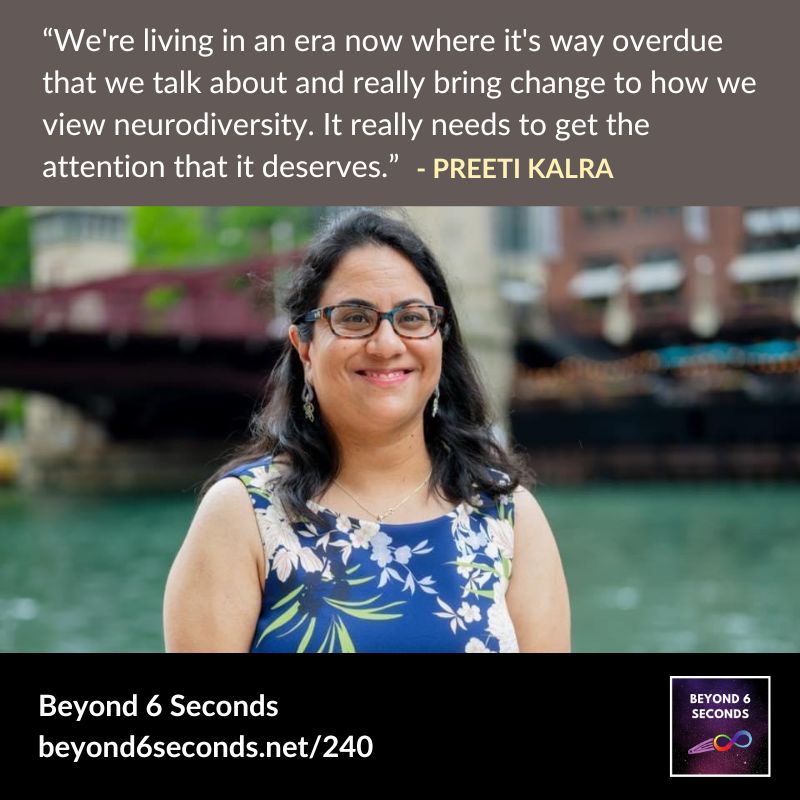
I’m always looking to hear about other people’s stories and their experiences on, you know, being neurodiverse, finding out really late in life and on their premature birth experience. And I think we’re living in an era now where it’s way overdue that we talk about these things and really bring change to how we view neurodiversity. And it really needs to get the attention that it deserves. And also, premature birth also needs to be widely recognized and really how it really does have the potential to individually impact a person throughout their lifespan. And that it doesn’t just end once the baby graduates the NICU.
Carolyn Kiel: Yeah, absolutely. And yes, I’ll put those links in the show notes with this podcast so that people can easily access them from there.
Yeah. Well, Preeti, it was great talking with you today. Do you have any other, like, concluding thoughts that you wanna leave with our listeners or anything else they can do to kind of help or support you?
Preeti Kalra: Just some you know, motivational, and inspirational thoughts to end, I think. We all have, you know, different experiences, right? There’s like almost 9 billion people on this earth and no two people are the same. And you know, it’s something I struggled with that you have to stay true to yourself and stay true to what you’ve gone through in life, and really respect what you’ve been through and cater your life through your strengths. If I had to, you know, say one thing, I would say that.
And really do what’s best for you. I know we live in a society that’s very collective, especially I come from a culture that’s very collective, like where people are expected to live life the same way. Even though our upbringings are not the same, our struggles are not the same, you know, our challenges aren’t the same. And, and it’s something I’ve struggled with, but I think this is just a good reminder that you should be proud of your life and really owe it to yourself or live a life that’s catered to your strength and to your challenges and how you wanna live it. And surround yourself with people who really accept you for who you truly are.
Carolyn Kiel: Yeah. That’s really powerful. Thank you. Very important words to remember. Preeti, thanks again for being on my podcast. It was great talking with you.
Preeti Kalra: Likewise. Thank you so much Carolyn.
Carolyn Kiel: Thanks for listening to Beyond 6 Seconds. Please help me spread the word about this podcast. Share it with a friend, give it a shout out on your social media, or write a review on Apple Podcasts or your favorite podcast player. You can find all of my episodes and sign up for my free newsletter at Beyond6seconds.net. Until next time.