Episode 253: Schizoaffective disorder – with Sonido Reyes
-
play_circle_filled
Episode 253: Schizoaffective disorder – with Sonido Reyes
Carolyn Kiel
Sonido Reyes is an award-winning and bestselling author who is best known for tackling difficult topics through a hopeful lens. They write stories celebrating their own queer and Mexican identities, including The Lesbiana’s Guide to Catholic School, The Luis Ortega Survival Club, The Broposal, and The Golden Boy’s Guide to Bipolar. They also have contributed short stories to the anthologies Transmogrify! and For the Rest of Us. Sonido is also the vice-president of My Galvanized Friend, a nonprofit focused on providing access to and amplifying LGBTQ+ writing, art, and creators.
During this episode, you will hear Sonido talk about:
- How they were diagnosed with schizoaffective disorder
- What life was like growing up with schizoaffective disorder
- How manic episodes have affected their writing
- What they want people to understand about schizoaffective disorder
- How they choose the topics of the stories they write
- The importance of representation in books
- How they became involved with the nonprofit My Galvanized Friend
Visit SonidoReyes.carrd.co for links to Sonido’s website, writing and social media.
If you enjoyed this episode, you may also enjoy my conversation about schizoaffective disorder with Sally Littlefield on episode 243 of this podcast.
This episode is sponsored by Tas Kronby, Accessibility Consultant & Designer: Tas Kronby offers Vestibular Accessibility Audits for your online content that go beyond compliance. Learn what you need to make your business truly inclusive. Tas will help you Design with All in Mind. Visit TasTheArtist.com/design-services/ to schedule your free consultation.
Do the things we mention in this episode match your experience as a neurodivergent person? Do you have other experiences? Let me know what you think!
Contribute to Carolyn’s tip jar to support this podcast’s disability advocacy at BuyMeACoffee.com/Beyond6Seconds!
Follow the Beyond 6 Seconds podcast in your favorite podcast player!
Subscribe to the FREE Beyond 6 Seconds newsletter for early access to my latest podcast episodes!
*Disclaimer: The views, guidance, opinions, and thoughts expressed in Beyond 6 Seconds episodes are solely mine and/or those of my guests, and do not necessarily represent those of my employer or other organizations. These episodes are for informational purposes only and do not substitute for professional medical advice. Consult a medical professional or healthcare provider if you are seeking medical advice, diagnoses, or treatment.*

The episode transcript is below.
Carolyn Kiel: Welcome to Beyond 6 Seconds, the podcast that goes beyond the six second first impression to share the extraordinary stories of neurodivergent people. I’m your host, Carolyn Kiel.
Carolyn Kiel: This episode is sponsored by Tas Kronby, Accessibility Consultant & Designer: Parallax scrolling, scroll bar hijacking, flickering, and neon colors are ruining your design—they trigger dizziness, migraines, and vertigo. You’ve audited for vision and hearing compliance. But does your online content make people sick? Tas Kronby offers Vestibular Accessibility Audits that go beyond compliance. Learn what you need to make your business truly inclusive. Tas will help you Design with All in Mind. Visit TasTheArtist.com/design-services/ to schedule your free consultation.
Carolyn Kiel: On today’s episode, I’m speaking with Sonido Reyes, an award-winning and best-selling author who is best known for tackling difficult topics through a hopeful lens. They write stories celebrating their own queer and Mexican identities, including The Lesbiana’s Guide to Catholic School, The Luis Ortega Survival Club, The Broposal and The Golden Boy’s Guide to Bipolar. They have also contributed short stories to the anthologies Transmogrify! and For the Rest of Us. Sonido is also the vice president of My Galvanized Friend, a non-profit focused on providing access to and amplifying LGBTQ+ writing, art and creators.
Sonido, welcome to the podcast.
Sonido Reyes: Hi. Thanks so much for having me.
Carolyn Kiel: I’m excited to talk with you about your writing and a lot of the work that you do, and another part of your experience that you wanted to share on the show. So I had put out a call on Threads a little while ago looking for people who wanted to share their experiences, and one of those was lived experiences of schizoaffective disorder, and you reached out and were kind and willing enough to share more of your experience with that.
So what is schizoaffective disorder? And like, how is it different from schizophrenia?
Sonido Reyes: I guess I would categorize schizoaffective as kind of like a mix of schizophrenia or a psychotic disorder with a mood disorder. So for me it’s schizophrenia and bipolar. So it’s kind of like both in one disorder. So I do have schizophrenia and bipolar as well with my schizoaffective. They’re both like part of that.
So for anyone who doesn’t know what the schizophrenia, I can speak to like how it manifests for me. Everyone’s experience is different. But for me it comes with, you know hallucinations or delusions. And bipolar is like the mood thing where sometimes I’ll have periods of mania where just like so much energy, impulsivity, not having the best grasp on reality, and then depressive episodes on the latter half of that where it’s just like no energy, real sad. Um, so yeah.
Carolyn Kiel: Yeah. Thanks for kind of giving the, the description and a little bit about your own experience and what that’s like for you.
How did you get diagnosed with schizoaffective disorder?
Sonido Reyes: So psychosis unfortunately runs in my family. So before I was diagnosed, I had an idea that I was schizoaffective. I kind of knew what it was because I had other family members who had that. And so when I started seeing a psychiatrist and a therapist I think this was like 2019 when I got diagnosed, I could be wrong on the year, but I already knew for myself that that was probably what it was just because of my family members. But I basically like told the psychiatrist my, you know, family history and then all of my own stuff. And I was like, I’m pretty sure this is what it is, but I don’t know. You tell me. And he was like, yeah, that basically like, agreed with me. So for me it was a lot more straightforward than maybe people who don’t have an experience with it, with people close to them.
Carolyn Kiel: Yeah.
Sonido Reyes: Because I kind of already knew like what it looked like and had done a lot of research on it beforehand because of the experiences I’ve had with it in my family.
Carolyn Kiel: Mm-hmm. Okay. So yeah, that family history kind of gave you more an understanding of, of what the condition could feel like and and what that looked like. So that helped with the diagnosis. I see.
When you were growing up, did you have like any kind of early indications that you had it or kinda what was life like growing up?
Sonido Reyes: So looking back, it’s kind of hard to say when exactly the symptoms started. I know probably in high school. Like I, I feel like before that I’ve, I’ve always had kind of like depression and I struggled with that side of things, but as far as the hallucinations and the psychosis, that didn’t really start until I was a teenager, I think. At least to when it really picked up. And for a while I just thought it was like, paranormal, or, which some of it maybe it was, but I, I do think that like there’s a difference, for me at least.
I unfortunately didn’t have a lot of, like I know I said that it runs in my family, but I wasn’t very close with the people in my family who had experienced this. Either that or they were no longer with us. And so I, I didn’t really have at that time, someone that I knew to like, go and ask about it. So I just kind of thought that I was like, I don’t know, seeing demons or something like that. But that’s when I remember kind of like it started around that time.
Carolyn Kiel: So a, a big part of that of course is, you know, hallucinations and sometimes delusions go along with, or can go along with that as well.
Sonido Reyes: Right. Like paranoia and, yeah. I guess that was another thing too, like around that time I was getting really paranoid. Like, I always thought that there was someone who was out to get me or someone was gonna like, I don’t know. And then someone was watching, like, I thought there was cameras everywhere. Like I would test all the mirrors and the drains and stuff for like cameras and yeah. So I was really paranoid about that stuff at that time too.
Carolyn Kiel: Yeah. And were there friends or family members who kind of said like, Hey, this is unusual? Or did you realize that in yourself as you were kind of going through the paranoia like, hmm?
Sonido Reyes: I think I’ve always been really good at hiding it. So I think it kind of, I don’t think anyone saw it coming really, except for me until I started talking about it. I didn’t talk about it then. And if I did talk about it, I talked about it with my peers who, in high school I had a lot of friends who like did drugs and stuff, and so for them they experienced certain hallucinations when, when they were high. And so I’m like, oh yeah, I’m just like you. I wasn’t doing any drugs, but I, you know, that was like the connection for me. It was like, oh, it’s just like that, except I don’t need drugs to whatever. Like, that was like in my younger self thought that that was just like, oh, well, yeah, people experience this, but some people take drugs first. I didn’t really like know the extent of how concerning or not concerning it maybe was.
Carolyn Kiel: Yeah.
Sonido Reyes: But I didn’t really talk about it to my family really for like a long time. I think we have like a big stigma in our family about like not being okay.
Carolyn Kiel: Oh.
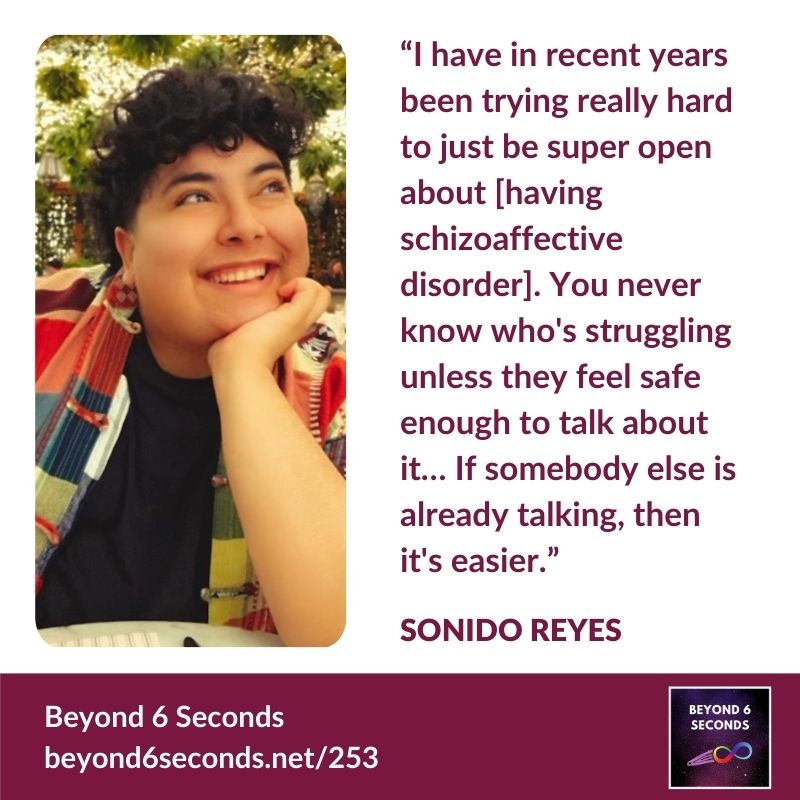
Sonido Reyes: And so unfortunately a lot of the people in my family who have struggled with this, like haven’t talked about it either. And so I have in recent years been trying really hard to just be super open about it. ‘Cause you never know who’s struggling unless they feel safe enough to talk about it. So I’m just like, maybe there are other people who like don’t know how to talk about it, but then if somebody else is already talking, then it’s easier I think. So it wasn’t until I started like intentionally talking about it that I think people realized what was going on.
Carolyn Kiel: Yeah, no, that makes sense because there is such a huge stigma unfortunately, against schizophrenia, any kind of psychosis and, and delusions and things like that. And yeah, I’m sure there are a lot more people than we’re even aware of who privately struggle with it and don’t want to show it, in part because of that stigma.
Sonido Reyes: Yeah. And I think, sorry I might get on my soapbox for like a little bit. I found out a long time ago that like, apparently when you have schizophrenia or like other psychotic disorders, the more episodes you have, the worse your episodes get. So once I found that out, I was like, oh, so I’m never gonna get better! Oh, so like, blah, blah, blah. But really I should have taken that as like, oh, so I should seek help now versus waiting until it gets worse. And then when I did seek help, like I did actually, I feel I am a lot better now than I was then. Like I know how to like, you know, spot the signs before stuff happens and there are ways to cope and ways to like be, you know, living a good life with this illness. So like, I would say just try to talk to someone about it before it gets to that point if you can.
Carolyn Kiel: Yeah, no, that, that’s a really good point that there are actually different types of treatments that can help. And of course it depends on the person.
Sonido Reyes: You might have to try a few different things, like, it’s taken a while for me to get to this point.
Carolyn Kiel: Yeah. That’s great that there are treatments and therapies and things that can help.
You talked about this a little bit earlier, but these days, how does schizoaffective disorder impact your everyday life?
Sonido Reyes: These days I struggle a lot more with the mood disorder side than the psychosis side just because I’m on antipsychotics right now. That might change because my insurance went up a lot and so I might have to change around my med situation and stuff, which is unfortunate. But for the last few years it really has been more of like the mania that’s been the problem. Because I’m an author and with writing books comes some really exciting events that sometimes trigger a manic episode. Because I think it’s just like when really exciting things happen. I guess the chemicals in my brain just go a little haywire and I get too excited and then it just lasts for weeks instead of that day.
Carolyn Kiel: Mm-hmm.
Sonido Reyes: So, and then of course, I crash after that. And it’s, so that’s probably what I struggle with a lot more. Trying to kind of manage how excited to get, and that’s like hard because I wanna be excited about accomplishments and I want to celebrate and all that.
I just, that’s the thing that I guess I haven’t figured out yet, is like how to gauge like what is, you know, a, a healthy level of like excitement versus when it starts veering into, like slipping into mania.
Carolyn Kiel: Yeah, that’s gotta be really difficult to detect.
Have you had manic episodes where you’re writing for like hours and hours and hours?
Sonido Reyes: Mm-hmm. Yeah, I’m pretty sure like, I didn’t know when this happened, that it was probably a manic episode, but with my first book, The Lesbiana’s Guide to Catholic School, there was like a 24 hour period where I, it was probably more like 27 hours. ’cause I didn’t sleep the whole time and I was writing the entire time and I wrote like 22,000 words.
And I’ve never done that since and never want to. But I finished that whole book in like 16 days. And that 24 hour period was like, so intense. And that’s when I finished the book.
Carolyn Kiel: Yeah.
Sonido Reyes: So it was kind of the tail end of that drafting that I went into a manic episode and then I just like finished the book and didn’t sleep for forever.
And I think that was the most intense productivity that happened with mania. And I don’t recommend it. Like it’s, it wasn’t good words, like the book was bad back then. Like those 22,000 words had to be severely revised.
Carolyn Kiel: Oh, wow.
Sonido Reyes: Yeah.
Carolyn Kiel: Yeah. Wow. Yeah. Again, finding that balance has got to be a challenge,
Sonido Reyes: Yeah,
Carolyn Kiel: especially if it’s something that you really love doing!
Sonido Reyes: Yeah, yeah. I think I’ve gotten a little better at that part now. The worst part, it’s not so much the, productivity and stuff. ’cause like, you know, who doesn’t like saying you were very productive? I don’t like being productive, but I like saying I was productive.
Carolyn Kiel: Yeah.
Sonido Reyes: But I, it’s more like I have to be careful about like, impulsive decisions when I’m in that space. ‘Cause I will like, spend all of my money. And as an author I get paid in bulk. So if I get paid once in six months, I have to make that money last six months. If I spend it all because I’m manic, then I’m like kind of screwed. I have done that before and it was really, really rough. So that’s the bigger thing was like trying to like manage the impulses. I think just being able to spot it like, oh, I’m manic right now. So like, I really don’t trust all of the things that I wanna do in the next couple weeks.
Carolyn Kiel: So having, at least being able to be aware that you’re in a manic state, that
Sonido Reyes: Yeah.
Carolyn Kiel: kind of helps you.
Sonido Reyes: It does a lot.
Well, I also like a rule for myself ’cause I don’t always spot it. So like if I wanna spend more than like a hundred dollars on something that isn’t a regular payment, I can’t do it for two days. So it’s like I, I have to like write down the thing that I wanna spend the money on, and then if two days later I still wanna buy the thing, then I can do it. But if I’m manic, there’s no way I’ll still want to after two days because
Carolyn Kiel: Oh,
Sonido Reyes: I’ll be, have moved on to something else.
Carolyn Kiel: Mm-hmm.
Sonido Reyes: So that’s like my rule that’s kind of like saved me from doing that again.
Carolyn Kiel: Oh, wow. Yeah. That’s a good rule. It’s good to have those kind of guidelines and that sounds like it’s really helpful.
Schizoaffective disorder and psychosis and other conditions related to that. There’s still a lot of stigma in society. It’s not really well understood by a lot of people. In your perspective, what are some of the most important things about schizoaffective disorder that you’d like people to either know or understand better?
Sonido Reyes: I think that everybody is different. And this goes for like any stigmatized illness, not necessarily just schizoaffective or psychosis, but any stigmatized illness. Everyone’s different. Like you might have had a bad experience with someone who was mentally ill, but that doesn’t mean that like everyone who has that illness is going to like do that to you.
It’s like the same thing with any kind of prejudice. Like yeah, there are bad people who are of every demographic. So there are bad people who are schizoaffective, but it doesn’t mean that everyone who’s schizoaffective is bad because they’re schizoaffective. I feel like that goes for especially like, you know, bipolar and borderline and really anything that people have a bad feeling about. Like if you hear that someone has a certain disorder and then your first instinct is to close up or whatever, I think that’s something to address within yourself, because everybody is their own person. And really all the diagnosis is, is it’s like a tool now to know better how to manage your symptoms. So now that I have a diagnosis, I can now get treatment versus not having a diagnosis. I was still schizoaffective before I had a diagnosis. I just wasn’t medicated and I wasn’t in therapy for it and I wasn’t getting help. So like, I would say someone who knows their illness is probably a lot safer than like, because you have like coping tools, right? Not that anyone is unsafe for not knowing. It’s just like when you know, it’s, it’s easier to know how to, how to manage your symptoms.
I think it’s, it’s really just like on an individual level, like because even between everyone who has the same illness, like not everyone’s gonna experience their symptoms the same. So you can’t really know how one person is gonna be just because they have a specific disorder.
Carolyn Kiel: So not making those assumptions about someone just because they have a particular disorder.
Sonido Reyes: Right, because technically schizophrenia, there are like, I think like five symptoms, and you only need three of them to be diagnosed with schizophrenia. Everyone thinks of schizophrenia as like hallucinations or delusions, but those are two of the five. So you could have three that aren’t even those two and still be considered schizophrenic, have that diagnosis and nobody would ever think of you as schizophrenic by knowing what your symptoms are. I think being more educated about stuff is definitely helps reduce stigma, I think too.
Carolyn Kiel: Oh yeah. Wow.
I’d love to learn more about your writing and kind of how you integrate your neurodivergence and your other identities into the types of things you write.
How do you choose either the topics or the stories that you wanna write about when you’re writing your books?
Sonido Reyes: So I think at first I kind of fell into contemporary stories about like real people and real problems that real people have. Because I actually had a lot at the time, a lot of ideas that were like fantasy and sci-fi and all that. But for my first book, I was like, okay, well I’m gonna write something that, that I don’t have to research into like how this world works and like all that. So I thought it’d be like quote unquote “easier” to write about, like lived experience that I have. Or at least like someone who is similar to who I was in high school. So The Lesbiana’s Guide to Catholic School became a book.
But usually there’s one or two things that I really like, feel like I need to either process or that I feel like I really want to talk about in every book. So even ’cause I, I do have stuff in the works that’s not contemporary anymore, but for everything, I feel like that’s pretty much what it is. It’s like there’s a thing that I want to talk about.
So for Golden Boy’s Guide to Bipolar, which is a spinoff actually to The Lesbiana’s Guide to Catholic School. So it take, it’s from the brother’s perspective of the main character in the first book. And that one, I just, I knew that I wanted to write a book about a bipolar character. And I really, really wanted to do that character justice because I know how stigmatized that illness is. And so I decided to make that book from a character who my readers already knew and loved. I didn’t want people to come in with a prejudice like they go into this book not knowing they, like in, in The Lesbiana’s Guide to Catholic School, he doesn’t have his diagnosis. So people didn’t know he was bipolar until this book came out. They knew there was something going on, like he was struggling with something, but I really wanted it to kind of feel like how it might feel if you know and love someone and then they’re going through something and they get diagnosed. And so I, hope I did a good job of, of like making this character someone that people already rooted for and already loved, because I didn’t want anyone to have any prejudices already on the character. So that’s why I chose him for that. ’cause people were like, before that book came out, they were like, he’s my favorite character! And I just felt like he was like the perfect one to explore that through.
Carolyn Kiel: Yeah. So that sounds like one way that you integrate your neurodivergence into your writing is, you know, through the character who’s bipolar. Do you ever write about schizoaffective, or have that integrated into your, any of your characters?
Sonido Reyes: I haven’t yet published anything with schizoaffective. I have written them, but I haven’t like started the process to try to get them published yet. It might be too soon for me. But I don’t know. I have books that I’ve written and books that I have yet to write, that I plan to write with schizoaffective. And I think it’s just like a matter of like finding the right story to put it out. ’cause I, it’s hard ’cause I have so many things. So my other books, I have multiple autistic characters in my books and queer characters, trans characters, like a walking diversity checklist that I can’t put all of them into every book, which is unfortunate because there are a lot of people who, like comorbidities are a thing, like people usually don’t have just one thing. So I’ve kind of had to like, you know, ease people into it, one thing at a time. I add another thing onto the next book and then I another thing in the next book.
Carolyn Kiel: Yeah.
Sonido Reyes: So yeah, I think I, I do plan to have those books. But, publishing is so slow. So if, if one comes out with that, it probably won’t be until like, I don’t know, 2028, 2029.
Carolyn Kiel: Yeah.
Sonido Reyes: It’s gonna be a while, unfortunately,
Carolyn Kiel: Mm-hmm.
Sonido Reyes: because they have like other stuff in the assembly line, I guess.
Carolyn Kiel: Yeah.
Sonido Reyes: Yeah. But I do want to, for sure.
Carolyn Kiel: That’s great. And yeah, as you said, you’ve already, it sounds like you’ve written things also that incorporate your, your other identities outside of neurodivergence, like, you know, being queer and, and Mexican and, and that part of your life. How does that influence your writing? Like, is that a little bit part of every book, or you kind of think about where you wanna introduce the characters like that?
Sonido Reyes: I feel like all of my characters are going to be some flavor of queer, and they’re all gonna be Mexican or like Mexican coded if it’s not a story that takes place on this planet. Like, like if it’s a fantasy or something, they’re all gonna be like Mexican adjacent. And that’s intentional.
And then everything else, whatever feels right for the, the character or that story. It’s not always the main character, but it might be a side character who has something that I want to explore. But yeah, I think it’s like every story has those two things at least. And then probably another thing or two on top.
Carolyn Kiel: Cool. Yeah. Yeah, that makes sense. And I think it’s good to have that representation. ’cause yeah, as you said, there tends to be a lot of intersectionality between, especially when it comes to neurodivergence and queerness and certainly, of course, ethnicity and, and country of origin. So it’s great to have representation in books you know, of people’s real lives.
Sonido Reyes: Yeah.
Carolyn Kiel: Outside of writing, you’re also involved in an organization called My Galvanized Friend, and I’d love to learn more about that. So like what, what got you inspired to get involved with that?
Sonido Reyes: Yeah, so it was actually, uh, this might be more information than you asked for, but there is a queer owned coffee shop in my city called Brick Road Coffee. They have like a little lending library in there. They have like all these events and stuff, so they were already kind of like doing a lot of queer literature related stuff. They were even hosting author events. Like I did an author event with them a few times, and so I became close with the owners. And there’s also a couple other people who like really, really love books who go there. And we’re also queer. And so we just decided that we were gonna start a nonprofit.
The main thing we do right now is the literary magazine for My Galvanized Friend. So every, I think we just do it on a six month basis right now, we’ll put out like a literary magazine. We take submissions and you know put together like a queer literary magazine with like a different theme every time. Our most recent one we are going to put out in the new year. And that was Queer Joy was the theme for that one. So there’s always like a different theme.
And then they also do a book club, a queer book club at the library. And there’s author events and stuff like that. So it’s just kind of trying to like bring queer literature and art to like we’re based in Tempe, Arizona, but like, so that’s like locally where we’re really working, but also just like, and the lit mag is like digital, so it’s like kind of anyone can, you don’t have to be in Tempe to submit to that or to be part of that.
Carolyn Kiel: Mm-hmm.
Sonido Reyes: But yeah, so I’m having a lot of fun with that! I think it’s really great.
Carolyn Kiel: Yeah. That’s awesome. Yeah, and that’s great that you can get submissions from really anywhere for the magazine.
Sonido Reyes: Right.
Carolyn Kiel: And I think it’s important to highlight those different themes, and of course writing, from queer authors. That’s really cool.
So do you put out calls for contributing stories to the magazine online, or how does that work?
Sonido Reyes: Yeah, so we have an Instagram account and then on our website there’s like a, a place to submit your work. And it’s not just writing, but it’s also art. So you can submit like anything that you have that fits that theme. You could also submit stuff that doesn’t fit the theme. And then if we really like it, we might like save it for a theme one day. But maybe don’t like plan for that, but in general, that’s always open on the website. For the next one that’s been announced, you’ll be able to submit your work. Art, poetry, essays, fiction, anywhere from like, you know, a short poem that’s like two lines to I think a max of maybe four or 5,000 words, but that’s like a little bit on the high end. Most of it is like maybe one to 3000 words for the long form. So yeah, you can submit on the website or you can find us on Instagram, mygalvanizedfriend.
The name is a nod to Wicked and so is Brick Road or the Wizard of Oz because, you know, back in the day, if you clock someone else as maybe being queer, you can’t just say, are you gay? You would say, are you a friend of Dorothy? And then, you know, they would say yes if they’re queer.
And so Brick Road is like all Wizard of Oz theme. Since my galvanized friend is like associated with Brick Road, also Wizard of Oz theme, and that’s the like Tin Man, my galvanized friend. Yeah.
Carolyn Kiel: Oh, okay! All right. Oh, that makes so much sense! Okay, cool.
What’s the best way for people to get in touch with you if they wanna learn more about your writing?
Sonido Reyes: So I am on all the social media except for really Twitter. I’m not really on there.
But I am on BlueSky, Threads, Instagram. I’m sort of on TikTok, not really, but I have like two videos on there. Tumblr I occasionally check. I have Twitter, but I don’t post there. I just have it so that no one can steal my name.
Carolyn Kiel: Yep. I’ll definitely put a link to your website SonidoReyes.com in the show notes and a link to your socials too, so people can find you everywhere.
Sonido Reyes: I have all of that also on my website too, so you’ll be able to find me. If you, if you have my website, you can find me anywhere.
Carolyn Kiel: Okay, perfect. Thank you so much for being on the show. You know, as we close out, is there anything else that you’d like our listeners to know, or anything that they can do to help or support the kind of work that you’re doing?
Sonido Reyes: Yeah, I, I just, if if you, I mean, Golden Boy’s Guide to Bipolar, buy it!
But really just like, I think, you know, when it comes to, I mean, my expertise is like writing, but really like any kind of art, just knowing like where it comes from and supporting art from marginalized creators. Art is, I think, also activism. So just knowing that like I think it can like change people. So I do kind of hope that, you know, if, if you know someone who has a certain experience or something, maybe read a book from someone who has that experience. And yeah, that’s kind of like where I try to like write my stories in like a, maybe this will help someone else be seen by their loved ones or something. So.
Carolyn Kiel: Yeah, reading books or writing and consuming art that people who have the lived experience with is so important in order to kind of really, truly understand what people’s experiences are like.
Thank you so much for being on my show today. I appreciate it.
Sonido Reyes: I appreciate being here. Thank you for having me.
Carolyn Kiel: If you enjoyed my conversation with Sonido about schizoaffective disorder, then you may also want to check out my episode with Sally Littlefield. Sally shares her own experience with having schizoaffective disorder on Beyond 6 Seconds episode 243. I’ll put a link in the show notes to that episode.
Has this podcast had an impact on your life, your heart, or your perspective in some way? If so, I’d love to hear about it. Send me a message on social media or through my website at beyond6seconds.net/contact. Your feedback means a lot to me, and it helps keep me going with this show. Thank you.
Carolyn Kiel: Thanks for listening to Beyond 6 Seconds. Please help me spread the word about this podcast. Share it with a friend, give it a shout out on your social media, or write a review on Apple Podcasts or your favorite podcast player. You can find all of my episodes and sign up for my free newsletter at Beyond6seconds.net. Until next time.