
Episode 239: Space To Exhale – with Lisa Hurley
-
play_circle_filled
Episode 239: Space To Exhale – with Lisa Hurley
Carolyn Kiel
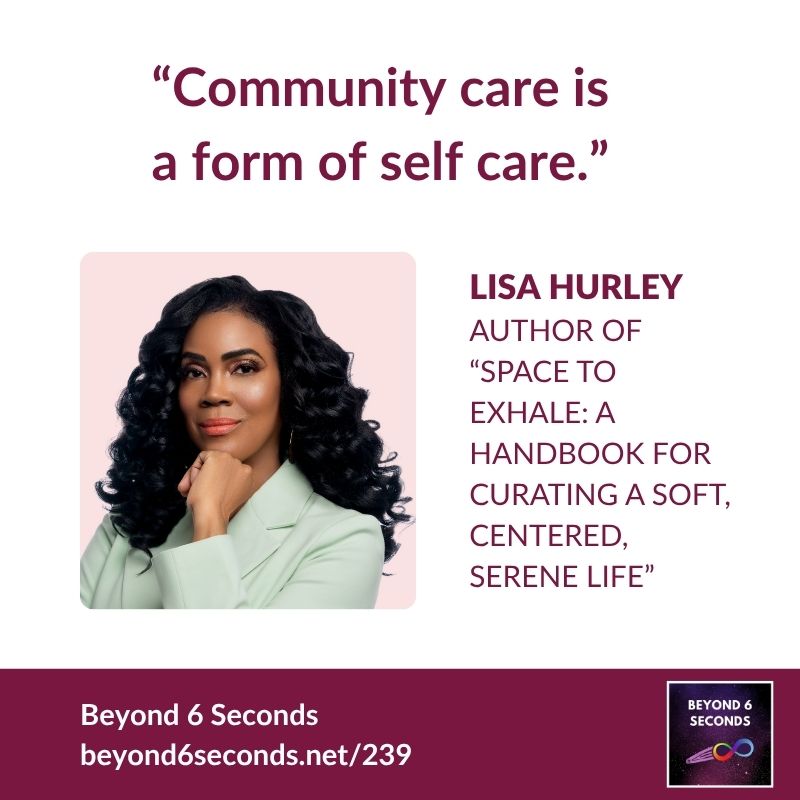
Lisa Hurley is an Anthem award-winning activist and author of the new book, “Space To Exhale: A Handbook For Curating A Soft, Centered, Serene Life.” She is also the Founder of The Great Exhale, a serene virtual community focused on sisterhood and soft living, where Black women can relax, lay their burdens down—and exhale. Her advocacy converges at the nexus of self-care, community care, joy, and rest.
During this episode, you will hear Lisa talk about:
- How she realized that she is autistic, and what her life is like as a Black, autistic woman
- How autistic burnout inspired her to write “Space to Exhale,” and the guidance she provides in her book
- The importance of having a community while taking care of yourself
- “Life-Work Balance” vs “Work-Life Balance”
- What it means to prioritize “soft living”
Find out more about Lisa and her book at SpaceToExhaleBook.com and follow Lisa on Instagram, TikTok and LinkedIn.
Follow the Beyond 6 Seconds podcast in your favorite podcast player!
Subscribe to the FREE Beyond 6 Seconds newsletter for early access to my latest podcast episodes!
Support or sponsor this podcast at BuyMeACoffee.com/Beyond6Seconds!
*Disclaimer: The views, guidance, opinions, and thoughts expressed in Beyond 6 Seconds episodes are solely mine and/or those of my guests, and do not necessarily represent those of my employer or other organizations. These episodes are for informational purposes only and do not substitute for professional medical advice. Consult a medical professional or healthcare provider if you are seeking medical advice, diagnoses, or treatment.*

The episode transcript is below.
Carolyn Kiel: Welcome to Beyond 6 Seconds, the podcast that goes beyond the six second first impression to share the extraordinary stories of neurodivergent people. I’m your host, Carolyn Kiel.
Carolyn Kiel: On today’s episode, I’m speaking with Lisa Hurley, a three-time Anthem Award-winning activist, writer, podcaster, and community builder. She’s the author of Space to Exhale: A Handbook for Curating a Soft, Centered, Serene Life. She’s also the Founder of The Great Exhale, a serene virtual community focused on sisterhood and soft living, where Black women can relax, lay their burdens down, and exhale. Her advocacy converges at the nexus of self-care, community care, joy, and rest.
Lisa is an Executive Member of the International Academy of Digital Arts and Sciences, a Juror for the Anthem Awards and a Founding Member of the Book Academy. She’s been honored as one of the Top 20 Entrepreneurs to follow on LinkedIn, voted as one of LinkedIn’s Top 50 Black Creators and recognized as one of the Top 10 Anti-discrimination Activists in the world.
Lisa’s also a graduate of the University of the West Indies and of New York University. A strong believer in good vibes, Lisa is a Reiki Master who is known for her inspiring affirmations on TikTok. A respected voice, her words have been quoted in Forbes, Entrepreneur, Adweek, and more. Lisa, welcome to the podcast.
Lisa Hurley: Thank you, thank you, thank you. I’m so happy to be here.
Carolyn Kiel: Yeah, I’m really looking forward to talking with you and learning more about your story and your new book that will be out and available by the time this airs, so I’m really looking forward to learning more about that.
Lisa Hurley: Thank you.
Carolyn Kiel: And one of the other reasons that I was very interested in talking with you is that, um, this is a podcast focused on neurodiversity and you yourself are autistic.
So I’d love to just start out talking a little bit about your journey in that area. So I guess, how did you realize that you are autistic?
Lisa Hurley: So a couple of years ago I was, you know, on social media scrolling and came across a post by just somebody that I barely knew, to be honest. Um, cishet white, middle aged gentleman. And he was, he wrote, his post was about his discovery that he was autistic. And so I was just casually interested. And then as I read it, I was like, I was like, hold on a minute! I was like, check, check, check, check, check, check, check. And I actually started to cry, by the end of the post, I started to cry because I realized, oh my gosh, this has been, I, I don’t want to say what has been wrong because I don’t like it framed that way. But because I’ve always felt from childhood, like if something was just a little bit off, I didn’t quite fit in, didn’t quite understand people, didn’t get why folks couldn’t just be more direct. Various things. And so once I read that post, I realized, I’m like, oh, I am a thousand percent autistic. That was, that was step one.
Then I was like, okay, a post is not science. So then my next step was to take basically all of the online tests that are available. And so I scored off the charts for every single test. I did, uh, autism. I did a couple of ADHD tests as well. But more so the ones focused on autism, and I just scored off the charts. And every now and then I would go back and revisit, just to make sure that I hadn’t, you know, done it like in an emotional moment or whatever. And every time it was consistent. Similarly to whenever I do tests about, whether they’re personality tests or other tests about introversion, I always, I’ve, there’s never been ones that have scored extroverted, so I always score introverted.
And then, so that was step one, step two, and then the third step was, I think it was late last year when I finally got tested. And yeah, then, then, then the science came and backed up everything that I already knew.
Carolyn Kiel: Mm-hmm. Wow. So it happened at a relatively, sounds like short and compressed period of time between sort of understanding about it and then sort of coming to the discovery. Wow.
Lisa Hurley: A few years. It was just a few short years. You know, but compare that to a lifetime, to decades of just feeling, feeling off, and feeling different and feeling misunderstood, and having to work hard to understand others and to be understood, even at times where I thought that I had spoken clearly or communicated clearly, but obviously something was lost in translation.
And so just having to, having dealt with that all my life, just getting to the point where I had an answer, for me, it felt like complete relief. That’s what felt like.
Carolyn Kiel: Mm-hmm. Yeah. Wow. So what is your everyday experience like as a Black autistic woman, especially now having that understanding about yourself that you’re autistic?
Lisa Hurley: Yeah. It is, it’s, it’s been interesting. I don’t think that I am necessarily the image that comes to mind when people think of someone who is autistic. And so, yes, I am a Black, I, I I’m a woman. Let, let’s start there ’cause you and I both know, right? Okay. Right. So I’m a woman and I’m Black and I’m older, right? So they’re all of those, sort of inter, inter dimensionalities of my, you know, my character, my makeup. So all of those play a part.
People have responded well. I’ve posted about it publicly even before when I was self-diagnosed. I knew, I knew, I knew I was autistic. So I very confidently put, you know, my actually autistic hashtag in my bio on, on LinkedIn. But people, people have responded mostly well. However, there are those who are uncomfortable because of my diagnosis. And I don’t know if you have ever experienced anything like, like that. But it’s almost as if they prefer to not know or they want it hidden away. You know, they, you, you, I, I’ve gotten, you know, “why are you bringing attention to this? Why are you publicizing this? I would never have known and now everybody knows this about you and you could be in danger.” Now given, given the current climate, yes, yes. Yeah, you know, things, things in life are often both/and, right? They’re, they’re often not, not a binary. And so points have been made about potentially being in danger.
At the same time, it makes me feel more comfortable to just have it out there, not have to, uh, mask as much. The thing is having masked all one’s life, it becomes a, a habit. So now it’s having to unlearn the habit of constantly masking and constantly trying to appease others and make others more comfortable, even to the detriment of my own comfort. So it’s been an interesting journey so far.
Carolyn Kiel: Yeah. Yeah, the, the masking piece is interesting because that takes a very long time. You know, for some people, I mean, definitely in my own experience to just sort of understand like, okay, what, what part is the mask and what part is really me? Like what am I really like? You know? ’cause even when you’re alone, you’re still masking, which sounds odd, but that sometimes happens, so.
Lisa Hurley: Mm-hmm. It, often happens, I think. Because it, sometimes you’re, you’re right, you don’t know which is your personality and which is your, um, your, the armor that you put on to get through the world daily. Sometimes you’re not sure.
So I know, I know this is you interviewing me, but I am curious as to, would you mind sharing a bit about your journey? Just for, for, for my own?
Carolyn Kiel: Yeah, absolutely! So, my journey in, in some ways was kind of similar to yours. So about a few years ago I think it was around 2021 you know, middle of the pandemic. And i’ve had this podcast for much longer than that. It wasn’t always focused on neurodiversity, it was just general interviews.
And through podcasting, I’m always looking for guests. I’m online a lot for the podcast. So I had interviewed some people with disabilities who talked about their lives with various like physical disabilities and things like that. So the algorithm kind of was putting me into like the disability community and then somehow I kind of wound up in the adjacent adult autistic community, a lot of like late diagnosed autistic people. And I wound up really resonating with some of the creators, you know, not just about what they were writing about, but also like interacting with them and being like, oh, I’m like, I’m so comfortable with, you know, because I had all, you know, I, I grew up in the eighties and nineties, and you have all these stereotypes that you grow up about what you think autism is. Um. I never thought I knew any adults who were autistic. It turns out I, I probably did, but, you know, a lot of us my age just don’t know.
And so I was really resonating with, socializing and, and building friendships and having other autistic guests on the show. And then sort of similar to you, I read an article by a woman who wrote about what autism sometimes looks like and feels like in girls and women. And I’m like, wow, this is really spot on. Like, all of these things, like in terms of, you know, the words that people use to describe me when I was growing up, to ways that I was perceived, to ways that I felt. It’s like this, this is like really like, okay, so this is very focused and very accurate for me.
So that plus resonating so well with other autistic people made me pursue, you know, a diagnosis. ’cause I, at that point, I just kind of wanted to know if, if I was autistic or not. And then, so towards the end of 2021, I wound up getting that diagnosis.
And then shortly after I focused this podcast on neurodivergence. So not just autism, although I talk about it quite a lot, but just interviewing people from all different neuro types, different experiences, different parts of the world, just to hear their stories and understand their experiences. Because if I had assumptions and stereotypes about autistic people before I even met any, I assume that there’s probably a lot of other stereotypes and mis made assumptions that need to be addressed and and broken. So that’s what I’m doing now.
Lisa Hurley: That is awesome and thanks for, thanks for sharing that with me. Uh, I always, yeah, I always like to know a little bit more about, about folks. I’m very curious and yeah, and genuinely interested, so thanks for sharing.
Carolyn Kiel: Yeah. Wonderful. Yeah. Thank you so much for asking.
One of the things that you’ve been doing for a while is, is building communities and really helping people, especially Black women find ways to rest and, and as you say, exhale and especially at a time like this, that is so valuable and very much needed. And your book is called Space to Exhale. And I’d love to know like what inspired you to write that book right now?
Lisa Hurley: Thank you. Well, I realize that it is probably, at least partially what I now know to be autistic burnout. I thought it was regular burnout. Apparently there, there are layers. So I was just burned out and, but that was after years of having been in the activism space, which I started actively writing as an activist in about 2020. Activism is, is extremely fulfilling, but it is also very exhausting. It is exhausting because you have this sort of like secondhand communal grief when you see folks that look like you being harmed with impunity. You grieve for them, for their families and communities. You grieve for humanity. You grieve for yourself and your loved ones.
And then, so I was doing all of that and also writing as much as I can. You know, as an introvert, I mentioned earlier in the, in the show, I’m definitely an introvert, so I am not ever going to be the person who is out marching in the street. That would not work for me. I’m an int, I’m introverted, I’m an HSP highly sensitive person as well. Autistic, all of the things. But I can write, I can write. And so that was the, the medium that I chose to use to express my, my activism.
And so after years of doing that, I just became burned out, not only from the activism, but also from just navigating the world in general while Black, working while Black, existing while Black, uh, is exhausting in itself when you live in a majority white context or country. So dealing with that as well, and it just became too much. It became too much. So there’s that happening.
Concurrently if you go all the way back to baby Lisa, learning, learning to read and write and loving all the words and whatever. So I always, I’ve always been a words person, always loved to write. And because of that, I think maybe there was a little, you know, a little idea in my, in my head that maybe one day I’ll write a book. And then fast forward to about, I think it was 2023 and I had an idea of 2022, I had an idea for a book. Life started life-ing, and then I thought, okay, one day I’ll get back to it. And then in 2023, Wiley reached out to me and said, “Ooh, we think that you would be a great author, you’d make a great author, we’d love for you to write a book.” And I said, “okay, thank you. And that would be awesome. But I am not writing a traditional business book. Is that okay?” And they, you know, my acquisitions editor signed off on that. And that’s how, that was sort of the, the, the two influences that got me to this point.
Really what I wanted and want to do with the book, what I want the book to do in the world is help others feel better. Everybody of course, but especially Black women. Black women have always been and will always be my focus. Anyone who’s been following me for a while on social media knows that. Because when you think of any form of marginalization and then you add being Black and a woman onto it, then that basically puts the person at the back of the line. Right? Whatever kind of disability, whatever kind of, of issue, if you are racialized as Black and if you are gendered as a woman, then it is, uh, significantly more difficult , your experience in the world and what you have to deal with. And I just want us all to feel better. You know, I want us to, to feel better, to rest more, to take a breath, to get off of the treadmill of hustle culture.
And I, like I said, Black women will always be my focus, but I’m of course not blind. Everybody I know regardless of gender, ethnicity, and so on, everybody I know is exhausted, is tired of work, tired of feeling like the world is burning around us and we have to show up to these meetings at work to talk about what feels, in many cases, completely irrelevant stuff, right? It’s like, this is not life and death. This is not important. Why are we acting like it’s so urgent and rushing everyone? But that’s the experience.
I want us all to really pause and ask and interrogate ourselves, our companies, our structures. Is this what we really want? Is this, you know, fast forward to when we are all much older, are we going to be thinking back to, wow, you know what, that one day, woo, remember when we had that project kickoff meeting? Probably not, right? Never, never happened, never happened. Will never happen. We’re gonna be thinking about our lives, our families, our friends, good positive memories, fun times that we had with people that we love. We’re gonna be thinking about how we treated ourselves well. Uh, we’re gonna be thinking about how we did the inner work to just become better people, better human beings.
So my goal for my book is to become just part of the canon that inspires people to be better.
Carolyn Kiel: That’s awesome. And that’s so important because as you said, I’m sure almost everybody’s feeling that is, you know, all, it’s like, you know, many of us have to go to work or go to school or just go about our lives while so many things are going on that feel like out of our control or just like are making us despair quite a bit. So yeah, I think this book is coming at an amazing time and that a lot of people are really gonna benefit from, from the things that you talk about in it.
So you told Wiley you didn’t wanna write a typical business book, and they were good with that. How is your book different from, say other, whether business book or if it’s a self-care or self-improvement book? Or you don’t even have to categorize it, I guess, but like how, how is it different from that?
Lisa Hurley: If I, if I did have to categorize it, I would put in terms of like book genres, I think I would put it in the self-help category. I call it part memoir, part manifesto, part meditation guide, that, that’s what I call it. And that is, I think a pretty thorough explanation of it.
And so it’s structured in three parts: know yourself, love yourself, and be yourself. I launched The Great Exhale and then the book came after and I definitely wanted the book to not completely, but be partially patterned after The Great Exhale. And so inside The Great Exhale, there are three main sections: know yourself, love yourself, be yourself. And so the book follows that structure. And each chapter starts with an invocation or a prayer. And you know, I tell people, look, think of the book as a buffet. Not everybody is going to be into prayers. I understand that we all have different beliefs. If you don’t like the prayers, move on. There, there’s lot, there’s lots of other stuff. So there are prayers to open each chapter. Then I share, uh, a personal anecdote from my life, which sort of is the grounding as to, okay, why are we, why are we discussing know your values? Why are we discussing manifestation, self-love, self-care, soft living? So I use examples from my own life to explain the how and the why.
And then I include tips for, okay, this is what we’ve talked about. This is what happened to me. And either if it’s something, let’s say in the case of manifestation. I, I tell people, okay, well this is what worked for me. Here’s how you can help it work for you. If it is something like maybe I did not enjoy experiencing,
Carolyn Kiel: Mm-hmm.
Lisa Hurley: then the tips are, here’s how you can avoid XYZ experience. So there, there are lots of tips, life lessons, guides, suggestions, recommendations, all of that.
Each chapter really is a workbook in itself. So each chapter closes with the workbook section, which is, uh, a breath work exercise. The book is called Space to Exhale. So there is literal space to exhale in the book at the end of every chapter. So there are breath work exercises, meditations, there are affirmations, journaling prompts, all of it in order to help make it easier for people to do the work but do it in a way that is bite-sized, snackable, easily digestible and not overwhelming.
Carolyn Kiel: The way that it’s divided, it’s part, you know, part memoir, part meditation and part manifesto I think that’s a, such a great mix. And, um, I think it’s really great that you include parts of your own story in there to sort of tie it, you know, together and make it personal. And I think a lot of people really relate when people share their own stories, and that’s really, really wonderful.
So with the, this relatively newfound knowledge that you’re autistic, is that something that you brought into the memoir parts of your book? I’m sure it involved a quite a bit of like looking back on your life and, and pulling together stories. So I don’t know how you brought different parts of your identity into the memoir part of your book.
Lisa Hurley: I don’t go into it in depth but I do mention it. And there is a section on, a chapter actually on rest. And so within that chapter I mentioned autistic burnout, which we mentioned. Like we said before, there’s burnout and then there’s artistic burnout, which is a, a whole nother level. Right? And I, I call it swan theory. Right?
Carolyn Kiel: Mm-hmm.
Lisa Hurley: I call it swan theory because it looks as though we are gliding, but we are kicking slash struggling underneath where no one can see. And that happened to a lot of, especially older women who are maybe undiagnosed or late diagnosed. All we do is glide or, or, or appear to glide because we get into the habit, the habits like we were speaking about before, the habit of masking, the habit of just doing, producing, going through the motions of life. And people have expectations of us and we show up and we fulfill those expectations and then, you know, do a wall slide at the end of the day because we’ve got no spoons left. Right? And so I do mention autistic burnout specifically.
Carolyn Kiel: Yeah, and I think a lot of people in the disability community can appreciate that as well, because in terms of, you know, the concept of having enough spoons or enough energy to be able to get through the day or just process all the things that are happening. It’s something like one in four people in the world are disabled. So I think that that understanding of, not only are things incredibly stressful right now, a lot of people are really kind of struggling on their own with different issues, different energy levels and different demands and expectations. So yeah, that’s important to acknowledge.
One thing I’m curious about is because you host a, a community or you hosted a community before you wrote the book, so do you also talk about the concept of having a community to support you as you take care of your own self? Or how does that figure into things?
Lisa Hurley: Absolutely. I believe that community care is a form of self care. So the, the self care part is making sure that you go and seek out communities that are helpful and supportive for you. The self part is that you go and do it. And then the community part is everybody being together and supporting each other.
I think a lot of the western world has socialized us into this hyper individualistic, ah, super harmful way of, of traveling through the world. And cultures similar to the culture that I am from, I was raised in the Caribbean, in Barbados, and although it is westernized to an extent, there’s still a lot of focus on the extended village, the extended community, the extended family. And I definitely remember times growing up when, you know, if a child was either in trouble or hurt or, or did well at something or whatever, like everybody would intervene or celebrate or lend assistance and so on. And so that is, uh, kind of what I’m used to. And it’s immensely helpful just moving through the world, not feeling as if everything is on your shoulders. That alone helps you to be able to exhale and be more relaxed. Right?
Carolyn Kiel: Yeah.
Lisa Hurley: And so community care is absolutely a central component of self-care. If you don’t have community right now, go out and start building one. Find, uh, an affinity group, right? It could be anything. If you like knitting, go find a knitting group. If you like reading books, join a book club. So just find something that you’re interested in.
Find kindred spirits. I used to be, um, a part of an intentions group, so, uh, you know, we would gather, I think it was like every week, and share our intentions. This is what we would like to have happen. People would share wins. People would share what they wanted support with. And just even something like that, very, very uplifting and helpful.
And then of course, what typically happens in situations like that? Like that, like a, a join a choir. Right? Any, anything of that nature. But you have the, the choir stuff or the the knitting stuff or the book stuff. But then there are also opportunities after the official formal meeting where you just socialize and you hang out and you make plans and you ask after people’s children and parents and pets and all of the things. So it is immensely important because that takes the burden off of any one person and spreads it. A burden shared is a burden halved.
Carolyn Kiel: Yeah.
Lisa Hurley: Yeah.
Carolyn Kiel: Yeah. That community is, is very important. And you’re right, I think in Western society, you know, as even, comparing it to a few years or a few decades ago, it’s much, much more difficult to build community because we are so socialized to be individualized in, in many ways, and to think that we’re all on our own. So, um, yeah, it’s important to find that community. And as you said, a lot of times, finding it through a common interest is a great way to start and, and find people who, you know, just a hobby, anything like that.
Lisa Hurley: Anything.
Carolyn Kiel: You can build after that.
Lisa Hurley: Yeah. And speaking, speaking of hobbies, that’s something that I talk about as well, in terms of making sure that we don’t only focus on work. I say, it’s life work balance, not work life balance. The language is absolutely a criminal in this enterprise, right? Because when we say work life balance, that immediately puts work first, and it trains us to think that that is the natural order of things, and it is not. We’re not born, and then, you know, we’re born and then a couple months later it’s like, okay, time for you to go to work. No, that’s not what happens! It’s time for you to grow and learn and be nurtured and be happy. And, you know, as a baby, you know, hold your own toes, right? Be like, oh my gosh, toes are amazing! right? And, and just like, and discover and be filled with wonder and smile and, and sometimes cry and be comforted. All that is just life.
Carolyn Kiel: Mm-hmm.
Lisa Hurley: All of that is just life. Life comes first. And so that, that’s something that I think is really important. Remembering, I remind us all to focus on life work balance in that order.
Carolyn Kiel: Mm-hmm. Yeah. That’s important. And especially these days when so many people connect their identities to their work and then unfortunately, it’s so common for layoffs and people to lose their jobs and to have challenges finding things, and it totally throws people off and, and sends them into despair even beyond like the obvious financial impacts and things.
Lisa Hurley: Yeah. Yeah.
Carolyn Kiel: If it’s part of your identity, that makes it really, really hard.
Lisa Hurley: And if you have no hobbies, if you don’t do anything for fun, then you don’t even have an outlet. You know, I encourage people, I’m like, go out and do, do some things really badly. Like go and sing, sing horrible karaoke, and laugh at yourself with of your friends, right? Go like, try, shoot, if I were to try to knit a sweater today, I don’t know, it would probably win ugliest sweater, but I would have an absolute blast trying to do it.
That’s another thing as well, just not forcing ourselves to monetize everything and have everything be perfect, you know? So, relax, get a hobby, take a walk, touch some grass, you know, right? Please please take a breath and touch some grass. Yes. And get a hobby.
Carolyn Kiel: Yeah. Oh, it is. It, it is, yeah. I mean, that is really important to have like a, a well-rounded life. So you have other, other things that bring you joy or bring you peace or calm or, or whatever kind fills your, you know, fills your spirit.
I wanted to ask you about something else that’s in your book. I think I mentioned it when I was reading through your bio, but you talk about the concept of “soft living.” And that’s such an interesting term to me. I, I, I think I’ve heard it before, but I, I was never really sure exactly what it means. So I, I’d love to learn more about like what, what is soft living and, and how does that tie into what you write in your book?
Lisa Hurley: So soft living encompasses a bit of what we’ve been discussing in terms of literally allowing ourselves to live more gently, to hustle less and rest more, to be more loving toward ourselves, uh, to treat ourselves with kindness and, and care. Now, a lot of people think that soft living means going to the spa, getting your nails done, getting your hair done, and that could be part of it. That could be part of it. And you know, I will, yeah. You’ll never hear me say a bad word about a spa. Right?
Carolyn Kiel: Yeah.
Lisa Hurley: Let there be more spas, I say! Right? But it is not only about, it is not about pursuing luxury. And when I say that, I mean, you know, I’m not going to go buy an expensive pocketbook or pair of shoes and not be able to pay my rent. Right? So I know, you know, no judgment. We’ve all made some bad decisions. I, I’ve definitely done things, especially in my twenties and I look back, okay, that was not, not wise at all.
But, you know, we grow up, we do better. And so you can definitely indulge in little luxuries if that is important to you. But I’m not talking about going and spending your life savings to you know, hire a private jet and fly around the world. I am talking about little daily luxuries and acts of self-care. Including things like, for example, during your workday, just something as simple as blocking time on your schedule where you cannot be booked for meetings. Something as simple as that. And you take that, maybe 15 minutes, hopefully half hour. And you take a walk, you do some deep breathing, you read a book, you do something quiet. If it’s warm and sunny out, maybe you sit down, um, I don’t know, in a park or by the waterfront somewhere, and just relax your mind and body from being in a state of hyper drive and overdrive and just relax. So it can be something as simple as that. Uh, so soft living is just treating ourselves well, what, whatever that looks like for us, whatever that looks like for us.
So depending on where one is in life financially, you know, I’m sure if you are, like, if you are Rihanna, soft living, soft living is gonna look a little, a little different, right? Soft living probably does involve a lot of private jets. And that is okay because you’re Rihanna and you’re a billionaire, right? But all of us, we don’t, we don’t have to be rich in order to enjoy soft living. And that’s what I want people to take away. Right? It is very accessible. Like for example, this chair that I’m sitting in now, it is nice and soft and padded. It’s an office chair. I just like had it like in another part of my house. And I’m at my dining table now, sitting. And I was using one of my dining room chairs as my, you know, daily. And then one day I was like, wow my back really hurts! Like what is going on? The chair is too hard because the, the dining room chair is not meant for you to sit at for eight hours.
Carolyn Kiel: Mm-hmm.
Lisa Hurley: It was a wooden slatted back, you know, chair. You know the kind, right? Yeah, I I, I don’t know what I was thinking. I was just like, it’s the dining table. Here are the chairs. I sat in the chairs.
And so I was like, okay, there’s a solution. I literally have a softer chair right here in my house. I will just switch the chairs out and be nicer to myself, and be kinder to myself and stop my back from hurting. And it, it stopped within a couple of days. And just come up with solutions for, oh, how can I be more comfortable? How can I feel better? How can I treat myself with more love and, and care and gentleness? So even something as simple as that. I did not spend a penny, right? We’re switching out two chairs. So just looking for like really, uh, interrogating yourself and interrogating your life and identifying areas where, okay, I feel a little uncomfortable here, or I feel a little stressed, or whatever it happens to be. How can I come up with a solution that helps me to feel better?
Carolyn Kiel: Hmm.
Lisa Hurley: You know? Yeah.
Carolyn Kiel: Yeah. And from the example you gave before about blocking out certain parts of your time where you can’t be disturbed. It seems like also small ways to kind of take control of, you know, take back some control over your life. Because, I dunno, I’ve been in the situation if I’m at, you know, been at work or schoolwork or something else where it’s like, oh, I, I can’t get up. I, you know, I have to sit here because I have meetings and I’m busy and I’m too busy to get up and I’m too busy to eat. But if you force yourself to, even if it’s just like a 15 minute block, you’re like, okay, I’m taking back control of my day where I can’t be bothered in these 15 minutes, half hour, whatever it is, and I can choose to, you know, get out and stretch or, or do whatever I want and kind of step away for a while. And then generally you come back feeling, you know, in, in a better state of mind
Lisa Hurley: Yes.
Carolyn Kiel: for having taken that break. So I think that’s part of it too. That’s really cool.
Lisa Hurley: So, a, a question for you. So what had you imagined soft living to mean when you first came across the term? I’m just curious.
Carolyn Kiel: Yeah, I, I thought it was almost like a synonym to self care, but also like a more gentle and easier living. So for me it was like, how do you remove stressors from your life? Which is not exactly the same thing because you know, you’ll always have stress, but in some ways it’s how do you kind of step away from like the stress that you can’t control in your life and kind of take back things and say like, well, how can I, how can I make sure that I’m relaxing? How can I make sure that I’m not taking on burdens that don’t belong to me? But at the same time, I’m not like cutting myself off from community and things I need to be involved in.
So I think that’s a hard balance to strike, especially now, is how do you, how do you protect your, your peace while not just shutting out all the horrible things in the world and saying like, I live in a bubble and I’m just me by myself. And I dunno. I, I find that difficult and sometimes I get, you know, into the doom scrolling on social media, which is like the worst for your mental health. But, um, yeah, I, I don’t know if that’s something you talk about in, in your book at all, or if you have thoughts on that, but I, I think a lot of people probably really struggle with that right now.
Lisa Hurley: Oh yeah. Well that’s one of the forms of rest that I recommend. It’s like take a, an occasional digital detox. As you, as you mentioned, it is useful to have an idea of what is happening in the world. The way the news cycle works, however, you can probably tune in once a week, you know, hit up, you know, CNN, Al Jazeera, BBC, or, you know, hit, hit up a few of your favorite, uh, news outlets. And you’ll probably be up to date with everything that’s happening in the world beyond, like some very unusual occurrence. But checking in once a week is very different from spending several hours a day doom scrolling. And so I definitely recommend taking time away from the electronics, time away from certain kinds of, uh, media and movies, and just like allowing your mind to rest and be happy. You know, our minds need a break too, from constantly strategizing and performing and producing. Our, our bodies need a, need a break, but so do our minds.
Carolyn Kiel: Yeah.
Lisa Hurley: And so just, yeah. Take a break. Give yourself a break. Absolutely.
Carolyn Kiel: Yeah. That’s important for people to be able to give themselves permission to take that break and just as you said, digital detox, just, you know, close down social media and um, you know, just connect with the world and the people immediately around you and your community.
Lisa Hurley: Yes. Yeah. One of my favorite things to do actually, I mean, fortunately I am a member of part of a family of readers and also a family of introverts, as it happens. And so it’s, it’s interesting because many of us, you know, we just like to read, and so we’ll all be in the same room sort of co-regulating each other, just enjoying each other’s presence and energy, but reading our different things.
Or, you know, my, my niece might be on her phone or her tablet doing whatever she does. My sister will be reading a book. I’ll be reading a book, whoever is in the room, my mom. And it just is, I don’t know. It’s just, it’s just blissfully quiet. It is healthy, it is peaceful. There is love and joy and community energy in the air. Uh, but there’s also no need to mask and create conversation for the sake of it. It is immensely relaxing. So just spending time with people that you really love and can be around in, in your unmasked state is very healing.
Carolyn Kiel: Mm-hmm. Yeah, absolutely. Yeah. As you said, you don’t have to be directly interacting with people all the time. I know for some people that can be really exhausting, whether you’re an introvert or you’re autistic or you know, for, for any other reason. But, um, yeah, as you said, just being in the room, the same room with people that you care about and even if you’re doing similar or the same activities yeah, I think that’s a great, that’s a great way to kind of co-regulate with each other. Definitely.
Well, Lisa, I’m really excited for your book to come out and it’ll be out by the time this episode comes out. How can people get in touch with you if they wanna learn more about you know, buying your book or just learn more about the work that you do?
Lisa Hurley: Thank you. So my website is SpaceToExhaleBook.com and I am on most social media platforms like Instagram, for example, thelisahurley. TikTok, the same, thelisahurley. I’m on LinkedIn as well. People can just look me up, you know, follow or send a connection request. And so that’s where people can find me.
I just wanna encourage people, whether it is myself or other authors in your life, people that you know. Literally just go out and support. You know, buy, if you can buy one book, buy one. If you can buy more, buy more than one. And because again, it is about me, but it’s also for other authors in, in your lives because it makes it easy when our books sell well, it makes it easy for other authors that are coming behind us to get deals and to, um, be treated properly by their publishers and all, all of that stuff. And so it’s not, you’re not just buying a book. You’re actually paving a way
Carolyn Kiel: Mm-hmm.
Lisa Hurley: for myself and for other authors to succeed and do well.
Carolyn Kiel: Mm-hmm. Yeah, absolutely. Really important point there. Yeah. And you know, as, as we close out, is there anything else that you’d like our listeners to know or any other ways that they can help or support you? Obviously buy the book. It’s out now, so definitely buy the book. Buy more than one book if you can.
Lisa Hurley: Yes, yes. Definitely do that. Recommend the book to your local libraries. Request it at your local libraries. Buy books for your book clubs. Uh, recommend me maybe to come in as a speaker and do a fireside chat at your organization. There’s so many different ways. So all of the above. But most of all, what I want people to remember is that rest is the new success.
Carolyn Kiel: Wonderful. Thank you so much, Lisa. Congratulations on your book launch and, yeah, I’m really excited. It’s something that is very, very much needed, especially at this point in time, so I’m really excited that it’s coming out now. So congratulations and, uh, looking forward to reading it. Thank you.
Lisa Hurley: Thanks so much. Thanks for having me. This was great. Thank you.
Carolyn Kiel: Thank you.
Carolyn Kiel: Thanks for listening to Beyond 6 Seconds. Please help me spread the word about this podcast. Share it with a friend, give it a shout out on your social media, or write a review on Apple Podcasts or your favorite podcast player. You can find all of my episodes and sign up for my free newsletter at Beyond6seconds.net. Until next time.